
🪄 AI Summary
Heading 1
Heading 2
Heading 3
Heading 4
Heading 5
Heading 6
Lorem ipsum dolor sit amet, consectetur adipiscing elit, sed do eiusmod tempor incididunt ut labore et dolore magna aliqua. Ut enim ad minim veniam, quis nostrud exercitation ullamco laboris nisi ut aliquip ex ea commodo consequat. Duis aute irure dolor in reprehenderit in voluptate velit esse cillum dolore eu fugiat nulla pariatur.
Block quote
Ordered list
- Item 1
- Item 2
- Item 3
Unordered list
- Item A
- Item B
- Item C
Bold text
Emphasis
Superscript
Subscript
Most SaaS channels fail for a simple reason: nobody decides what the channel is for. A workable YouTube strategy for B2B SaaS starts with the buyer questions your sales team hears every week, then turns each answer into a repeatable video format. Production quality matters, but selection and consistency matter more. This guide shows the decisions I make first, the formats I would build, and the numbers worth watching.
Quick Answer
Pick three buyer questions per funnel stage, assign one repeatable format to each, publish on a fixed rhythm, and cut every long video into Shorts. Judge the channel by qualified conversations, not subscribers.
At a Glance
Why YouTube Belongs in a SaaS Buyer Journey
Gartner's research on 750 buyers of complex purchases found that buyers spend only about 17% of their purchase time meeting suppliers. The rest goes to independent research, peer conversations, and internal alignment. A channel that answers questions clearly is present during that unattended time.
Search behaviour points the same way. Foundation Inc's own analysis reports that when a buyer searches for a SaaS demo, a YouTube video appears on page one eight times out of ten. This is a vendor analysis, and the exact query set is not public, so I treat it as a directional signal rather than a benchmark.
There is also an audience shift worth noting. Edison Research's Podcast Consumer 2026 study found that 37% of weekly podcast consumers name YouTube as the service they use most for podcasts, up from 31% two years earlier. If your team records interviews or webinars, that audience is already on the platform.
Three reasons I give SaaS leaders:
- YouTube content keeps earning views through search long after publishing day.
- A long video can feed Shorts, LinkedIn clips, email, and sales enablement.
- Buyers can judge product depth and founder credibility before booking a call.
Start With Buyer Questions, Not Video Ideas
The common mistake is to brainstorm titles. I start with a question inventory instead. Pull questions from sales calls, support tickets, onboarding calls, and lost-deal notes. If you want a method for this, see how teams mine sales calls for content.
Then sort the questions by buying stage:
Keep the first list small. Fifteen strong questions will carry a channel for months.
Build the Channel in Six Steps
I use the same order with most SaaS teams. You can compress it for a small team, but I would not skip steps one, three, or six.
- Name the owner and the goal. One person owns the calendar. The goal should be specific: for example, more qualified demo requests from mid-market accounts.
- Choose three to four repeatable formats. A format is a template your team can produce without reinventing it. Examples: "Ask the founder," "Customer teardown," "Feature in 90 seconds."
- Write the brief before recording. Each video needs a named viewer, a single question, and a stated next step. A reusable video brief template keeps this consistent.
- Record in batches. Two or three videos per session cuts setup time and keeps the look consistent.
- Package for search and click. Title, thumbnail, description, and chapters are part of the asset. More on this below.
- Review monthly and adjust. Retire formats that do not earn watch time or conversations.
Takeaway: a channel is a production system with a calendar, not a pile of uploads.
Formats That Work for SaaS Channels
Not every company needs every format. Any YouTube strategy for B2B SaaS works best when the formats match what your team can sustain, so I pick conservatively.
For demos in particular, I would read how teams approach product demo videos for SaaS before scripting.
Package Every Video for Search and Clicks
Packaging is where good videos quietly fail. I treat it as a checklist:
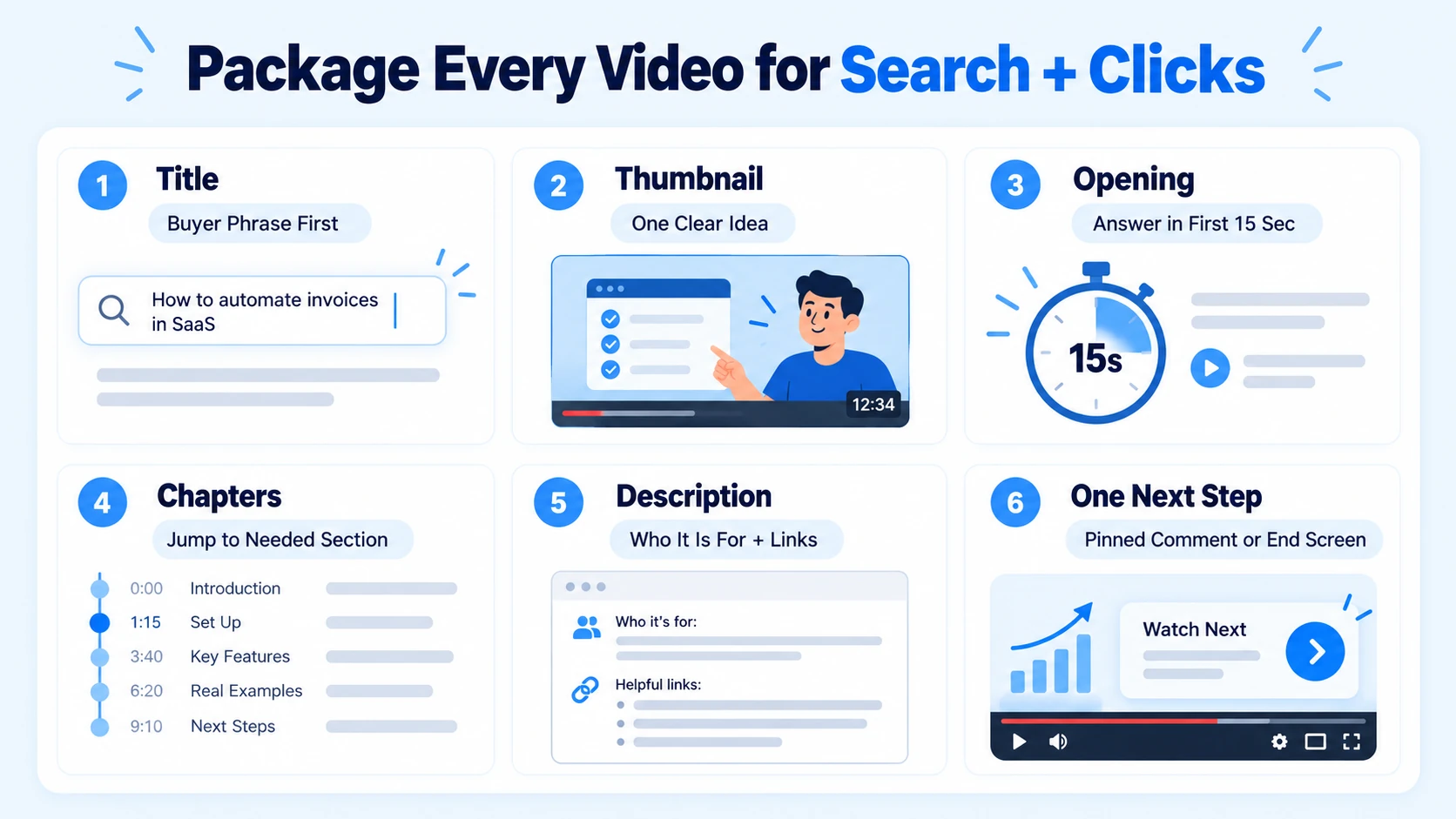
- Title: put the buyer's phrase first, such as "How to [task] in [tool category]," then add a specific benefit.
- Thumbnail: one idea, readable on a phone, with a face or product frame. Our guide on thumbnails that earn clicks covers the basics.
- Opening: state the answer or the problem within the first 15 seconds.
- Chapters: add timestamps so buyers can jump to the part they need.
- Description: two lines on who it is for, then links to the next logical page.
- Pinned comment or end screen: point to one next step only.
For deeper keyword mechanics, see YouTube SEO basics for B2B channels and our explainer on how YouTube distributes reach.
Use Shorts as a Discovery Layer, Not a Separate Channel
Shorts are a way to surface the best moments from long videos. YouTube's own help page confirms that vertical or square uploads up to three minutes are treated as Shorts. That gives SaaS teams room for a full argument, not only a teaser.
My rules for Shorts on a SaaS channel:
- Cut from long videos you already published, so each clip has a clear source.
- Lead with the sharpest sentence, not a greeting.
- End with a pointer to the full video.
- Keep the topic narrow: one problem, one answer.
If you want a deeper view of this tradeoff, our comparison of long-form YouTube vs short-form clips is a good next read, and the YouTube Shorts strategy for B2B brands piece covers hooks and cadence.
A 90-Day Rollout for a Small Team
This is a realistic plan for a team with one marketer, one subject-matter expert, and an editing partner.
Expect slower returns than paid channels. In my experience, the first month teaches you about production flow, and the next two teach you about audience response. That is normal.
Measure What the Channel Is Meant to Do
Views alone are weak evidence. Match each metric to the job the video does.
Attribution will be imperfect. I look at several signals together and ask the sales team directly. Our guide on attribution for video and podcast content and the list of video KPIs B2B teams should track can help you set this up. Do not treat correlation as proof that a video created a deal.
Adapt the Plan to Your Company Stage
The same channel plan should not look identical at every stage. A seed-stage team with one marketer needs a smaller promise than a growth-stage team with a content lead. I adjust scope before I adjust ambition.
A YouTube strategy for B2B SaaS should also change as the product changes. When you launch a new module, add one launch video and two Shorts rather than a new series. When a competitor shifts positioning, a calm comparison video can answer the questions buyers are already asking.
A Weekly Production Workflow That Survives Busy Weeks
Most channels stall in the handoff between recording and publishing. I prefer a workflow with fixed owners and fixed days, so nobody has to ask what happens next.
Two rules keep this honest. First, one round of consolidated feedback is better than five rounds of scattered comments. Second, the editor should see the brief before the footage, not after. Our guide on running a video revision and feedback loop goes deeper, and the video editing brief template shows what to include.
Where SaaS Teams Go Wrong
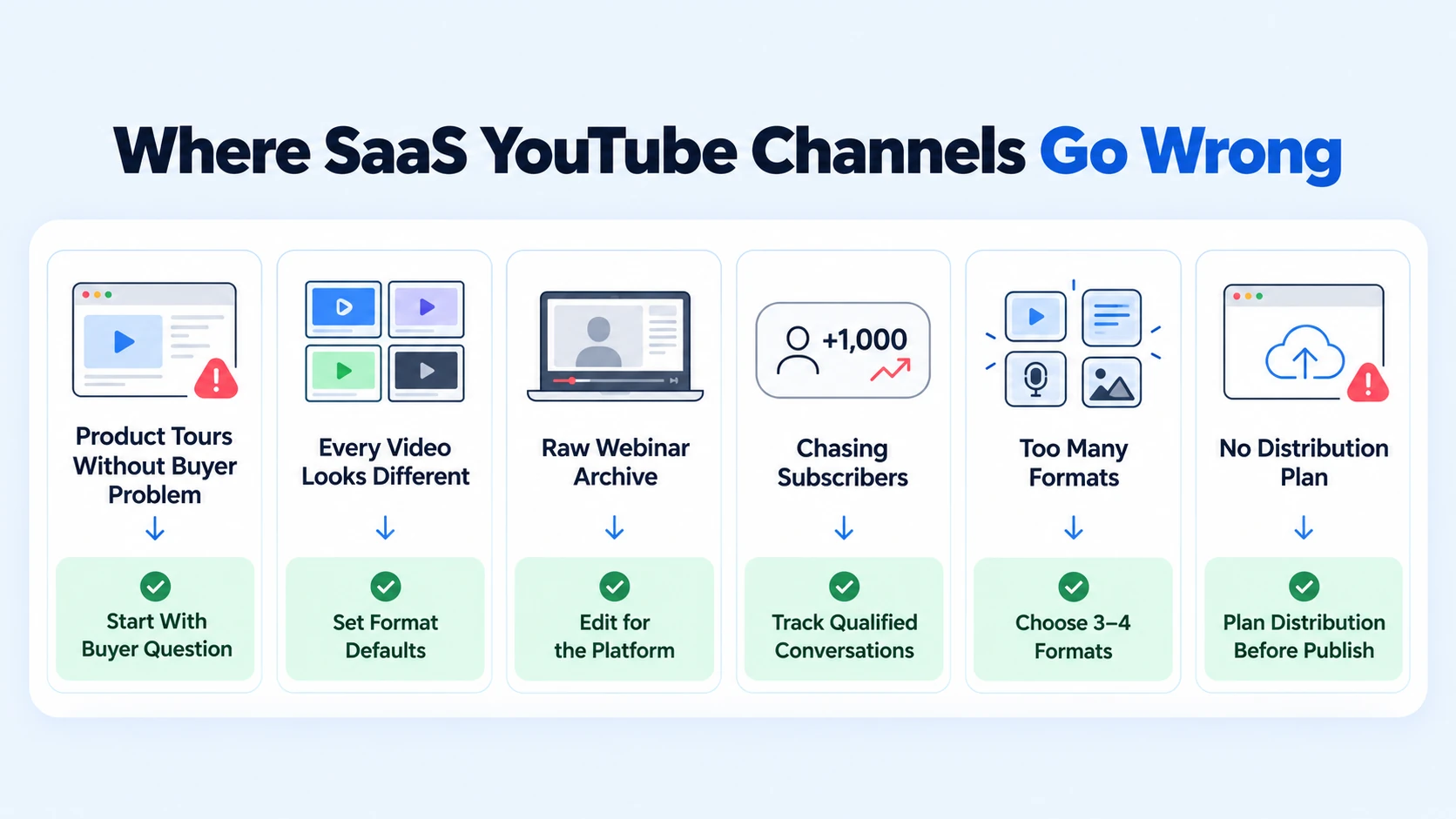
- Publishing product tours with no buyer problem attached.
- Letting every video have a different look and length.
- Using the channel as an archive for webinars with no editing.
- Chasing subscribers instead of qualified conversations.
- Starting with ten formats and sustaining none.
- Leaving distribution to chance after upload.
Who Does the Work
A YouTube strategy for B2B SaaS usually breaks at production, not at ideas. Teams have the questions but not the editing capacity. You have three common options:
If you are weighing these, the comparisons of in-house vs outsourced editing for SaaS and freelancer vs agency for B2B lay out the trade-offs. Our B2B SaaS video editing and YouTube video editing work typically sits in retainers of roughly $2,500 to $5,000, depending on scope, volume, turnaround, and how much distribution support is included. This is a typical working range, not a fixed package.
Conclusion
The decision is simple to state and harder to execute: treat the channel as a system that answers buyer questions on a schedule. A sound YouTube strategy for B2B SaaS, AI, and tech startups & teams does not depend on viral moments. It depends on a clear owner, a small set of formats, careful packaging, and a monthly review. Editing creates the asset. Distribution and consistency give it a chance to produce business value. If your team wants help running that system, we are happy to talk it through, and you can book a call.
FAQ
What is a YouTube strategy for B2B SaaS?
It is a plan for using YouTube to answer buyer questions, build trust, and support sales for B2B SaaS, AI, and tech startups & teams. It defines the channel's goal, formats, cadence, packaging, and measurement. It is not a plan to maximise views.
How much does it cost to run a SaaS YouTube channel?
Cost depends on volume, production difficulty, and who does the work. Freelancers, subscriptions, project work, and retainers price differently. Komet Media's typical retainers sit around $2,500 to $5,000, shaped by scope, turnaround, and distribution needs.
How often should a SaaS company post on YouTube?
I suggest one long video every one to two weeks plus a few Shorts. That is a starting point. Your team's capacity should set the pace, because consistency matters more than volume. See our YouTube posting cadence guide.
How long does it take to see results?
Expect a learning period of two to three months before patterns appear. Pipeline impact takes longer because B2B cycles are long. Track leading signals such as watch time and demo page visits along the way.
What deliverables should a video partner provide?
At minimum: original video scripts and edits or repurposing existing assets, Shorts cut from long videos, captions, thumbnails, and consistent branding. Better partners also help with topic selection, packaging, and distribution.
Should we hire a freelancer or an agency?
A freelancer can work when volume is low and your team gives clear direction. An agency suits teams that need process, backup capacity, and distribution support. Neither is automatically better.
Can a small SaaS team run this without a video hire?
Yes, a YouTube strategy for B2B SaaS, AI, and tech startups & teams can run lean if you limit formats and batch recording. One owner, one subject-matter expert, and an editing partner can sustain a modest rhythm.
Does Komet Media work with SaaS companies?
Yes. Komet Media works with B2B SaaS, AI, and technology startups & teams on video creation from scratch, repurposing, and distribution. You can see our video marketing services for the wider scope.