
🪄 AI Summary
Heading 1
Heading 2
Heading 3
Heading 4
Heading 5
Heading 6
Lorem ipsum dolor sit amet, consectetur adipiscing elit, sed do eiusmod tempor incididunt ut labore et dolore magna aliqua. Ut enim ad minim veniam, quis nostrud exercitation ullamco laboris nisi ut aliquip ex ea commodo consequat. Duis aute irure dolor in reprehenderit in voluptate velit esse cillum dolore eu fugiat nulla pariatur.
Block quote
Ordered list
- Item 1
- Item 2
- Item 3
Unordered list
- Item A
- Item B
- Item C
Bold text
Emphasis
Superscript
Subscript
Most B2B teams still treat Instagram like a poster wall. The brands pulling real pipelines from it are doing something different: they're using Reels to compress expertise into 60 seconds and put it in front of buyers who have never heard of them. This guide breaks down the best B2B Instagram Reels examples to learn from in 2026, what makes them work, the reel hook techniques behind them, the common mistakes killing reach, and exactly how your SaaS or funded tech team should be thinking about short-form video—whether created from scratch or repurposed—right now.
TL;DR
- 41% of B2B marketers say short-form video drives the highest ROI of any content format.
- The best B2B Reels teach, show proof, or put a founder on camera. They don't pitch.
- 55% of Reels views come from non-followers, making them Instagram's strongest discovery format for new audiences.
- Original content creation from scratch, alongside repurposing from webinars and podcasts, creates a sustainable Reel library.
Why B2B Instagram Reels Examples Matter More Than Ever in 2026
The channel argument is settled. Instagram adoption among B2B marketers has surged to 61% in 2026, up from 42% in 2023, according to the Content Marketing Institute. That's not a trend. That's a structural shift in where B2B buyers spend their attention. From July 10, 2025, all public content from professional Instagram accounts became eligible to appear in search engine results by default, meaning your Reels, carousels, and photos can now surface directly in Google searches without users ever opening the app. That changes the value equation entirely. A Reel is no longer just social content. It's indexable, discoverable, and compounding. Reels made up 46% of US time spent on Instagram in 2025.
On the engagement side, Reels deliver a 2.7% engagement rate, the highest of any Instagram content format, and reach roughly 30.81% of a business account's followers. Compare that to the platform average of 0.45% across all content formats in Q2 2026. The top social media marketing channels for B2B in 2025 are short-form videos on YouTube, Instagram, and TikTok, per HubSpot's State of Marketing 2025 report.
Instagram sits in that core mix, not as a bonus channel, but as a primary distribution surface. The algorithm reinforces this further. Same-day posts now make up more than 30% of recommended Reels, double a year ago, so posting cadence matters more than it used to. And Instagram shares per reach grew by more than 150% in 2025, with the algorithm now treating DM shares as the strongest distribution signal, meaning content that gets forwarded inside buyer teams compounds its reach faster than content that just gets liked.
For B2B SaaS and funded AI teams, the math is simple: your buyers are here, the algorithm rewards consistency, and public Reels now show up in Google. The only question left is what to post.
B2B Instagram Reels Examples That Actually Work: The Brand Breakdown
The strongest B2B Instagram Reels examples to learn from in 2026 share a consistent logic: they treat the Reel as a trust-building asset, not an ad.
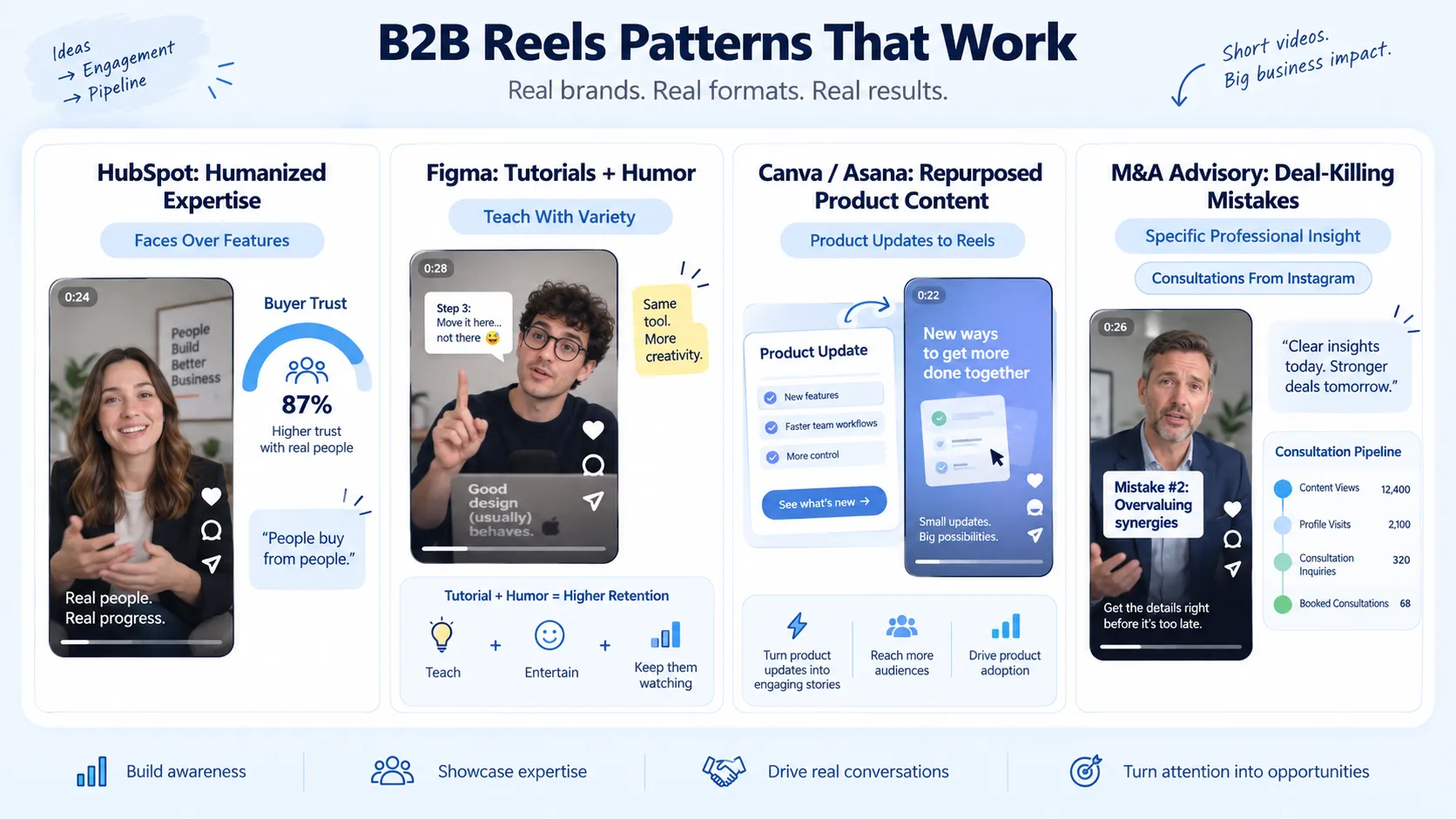
HubSpot is the most-cited model for a reason. HubSpot uses Instagram as a brand humanization engine, not a product catalogue. Their feed mixes Reels showing real team members, culture moments, and behind-the-scenes content alongside educational carousels on marketing and sales topics, and they actively use Reels to put faces, not feature screenshots, in front of their audience. HubSpot uses Reels to break down marketing strategies in digestible, relatable formats, making its expertise accessible while driving engagement.
Figma runs a different angle but with equal discipline. Figma does an outstanding job with a content mix of mini-tutorials via Reels, green screens, humor and memes, and vox-pop style content at conferences. The key is variety within a consistent brand frame: every piece still teaches something.
Canva and Asana demonstrate two clean repurposing plays. Canva turns product updates into tutorial Reels, Asana turns blog posts into carousel series, and HubSpot turns podcast content into short Reels. All three are doing what the best B2B content repurposing strategies recommend: extracting value from assets they already own. For professional services, the results are just as concrete.
A professional services firm specializing in M&A advisory created thought leadership Reels around common deal-killing mistakes, using a 60-second format to explain a specific contractual issue, how it emerged during due diligence, and what sophisticated buyers now look for. These weren't selling services directly. The firm reported that 23% of their new client consultations in Q4 2025 and Q1 2026 mentioned discovering them through Instagram, with several citing specific Reels that prompted them to reach out.
The pattern across all these B2B Instagram Reels examples is identical: specific expertise, a clear point of view, and a format that respects the buyer's intelligence.
How B2B SaaS Companies Are Using Instagram Reels for Lead Generation
The SaaS use case for B2B Instagram Reels examples to learn from is distinct from professional services. The goal isn't just brand awareness. It's pipeline, demo demand, and qualified traffic. Instagram's algorithm heavily prioritizes Reels in 2026, often delivering 3-5x the reach of static posts even for smaller B2B accounts. But reach is table stakes. The formats that convert to pipeline are more specific.
For SaaS teams, the highest-performing lead generation content formats on Instagram are founder-led Reels: short, direct takes on industry problems that build credibility with buyers, with CEO content averaging 2.1% engagement, above the B2B benchmark for most static formats.
One manufacturing client generated 47 qualified leads in Q1 2026 from a series of 90-second process breakdown Reels that showed their quality control methodology. Another SaaS client turned a single "common objection counter" Reel into 200+ demo requests by addressing pricing concerns head-on with transparent value framing.
The repurposing angle is where SaaS teams have the most immediate leverage. Most funded teams already run webinars, record demos, and host podcasts. Repurposing works in multiple directions: your best Reels can become YouTube Shorts, LinkedIn videos, Twitter clips, and email content. Conversely, webinar highlights, podcast clips, and conference presentations can be edited into Reel-length segments.
At Komet Media, this is exactly what we build for B2B teams. You bring the product knowledge, the founder's thinking, and raw ideas. We produce original video content from scratch or turn existing recordings into short videos that educate buyers, support your short-form video strategy, and create a compounding pipeline.
After watching a product video on Instagram, roughly 48% of users take a follow-up action, such as searching for more details or visiting a website. That follow-up action, for a SaaS brand, is often a demo request.
What Should a B2B Instagram Reel Look Like? Structure and Format
The format question is where most B2B teams overthink and then underdeliver. The answer is simpler than you'd expect. Instagram pushes Reels under 90 seconds to non-followers, and watch time plus shares are the signals that move distribution. That's your production brief: under 90 seconds, hook fast, earn shares. The hook is the single most important production decision.
Your viewer makes a snap decision in 500 milliseconds whether to keep watching or keep scrolling. By the time your audio cue hits, half your audience is already gone. The best hooks use big, clear text overlays and strong visuals so the content works on mute. A strong B2B Reel follows this structure:
- Hook (0-3 seconds): Lead with the specific problem, the counterintuitive claim, or the exact outcome. "The reason your demos aren't converting" beats "Hi, I'm [Name], today we're going to talk about..."
- Body (4-60 seconds): One idea, explained tightly. No tangents. Captions on every word since half the time people watch Reels muted.
- Proof or example (middle third): A screenshot, a result, a case study line, a quote.
- CTA (final 5 seconds): One ask only. "Comment DEMO," "Link in bio," or "Send this to your team."
Benchmark expectations for B2B Reels differ significantly from consumer content. B2B Reels averaging 5,000-15,000 views typically indicate healthy performance for accounts under 5,000 followers, with engagement rates of 2-4% representing strong performance compared to 6-10% for consumer content.
For video editing services that support this kind of production, the investment is far lower than most B2B teams assume. The high-production corporate video era is over. Clarity and specificity outperform production polish.
B2B Instagram Reels Ideas That Drive Engagement: 7 Formats Proven in 2026
These are the formats that consistently generate saves, shares, and profile visits across B2B Instagram Reels examples we study and build.
- Founder POV takes: A 45-60 second direct-to-camera opinion on a buyer pain point. No slides. No logo bumper. Just a specific point of view from someone who knows the problem.
- "Before we built this" stories: Behind-the-scenes content showing the product decision, the customer complaint that triggered a feature, or the mistake that changed your roadmap. The hook writes itself: "This started as a customer complaint. Now it is our best-selling feature."
- Webinar clip with bold captions: Take the sharpest 60 seconds from your last webinar, add kinetic text, remove the intro, and post it. This is the fastest content repurposing play available.
- Objection-handling Reels: Address the exact reason your buyers stall. Pricing, complexity, competitor comparisons, implementation fear. Naming the objection on screen is the hook.
- Mini case study: 60 seconds. Customer name (or industry), the problem they had, the result they got. Three sentences. One metric.
- Edutainment stat drops: Lead with a counterintuitive industry number, explain why it matters, give one actionable implication. Easy to produce, high save rate.
- Social proof compilation: Splice three customer quotes over clean b-roll of your product UI. No voiceover needed. Text does the work.
The key isn't mimicking B2C trends; it's translating your expertise into formats that respect your audience's intelligence while matching the platform's native behavior. For Instagram growth specifically, these formats beat polished brand content every time because they're built around buyer questions, not marketing messages.
Common Mistakes B2B Brands Make on Instagram Reels (and How to Fix Them)
Even teams producing strong content make the same structural mistakes. Knowing them is as important as studying the best B2B Instagram Reels examples to learn from.
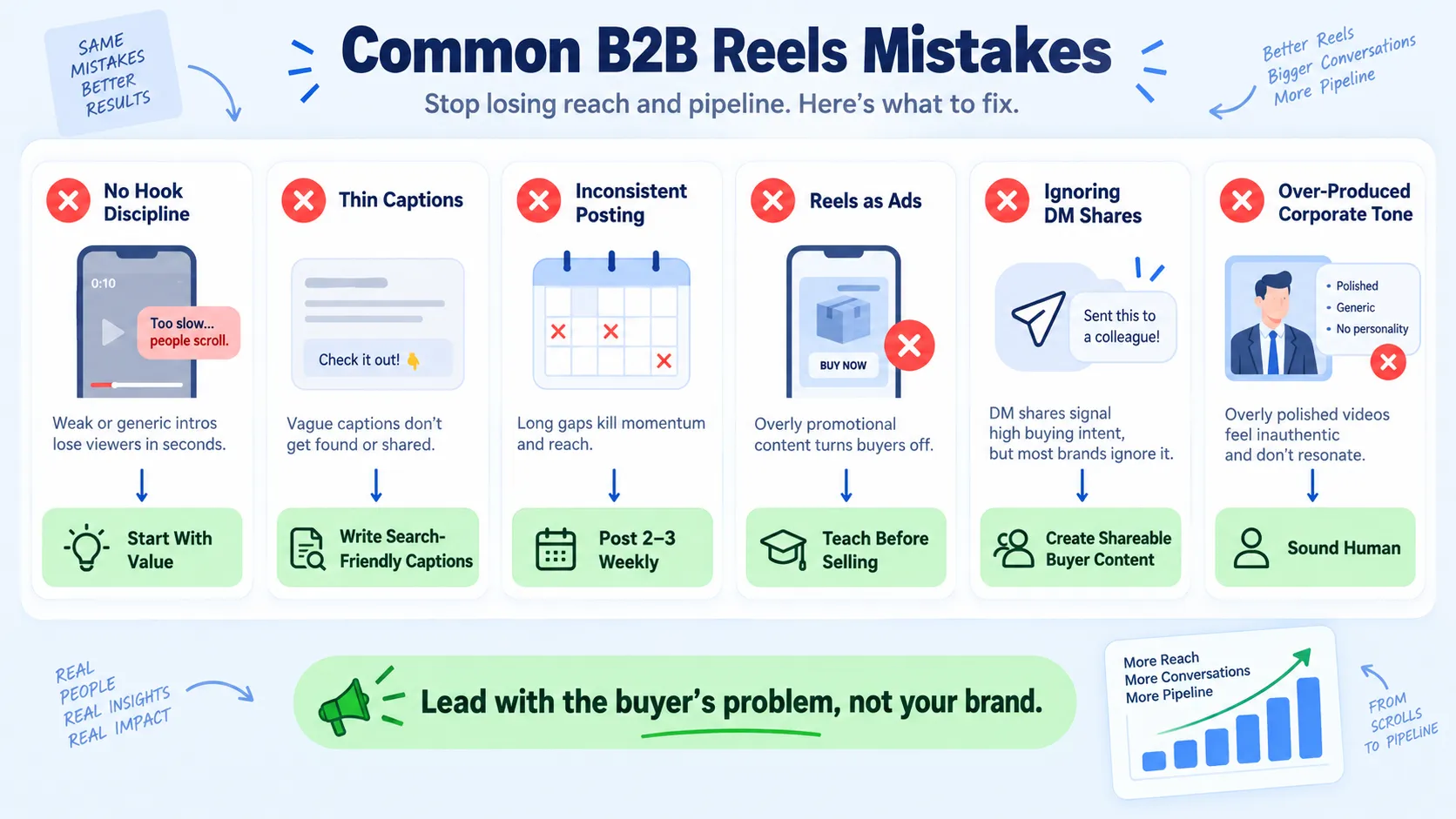
No hook discipline: Generic greetings or slow explanatory intros are among the most frequent Reels algorithm mistakes that cause early abandonment. Starting with "Hi, welcome to our page" is the fastest way to lose distribution. Fix: frame one must deliver the value or the tension.
Two-word captions: Captions are now meta descriptions. Two-word captions with seven hashtags do not serve you anymore. Since Instagram content is now indexed by Google, your caption should function like SEO copy: a clear, keyword-informed summary of what the Reel contains.
Inconsistent posting: Consistency matters more than frequency. Posting three to five quality Reels per week is often better than daily low-effort content. For most B2B teams, two to three Reels per week—combining net-new video production with repurposed assets—is sustainable and outperforms sporadic posting.
Treating Reels like ads: The fastest way to kill organic reach is to lead with your logo, product name, or offer in the first three seconds. Buyers skip commercials. They save content that teaches them something. Reels that educate first and sell second consistently outperform the reverse.
Ignoring DM share signals: Instagram rolled out an algorithm update in December 2025 giving heavier weight to direct-message sends as a distribution signal for Reels. Content that gets forwarded inside buyer teams gets compounded reach. Design Reels buyers would want to share with their colleagues, not just like on their own feed.
Over-producing to the point of sounding corporate: The B2B brands winning on Instagram Reels in 2026 aren't trying to be something they're not. They're translating their genuine expertise into formats that respect both platform mechanics and buyer intelligence.
Our Instagram marketing services are built around fixing exactly these structural issues for B2B teams who are already posting but not seeing the pipeline results they expect.
Conclusion
The B2B Instagram Reels examples to learn from in 2026 share one thing: they treat short-form video as a buyer education channel, not a brand announcement board.
- Reels under 90 seconds with strong hooks reach non-followers at a scale no other Instagram format matches.
- The highest-ROI plays combine original content production from scratch, founder-led videos, objection handling, and repurposed webinar clips.
- Captions are now Google-indexed, making every Reel a searchable content asset.
- The brands winning are consistent, specific, and willing to teach before they sell.
Whether you want to create original videos from scratch or turn existing webinars and recordings into Reels, you need a system to produce videos that work. That's what we build at Komet Media.
Frequently Asked Questions
Q1: How long should a B2B Instagram Reel be?
Keep it under 90 seconds. Instagram pushes Reels under 90 seconds to non-followers, and watch time plus shares are the primary distribution signals. For B2B, 45-75 seconds is the sweet spot: long enough to make a real point, short enough to hold attention.
Q2: What types of B2B Instagram Reels get the most engagement?
Founder-led Reels that offer direct takes on industry problems consistently lead for B2B SaaS, with CEO content averaging 2.1% engagement above the B2B benchmark for most static formats. Objection-handling and mini case study formats are close seconds.
Q3: Can Instagram Reels actually drive the pipeline for a B2B SaaS company?
Yes, when the content is specific enough. One SaaS client turned a single "common objection counter" Reel into 200+ demo requests by addressing pricing concerns head-on with transparent value framing. The Reel has to do real buyer-education work to convert.
Q4: How often should a B2B brand post Instagram Reels?
Consistency matters more than frequency. Three to five quality Reels per week consistently outperforms daily low-effort content. For most B2B teams, two to three per week from repurposed content is a realistic and effective cadence.
Q5: Does the Instagram algorithm treat B2B content differently?
The algorithm applies the same signals to every account: watch time, shares, and saves. Creative execution matters more than follower count, with engagement, watch time, and storytelling driving performance rather than hashtags or account size. A well-structured B2B Reel can outperform a large account's generic content.
Q6: What's the biggest mistake B2B brands make in their Instagram Reels strategy?
Treating Reels like ads instead of content. Generic greetings or slow explanatory intros are among the most frequent Reels algorithm mistakes that cause early abandonment. The fix is leading every Reel with the buyer's problem, not your brand. Teach first. The trust that creates is what eventually drives inbound.