
🪄 AI Summary
Heading 1
Heading 2
Heading 3
Heading 4
Heading 5
Heading 6
Lorem ipsum dolor sit amet, consectetur adipiscing elit, sed do eiusmod tempor incididunt ut labore et dolore magna aliqua. Ut enim ad minim veniam, quis nostrud exercitation ullamco laboris nisi ut aliquip ex ea commodo consequat. Duis aute irure dolor in reprehenderit in voluptate velit esse cillum dolore eu fugiat nulla pariatur.
Block quote
Ordered list
- Item 1
- Item 2
- Item 3
Unordered list
- Item A
- Item B
- Item C
Bold text
Emphasis
Superscript
Subscript
Scaling video production usually reveals the cracks in your creative operations. You hire freelancers or external vendors to increase output, but soon find that every video looks slightly different. Managing Brand Consistency Across Video Editors is a structural problem, not just a creative one. When your typography shifts, your pacing changes, and your hook structures vary by editor, your B2B buyers lose the visual familiarity that builds trust. I have seen demand generation teams waste hours correcting these avoidable errors. This guide explains how to fix your production workflow before those inconsistencies damage your commercial authority.
What Is the Quickest Way to Fix Inconsistent Video?
The fastest way to fix inconsistent video is to build a central brand asset library and a strict video brief. Clear rules for typography, pacing, motion graphics, and audio mixing prevent individual editors from guessing what your brand requires.
Why Does Brand Consistency Decline as Video Volume Grows?
When a venture capital firm or an enterprise software company decides to increase their content output, they often distribute raw files to multiple editors to speed up delivery. The first few videos look fine. By month three, the YouTube channel looks like it belongs to five different companies.
Video editors are creative professionals. If you leave a void in your brand documentation, they will fill that void with their personal editing style. One editor might prefer fast, aggressive jump cuts suitable for a consumer lifestyle brand. Another might prefer long, cinematic pauses. One might colour grade your founder's interview to look warm and inviting, while another pushes the contrast to make it look gritty and dramatic.
None of these choices are objectively wrong in isolation. However, they are disastrous for a B2B brand trying to build institutional trust.
Business buyers look for reliability. According to the 2025 B2B Buyer Behavior Study by Demand Gen Report, consistent brand presentation across multiple touchpoints increases buyer confidence during long sales cycles. When a prospect watches a highly polished webinar recording on your website and then sees a poorly formatted, off-brand clip on LinkedIn, that friction creates doubt.
The primary cause of this drift is the lack of a central source of truth. Internal teams often rely on verbal feedback or scattered Slack messages to guide their video editors. When managing brand consistency across video editors, marketing leaders quickly realise that a Slack thread is not a production system. You cannot expect a new freelancer to read three months of project history to understand how long your logo should remain on screen.
What Is the Cost of Managing Scattered Video Assets?
Inconsistent video does not just hurt your public image. It destroys your internal operational efficiency.
I have watched chief marketing officers and startup founders spend hours leaving timestamped notes on review platforms like Frame.io. They find themselves correcting basic font choices, asking for background music to be lowered, or pointing out that the lower-thirds graphic is using the wrong hex code.
This review cycle friction is expensive. If a marketing director spending $100 an hour wastes three hours a week correcting basic formatting errors across five different videos, the business is losing money and momentum. The edit is rarely the only problem. The problem is that the team is paying highly skilled leaders to do basic quality assurance work.
Failing to standardise your approach also limits your ability to scale. If every video requires three rounds of heavy revision because the editor is guessing your preferences, you cannot confidently commit to a daily publishing schedule. Your content pipeline becomes bottlenecked at the approval stage.
You can read more about how unclear instructions damage timelines in our breakdown of video editing brief mistakes that slow you down.
Furthermore, inconsistent assets confuse your sales team. A strong B2B video operation should produce assets that account executives can use in emails, follow-ups, and discovery calls. If the sales team feels that a video looks off-brand or amateurish, they will simply refuse to share it with prospects. A polished video with no distribution plan is still an underused asset, but an off-brand video will not even survive internal distribution.
How Can Central Systems Help Manage Brand Consistency Across Video Editors?
The solution to creative drift is rigid documentation. You must separate the rules that require strict compliance from the creative decisions that require editor intuition.
A strong brand system gives the editor a sandbox. The boundaries of the sandbox are fixed, but the editor has total freedom to play within them. To achieve this, you need to build a comprehensive visual and audio identity kit.
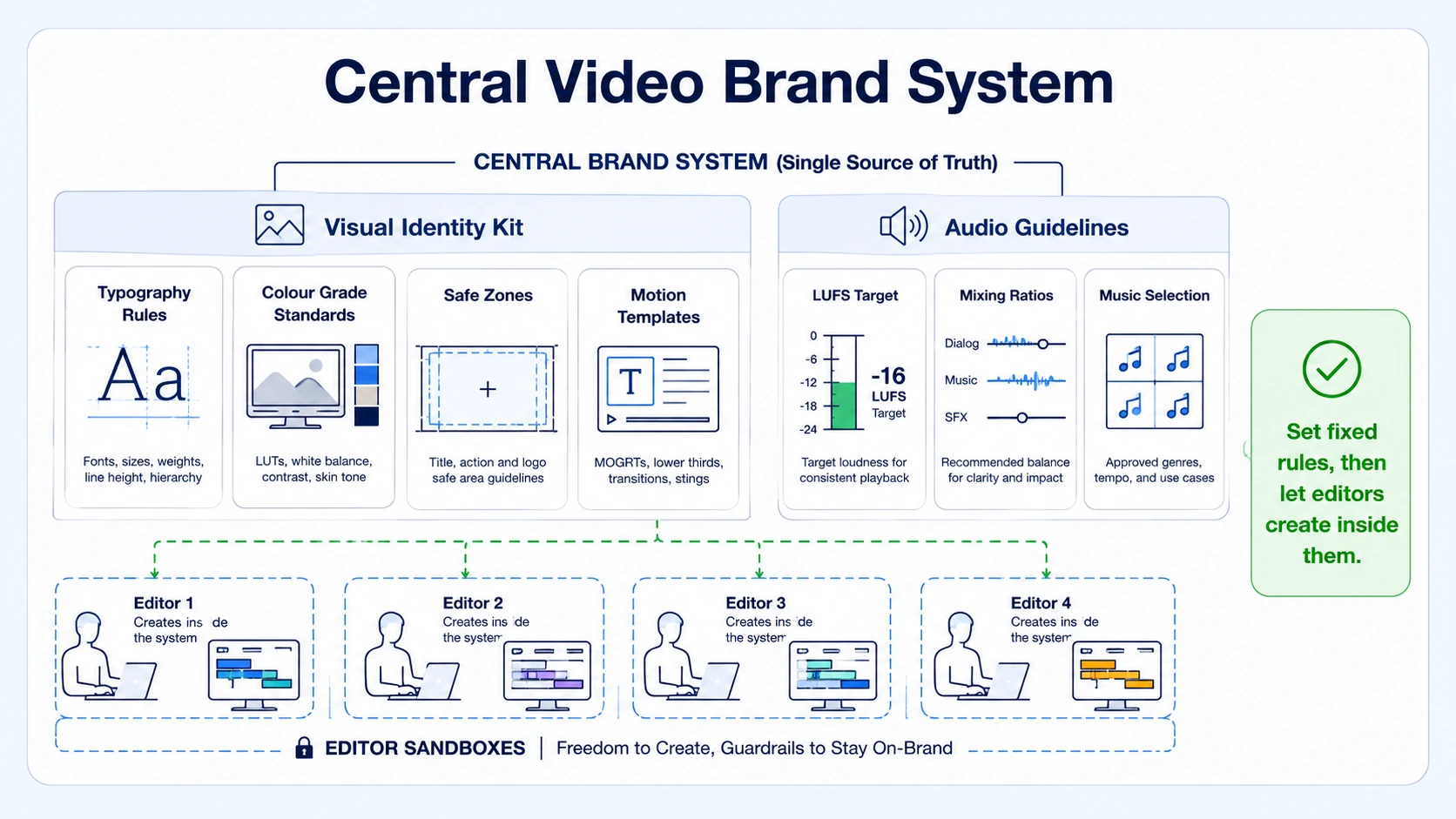
The visual identity kit
Your video guidelines must go deeper than a simple PDF with your company logo. A practical visual identity kit for video should include:
- Typography rules: Specify the exact font families for titles, subtitles, and captions. Include rules for tracking, leading, and casing. State exactly how many words should appear on screen at one time during a short video.
- Colour grading standards: Provide a custom LUT (Look-Up Table) for your brand. This ensures that whether an interview is shot in a bright studio in New York or a dim office in San Francisco, the final skin tones and contrast levels match your corporate identity.
- Safe zones: Provide overlay templates that show editors where they cannot place text. This prevents captions from being hidden behind the TikTok interface or the LinkedIn description box.
- Motion graphic templates: Supply editable MOGRT files for Adobe Premiere Pro or project files for DaVinci Resolve. Editors should not be building lower thirds or intro bumpers from scratch.
The audio guidelines
Poor audio processing is the fastest way to make a B2B video feel cheap. Your system must dictate how audio is handled across every project.
- Loudness standards: Define the target LUFS (Loudness Units relative to Full Scale) for your exports. Social media platforms generally prefer -14 LUFS, while podcast platforms often require -16 LUFS.
- Mixing ratios: State clearly that background music must duck heavily beneath spoken dialogue. A common standard is setting dialogue between -6db and -12db, with music resting comfortably at -25db or lower.
- Music selection: Define the exact mood and genre of music allowed. If your SaaS company sells compliance software to banks, your editors should not be inserting high-energy electronic dance music into your product demos.
What to document versus what to leave to the editor
To prevent your editors from feeling like robots, you must clearly define where they can make creative choices.
How Do You Standardise Your Video Editing Workflow?
Building the brand kit is only the first step. You must then dictate exactly how files move between your company and your video editors.
Disorganised file management leads to inconsistent video. If an editor downloads a compressed, low-resolution version of your logo from Google Images because they cannot find the master file, your brand suffers.
Create a rigid cloud storage structure. Every time a new project begins, duplicate a master folder template. This template should include separate subfolders for raw footage, audio stems, project files, brand assets, and final exports. When you onboard a new editor, you do not need to send them a dozen loose files. You simply grant them access to the master brand folder.
Your feedback loop also requires standardisation. If you have five stakeholders leaving feedback via email, Slack, and text messages, the editor will inevitably miss critical brand corrections. Centralise all feedback in a dedicated review tool. Require stakeholders to consolidate their notes into a single round of revisions before passing them back to the editing team.
For a deeper look at streamlining this process, review our guide on running an efficient video revision and feedback loop.
The secret to managing brand consistency across video editors lies in how you start the project, not how you review the final draft. A project that begins with a clean folder structure, a loaded brand kit, and a clear brief will almost always result in an on-brand first draft.
How Should You Adapt Your Brand for Different Video Platforms?
Consistency does not mean publishing the exact same video file across every platform. A landscape video built for YouTube will look out of place if forced into a vertical Instagram Reels format without adaptation.
Your brand guidelines must account for platform-native behaviours while retaining your core visual identity.
For example, when publishing on LinkedIn, B2B audiences respond well to clean, professional formatting with highly legible captions. The hook should be direct and value-driven. When adapting that same core message for YouTube Shorts, the editing might need to be slightly faster, and the visual framing must account for the platform's specific interface overlays.
Your typography, brand voice, and colour grading remain identical. The aspect ratio, pacing, and caption placement shift to respect the platform. This is the difference between a unified brand and a rigid, unadaptable one.
According to the 2025 State of Video Report by Wistia, businesses that tailor their video dimensions and pacing to specific platforms see significantly higher completion rates than those who blindly cross-post identical files.
How Does Komet Media Build Editing Systems for Brands?
We built Komet Media because we saw strong businesses sitting on valuable recordings without turning them into useful content. Many teams do not have a content shortage. They have a production and distribution problem.
When we take over video editing services for a SaaS business or a venture capital firm, our first step is never to open Premiere Pro. We build a logic map for your brand.
We start by auditing your existing content to understand what is currently working. We then build out your central visual identity kit, establishing the specific typography, motion graphics, and audio standards that will define your content moving forward. We create reusable templates that guarantee your brand looks identical whether we are delivering a 40-minute podcast episode or a 30-second LinkedIn clip.
Komet Media usually works through mid-tier retainers ranging from approximately $2,500 to $5,000 per month. We do not position ourselves as a low-cost editing vendor where your raw files are bounced between random freelancers.
We operate as a dedicated production partner. Our retainers generally cover the full lifecycle of a video asset. We handle the content selection, the technical editing, the platform adaptation, and the final distribution scheduling. We have seen SaaS teams publish more consistently once they stop handling every asset as a separate project and start treating video as an integrated business system.
If you are comparing models for scaling your content, our breakdown of in-house versus outsourced video editing for SaaS provides a clear view of the commercial trade-offs.
How Can You Measure the Impact of a Unified Video Brand?
How do you know if your brand system is actually working? You cannot measure the success of managing brand consistency across video editors without looking at both external performance and internal operational metrics.
Do not judge every video only by views. Match your metrics to the purpose of the asset.
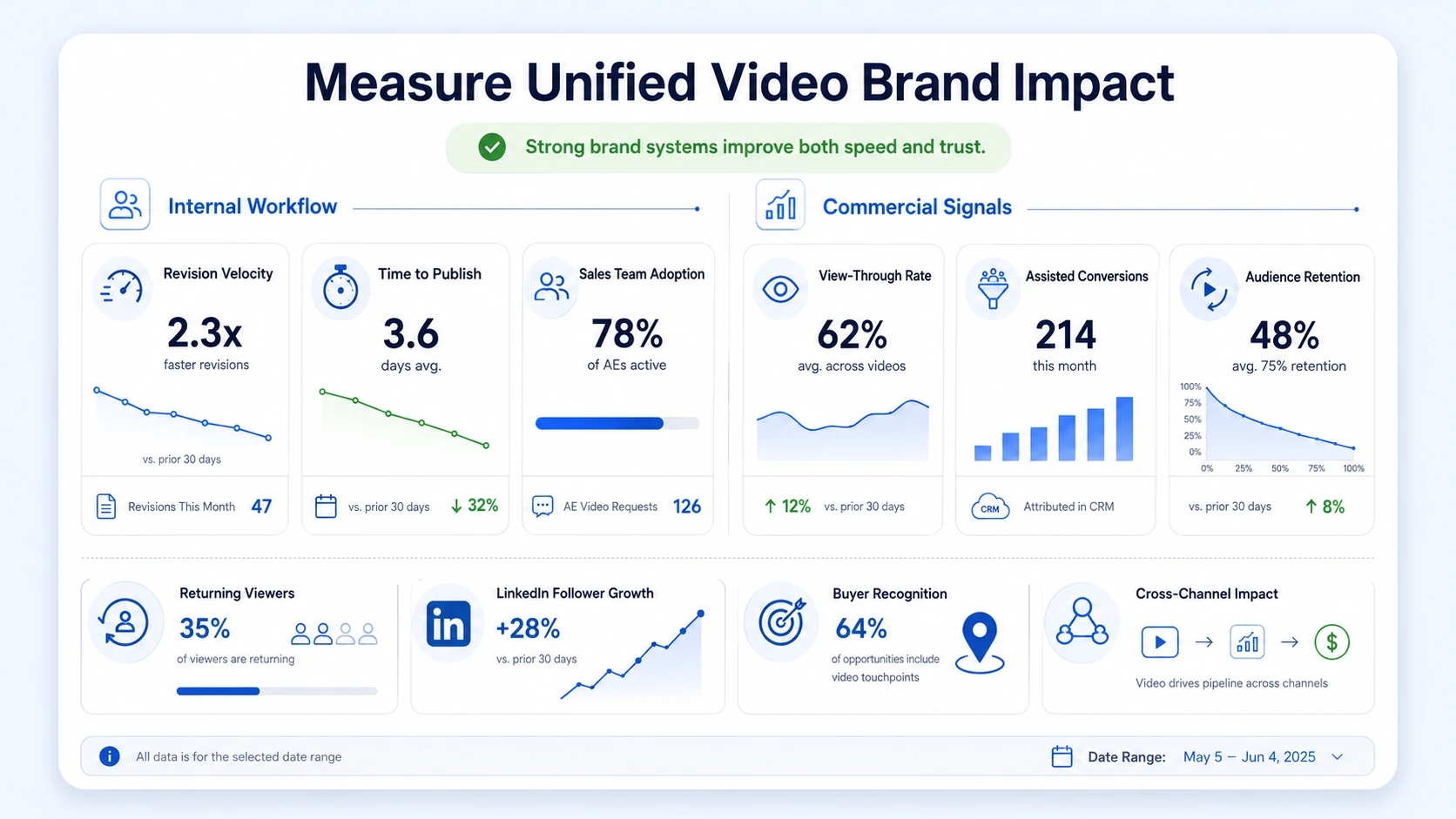
Internal operational metrics
Your marketing team will feel the most immediate impact of a unified brand system.
- Revision velocity: Track how many rounds of feedback a typical video requires before final approval. If your review cycles drop from three rounds to one, your brand system is working.
- Time to publish: Measure the days between recording a founder interview and publishing the first short clip. A strong system should reduce this timeline significantly.
- Sales team adoption: Track how often your account executives request links to specific videos to share with prospects. Sales teams only share content that makes the company look premium and authoritative.
External commercial metrics
Once your internal workflow is smooth, you should look at how the market is receiving your consistent content.
- View-through rate (VTR): Consistent, high-quality audio and clear typography prevent viewers from abandoning the video early. Watch your retention graphs. If viewers are staying past the initial hook, your production quality is supporting your message.
- Assisted conversions: Look at your CRM data to see if prospects are engaging with your video content during the sales cycle.
- Audience retention: Track your returning viewers on YouTube and your follower growth on LinkedIn. A consistent visual brand helps viewers instantly recognise your content in a crowded feed, increasing the likelihood they will stop scrolling.
According to 2026 data from the Content Marketing Institute, B2B marketers who document their content strategies and visual guidelines report significantly higher ROI than those who rely on ad-hoc production. Predictability breeds trust, and trust drives revenue.
Why Does a Structured Video System Matter for B2B Brands?
You cannot scale a B2B media operation if every new hire requires a month of training to understand your visual identity. By managing brand consistency across video editors with strict guidelines, central assets, and a clear review workflow, you protect your authority and speed up your publishing schedule.
Stop treating every video as an isolated creative experiment. Treat your video production as a structured business system. When you remove the guesswork from the editing bay, your team can focus on what actually matters: capturing great ideas and getting them in front of the right buyers.
Frequently Asked Questions About Managing Video Brand Consistency
What does managing brand consistency across video editors actually mean?
Managing brand consistency across video editors is the process of ensuring that every video produced by different individuals shares the exact same typography, pacing, colour grading, and audio standards. This prevents your company channels from looking disconnected.
How much does it cost to hire an agency to manage this process?
Retainers with a dedicated partner like Komet Media usually range from approximately $2,500 to $5,000 per month. This final pricing depends heavily on the volume of long recordings, short clips, and specific distribution support required.
What is the typical turnaround time when using a strict brand brief?
A clear brand brief speeds up the production timeline. Most professional B2B agencies can deliver first drafts of short videos within 48 to 72 hours, while longer podcast episodes or webinars may take five to seven days.
What deliverables should we expect from a video editing partner?
You should expect the final platform-ready video exports, clean transcriptions, separate thumbnail image files, and caption files. Some partners also deliver motion graphic templates that your internal team can reuse for smaller projects.
Is it better to use a freelancer or a dedicated video agency?
Freelancers work well for occasional, one-off projects. An agency is better suited for businesses that need dependable recurring production, multi-platform adaptation, and a system that does not break down when one person takes a holiday.
How does an internal team compare to an outsourced partner?
Internal teams offer deep, nuanced product knowledge but often struggle with capacity and turnaround times. Outsourcing adds predictable volume and specialised skills like motion graphics, allowing your internal marketing leaders to focus on distribution strategy.
Does this service model fit a seed-stage startup?
It fits funded startups that have existing recordings like founder interviews, webinars, or product demos. If a startup is not yet producing raw material or testing a clear message, a recurring editing system may be premature.
How does Komet Media handle brand consistency for new clients?
We start by auditing your existing content and building a central asset library. We define your pacing, hook structure, and typography before the first edit begins, ensuring our output matches your established authority from day one.