
🪄 AI Summary
Heading 1
Heading 2
Heading 3
Heading 4
Heading 5
Heading 6
Lorem ipsum dolor sit amet, consectetur adipiscing elit, sed do eiusmod tempor incididunt ut labore et dolore magna aliqua. Ut enim ad minim veniam, quis nostrud exercitation ullamco laboris nisi ut aliquip ex ea commodo consequat. Duis aute irure dolor in reprehenderit in voluptate velit esse cillum dolore eu fugiat nulla pariatur.
Block quote
Ordered list
- Item 1
- Item 2
- Item 3
Unordered list
- Item A
- Item B
- Item C
Bold text
Emphasis
Superscript
Subscript
Most founders and executives don't discover video editing agency red flags until after they've wired the deposit. By then, you're locked into a revision loop, chasing a project manager who hasn't responded in six days, and watching your competitor's content go live while yours sits in "post-production." This guide breaks down exactly what to watch for, what questions to ask, and how to vet any agency before your budget touches their account.
TL;DR
- Vague portfolios, no revision policy, and unclear contract terms are the fastest indicators of a bad agency fit.
- Agencies that can't explain their post-production workflow upfront will miss deadlines consistently.
- Transparent pricing, a defined creative brief process, and dedicated project management are non-negotiables.
- If an agency can't show B2B-relevant work, they're not the right partner for executive visibility.
What Are the Real Video Editing Agency Red Flags to Avoid When Hiring?
The biggest mistake founders make is treating video agency selection like a commodity purchase. They compare pricing tiers, skip the portfolio review, and sign a contract they haven't fully read. The video editing agency red flags to avoid aren't always obvious. Some are buried inside the onboarding process. Others only show up after the first deliverable lands.
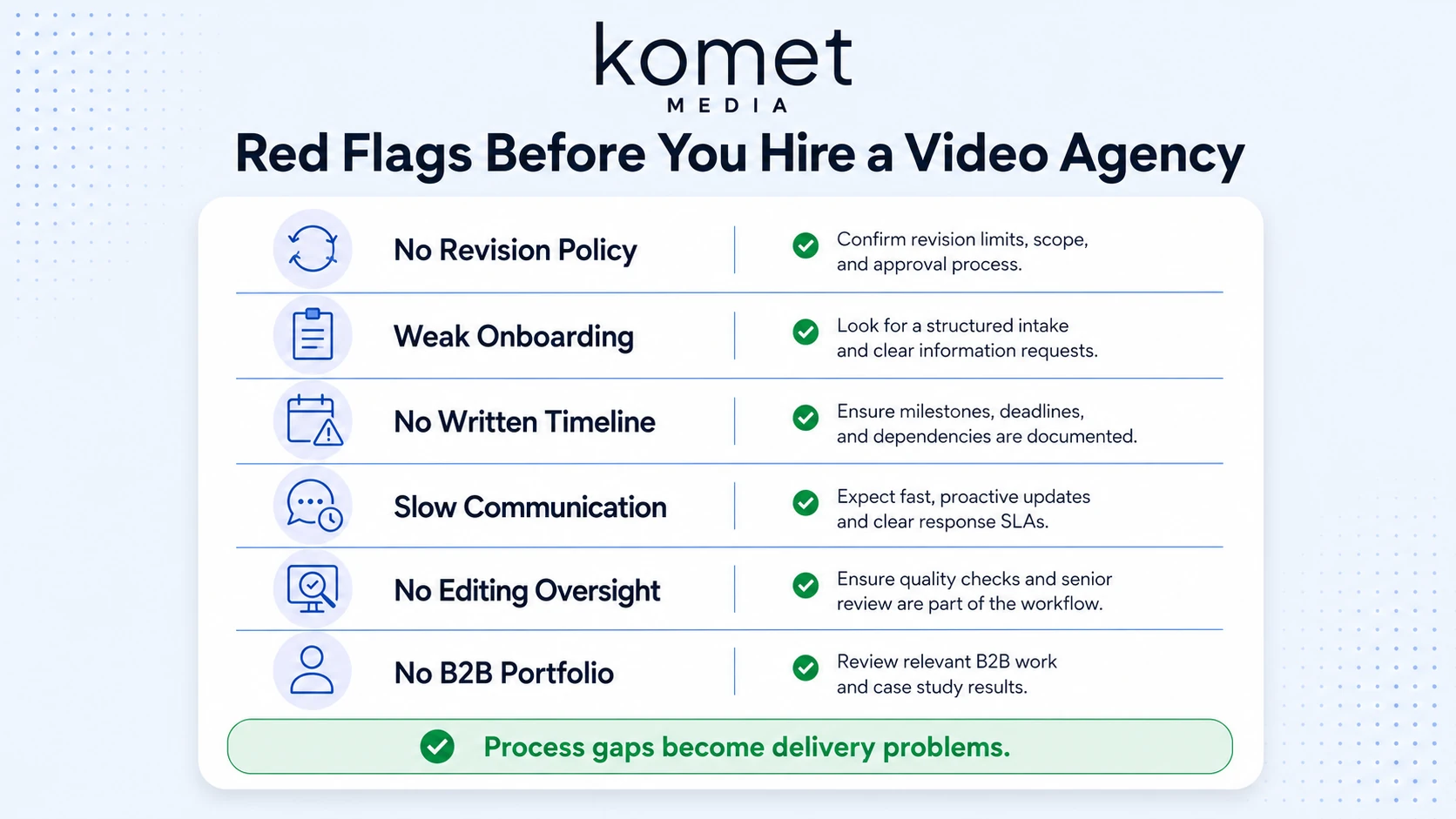
Here are the core warning signs:
- No documented revision policy: If the agency can't tell you exactly how many revision rounds are included and what triggers an additional fee, scope creep is coming. Every round of "just one more change" will either stall your timeline or inflate your invoice.
- Generic client onboarding process: A serious agency uses a structured creative brief to capture your brand voice, target audience, visual style, and content goals before a single frame is touched. If onboarding is a brief intake form or a 15-minute call with no follow-up document, they're guessing.
- No defined content delivery timeline: Vague language like "turnaround in 3–5 business days" with no SLA behind it is a placeholder, not a commitment. Ask for the written service level agreement before signing.
- Communication breakdown from day one: If response times are slow during the sales process, they will be worse once you're a paying client. Agencies that don't use dedicated project management tools (like Frame.io, Asana, or similar) create version confusion and missed handoffs.
- Outsourced editing with no oversight: Some agencies sell premium positioning but run a freelance marketplace model underneath. There's nothing inherently wrong with outsourced editing, but if the agency can't tell you who is editing your content, what tools they use, and how quality is reviewed, you have no visibility into production quality standards.
- No B2B work in their portfolio: Consumer brand reels and B2B executive content are different disciplines. A portfolio full of music videos and product launches doesn't prove they can build trust with your buyers, investors, or future hires.
The agencies that fail serious B2B teams are rarely incompetent. They're usually structured for volume, not for the kind of brand consistency that executive visibility requires. When you're evaluating video editing services for a leadership team, the vetting process needs to be rigorous from the start.
How Do I Know If a Video Editing Agency Is Bad Before Committing a Budget?
The clearest signal is the gap between what an agency promises during the pitch and what they can actually demonstrate. Here's how to pressure-test before you pay.
1. Ask for a process walkthrough, not just a portfolio. Any agency can assemble a highlight reel of their best work. What you want to understand is what happens between project kickoff and final delivery. If they can't articulate their post-production workflow clearly, that ambiguity becomes your problem.
2. Request a sample creative brief. A real agency will have a templated creative brief they use for every project. Ask to see it. If they say "we figure it out as we go," that's a hard pass.
3. Check their communication infrastructure. Do they use Frame.io for client review? Is there a dedicated Slack channel or project management portal? Agencies running everything through email threads will lose assets, miss comments, and create version confusion.
4. Ask who actually edits the content. Is it an in-house team on Adobe Premiere Pro? A rotating pool of contractors? Some hybrid? The answer affects consistency, especially on long-term engagements where brand voice matters.
5. Read the contract terms closely. Look for language around content ownership, turnaround time guarantees, revision limits, and what happens when a deadline is missed. Vague contract terms almost always benefit the agency.
Agencies that cannot answer "who edits this, and what is your quality review process" in two sentences are not ready for a serious B2B engagement.
For founders and executives who need consistent short-form video output, checking these five points eliminates the majority of risky vendors before a dollar is committed.
Video Editing Agency Portfolio Red Flags That Signal a Mismatch
Portfolio vetting is where most buyers go wrong. They look at the quality of the final cut without evaluating whether the work is contextually relevant to what they actually need.
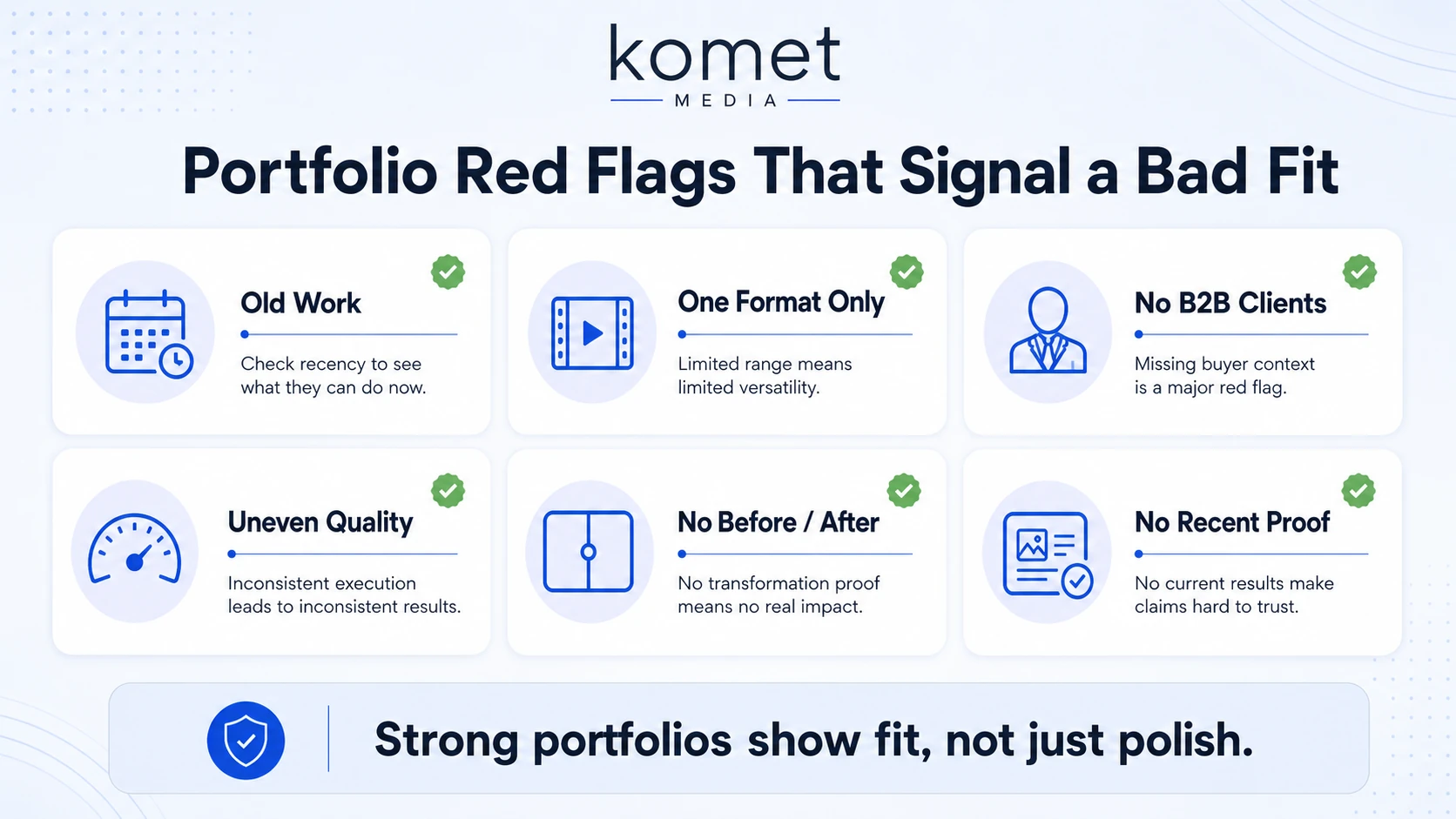
Here is what to look for during a portfolio review:
- Recency: Is the work current? A portfolio heavy on projects from several years ago suggests the agency hasn't grown new clients or retained old ones.
- Format specificity: Do they show short-form video editing across multiple platforms (LinkedIn, YouTube Shorts, Instagram Reels) or primarily one format? Agencies that specialize too narrowly may struggle with your full distribution strategy.
- Industry relevance: Do you see B2B brands, founders, executives, or professional service firms represented? If every example is DTC or consumer, their creative instincts are calibrated for a different audience.
- Consistency across clients: Strong agencies show consistent production quality standards across accounts, not just on a single hero project. Variation in quality often means different contractors handle different jobs.
- Before/after content repurposing examples: If you're hiring for content repurposing, ask to see source material alongside the finished clips. This shows you their editorial judgment, not just their technical ability.
One specific portfolio red flag worth naming: agencies that only show curated case study videos on their website but can't share raw examples or recent client work on request. This often means the portfolio is outdated or the quality is inconsistent.
When comparing vendors, build a simple evaluation table:
This structure forces an apples-to-apples comparison and surfaces gaps that a pitch deck would never reveal.
Signs a Video Editing Agency Will Miss Deadlines (and Kill Your Pipeline)
Missed content delivery timelines are the most operationally damaging outcome of a bad agency relationship. For founders building executive visibility, consistency is the entire strategy. A single missed week of content breaks momentum with your audience.
Watch for these deadline red flags during the evaluation phase:
- No turnaround time written into the contract: If the agency quotes a verbal delivery window but won't commit it in writing, that timeline is aspirational, not operational.
- No buffer built into the workflow: Professional post-production workflows account for review rounds and revision cycles inside the total delivery window. Agencies that quote turnaround without factoring in client review time will consistently run late.
- Overextended team signals: Ask directly how many active clients the agency currently serves. A team of three editors handling dozens of active accounts simultaneously is a capacity risk.
- No project management tools in use: Agencies running production through email are structurally unable to manage parallel workstreams. Frame.io, ClickUp, and similar tools exist precisely because production without them creates version chaos.
- History of scope creep: Ask prior or reference clients directly: did the project scope or timeline shift after signing? Scope creep compounds into missed deadlines, and it almost always traces back to an unclear creative brief or contract terms that didn't define deliverables precisely.
At Komet Media, every engagement starts with documented delivery timelines that are written into the project scope before the work begins. That's not a differentiator; it's a baseline. Any agency that treats written timelines as negotiable is telling you something important about how they operate.
If consistent output for investor-facing content, buyer trust, or team recruitment is part of your goal, explore how video marketing with structured delivery systems supports that consistency.
What Questions Should You Ask a Video Editing Agency Before Hiring?
The right questions expose a bad fit before it costs you time and money. These are the questions I recommend asking every agency before signing.
1. What does your client onboarding process look like, step by step?
A structured answer covering the creative brief, brand intake, and kickoff call is a good sign. A vague answer about "getting aligned" is not.
2. What is your revision policy, and what triggers additional fees?
The specific number of rounds, what constitutes a revision versus a new request, and whether creative direction changes mid-project are billable all need to be answered clearly.
3. Who will be editing my content, and what tools do they use?
Knowing whether your work is handled in-house on Adobe Premiere Pro versus routed to a freelance marketplace helps you assess quality control and brand consistency over time.
4. How do you handle a missed deadline?
The answer reveals their accountability structure. Agencies without a clear answer don't have one.
5. Can you show me examples of B2B executive content you've produced in the last 12 months?
Recency and industry relevance both matter here.
6. What does your transparent pricing model cover, and what is excluded?
Ask specifically about captions, music licensing, motion graphics, and additional formats. Surprises in the invoice always trace back to this conversation not happening.
7. How do clients communicate with the team throughout production?
Email-only agencies are a workflow risk. Look for dedicated channels, project portals, or review tools.
These questions work for any vendor evaluation, whether you're considering a large agency or a specialized shop. For reference, our services page outlines how Komet Media answers each of these in our own onboarding process.
How VC Firms and Investors Evaluate Video Production Vendors
This angle matters more than most founders realize. If you're building investor-facing content, the production quality and brand consistency of your video assets are being evaluated alongside your pitch materials. A video that looks like it was assembled overnight signals the same carelessness as a typo in your deck.
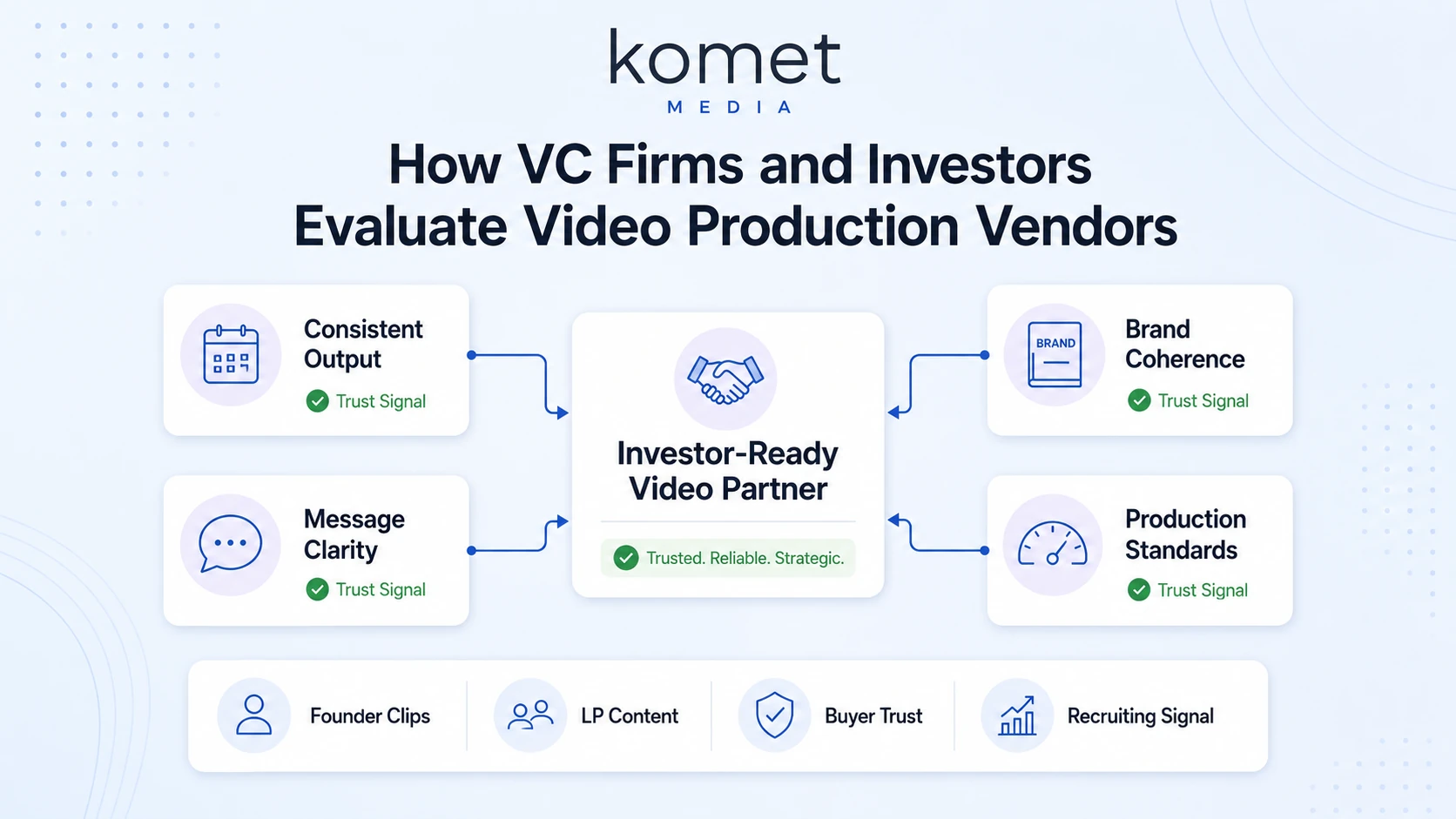
Investors and VC firms look at video content through a specific lens:
- Consistency over time: A founder who appears in well-produced clips regularly signals operational discipline, not just a one-time effort.
- Brand coherence: Typography, color grading, motion graphics, and audio quality should match the professionalism of your brand at every touchpoint.
- Message clarity: Investor-facing video content needs to communicate clearly in the first few seconds. Agencies without experience in executive positioning will default to consumer-style hooks that undermine credibility.
- Production standards: Grainy footage, inconsistent audio, or poorly timed cuts are distractions in a high-stakes context. Investors notice.
An agency that cannot demonstrate work produced for founders, executives, or professional services firms is not equipped to support investor-facing content.
When evaluating vendors for this use case, the video editing agency red flags to avoid shift from operational concerns to strategic ones. It's not just about whether they can deliver on time; it's about whether their output builds or erodes trust.
Agencies like Motionvillee, Vidpros, TastyEdits, and ShortVids compete well on volume and subscription pricing, but none of them specialize in B2B executive positioning or investor-facing content. That positioning gap is exactly where Komet Media operates. At Komet Media, we work specifically with founders, executives, and serious business teams who need their content to carry weight in rooms where it matters.
Conclusion
- The video editing agency red flags to avoid are rarely about production quality. They're about process, transparency, and fit.
- Weak onboarding, vague revision policies, undocumented timelines, and no B2B portfolio experience are the fastest disqualifiers.
- For executive visibility, investor trust, and buyer confidence, your agency partner needs to understand the stakes of the content, not just the craft.
- Vet hard, ask specific questions, and trust what you see during the sales process, it only gets worse after you sign.
Frequently Asked Questions
Q1: What are the most common video editing agency red flags to avoid?
Vague revision policies, no documented content delivery timeline, generic portfolios without B2B examples, and communication gaps during the sales process are the most common. Any agency that can't explain its post-production workflow in concrete terms before you sign is a risk.
Q2: How do I vet a video editing agency's portfolio effectively?
Look for recency, format variety, industry relevance, and consistency across multiple clients. Ask for before-and-after content repurposing examples if that's your use case. A strong portfolio shows editorial judgment, not just technical polish.
Q3: What should a video editing agency's contract include?
At minimum: defined turnaround time, documented revision rounds, content ownership terms, scope change billing triggers, and a service level agreement. Vague contract terms are almost always written in the agency's favor.
Q4: Are subscription-based video editing services a good fit for B2B executives?
Subscription models work for high-volume, lower-stakes content. For executive visibility, investor-facing assets, or brand consistency across channels, a strategy-led agency with defined onboarding and B2B experience is a better fit.
Q5: How do I know if an agency is outsourcing editing work?
Ask directly: "Who edits our content, and are they in-house or contracted?" Follow up by asking what tools they use and how quality is reviewed. Agencies that route work through a freelance marketplace without oversight cannot guarantee brand consistency.
Q6: What questions reveal a bad agency fit immediately?
Ask for their creative brief template and their revision policy. If either answer is vague or ad hoc, the engagement will be too. Also ask how they handle a missed deadline, agencies without a clear answer have never had to account for one.