
🪄 AI Summary
Heading 1
Heading 2
Heading 3
Heading 4
Heading 5
Heading 6
Lorem ipsum dolor sit amet, consectetur adipiscing elit, sed do eiusmod tempor incididunt ut labore et dolore magna aliqua. Ut enim ad minim veniam, quis nostrud exercitation ullamco laboris nisi ut aliquip ex ea commodo consequat. Duis aute irure dolor in reprehenderit in voluptate velit esse cillum dolore eu fugiat nulla pariatur.
Block quote
Ordered list
- Item 1
- Item 2
- Item 3
Unordered list
- Item A
- Item B
- Item C
Bold text
Emphasis
Superscript
Subscript
Most executives have real expertise. The problem is that expertise trapped in a deck, a long email, or an internal call never builds trust with buyers who haven't met you yet. Thought-leadership video examples for executives in 2026 show a sharper truth: video is now the fastest path from invisible authority to recognized subject matter expert. According to Forrester Research, one minute of video is worth 1.8 million words, and audiences want to see the thinker, not just read the ideas. This guide breaks down what works, what format to use, and how to build a system around it.
TL;DR
- C-suite content generates five times more views and engagement than posts from other LinkedIn members.
- Short-form video under 60 seconds dominates LinkedIn distribution; long-form earns deeper buyer trust.
- The best executive videos are opinion-driven, point-of-view-led, and either created from scratch or repurposed from existing content.
- Formats that work: hot-take clips, podcast pull quotes, demo walk-throughs, founder stories, and live Q&As.
What Makes a Good Executive Thought Leadership Video
The bar isn't production value. It's perspective. In 2026, audiences are increasingly sensitive to artifice. Over-rehearsed scripts erode trust and come across as fake and lacking authenticity. Over-produced visuals also dilute authenticity. Something that feels human performs much better, especially with short-form content. Here's what separates a forgettable executive video from one that moves buyers:
- Specific point of view: You're not summarizing industry news. You're saying something most people in your space won't say out loud.
- Concise structure: Hook in the first three seconds. Point made by second 30. Call to think differently by the end.
- Relevant context: Tie your perspective directly to a problem your buyer is trying to solve right now.
- Low-friction delivery: Talking to camera, seated in a real environment, no teleprompter reading. Competence shows through comfort, not polish.
- Strategic distribution: Post natively to LinkedIn. Do not share a YouTube link. Native video gets dramatically more reach.
Executives now consume thought leadership as a due diligence tool. In a 2025 Edelman-LinkedIn report, around 55% of target and hidden decision-makers across industries use this content in their vendor vetting process. That means your video isn't just content. It's a trust signal being reviewed before the first sales call happens.
The internet is saturated. AI has made it frictionless for anyone to produce text at scale. The result is an authenticity gap. People aren't just looking for information, they're looking for signal, credibility, and a real human point of view. Video is how you supply that signal. Generic takes don't qualify. 81% of budget holders say thought leadership content helps buying groups align. Executive video that educates a buying committee shortens the sales cycle before your team even enters the room.
Thought-Leadership Video Examples for Executives in 2026 That Actually Work
These are the formats serious founders and C-suite leaders are using this year, with clear examples of the execution model behind each.
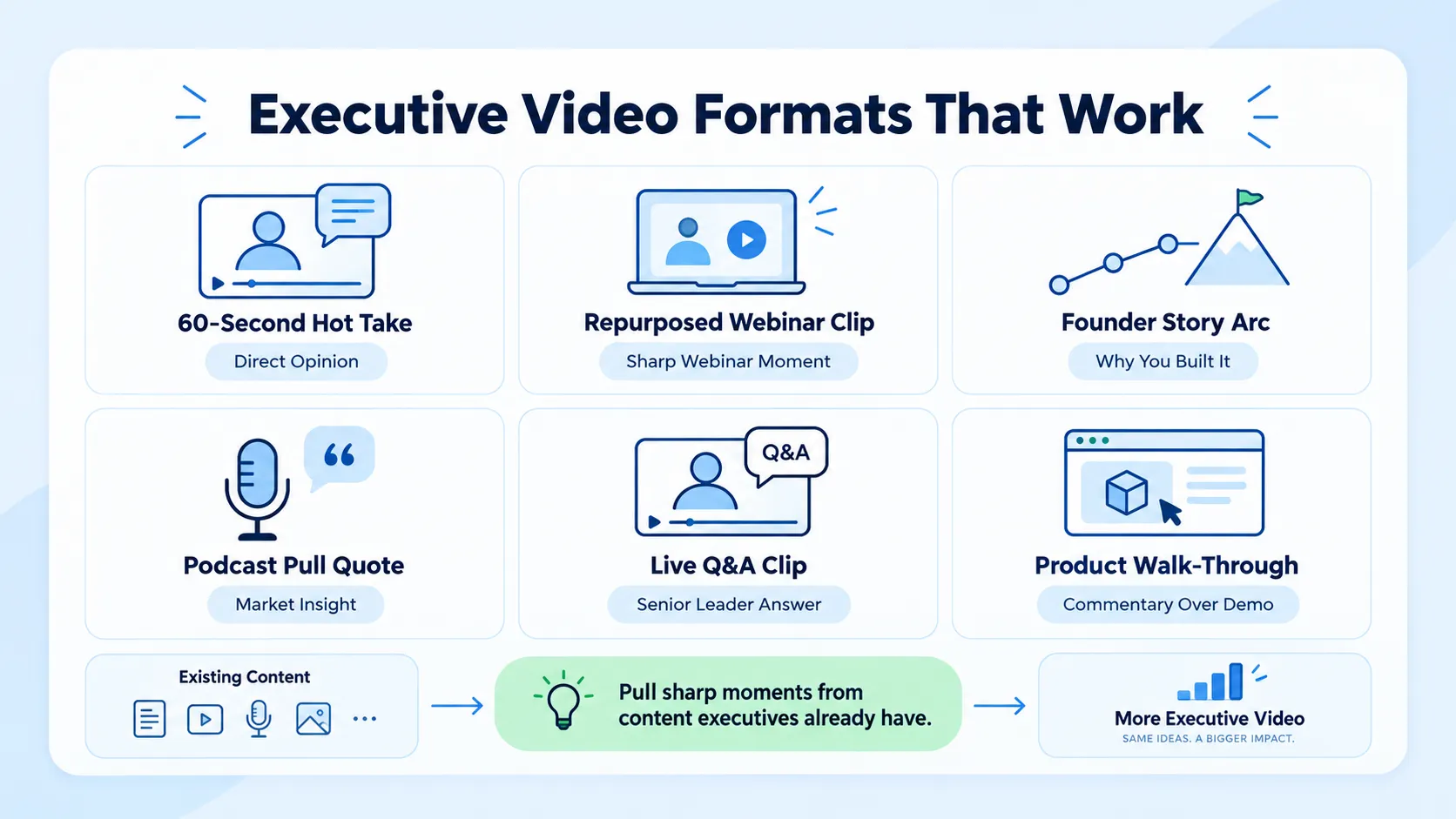
1. The 60-Second Hot Take
A single opinion on a trend, a common mistake, or a contrarian view in your market. No intro, no "hey guys." Jump straight to the claim. Gary Vaynerchuk built his entire personal brand on this model: raw, direct, zero warm-up. For B2B SaaS founders, this works when tied to product category problems buyers already feel.
2. The Repurposed Webinar Clip
You ran a webinar. Somewhere in that session you said something sharp and specific. Pull it, add captions, trim to 45–90 seconds, and post it natively on LinkedIn. Thought leadership videos, particularly live Q&A sessions, generate six times more interactions than pre-recorded content, helping position executives as industry authorities while building authentic connections with stakeholders. That moment of live candor is your clip.
3. The Founder Story Arc
A 2–3 minute video where you explain why you built what you built. Not your feature set. The real frustration, the customer pain you lived, the decision that changed the company's direction. Simon Sinek's "Start With Why" framework works because it puts belief before product. That's exactly the structure a founder story should follow.
4. The Podcast Pull Quote
You were on a podcast. You said something precise about your market. Pull that segment, clean the audio, add captions, and post it. This is the fastest version of a content repurposing framework at scale.
5. The Live Q&A Clip
McKinsey & Company's video content consistently uses the conversational interview format: one senior partner, one sharp question, five minutes. It earns trust because it doesn't feel produced. For AI and SaaS founders, this format turns investor calls and customer conversations into pipeline content.
6. The Product Walk-Through with Commentary
A demo video where you, the founder or product head, narrate what the product does and why a specific design decision matters. This is the format that builds product trust. HubSpot's early thought leadership video content was built on exactly this model: founder explaining the "why" behind the tool, not just the "what."
Best Thought Leadership Video Formats for C-Suite Leaders
The right format depends on one variable: what stage of the buyer journey you're targeting.
The strongest executive video content strategy does not choose between short and long. It integrates them, ensuring they both work together while supporting different needs. Short-form earns visibility. Long-form earns the meeting. You need both running simultaneously.
LinkedIn's algorithm actively favors video content under 60 seconds, generating up to three times more impressions than text posts. This algorithmic preference, combined with user behavior patterns, has established short-form video as the cornerstone of executive communication strategy in 2026.
How Executives Build a Personal Brand Through Video Content
Consistency matters more than production budget. Here's the system I recommend to every founder or executive starting from zero:
- Establish your content pillar: Pick two or three categories you own. For a SaaS founder, that's product thinking, go-to-market, and the problem your category solves. Stay inside those pillars.
- Record before you edit: Create a bank of raw footage each week: one opinion clip, one answer to a buyer question, one repurposed asset from an existing webinar, podcast, or event.
- Edit for retention, not aesthetics: Captions, jump cuts, tight pacing. Every second of dead air is a drop-off point.
- Post natively on LinkedIn: Personal profiles get 2.75x more impressions and 5x more engagement than company pages. Meanwhile, 59% of decision-makers prefer content from individual people over brand accounts.
- Repurpose down the funnel: A 5-minute YouTube video becomes three LinkedIn clips, a podcast highlight, and a sales enablement asset your SDRs can share before a demo.
- Measure what moves pipeline: Views and impressions are vanity metrics. Watch demo request volume, inbound connection quality, and reply rates to cold outreach after a video is live.
A 2025 Sprout Social study found that 72% of B2B decision-makers trust professionals with an active thought leadership presence more than company marketing alone. That gap only widens when you replace text posts with actual video.
Short-Form vs. Long-Form Video for Executive Thought Leadership
This is the wrong debate if you're framing it as either/or. The real question is: what job does each format do?
Short-form (under 90 seconds):
- Drives platform reach and algorithm distribution
- Works for hot takes, repurposed clips, and founder positioning
- Builds familiarity with buyers who don't know you yet
- Ideal for LinkedIn and YouTube Shorts
Long-form (5 minutes and above):
- Builds depth of trust with buyers already in your funnel
- Earns watch time and signals credibility to algorithms on YouTube
- Best for product walk-throughs, interview formats, and webinar recordings
- Supports video marketing and sales enablement simultaneously
LinkedIn video is accelerating into 2026, with 154 billion video views reported in 2024 and viewership up 36%. Benchmarks also show 2024–2025 video impressions rising by 73.39% and views up by 52.17%, making video a format worth prioritizing.
The practical move for most executives: record one long-form asset per month, then pull four to six short-form clips from it. That's a full month of content from a single 30-minute session. That's what a real content repurposing framework looks like in practice. It's also exactly how Komet Media builds short-form video systems for B2B teams, providing full support whether repurposing existing footage or producing video content from scratch.
Common Mistakes Executives Make in Thought-Leadership Video Examples
Most executive videos underperform for predictable reasons.
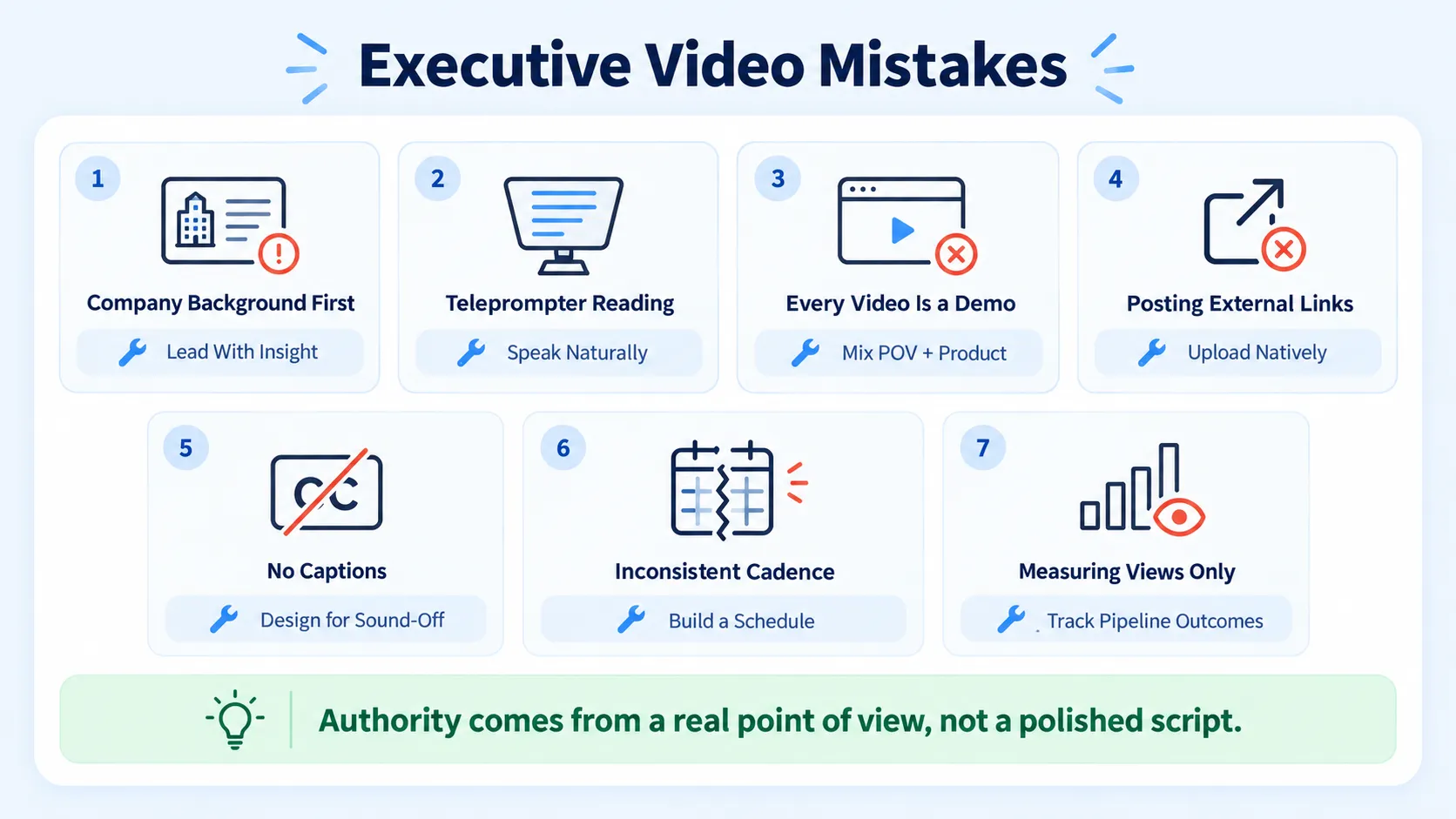
Mistake 1: Starting with company background
Nobody needs your founding year in the second one. Lead with the insight, not the introduction.
Mistake 2: Reading from a teleprompter
The most effective CEO thought leadership video is direct, measured, and rooted in a genuine perspective. Authority cannot be manufactured in post-production; audiences are smart and will catch on.
Mistake 3: Treating every video as a product demo
You need a mix. If 80% of your videos are product walk-throughs, you're creating sales content, not thought leadership. Buyers aren't ready to buy every time they see your content.
Mistake 4: Posting a YouTube link instead of native video
LinkedIn's algorithm suppresses external links. Native video gets three times the reach. Always upload directly.
Mistake 5: No caption layer
Create short-form vertical video under 60 seconds with captions. Most LinkedIn videos are watched on mobile with sound off. No captions means you lose most of your audience before they hear a word.
Mistake 6: Inconsistency
One video a quarter isn't a strategy. CEOs who post at least three times per week see a 94% higher follower growth rate and a 73% stronger brand association score compared to executives who post less than once per week. You don't need to hit that frequency on day one, but you do need a real publishing cadence backed by a production system.
Mistake 7: Measuring views instead of outcomes
Thought-leadership video examples for executives in 2026 that drive pipelines are tracked against inbound demo requests, not view counts. Connect your content output to your CRM and measure what actually converts.
Conclusion
The executive video opportunity in 2026 is wide open. Most competitors aren't doing this well.
- Use short-form for distribution and long-form for depth. Both are necessary.
- Lead with a genuine POV, not company background or product features.
- Build a production and repurposing system so you can either create new videos from scratch or turn one recording session into a full month of assets.
- Measure video performance against pipeline metrics, not vanity metrics.
- Start with formats that match your existing content: clips from webinars, podcasts, and demos are the fastest path to volume.
Thought-leadership video examples for executives in 2026 prove one thing clearly: visibility without substance doesn't convert. Substance without visibility doesn't either. Video is where both come together.
Frequently Asked Questions
Q1: How long should an executive thought leadership video be?
Short-form clips (30–90 seconds) are optimal for LinkedIn distribution and top-of-funnel reach. Long-form content (5–10 minutes) builds deeper trust with buyers already in your funnel. The best strategy uses both: one long-form session per month, repurposed into four to six short clips.
Q2: What should a CEO or founder actually talk about in thought leadership videos?
Talk about market problems your buyers are already feeling, contrarian takes on your industry, product design decisions and why you made them, and lessons from building the company. Avoid corporate announcements and anything that reads like a press release.
Q3: How do executives build personal brand authority through video without a large production budget?
The most effective executive videos balance professional quality with authentic delivery. Raw, behind-the-scenes content has emerged as a powerful trust-building tool, with unscripted moments generating significantly higher engagement than polished corporate messaging. A smartphone, a clean background, good lighting, and clear audio are enough to start.
Q4: How many thought leadership videos should an executive post per month?
Aim for six to eight short-form posts per month minimum. That's roughly two per week. You can hit this output with one or two recording sessions monthly if you have a proper content repurposing framework in place to break long-form content into clips.
Q5: Which platform is best for executive thought leadership video in 2026?
LinkedIn is the primary platform for B2B thought-leadership video. LinkedIn surpassed 1.3 billion registered members as of 2026, with roughly 310 million monthly active users. YouTube matters for long-form discoverability and sales enablement. Start on LinkedIn, then syndicate to YouTube.
Q6: What's the difference between thought leadership video and a product demo?
A thought leadership video advances a point of view on a market problem or trend. It builds trust and authority before a buyer is in the sales cycle. A product demo shows how your solution works once a buyer is already evaluating options. Thought-leadership video examples for executives in 2026 consistently show the highest pipeline impact when both formats are used in sequence, not interchangeably.