
🪄 AI Summary
Heading 1
Heading 2
Heading 3
Heading 4
Heading 5
Heading 6
Lorem ipsum dolor sit amet, consectetur adipiscing elit, sed do eiusmod tempor incididunt ut labore et dolore magna aliqua. Ut enim ad minim veniam, quis nostrud exercitation ullamco laboris nisi ut aliquip ex ea commodo consequat. Duis aute irure dolor in reprehenderit in voluptate velit esse cillum dolore eu fugiat nulla pariatur.
Block quote
Ordered list
- Item 1
- Item 2
- Item 3
Unordered list
- Item A
- Item B
- Item C
Bold text
Emphasis
Superscript
Subscript
You recorded a strong episode. The insight was sharp, the guest was credible, and the conversation had genuine pipeline value. Then you clipped it, posted it, and got nothing. If that sounds familiar, you're running into the podcast repurposing mistakes to avoid in 2026, and most of them are structural, not creative. This guide breaks down exactly where B2B SaaS and AI startup teams go wrong, what it costs them in reach and pipeline, and how to fix it before your next episode drops.
TL;DR
- Bad clip selection, missing captions, and wrong aspect ratios quietly kill distribution before your content has a chance.
- Platform-native formatting and intentional content atomisation are non-negotiable in 2026.
- Repurposing without a distribution system is just busywork, strategy and execution must move together.
- Short-form clips are still highly effective: 89% of podcast listeners watch podcast clips on at least one social platform at least sometimes, and 72% do so often or always.
The Biggest Podcast Repurposing Mistakes to Avoid in 2026
These aren't edge cases. They're the patterns I see most often when B2B teams come to Komet Media frustrated that their content isn't converting. Each one has a measurable cost.
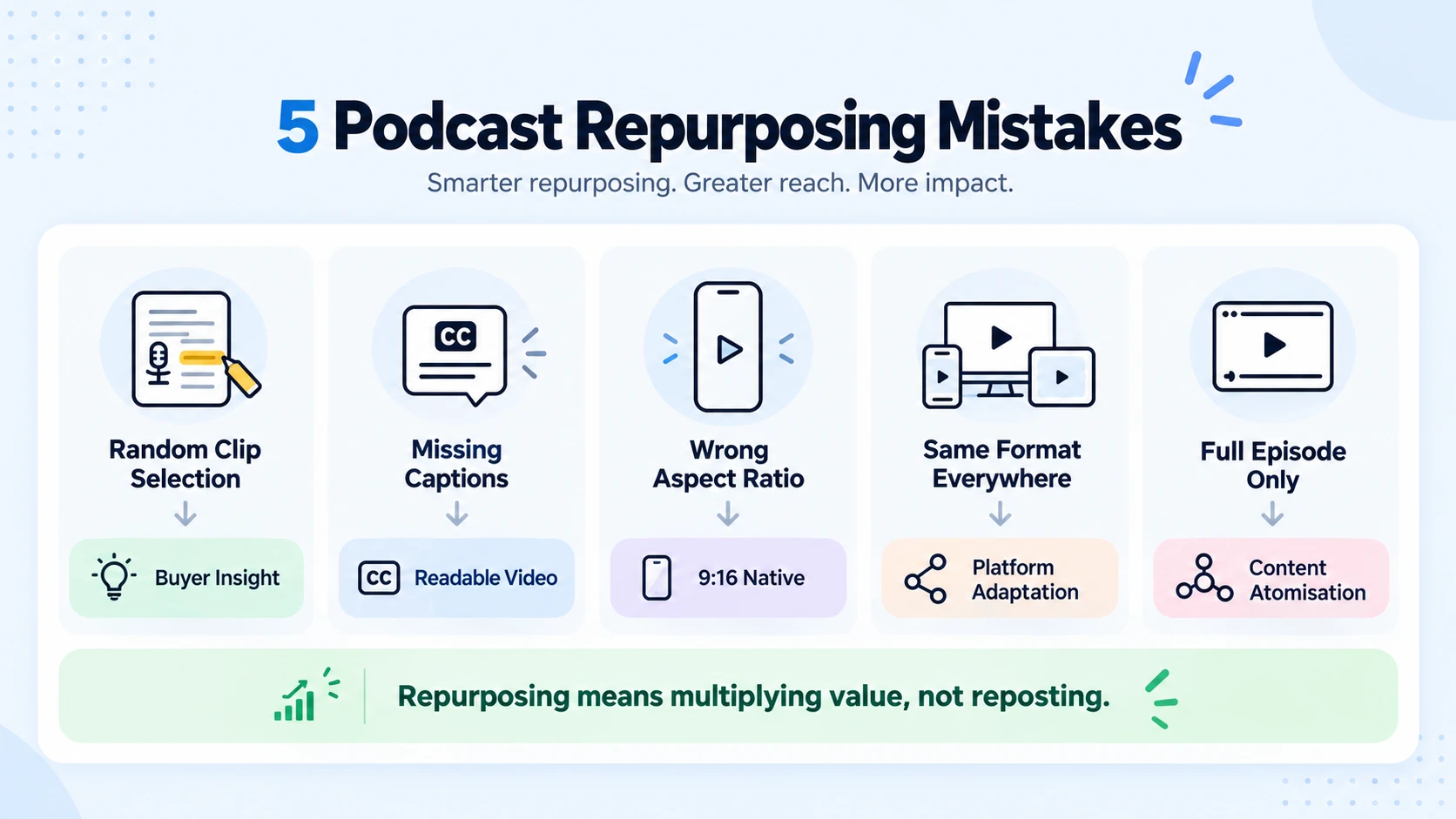
Mistake 1: Clipping randomly instead of clipping strategically. Most teams grab a clip because it's near the beginning or because the guest said something quotable. That's the wrong filter. The right filter is: does this clip answer a specific buyer question, challenge an assumption, or deliver a standalone insight? Clips built around a single, complete idea perform far better than clips that are excerpts of a longer argument. Tools like Descript and Riverside.fm make it easy to scan transcripts and find those moments, use them that way.
Mistake 2: Skipping captions. This is not a nice-to-have. The majority of short-form video is watched on mobile with sound off. No captions means no comprehension, which means no engagement, which means the algorithm deprioritises the post immediately. Captions also serve accessibility and Semantic SEO, they give platforms text signals to correctly categorise your content.
Mistake 3: Ignoring aspect ratio. A 16:9 clip on TikTok or Instagram Reels looks like an afterthought. Native vertical (9:16) is the format those platforms are built for. The YouTube Shorts algorithm actively favours content shot or cropped to vertical. This is a two-minute edit decision with outsized distribution consequences.
Mistake 4: Treating every platform identically. LinkedIn buyers consume content differently from TikTok Creator Economy audiences. A clip that performs on LinkedIn Audio Events or LinkedIn feed may need a different hook, pace, and caption style than the same moment reformatted for YouTube Shorts. Multi-platform publishing means more than uploading the same file everywhere.
Mistake 5: Posting the full episode and calling it repurposing. Content atomisation is the actual strategy. One 45-minute episode should generate: 4–6 short clips, a podcast transcript that doubles as an SEO asset, a set of audiograms, pull-quote graphics, and at minimum one long-form blog post. Posting the full episode as a YouTube upload is distribution, not repurposing.
Why Your Repurposed Podcast Content Isn't Getting Engagement
The clip is live. It has captions. The aspect ratio is correct. And it's still flat. Here's why. Short-form clips function as samples, they are often the first interaction a new listener has with your show, and the audience then decides whether to invest in the long-form content. That means the clip must deliver a complete, standalone payoff. If the value requires context from the episode, the clip hasn't been edited correctly.
The second reason is hook failure. Wistia's 2026 State of Video Report, drawn from more than 13 million videos and 79 million hours of viewing, found that shorter videos consistently hold higher engagement than longer ones. But short doesn't mean the hook can be lazy. The first two seconds must create a reason to keep watching, a counterintuitive claim, a sharp question, or a result. A cold open of "So, I think the thing about B2B marketing is..." will lose 80% of viewers before the insight lands.
The third reason is distribution timing. Creators who post teaser clips within 24 hours of publishing the full episode see a 39% increase in cross-platform traffic. Most teams post days or weeks later when algorithm momentum has already moved on.
The fourth reason is topic-market fit. A clip that resonates with a general audience may completely miss your ICP. For B2B SaaS and funded AI startups, the clips that drive pipeline are the ones that speak directly to the buyer's specific pain, product trust gaps, onboarding complexity, positioning confusion, not generic thought leadership. This is where short-form video production built around your ICP pays dividends over generic clip creation.
Finally, posting without a distribution system means your clip depends entirely on organic reach in a single feed. Cross-posting to LinkedIn, YouTube Shorts, and TikTok, combined with email and a Repurpose.io workflow, compounds the reach of every asset you create.
Common Podcast Repurposing Errors That Kill Reach and Waste Budget
These are the podcast repurposing mistakes to avoid in 2026 that quietly drain time and money without any obvious failure signal.
No transcription workflow. Podcast transcription is the foundation of a content repurposing strategy that scales. Without a transcript, every downstream asset, blog posts, show notes, social captions, email copy, has to be recreated from scratch. With a podcast transcription service feeding a structured workflow, those assets get produced in a fraction of the time. Tools like Descript generate transcripts automatically; Captivate.fm includes episode-level analytics alongside hosting.
No episodic content architecture. Most teams treat each episode as a standalone event. Topical authority and Knowledge Graph Optimisation require the opposite: episodes that build on each other, cover a consistent theme cluster, and link back to owned content. This is Episodic Content Architecture, structuring your show so that the repurposed assets collectively build a content moat, not just a content calendar.
Audiogram creation without sound design. Audiograms are still effective for LinkedIn and Twitter/X. But an audiogram with no sound-designed intro, no clean waveform design, and no compelling visual context performs like a dead post. The waveform alone is no longer enough.
Ignoring evergreen content strategy. Every episode generates SEO assets that build over time, social content that drives discovery, and email material that nurtures the existing pipeline. Evergreen clips, those built around enduring buyer questions rather than news cycles, compound value. Most teams over-index on timely content and under-invest in evergreen.
Using Anchor Clips as a primary distribution mechanism. Anchor Clips (now part of Spotify's creator tools) has limited organic reach compared to YouTube Shorts or TikTok. It's a supplementary channel, not a primary one. A single 45-minute B2B podcast episode, properly atomised, should produce at least 8–10 distinct content assets across formats and platforms. Most teams produce two.
Best Practices for Repurposing Podcast Episodes in 2026
Research from Podcast Atlas' Discovery Playbook 2026 concluded that social video offers podcasting one of its largest opportunities for reaching audiences who are not already regular podcast users, and 74% of clip viewers give podcast clips their full or near-full attention. The opportunity is real. Here's how to capture it without wasting production cycles.
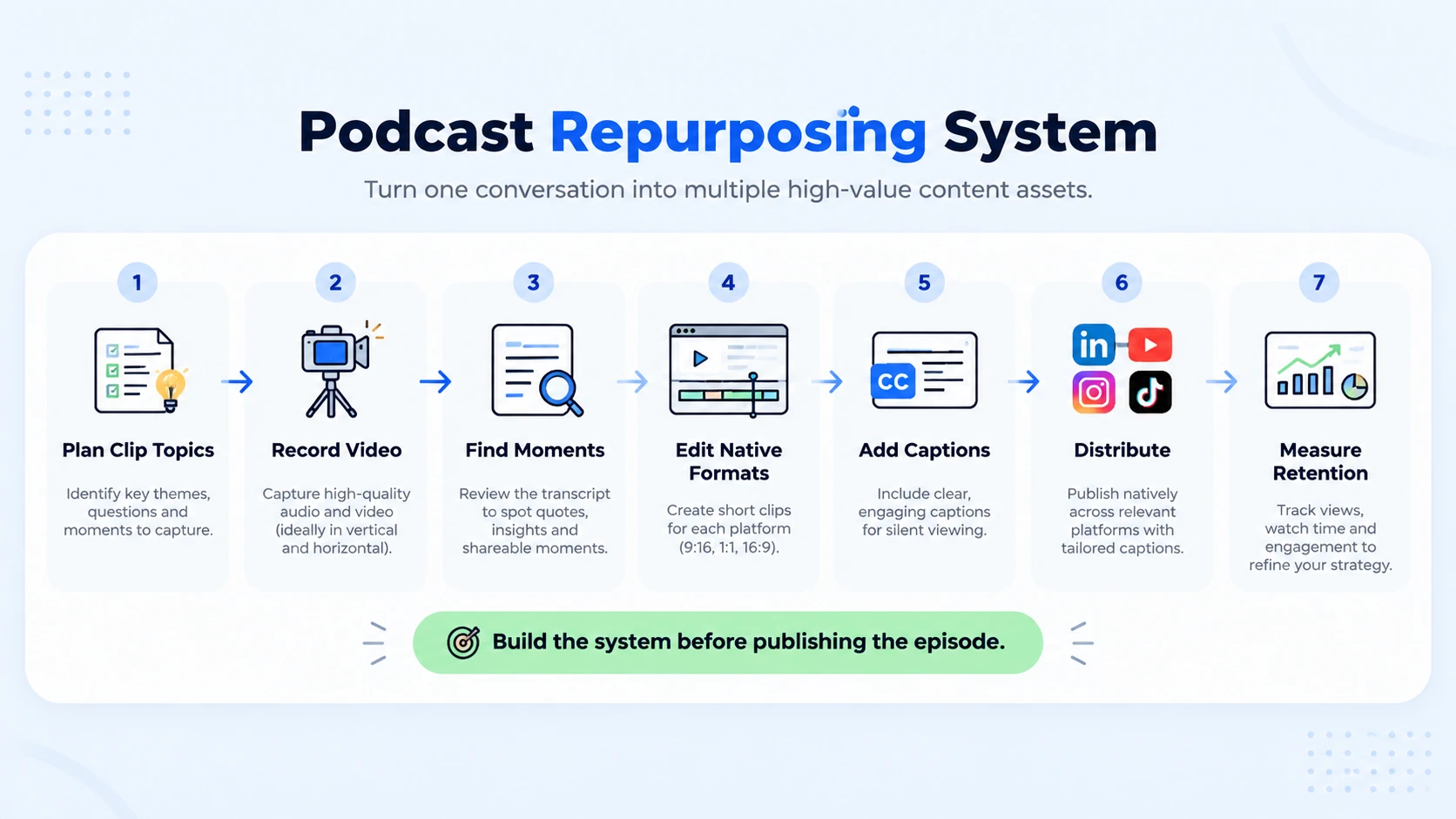
- Build a clip brief before you record. Identify 3–5 questions your ICP is actively asking. Brief your guests around those. This makes clipping intentional, not retrospective.
- Record natively for video. Creators are embracing multi-format workflows: full-length episodes are posted to audio platforms and YouTube, while short clips on TikTok, Instagram Reels, and YouTube Shorts function as samples. If you're not recording video, you're locked out of the highest-performing distribution channels.
- Establish a clip length hierarchy. 15–30 seconds for LinkedIn and TikTok hooks; 45–90 seconds for YouTube Shorts and Instagram Reels; 2–3 minutes for LinkedIn articles and email embeds. 39% of marketers assert the 30–60 second range is the sweet spot for short-form video performance.
- Produce platform-native captions. Each platform renders captions differently. LinkedIn auto-captions are notoriously inaccurate. Custom-styled captions burned into the video file give you control and consistency.
- Distribute via a structured workflow. Repurpose.io automates cross-posting from a single source file to multiple destinations. Combine it with a podcast marketing calendar that maps each clip to a distribution date and platform.
- Use Podcast Transcription Services for SEO. Every episode should generate a show notes page with timestamped highlights, a full transcript, and internal links. This is how podcast repurposing builds Topical Authority in search.
- Measure retention, not just views. Views without retention data tell you nothing actionable. Average watch percentage is the signal that tells you whether your editing and hook structure are working.
What You Should Never Do When Repurposing Podcast Clips
These are hard stops, the podcast repurposing mistakes to avoid in 2026 that no amount of distribution budget can fix after the fact.
Never post a clip without a hook in the first two seconds. The entire algorithmic distribution system of TikTok, YouTube Shorts, and Instagram Reels is built on early retention signals. A weak open is a permanent drag on reach.
Never repurpose content that wasn't designed to be repurposed. A meandering 90-minute conversation with no clear point-of-view moments will produce mediocre clips regardless of editing skill. The fix is upstream, at the recording stage.
Never ignore platform algorithm rules. The YouTube Shorts algorithm specifically rewards vertical video, fast hooks, and native uploads (not cross-posted links). TikTok deprioritises watermarked content from other platforms. These rules change, but ignoring them entirely is how repurposed content gets buried on day one.
Never skip the distribution layer. Most podcast episodes receive limited exposure beyond existing subscribers, short clips create multiple opportunities for new audiences to discover your expertise. Without intentional social media distribution, even excellent clips reach only the audience that already knows you exist. That's not growth; it's maintenance.
Never treat repurposing as a post-production afterthought. The teams that extract the most pipeline value from their podcast content build the repurposing system before the first episode is recorded, not after the tenth episode has already been buried.
Are Short Podcast Clips Still Effective for Social Media in 2026?
This question comes up every six months, usually after someone posts a few clips that didn't perform. The answer is yes, but the bar has risen. There are over 5 million podcasts in 2026 compared to just 550k in 2018. The feed is crowded. Clips that worked two years ago because the format was novel no longer work on novelty alone. What works now is precision.
57% of social shares for video podcast content come from short-form clips under 60 seconds. The clip format itself is not the problem. Generic execution is the problem. YouTube leads clip engagement at 67%, followed by TikTok at 63%, which means the audience is there and actively watching. The gap between teams winning with clips and teams wasting time on them is almost entirely in clip selection, hook quality, and platform-native formatting.
For B2B specifically, podcast-engaged prospects close 23% faster than non-engaged ones. That's a pipeline number, not a vanity metric. The goal for a SaaS or AI startup running a podcast isn't viral reach, it's getting the right buyer to consume enough of your thinking that they arrive at a demo already educated. Short clips are the top of that funnel. They work when they're built to work. Explore how Komet Media's podcast production and repurposing services are structured around exactly that outcome.
Conclusion
The podcast repurposing mistakes to avoid in 2026 aren't mysterious, they're consistent, fixable, and disproportionately costly for B2B teams running pipeline-first content strategies.
- Clip selection, captions, aspect ratio, and hook quality are the four variables that determine whether a clip gets reached or gets buried.
- Content atomisation transforms one episode into 8–10 assets; posting the full episode is not a strategy.
- Distribution without a system produces inconsistent results regardless of content quality.
- For SaaS and AI startup teams, the real measure of repurposing success is buyer education and pipeline velocity, not view count.
Frequently Asked Questions
Q1: How many clips should I produce from a single podcast episode?
For a 30–60 minute B2B episode, target 4–6 short clips (15–90 seconds each), one audiogram, one transcript-based blog post, and one set of show notes with timestamps. That's a minimum viable repurposing stack, not a ceiling.
Q2: What is the ideal clip length for B2B social media in 2026?
The 30–60 second range is the most consistent performer across platforms. LinkedIn tolerates up to 90 seconds for thought-leadership clips. YouTube Shorts performs well up to 60 seconds. TikTok rewards hooks that resolve fast, so 30–45 seconds is safer there.
Q3: Does podcast transcription actually help SEO?
Yes, and significantly. A timestamped transcript on your episode page gives search engines indexable text, supports Knowledge Graph Optimisation, and builds Topical Authority across your subject cluster. Transcripts are also the source material for show notes, blog posts, and email content, the ROI compounds quickly.
Q4: Which tools work best for podcast repurposing workflows?
Descript and Riverside.fm handle recording and transcript-driven clip editing. Repurpose.io automates multi-platform distribution from a single source. Captivate.fm provides hosting with analytics. Each solves a different part of the workflow, they're complementary, not competing.
Q5: Why are my clips getting views but no demo requests or pipeline?
Views without ICP relevance are noisy. If your clips attract a general audience but not your specific buyer, your topic selection is off. Clips that drive pipeline address specific buyer pain, product confusion, evaluation criteria, competitor comparisons, not general thought leadership that appeals to everyone and converts no one.
Q6: Should a B2B SaaS startup build a podcast from scratch or repurpose existing content first?
If you have existing webinars, demo recordings, or founder interviews, repurpose those first. The fastest path to a clip library is content you already own. Once you've validated which topics drive ICP engagement, use that signal to inform a purpose-built podcast production strategy going forward.