
🪄 AI Summary
Heading 1
Heading 2
Heading 3
Heading 4
Heading 5
Heading 6
Lorem ipsum dolor sit amet, consectetur adipiscing elit, sed do eiusmod tempor incididunt ut labore et dolore magna aliqua. Ut enim ad minim veniam, quis nostrud exercitation ullamco laboris nisi ut aliquip ex ea commodo consequat. Duis aute irure dolor in reprehenderit in voluptate velit esse cillum dolore eu fugiat nulla pariatur.
Block quote
Ordered list
- Item 1
- Item 2
- Item 3
Unordered list
- Item A
- Item B
- Item C
Bold text
Emphasis
Superscript
Subscript
A podcast editing agency checklist should help you answer one question before you sign: will this partner turn each recording into episodes and clips that your buyers actually use, on a schedule you can rely on? Most B2B teams compare price and sample reels. The better tests are scope, process, audio standards, approvals and distribution. This checklist covers what to ask, what to verify in samples, what to put in the contract and which warning signs to take seriously.
Quick Answer: Podcast Editing Agency Hiring Checks
This podcast editing agency checklist covers five checks: services in scope, audio standards, turnaround and revisions, clip and distribution support, and file ownership. Ask for a paid trial episode.
Why a Podcast Editor Checklist Matters More for B2B Podcasts
A business podcast is rarely a media product on its own. It is a source of thought leadership, guest relationships and clips for LinkedIn, Instagram and YouTube. That changes what you need from an editor. Cleaning audio is the starting point. The valuable work is choosing which moments to cut, giving each one a clear opening, and making sure the episode and its clips go out on a calendar.
Audience habits support the video side. Tubefilter's report on Edison Research's Infinite Dial 2026 says 80% of respondents aged 12 and older have listened to or watched a podcast, a record, and that for the first time more than half, 57%, said they have both listened to and watched one. The article does not state the sample size or survey dates, so I would use it as a direction, not a precise measure. It does support asking any agency how it handles video podcasts, not only audio.
Services in the Podcast Editing Agency Checklist
Decide which of these you need and ask the agency to state each one as included, extra or not offered.
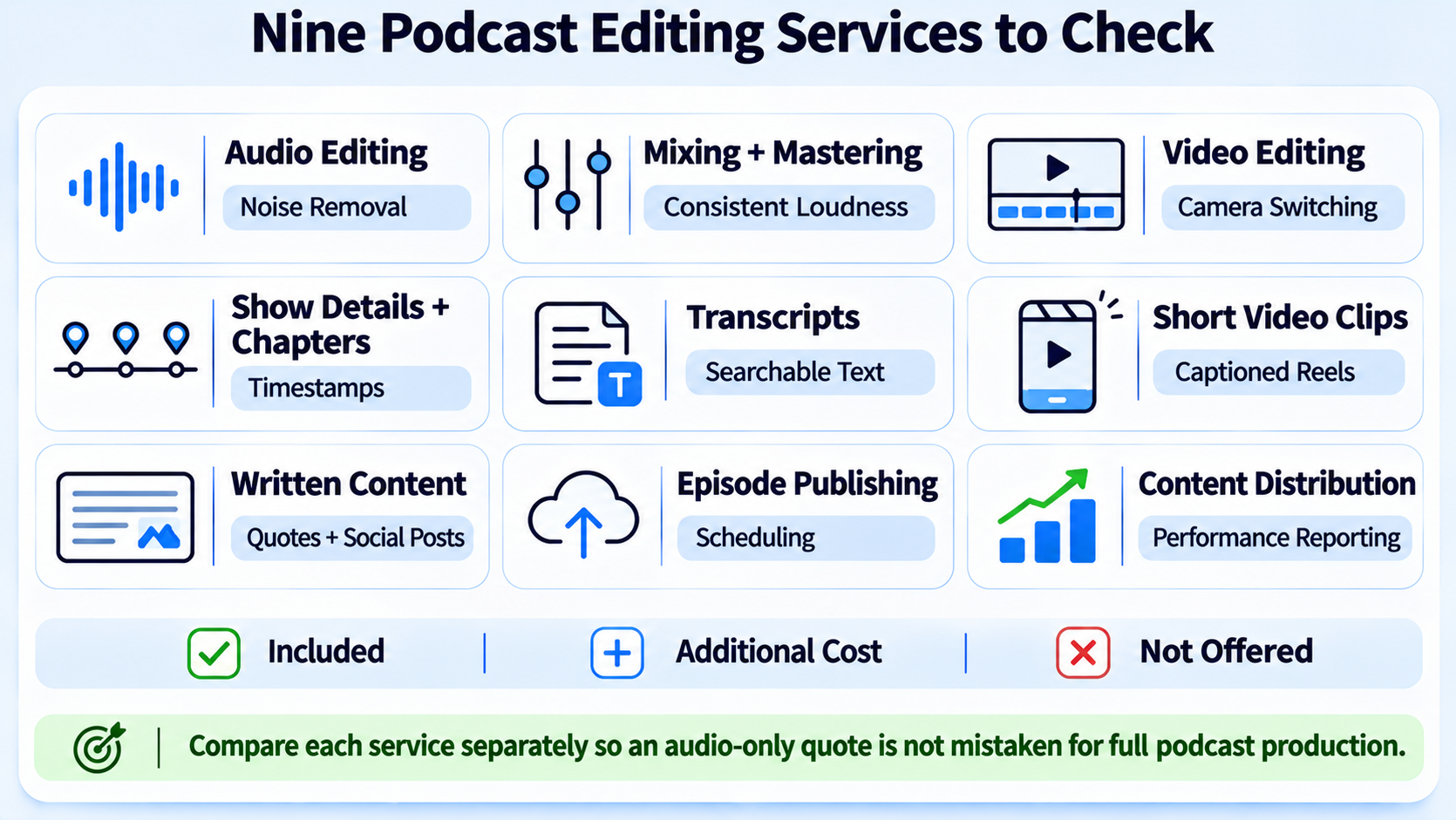
- Audio editing: noise reduction, level balancing, removing filler and long pauses, fixing crosstalk.
- Mixing and mastering: consistent loudness across episodes, intro and outro music, ad inserts.
- Video editing: multicamera cuts, speaker switching, framing, captions, thumbnails.
- Show notes and chapters: summaries, timestamps, guest bios and links.
- Transcripts: clean text for the episode page and for search.
- Clips: short vertical cuts for Reels, LinkedIn and YouTube Shorts, with captions.
- Written assets: pull quotes, newsletter text, LinkedIn posts drawn from the episode.
- Publishing: uploading to the host, scheduling and metadata.
- Distribution: posting clips, reporting and feedback into the next recording.
Our overview of podcast editing and podcast production services describes how these layers fit together. A cheaper quote that covers only the first two bullets is not comparable to one that includes clips and publishing.
Audio Standards to Verify in a Podcast Editing Agency
Ask the agency what loudness target it uses and how it checks it. A common reference is Spotify's guidance for uploads. Spotify says it normalizes playback to -14 LUFS (measured to the ITU 1770 standard), recommends a target of -14 integrated LUFS, and advises keeping true peak at or below -1 dB TP, or below -2 dB TP if the master is louder than -14 LUFS. Not every platform uses the same target, so ask which platforms the agency masters for and whether it delivers more than one version.
Beyond numbers, listen for these in a sample:
- Voices at a steady level from start to finish.
- No clipped words or pumping background noise after processing.
- Cuts that do not clip breaths or change the speaker's meaning.
- Music and ads that sit under speech.
- Silence trimmed without making speech sound rushed.
Send the agency one raw file of your own, including a difficult section such as a guest on a poor microphone, and compare the edit against the original. A polished reel of curated episodes proves very little about a messy real recording.
Questions to Ask a Podcast Editing Agency on the First Call
- Who edits my episodes, and will it be the same person each time?
- What do you need from us before the first episode: raw files, brand assets, style references?
- What file formats and recording methods do you accept?
- How do you decide what to cut? Can I see a written style guide?
- How many clips do you produce per episode, and how are they chosen?
- What is the standard turnaround, and what is rush turnaround?
- How many revision rounds are included, and what counts as a revision?
- How do you handle feedback: a shared document, comments on a timeline, a call?
- Who owns the project files and raw footage, and how long do you keep them?
- What happens if an editor is unavailable?
The answer pattern matters more than any single answer. Good agencies reply with specifics: file naming, round limits, named roles. Vague answers about "quick turnaround" and "unlimited tweaks" usually hide scope problems.
Turnaround, Revisions, and Approvals for Podcast Editing
State these in the contract instead of leaving them to goodwill. For a deeper treatment of the terms, see our guide to setting turnaround SLAs with a video editing partner.
- Turnaround: when the clock starts (receipt of complete files), and what stops it (late feedback).
- Revisions: the number of rounds, what is a revision versus a re-edit, and the cost of extra rounds.
- Approval path: one decision-maker and one channel, so feedback does not arrive in five places.
- Delivery format: audio masters, video exports, clip sizes per platform, caption files, transcripts.
- Escalation: who to contact if a deadline is at risk.
A useful rule: if two people on your side disagree about feedback, the agency should not be the one resolving it. Name an owner.
Podcast Clips and Distribution
Clips are where many B2B podcasts earn their return. Ask how the agency picks moments. A strong answer includes clarity of the point, relevance to your buyer and whether the moment makes sense without context. Ask for examples of clip hooks and captions, and ask what the agency adjusts per platform. Short audio clips need a visual treatment, such as captions, waveform or the speakers on screen.
Platform adaptation is standard practice. Wistia's 2026 State of Video report found that among teams repurposing video into clips, 67% post to LinkedIn, 49% to Instagram and 41% to YouTube, and 76% adjust the aspect ratio by platform. It is survey data from Wistia's audience, so it describes practice, not best practice. Our guide on how to repurpose a podcast covers the clip workflow in detail.
Distribution is a separate question from editing. Some agencies deliver files and stop. Others publish, schedule and report. Ask which one you are buying and what it costs.
Podcast Editing Pricing and What Drives It
Public prices for podcast editing vary widely, and many agencies quote after seeing your recordings. I will not give a market average because I have no current primary-source benchmark. What I can say is what moves the price:
- Episode length and number of episodes per month.
- Audio only or video, and the number of cameras.
- Difficulty of the source: crosstalk, noise, remote guests.
- Number of clips, captions styling and motion graphics.
- Show notes, transcripts and written assets.
- Revision rounds and turnaround speed.
- Publishing, distribution and reporting.
Komet Media's typical working range for ongoing B2B retainers is roughly $2,500 to $5,000, with final pricing based on scope, volume and distribution needs. A lower quote may be right for audio-only editing. Compare scope line by line.
Prepare Your Side Before Podcast Editing Onboarding
An agency can only perform as well as the inputs it receives. Before the first episode, prepare:
- A style sheet. Tone, how much filler to remove, whether to keep laughter and tangents, and words or names to spell consistently.
- Brand assets. Logo, fonts, colors, intro and outro music, and any lower-third format.
- A recording standard. Ask hosts and guests to record with headphones, in a quiet room, using a local recording where possible, with a backup track.
- A guest briefing. A short note on what the episode is for and how clips will be used, plus a release form for video.
- A feedback owner. One person who consolidates comments.
Poor source audio costs more to repair than to prevent. A twenty-minute recording guide for guests often removes more editing cost than any software.
What to Check on Every Podcast Editing Delivery
Quality control belongs on your side as well as the agency's. Use a short acceptance list for each episode.
- Listen to the first two minutes and the last two minutes at normal volume.
- Skim the middle at two or three random points for level changes and cuts.
- Check names, titles and company spellings in the show notes against your guest list.
- Confirm timestamps and chapters match the edited file.
- Watch each clip on a phone with sound off, to test captions and framing.
- Check that every statistic or claim in the clips has a source in the caption or notes.
If you find issues, log them in one list and send them together. Repeated one-off fixes slow both sides down, and patterns in the list tell you where the style sheet needs a rule.
Using the Checklist for Podcast Clips, Not Just Episodes
Many teams test the main episode and forget the clips, which is where distribution starts. Review a sample batch of clips against these questions: does each one open with a clear point, make sense without context, show captions that are accurate, and fit the platform? A strong podcast editing agency checklist also asks who selected the moments and why. Ask the agency to explain two clip choices and one rejected moment. It reveals judgment faster than a portfolio.
Measurement: What to Review With the Podcast Editing Agency
Agree on what you will review monthly and who owns each number. Typical podcast measures include episode starts and completion, returning listeners, clip views and watch time, subscriber growth, newsletter signups and guest-driven distribution. For B2B, add commercial signals: sales calls that mention an episode, inbound from guests' audiences and use of clips by sales. Attribution is imperfect, so read several signals together and avoid judging the show on downloads alone.
Podcast Editing Agency Red Flags
- No sample on your own recording. A reel of other shows does not show how they handle your audio.
- Guaranteed downloads or growth. Nobody controls audience size.
- Unlimited revisions with no process. This often leads to slow delivery or burnout on the other side.
- No named editor or account contact. You may be dealing with a rotating pool.
- No contract terms on file ownership. You should own your recordings and edited masters.
- Vague answers on loudness and delivery formats. A professional editor knows its specs.
- Requests for host or account passwords. Use role-based access instead.
- No view on distribution. If clips matter to you, ask who posts and who reports.
Podcast Editing: Agency, Freelancer, or In-House
A freelancer is often the right choice for a single audio show with simple needs. An in-house editor gives you control and context but requires a salary, software and cover for absences. An agency is a better fit when you need audio, video, clips and distribution handled consistently with a backup bench. Our comparison of freelance editors and agencies for B2B lays out the tradeoffs.
A One-Page Scorecard for Your Podcast Editing Agency Checklist
Score each agency from 1 to 5 on the lines below, then compare totals and notes.
Evaluating Samples in Detail
A sample is evidence, but only if you read it properly.
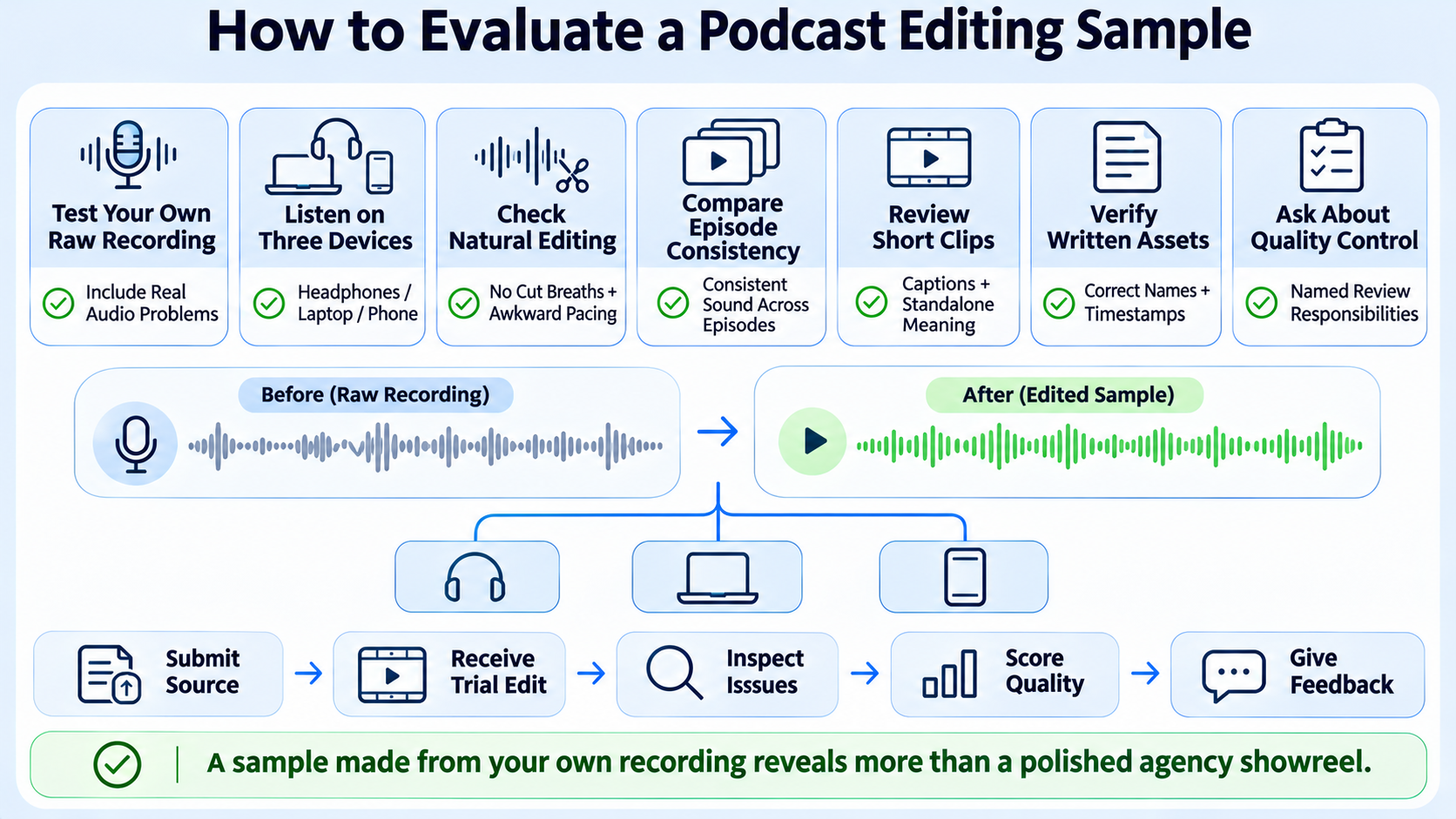
Request a sample from your own audio. Send a short section with realistic problems: two voices, background noise, a guest on a laptop microphone. Compare the original and the edit.
Listen on three systems. Headphones, laptop speakers and a phone. Problems that hide in one system show up in another.
Check the cuts. Do filler words disappear without clipping breaths? Does the pacing sound natural? Are edits invisible?
Check consistency. Ask for two episodes from the same show. Are levels, tone and music consistent?
Check the clips. Watch each on a phone with sound off. Do captions fit? Is the opening strong? Does the clip make sense on its own?
Check the written assets. Show notes should be accurate, with correct names and links. Timestamps should match the edited file.
Ask about process. How many people touch the file? Who does quality control? What do they do when they are unsure about a cut?
Video Podcast Considerations
If you publish video, the checklist grows.
- Camera switching. Does the editor follow the active speaker smoothly, or cut abruptly?
- Framing. Are the speakers framed consistently and legibly in both horizontal and vertical?
- Graphics. Lower thirds, titles and episode cards should follow your brand kit.
- Captions. Accuracy matters, especially for names and technical terms.
- Thumbnails and covers. Ask who designs them and how you give feedback.
- Remote recordings. Ask how the agency handles uneven quality across speakers.
Tubefilter's report on Edison Research's Infinite Dial 2026 says 57% of respondents have both listened to and watched a podcast. The article does not give the sample size, so use it as a reason to ask about video, not as a precise measure.
Scope Creep and Change Requests
Scope creep is a common source of friction. Prevent it with a few habits.
- Write the scope as a list of deliverables per episode.
- Define a change request. Anything outside the list is a request with a quote.
- Set a monthly review of volume, quality and unused capacity.
- Agree how rollover works. What happens if you send fewer episodes than planned?
- Document special instructions such as guest preferences, sensitive topics and words to avoid.
If the agency is also producing content from scratch, such as planning episodes, writing outlines or producing new series, put those tasks in the scope too, with their own timelines.
Working With Guests and Hosts
Editing quality depends on recording quality, and guests are the least controllable part.
- Send a guest guide before recording: headphones, quiet room, stable internet, close microphone.
- Record locally where possible and keep a backup track.
- Ask for release forms, especially if clips will be used on social platforms.
- Brief the host on pacing, avoiding talking over guests and repeating key points.
- Review the first minutes of each recording right after it ends so problems can be fixed while the guest is still available.
An agency can help with these processes, and a good one will tell you where recording habits are making edits harder.
Security, Rights and Confidentiality
Podcast files can contain sensitive content such as unreleased products, investor discussions and personal data. Check these points.
- File transfer and storage. How are files shared, who can access them and for how long are they kept?
- Confidentiality. Is there a signed agreement covering the content?
- Music and stock rights. Who licenses the music, and for which uses?
- AI tools. If the agency uses AI for transcription or editing, ask how content is protected and whether it is used to train third-party models.
- Ownership. You should own raw and edited files.
- Deletion. Ask for deletion or return of files at the end of the contract.
For regulated sectors, involve counsel and your security team before you share recordings.
Run a Paid Podcast Editing Trial
Before a retainer, commission one episode. Provide a real recording, brand guidelines and a written brief. Judge the result against the scorecard, and count how many rounds were needed. A trial costs a little and tells you more than any call. Bring your podcast editing agency checklist to the review meeting, mark each line pass or fail, and ask the agency to respond to every fail in writing. Their response shows how they handle feedback once the contract is signed, which matters as much as the first edit.
Conclusion: Hiring a Podcast Editing Partner
A podcast editing agency checklist is only useful if you act on the answers. Pick the partner whose scope, process and samples match your recordings, not the one with the lowest quote or the longest reel. Put turnaround, revisions and ownership in writing, and judge the trial on your own audio. The agency that scores well on that page is more likely to be a partner you keep.
FAQs on Podcast Editing Agencies
What is a podcast editing agency checklist?
It is a list of services, questions, samples and contract terms to verify before hiring a podcast editor or agency, so you can compare options on scope and quality, not just price.
How much does podcast editing cost?
Cost depends on episode length, audio or video, number of clips, revision rounds, turnaround and whether publishing and distribution are included. Komet Media's typical working range for ongoing B2B retainers is roughly $2,500 to $5,000, with final pricing based on scope.
How long does it take to edit an episode?
It depends on length, source quality and what is included. Ask for written timelines, including the starting point of the clock and a rush option.
What deliverables should I expect?
Audio masters, video exports where relevant, clips with captions, show notes, transcripts and chapters, plus publishing and reporting if included.
Should I hire a freelancer or an agency?
A freelancer fits simple audio shows. An agency fits teams that need video, clips and distribution with consistent quality and a backup.
Should podcast editing be in house or outsourced?
Keep guest selection, topics and approvals in house. Outsource editing and clips when capacity is the constraint.
Is this right for VC firms, PE firms and SaaS companies?
Yes, when the podcast supports thought leadership, guest relationships and content for sales and social.
How does Komet Media help with podcast editing?
Komet Media edits B2B podcasts, cuts clips for LinkedIn, Instagram and YouTube Shorts, and can also produce new content from scratch, from show planning to production, with distribution and reporting support.