
🪄 AI Summary
Heading 1
Heading 2
Heading 3
Heading 4
Heading 5
Heading 6
Lorem ipsum dolor sit amet, consectetur adipiscing elit, sed do eiusmod tempor incididunt ut labore et dolore magna aliqua. Ut enim ad minim veniam, quis nostrud exercitation ullamco laboris nisi ut aliquip ex ea commodo consequat. Duis aute irure dolor in reprehenderit in voluptate velit esse cillum dolore eu fugiat nulla pariatur.
Block quote
Ordered list
- Item 1
- Item 2
- Item 3
Unordered list
- Item A
- Item B
- Item C
Bold text
Emphasis
Superscript
Subscript
I have watched strong SaaS and venture capital teams sit on hours of valuable recordings because they lack a dependable production system. A great founder interview or a sharp product webinar means nothing if it stays hidden in a master file. Finding the best video editing companies San Francisco has to offer is rarely about finding someone who knows how to cut footage. It is about finding a partner who understands how buyers consume information across LinkedIn, YouTube, and company websites. I built Komet Media because I saw a gap between recording good ideas and distributing them effectively.
Quick Answer: Top 10 Video Editing Companies in San Francisco (2026)
The top partners include Komet Media for recurring B2B content repurposing, Sandwich Video for launch commercials, and Luma Creative for software demos. Choose a provider based on your primary distribution channel. Here is a comparison of the 10 best video editing companies San Francisco based teams can hire today.
Which Are the Top 10 Video Editing Companies in San Francisco for 2026?
When reviewing the best video editing companies San Francisco provides, you must look at their core capability. A firm that shoots beautiful brand documentaries is rarely the right team to build a daily LinkedIn video engine.
Each agency listed below excels in a specific area of commercial video production. Choosing the right one requires matching your internal workflow to their delivery model.
1. Komet Media
We position Komet Media as a dedicated partner for B2B SaaS, AI, and tech startups & teams that need a reliable content engine rather than a one-off campaign. We focus heavily on from-scratch video production, B2B SaaS video editing, and executive content repurposing. Many marketing teams record excellent webinars, client interviews, and podcasts. However, they lack the internal time to find the best moments and edit them for social channels.
Rather than waiting for a client to provide exact timestamps, we review the master recordings. We handle the content selection, professional editing, captions, motion graphics, and platform adaptation. We identify the strongest business arguments and build a recurring publishing system. This allows marketing leaders, venture capital partners, and startup founders to publish consistently across LinkedIn and YouTube Shorts without managing freelance editors daily.
2. Sandwich Video
Sandwich Video pioneered the modern tech explainer format in Silicon Valley. They are the clear choice if you have a significant budget and need a flagship launch video. Their work blends sharp, often dry humor with clear product education. They operate at the highest level of commercial production.
They handle full-scale live-action shoots, casting, scripting, and post-production. They focus on large project-based campaigns rather than daily social publishing. If your startup just closed a major funding round and you need a single, highly memorable video for your homepage, they are an exceptional choice. They do not operate on monthly retainers for short-form clipping.
3. Luma Creative
Luma Creative specializes in software demo videos and corporate storytelling. Making a complex software interface look interesting on video is a specific skill. Luma Creative excels at helping technical companies explain complex features through clean, professional visuals. They animate UI elements so the viewer understands the value of the software immediately.
They operate primarily on a project basis. This makes them highly suitable for building core website assets, major product update announcements, and sales enablement libraries. They work well with enterprise technology companies that need to maintain a strict, highly polished corporate brand standard across all visual assets.
4. Slow Clap Productions
Slow Clap Productions focuses on authentic storytelling for corporate campaigns. They manage everything from concept development and casting to logistics and final post-production. They are a strong fit for established companies needing high-end brand films, cultural overviews, or corporate social responsibility documentaries.
Their style relies heavily on real human emotion and documentary filmmaking techniques. If you want to highlight the real people behind your technology or document a customer's success story in a cinematic way, their team delivers highly polished results. Their production cycles are thorough and require proper planning timelines.
5. Represent Studio
Represent Studio is highly focused on software businesses. They produce UI/UX videos, digital launch assets, and motion graphic explainers. B2B software buyers want to see the product before they book a demo. Represent Studio builds videos that show exactly how an interface works without relying on boring screen recordings.
If you are launching a new feature on Product Hunt or need a clean hero video for a landing page, they are a dependable option. Their project-based model works well for product marketing teams that have a clear launch calendar and need high-fidelity visual assets to support their go-to-market strategy.
6. Vidico
Vidico produces animated explainers and live-action brand videos for technology companies globally, with a strong presence serving Bay Area teams. They offer both project pricing and retainer options. They are highly effective at taking abstract software concepts, such as cloud infrastructure or cybersecurity protocols, and turning them into digestible visual stories for buyers.
They offer transparent pricing models on their website, which helps marketing teams plan their budgets accurately. Vidico is a strong middle-ground option when you need professional animation or live-action commercial work but cannot justify the budget required by top-tier Hollywood-style commercial agencies.
7. Corduroy Media
Corduroy Media builds emotive, human-centered videos for tech brands and nonprofits. Their work is heavily focused on real people and documentary styles. They prioritize the narrative arc of the subject rather than just flashy graphics or fast cuts.
They are an excellent choice for employer branding campaigns, long-form customer documentaries, or internal corporate alignment videos. When a technology company needs to show the real-world impact of its software on a local community or specific user group, Corduroy Media provides the right directorial approach to capture that authenticity.
8. ContentBuck
ContentBuck operates primarily on a subscription model. They focus heavily on YouTube growth and SEO-driven video content. They handle scripting, thumbnail design, and editing for B2B companies trying to build an organic search presence on the platform.
Their approach is highly analytical. They look at search volume and viewer intent before producing a video. If your software company wants to capture users who are actively searching for "how-to" tutorials or software comparisons on YouTube, ContentBuck provides a structured system to rank your videos consistently.
9. Look Ad Me
Look Ad Me targets AI and DeepTech startups. They build launch-ready product videos and technical animations. Standard live-action video often fails to communicate the value of backend software or machine learning models. Look Ad Me specializes in visualizing these invisible technologies.
They are very useful for founders who need to explain complex neural networks, data pipelines, or backend architecture to investors and non-technical buyers. Their project-based work translates highly dense technical documentation into clear, engaging motion graphics.
10. 3DTRIXS
3DTRIXS specializes in 3D technical animation. If your company builds physical technology products, hardware, robotics, or complex mechanical systems, standard video production may not capture the internal workings of your product.
Their 3D modelling capabilities allow them to show cross-sections of hardware, simulate product physics, and highlight engineering details that a camera cannot physically capture. They are the ideal choice for IoT startups, medical device companies, and physical infrastructure brands needing specialized visual assets.
Why Does Standard Video Production Fail for Tech and VC Teams?
Many of the best video editing companies San Francisco startups work with are built for campaigns, not consistency. They deliver a highly polished asset, send the final invoice, and move on. This model worked well when a company only needed one video per year for a homepage.
However, B2B marketing does not run on single campaigns anymore. According to the Content Marketing Institute's 2026 B2B Research, 86 percent of B2B marketers now use video as a primary content format. Buying committees expect to see regular video content from founders, managing partners, and subject-matter experts while they research a purchase. They want to hear how your leadership team thinks before they sign a contract.
A polished video with no distribution plan is still an underused asset. I frequently speak with venture capital partners and SaaS founders who record brilliant hour-long podcast interviews. They publish the full episode once, get a few hundred downloads, and then the asset disappears into their archive. They do not have a content shortage. They have a production and distribution problem.
This is where content repurposing changes the workflow completely. Instead of treating every video as a separate creative project, you treat a long recording as a master source. You extract the best arguments, customer stories, and data points, and turn them into short clips, text posts, and newsletters that fill your content calendar for an entire month.
Should You Choose an Internal Team, a Freelancer, or a Video Agency?
When technology teams decide they need more video, they usually face three choices. They can build an internal team, hire a freelance editor, or partner with an agency. Each path carries specific trade-offs regarding speed, management time, and output quality.
Building an internal team gives you total control. However, hiring a skilled video editor in a major technology hub requires a full-time salary, benefits, software licenses, and hardware. Furthermore, a single editor often lacks the strategic marketing background to know which parts of a webinar will actually convert a buyer on LinkedIn.
Hiring a freelancer is usually the most cost-effective option initially. Marketplaces offer thousands of talented editors. The hidden cost of a freelancer is your own management time. A freelance editor typically requires you to provide a highly detailed brief. You must review the raw footage, select the exact timestamps, provide brand assets, and manage multiple rounds of revisions. You become the project manager.
Partnering with a specialized agency solves the management problem. If you evaluate an in-house versus outsourced video editing model carefully, an agency often provides a better return on time. A good partner does not just ask for timestamps. They understand your commercial goals, review the raw material independently, select the strongest business moments, handle the edit, and deliver platform-ready assets.
How Do Professional Video Production Partners Structure Their Workflows?
Understanding the workflow used by the best video editing companies San Francisco has to offer helps you avoid slow delivery. A strong workflow connects the raw recording directly to the final business result. A poor workflow traps your internal team in endless email threads about font sizes and music volume.
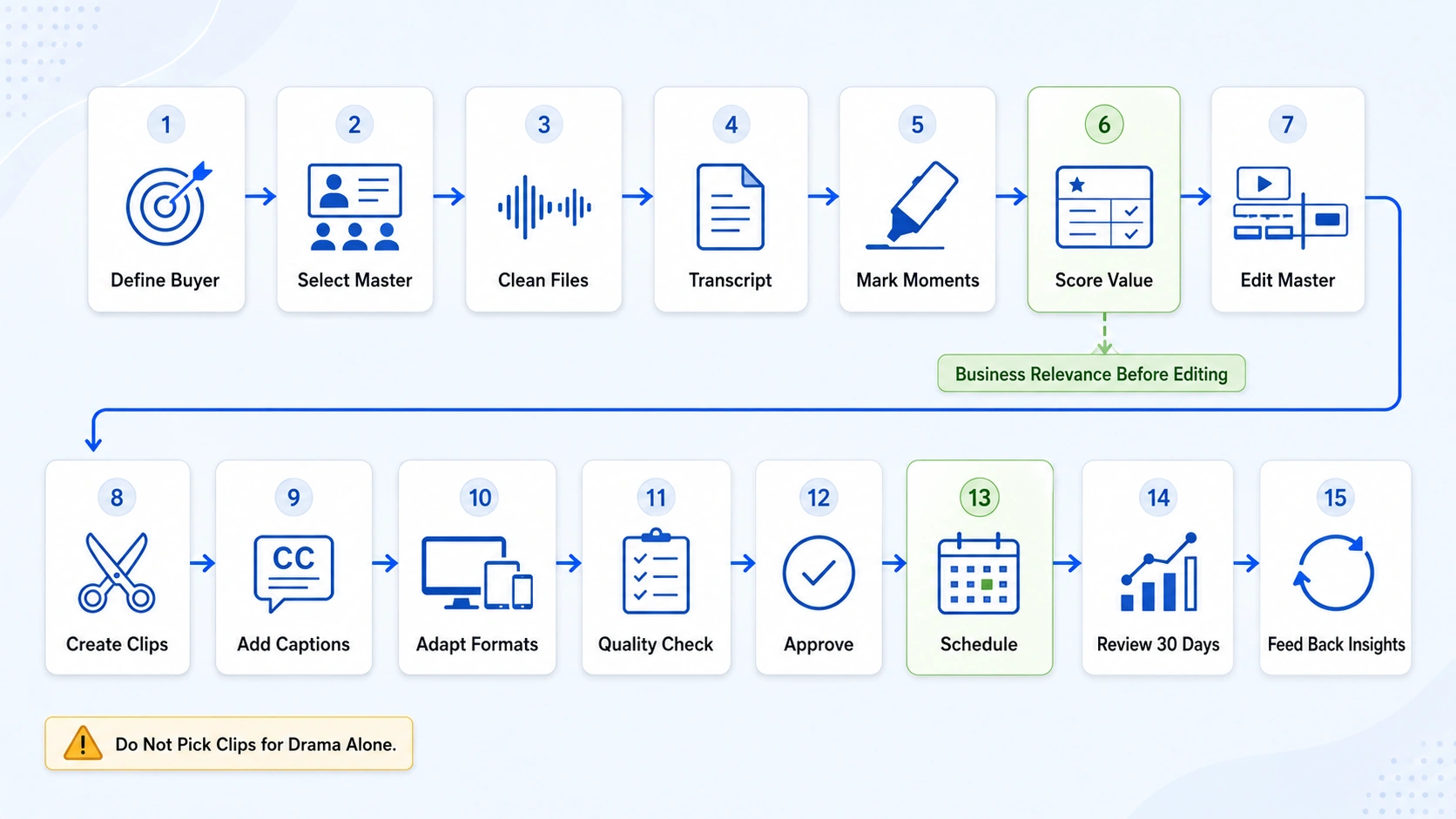
When we handle podcast repurposing at Komet Media, we do not jump straight into the timeline. We follow a clear sequence to ensure the final output actually serves the buyer and supports the sales pipeline.
A complete and reliable production cycle should include:
- Define the buyer and the specific business goal
- Select the master recording (webinar, interview, keynote)
- Prepare clean audio and video files
- Create or clean the transcript for accurate search
- Mark strong moments based on business relevance
- Score those moments by clarity and buyer value
- Edit the master asset to remove filler words and tangents
- Produce short, platform-specific clips
- Add branded captions and supporting motion graphics
- Adapt export formats by platform (vertical for Shorts, square for LinkedIn)
- Run internal quality and brand checks
- Approve assets through a streamlined feedback portal
- Schedule distribution across social channels
- Review performance data after thirty days
- Feed lessons and audience feedback into the next recording session
Small internal teams often skip the scoring phase entirely. They select clips based on what looks dramatic or what features a loud soundbite, rather than what answers a real buyer objection. When you score moments by clarity and strategic value, your short clips perform better because they offer immediate education to the viewer.
How Do You Evaluate Video Editing Costs and Pricing Models?
Cost structures vary widely across the best video editing companies San Francisco offers. The price you pay depends heavily on the level of strategic support you need. Pricing usually falls into three distinct categories: project pricing, subscriptions, and mid-tier retainers.
Project pricing works well for a one-off website commercial or a major product launch. You might pay anywhere from $10,000 to $50,000 for a flagship launch video that includes casting, location scouting, and high-end camera crews. This model is necessary for brand-defining moments but unsustainable for weekly content generation.
Subscription models offer unlimited editing for a flat monthly fee, usually between $1,500 and $3,000. These services provide steady, predictable costs. However, they rarely provide strategic guidance or content selection. You still have to manage the assigned editor, write the briefs, and provide precise instructions for every video. They are execution layers, not strategic partners.
Komet Media usually works through mid-tier retainers ranging from approximately $2,500 to $5,000 per month. We use this model because it covers the full strategy, content selection, professional editing, and platform adaptation. You are paying for a content system, not just software operation.
If you are unsure which model fits your current growth stage, you must look at your internal capacity. Final pricing in a retainer model depends on a few specific variables. Review our guide on how to choose a video editing agency to understand these factors deeply.
The factors that usually change the monthly cost include:
- Number of long master recordings provided each month
- Total volume of short clips required for distribution
- Complexity of required motion graphics and B-roll
- Custom caption styling and visual branding rules
- Dedicated account support and strategy calls
- Direct distribution and publishing support on your social channels
How Can You Measure Video Performance Beyond Vanity Metrics?
Data from recent Wistia video research indicates that educational content remains the most engaging format for B2B audiences. Buyers prefer to learn from subject-matter experts rather than watch overly promotional commercials. However, measuring the success of these educational videos requires looking past basic view counts.
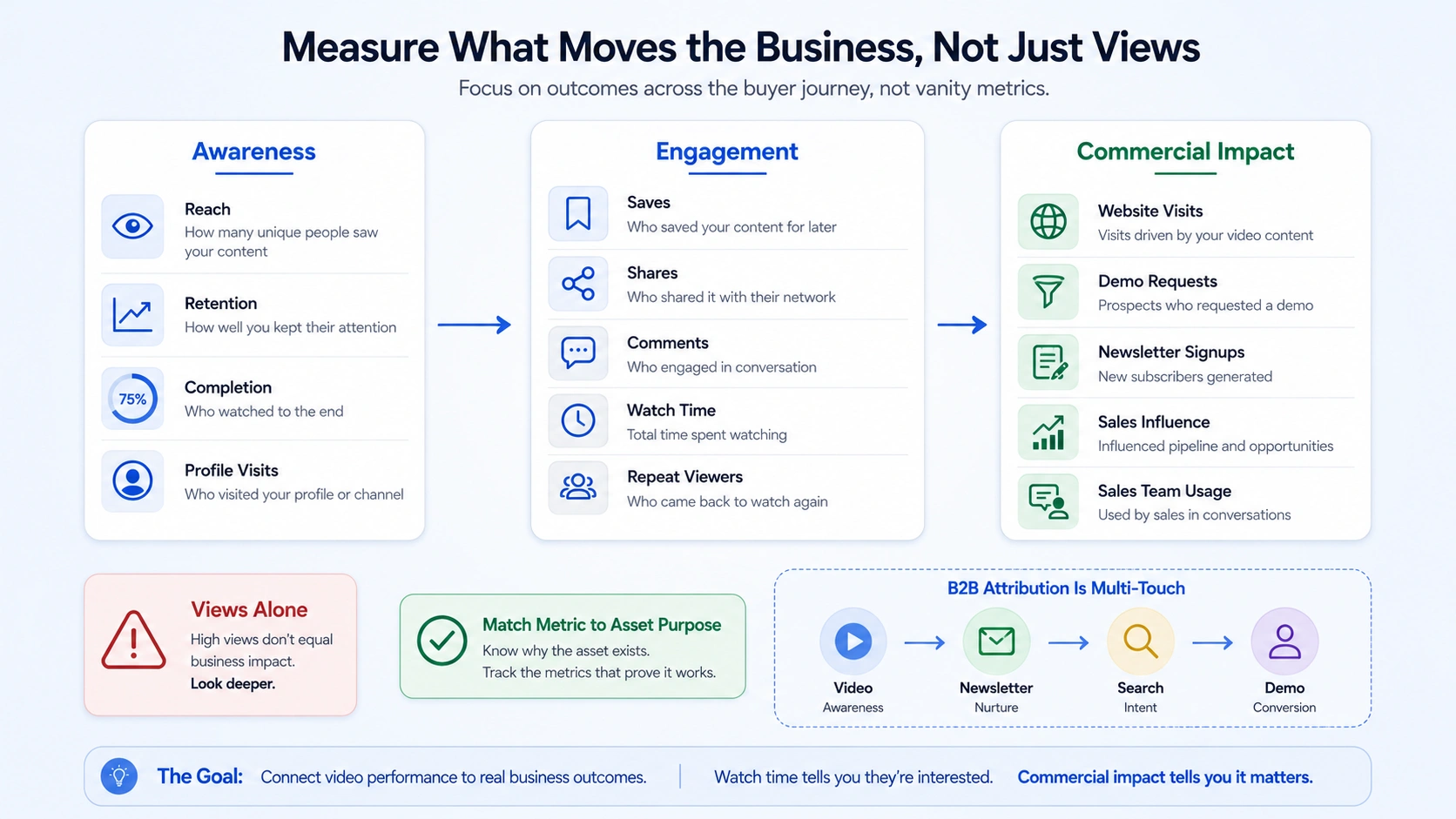
Match your metrics to the specific purpose of the asset. A short, provocative clip on LinkedIn serves a different purpose than a detailed ten-minute product demo on your pricing page. Judging both videos by the same metric will lead to poor marketing decisions.
When reviewing awareness and top-of-funnel reach, track:
- Total reach and unique impressions
- Viewer retention graphs and average completion rate
- Follower growth and social profile visits
When reviewing engagement and community building, track:
- Saves and shares (which indicate high utility)
- Meaningful comments and peer-to-peer replies
- Watch time and returning repeat viewers
When reviewing commercial impact and pipeline influence, track:
- Direct website visits originating from social profiles
- Demo requests and newsletter signups following a video release
- Sales conversations influenced by specific content pieces
- Content actively requested and used by the outbound sales team
Attribution in B2B video will always be slightly imperfect. Buyers often watch three short videos on LinkedIn over a month, read an email newsletter, and then search for your company directly on Google to book a demo. Software tracking often credits Google for that win. Use a mix of qualitative signals, such as adding a "how did you hear about us" field on your forms, and hard metrics to evaluate your content program accurately.
How Do You Select the Right Video Partner?
Selecting the right partner from the best video editing companies San Francisco provides depends heavily on your daily content needs and internal management capacity. If you need a cinematic launch video or a high-end corporate documentary, choose a project-based agency that excels in commercial filmmaking. If you need to turn your executive expertise, long podcasts, and technical webinars into a reliable, daily content engine, choose a partner built for recurring repurposing. The goal is not just to edit files and close a project timeline. The goal is to build a durable asset library that consistently educates your buyers and supports your sales pipeline.
What Are the Most Frequently Asked Questions About Video Editing?
1. Which of the best video editing companies San Francisco has is right for a SaaS startup?
It depends entirely on your immediate business goal. For a flagship website commercial or a major funding announcement, choose a project-based agency like Sandwich Video. For recurring weekly social media content, founder-led video, and podcast repurposing, a retainer-based partner like Komet Media is a much better fit for your ongoing needs.
2. What is the difference between hiring a freelancer and a dedicated agency?
A freelancer typically requires you to act as the project manager. You must provide a clear creative brief, select exact timestamps from your recordings, and manage the daily project timeline. An agency handles the strategic content selection, platform strategy, multiple asset adaptations, and internal quality control before you ever see a draft.
3. How much does a B2B video editing retainer typically cost?
Mid-tier retainers for comprehensive B2B video production and content repurposing usually range from $2,500 to $5,000 per month. Pricing varies based on the volume of long recordings provided, the number of short clips required, the complexity of motion graphics, and whether you require distribution support.
4. What is the typical turnaround time for short-form video clips?
Most professional B2B agencies deliver first drafts of short-video batches within three to five business days after receiving the master files. Complex motion graphics, heavy sound design, or heavily animated UI software walkthroughs may require a slightly longer production cycle to ensure high quality.
5. Do executive teams need to record videos in a professional studio?
No. Modern B2B audiences highly value clear expertise and authenticity over perfect studio lighting. High-quality webcams, dedicated external microphones, and a quiet, well-lit room are entirely sufficient to produce strong founder-led content, webinar recordings, and professional podcast episodes.
6. What exactly is content repurposing in a video context?
Content repurposing is the systematic process of taking a single long-form recording, such as a webinar or podcast, and editing it into multiple specific assets for different platforms. This maximizes the business value of every recording session by turning one hour of effort into weeks of usable social content.
7. How many short clips should a B2B brand publish each week?
Consistency and quality matter far more than high daily volume. Publishing three to five strong, highly relevant clips per week across LinkedIn and YouTube Shorts will consistently outperform posting fifteen generic clips that offer no clear educational value to the buyer.
8. What makes Komet Media different from other video editing agencies?
We actively connect from-scratch video production, content selection, professional editing, and platform distribution. We do not just ask for timestamps and return raw files. We review your master recordings, find the strongest business arguments, and build a recurring publishing system that directly supports your commercial and pipeline goals.