
🪄 AI Summary
Heading 1
Heading 2
Heading 3
Heading 4
Heading 5
Heading 6
Lorem ipsum dolor sit amet, consectetur adipiscing elit, sed do eiusmod tempor incididunt ut labore et dolore magna aliqua. Ut enim ad minim veniam, quis nostrud exercitation ullamco laboris nisi ut aliquip ex ea commodo consequat. Duis aute irure dolor in reprehenderit in voluptate velit esse cillum dolore eu fugiat nulla pariatur.
Block quote
Ordered list
- Item 1
- Item 2
- Item 3
Unordered list
- Item A
- Item B
- Item C
Bold text
Emphasis
Superscript
Subscript
Most VC firms sitting on years of GP conversations, portfolio founder interviews, and LP Q&A sessions are not turning any of it into content. That gap is a competitive problem. Podcast editing for VC firms is where raw, high-value thinking gets shaped into an asset that builds inbound trust with founders, LPs, and co-investors at scale. This guide covers what professional audio post-production actually involves for investment firms, which tools work, what it costs, and how to build a repurposing workflow that earns compounding returns on every recorded conversation.
TL;DR
- The top 2% of VC firms capture approximately 95% of all venture returns , and consistent thought leadership distribution is a direct driver of that gap.
- Podcast editing for VC firms goes beyond clean audio: it includes show notes, transcription, audiogram creation, and short-form video repurposing.
- Editor rates in 2025-2026 run from $50 to $600 per episode for freelancers; managed agency services start at around $500 per month and scale to $6,000+ per month for specialist B2B providers.
- The right production partner turns one recorded conversation into five or more distributable assets, or builds a complete video content program from scratch.
Should VC Firms Have Their Own Podcast?
The answer in 2026 is yes, but with a clear strategic reason behind it, not just because everyone else is doing it. Industry heavyweights such as Andreessen Horowitz and Sequoia now treat podcasting as a primary channel for thought leadership and deal flow. That signal has filtered down to emerging managers and sector-focused funds. The underlying reason is audience behavior: 58% of Americans age 12 and older, an estimated 167 million people, consumed a podcast in the last month, according to Edison Research's Infinite Dial 2026.
More specifically relevant for VC communications, 68% of 35 to 54 year-olds consumed a podcast in the last month in 2026. That is the working-age, budget-holding demographic most professional services firms are trying to reach. For VC firms, the strategic case stacks further. Podcasts allow LPs to hear directly from fund managers in a conversational setting.
A managing partner explaining a sector thesis in a 40-minute interview does more credibility work than a polished quarterly PDF. A single market analysis won't make an LP believe in a firm's expertise, but regular, well-researched content can. LPs often compare multiple firms before making commitments, and the one that consistently communicates thoughtful insights will have an advantage.
Portfolio company storytelling adds another dimension. When founders in your portfolio appear on your show, you're amplifying their signal and demonstrating the value-add your firm provides beyond capital. That's a direct recruiting tool for the next fund cycle. The risk is vague positioning. The Acquired podcast focused specifically on company acquisitions and growth stories, growing to over 400,000 monthly listeners by owning this niche.
The takeaway: niche specificity beats broad coverage every time in B2B podcast strategy. Decide whether your show is for founders (deal flow), LPs (trust and retention), or the broader ecosystem (brand awareness) before you record episode one.
How VC Firms Use Podcasts for Marketing and LP Communications
A VC podcast operates across three distinct audience layers simultaneously, and understanding each shapes how you edit and distribute every episode.
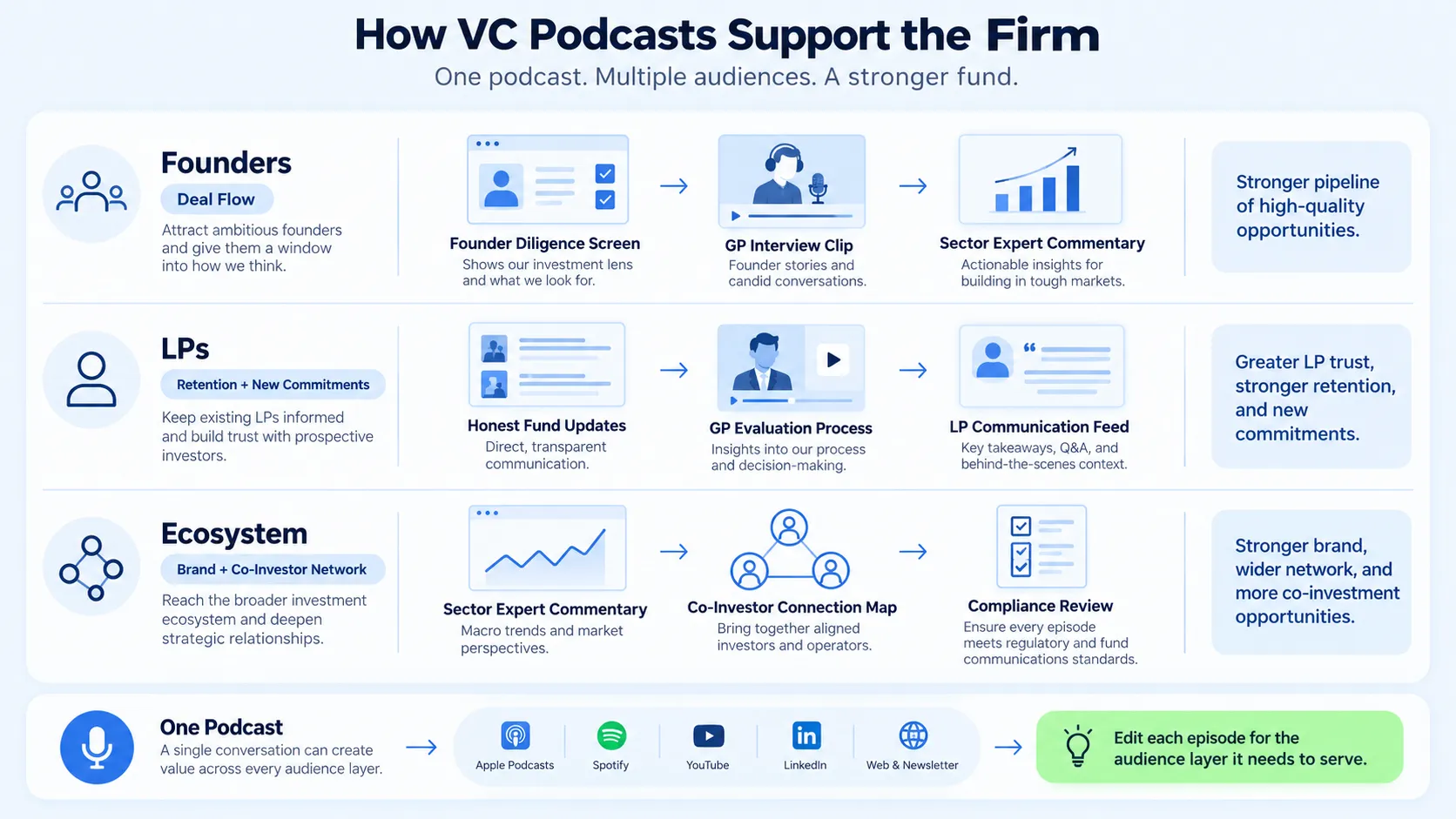
Founders (deal flow): Every episode featuring a GP explaining how they evaluate companies is a live diligence demonstration. Founders listening before they fundraise are qualifying your firm in real time. Unlike blogs or whitepapers, podcasts allow you to speak directly to your audience, often for 30 minutes or more each week. Listeners feel like they know the hosts, even if they've never met them. That same sense of trust and familiarity can work in your favor as a VC firm.
LPs (retention and new commitments): Podcast episodes function as a consistent LP communication layer that sits between quarterly reports. LPs want honest, clear communication, not just success stories. Sharing lessons from deals that didn't go as planned, discussing risk openly, and breaking down complex investment strategies into digestible insights can make a VC firm feel more approachable and reliable.
Ecosystem (brand and co-investor network): High-quality episodes position partners as sector experts. Founders and LPs increasingly look to social proof and credibility markers when deciding which firms to engage with. By showcasing unique insights on emerging technologies, market trends, or sector-focused analyses, a VC firm cements its place as a trusted authority.
One practical note: the regulatory environment for venture capital creates unique content challenges. Unlike many industries, VCs face SEC restrictions on how they discuss performance, fundraising activities, and investment opportunities. Build a streamlined compliance review into your post-production workflow before episodes are published.
What Podcast Editing for VC Firms Actually Involves
Podcast editing for VC firms is a multi-stage post-production process, not just removing filler words. Here is the standard workflow at a professional level:
- Ingest and organize: Raw audio from remote guest recordings typically arrives as separate multitrack files. These get imported into a waveform editing environment and synced.
- Noise reduction: Background hum, room reverb, HVAC noise, and compression artifacts from remote calls get treated using noise reduction algorithms. The Dialogue Isolate feature in tools like iZotope RX 11 can separate speech from noisy backgrounds, a common issue when a high-profile guest joins from a busy office or home.
- Content editing: Filler words, long pauses, tangents, and repeated statements are removed. For a 60-minute VC interview, this pass alone takes significant time.
- Dynamic range compression and level matching: Each speaker's audio gets normalized so no one dominates the mix. Dynamic range compression ensures consistent volume across the full episode.
- Music and branding: Intro and outro sequences, branded sonic identity, and transition elements are mixed in.
- Show notes and transcription: Professionally written show notes with chapter markers improve discoverability. Show notes and transcription typically cost $1 to $2 per audio minute when added to a production package.
- Audiogram creation and repurposing: Key clips are pulled and formatted as audiograms and short-form video assets for LinkedIn and YouTube Shorts distribution.
- RSS feed management and publishing: The final file is published to the podcast hosting platform with complete metadata, chapter markers, and ID3 tags.
A 60-minute interview may take 2 to 3 hours to edit, while a narrative or documentary-style episode can take 6+ hours depending on production layers. For a VC firm releasing weekly episodes or launching a show from scratch, that time burden is why most serious programs outsource to a specialist podcast production and editing team.
Best Podcast Editing Tools for Finance and VC Content
The right tool depends on whether your team is handling editing and production in-house or whether a production partner is building and managing the system for you from scratch.
Adobe Audition is best overall for professional podcast editing, mixing, and cleanup. Descript is best for text-based editing and AI workflow for audio and video podcasts. Many podcasters use Descript for the speed and accessibility of its text-based editing and AI tools, then move specific episodes into Adobe Audition when a project requires more detailed audio restoration work than Descript's built-in tools can provide.
That hybrid workflow is what most professional podcast production teams use for B2B clients. For VC firms handling compliance-sensitive content, SOC 2 Type 2 compliance in tools like Podcastle makes them viable for business use where security audits matter. If you're investing in podcast transcription and show notes as part of the workflow, platforms with built-in AI transcription (Descript, Riverside) significantly cut the manual labor involved.
What a Good VC Podcast Sounds Like: Production Standards
Sound quality is a trust signal before a single word registers. A poor recording tells the listener your firm doesn't invest in its own brand. Here is what professional audio post-production achieves for a VC show:
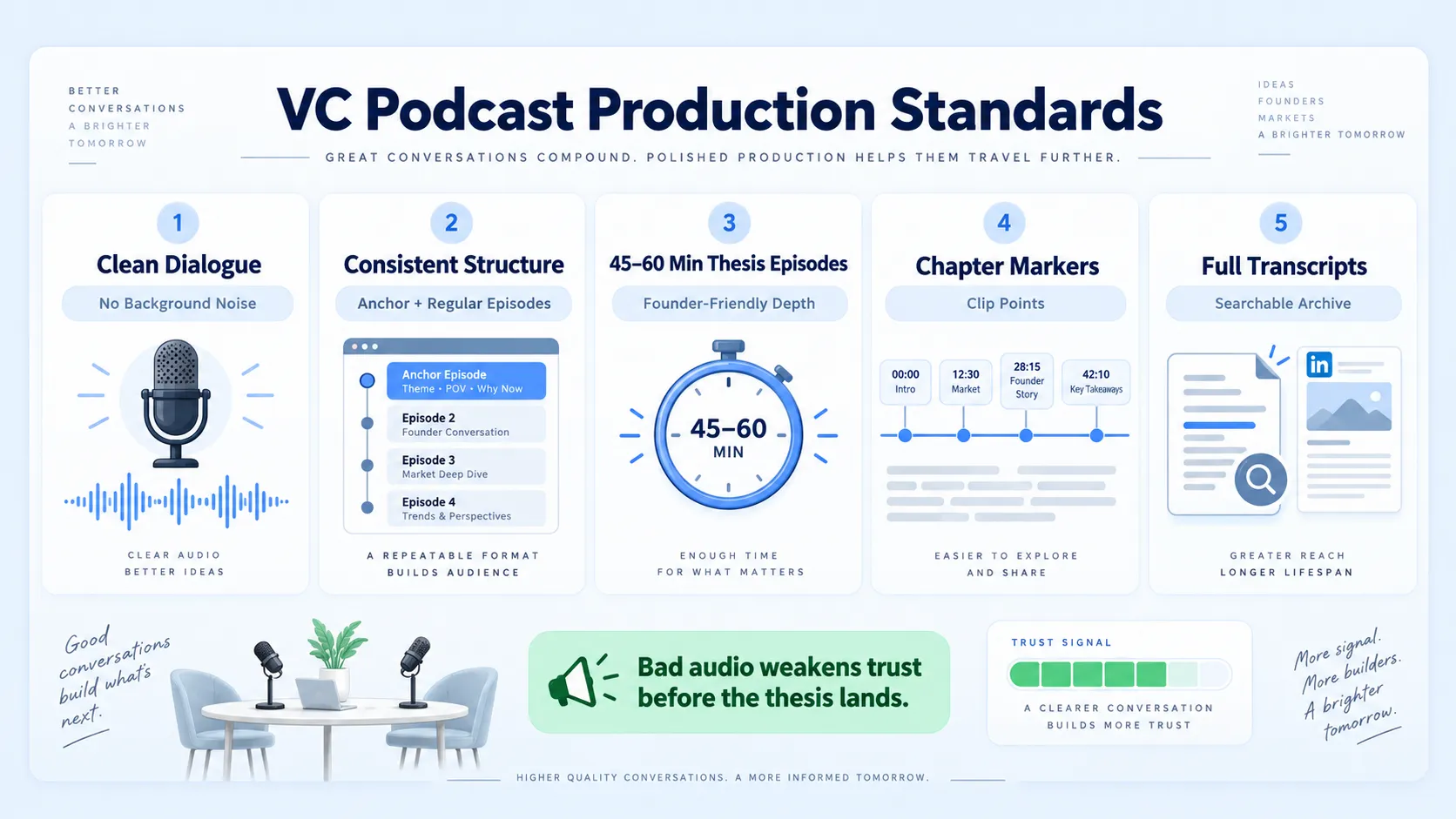
Clarity over complexity: VC listeners are time-scarce. Clean dialogue with minimal distraction, well-applied dynamic range compression, and no competing background noise are the baseline. These are not nice-to-haves.
Consistent episode structure: Anchor episodes (cornerstone conversations with marquee names) establish the show's authority. Regular episodes build the habit. Both formats benefit from consistent intro-to-outro architecture so listeners build familiarity quickly.
Appropriate duration: B2B podcasts tend to run longer, 45 to 90 minutes, involve multiple remote guests, and require show notes and transcript production, all of which push production complexity toward the upper end. For VC audiences, 45 to 60 minutes covers a thesis conversation with depth. Cut tighter for tactical episodes aimed at founders.
Chapter markers: Properly formatted chapter markers serve two purposes: they improve listener UX on platforms that support them, and they create natural clip points for short-form video repurposing. Every video editing services workflow at Komet Media maps chapters to clip opportunities before we edit a single frame.
Interview transcription services: Full transcripts enable SEO-optimized show notes, searchable content archives, and LinkedIn articles. They turn a single audio asset into five or six separate content deliverables without additional recording time.
The rule I use with every VC client: if your GP wouldn't present at a founder event with bad slides, they shouldn't publish with bad audio.
How Much Does Podcast Editing Cost for a VC Firm?
Pricing in 2026 spans a wide range because "podcast editing" means different things at different tiers.
Podcast editor rates in 2025-2026 run from $50 to $600 per episode for freelancers, depending on experience and scope. Managed agency services start at around $500 per month and scale to $6,000+ per month for specialist B2B providers. At the budget end ($50 to $100 per episode), you're typically getting basic cleanup and an export file with no show notes, no strategy, and limited turnaround reliability. These editors are usually sourced via Fiverr or Upwork, and the quality variance is significant.
For a VC firm where every published episode reflects on partner brand and LP perception, budget-tier editing is a false economy. The cost of a poorly produced episode in credibility terms far exceeds the savings. The firms getting the most return are those treating podcast production as a content system rather than a per-episode transaction: whether building a full show strategy from scratch or repurposing existing recorded conversations, every recording becomes short-form video clips, audiograms, podcast marketing assets, and transcribed articles. That full-cycle workflow is where the real ROI is captured.
Conclusion
Podcast editing for VC firms is a strategic investment, not a production checkbox. Here are the core takeaways:
- Clean audio is the floor, not the ceiling: show notes, chapter markers, transcripts, and audiograms are what turn one episode into a content engine.
- Your target listener is time-scarce and signal-sensitive. Sloppy production kills trust before your thesis lands.
- Budget for the full stack: end-to-end strategy and scripting from scratch, editing, show notes, repurposing, and distribution. Piece-meal production stalls momentum.
- For VC firms, managing partners, and fund operators, your podcast is a direct signal to founders, LPs, and co-investors about how you think. Treat it accordingly.
Frequently Asked Questions
Q1: How often should a VC firm publish podcast episodes?
Bi-weekly is the practical standard for most investment teams. It creates a sustainable production cadence without requiring a dedicated in-house team. Weekly works if you have a production partner handling post-production. Dropping below monthly makes it hard to build listener habit or RSS feed momentum.
Q2: Does podcast audio quality actually matter for a B2B audience?
Yes, more than most firms expect. Sophisticated LP and founder audiences equate production quality with operational quality. Distorted audio or poor levels signal that a firm doesn't invest in its own brand. Clean, consistent audio is a baseline trust signal, not optional polish.
Q3: What is an audiogram and do VC firms need them?
An audiogram is a short video clip combining a waveform visualization, captions, and a key audio moment from an episode. VC firms benefit from them because they make audio content distributable on LinkedIn and YouTube Shorts, where founders and LPs actually scroll. One episode typically yields three to five strong audiogram clips.
Q4: Can a VC podcast be used for LP communications specifically?
Absolutely. Podcasts allow LPs to hear directly from fund managers in a conversational setting. Many firms produce a semi-private LP-focused episode series distributed via unlisted RSS links or a gated podcast feed alongside their public show.
Q5: What deliverables should I expect from a professional podcast editing service?
A professional service for a B2B client should include: strategy and scripting (for teams starting from scratch), edited audio master, show notes optimisation, full interview transcription, chapter markers, audiogram assets, and a published file with complete ID3 metadata. Repurposing into short-form video alongside full-system creation is the differentiator that converts a podcast budget into a broader content strategy.
Q6: How do I choose between handling podcast editing in-house versus outsourcing?
The 2025 Independent Podcaster Survey found that DIY podcasters spend 4 to 8 hours per episode on average, with 21% spending 9 or more hours. For a managing partner or marketing head at a VC firm, that opportunity cost is rarely justified. Outsource if your episodes need to reflect institutional quality and your team's time is better spent on deal flow, LP relationships, or content strategy.