
🪄 AI Summary
Heading 1
Heading 2
Heading 3
Heading 4
Heading 5
Heading 6
Lorem ipsum dolor sit amet, consectetur adipiscing elit, sed do eiusmod tempor incididunt ut labore et dolore magna aliqua. Ut enim ad minim veniam, quis nostrud exercitation ullamco laboris nisi ut aliquip ex ea commodo consequat. Duis aute irure dolor in reprehenderit in voluptate velit esse cillum dolore eu fugiat nulla pariatur.
Block quote
Ordered list
- Item 1
- Item 2
- Item 3
Unordered list
- Item A
- Item B
- Item C
Bold text
Emphasis
Superscript
Subscript
If you're a founder, executive, or B2B marketer trying to turn cold traffic into booked calls or closed revenue, understanding what a VSL is is non-negotiable. A video sales letter is one of the highest-leverage assets in a digital marketing funnel, structured to move a prospect from problem-aware to purchase-ready in a single sitting. This guide breaks down exactly how VSLs work, how to build one, and why they consistently outperform text-based sales pages. No fluff. Just the framework.
TL;DR
- VSL stands for Video Sales Letter: a persuasive video built around a single conversion goal using a structured script.
- Pages featuring a VSL averaged a 12.7% conversion rate compared to just 4.8% for text-only pages, per a 2025 Unbounce benchmark report analyzing 44,000 landing pages.
- The proven script structure follows: hook, problem, agitate, solution, proof, offer, call to action.
- Length depends on price point and audience warmth, the B2B sweet spot is 8–15 minutes.
What Does VSL Stand For, and What Is a VSL in Marketing?
VSL stands for Video Sales Letter. A video sales letter is a video designed to sell a product or service by following a specific persuasive script structure. Unlike product demos, explainer videos, or brand videos, a VSL is built around a single conversion goal: getting the viewer to take one specific action, buy, sign up, or book a call, by the time the video ends.
The format has roots in direct response marketing, a discipline pioneered by figures like Dan Kennedy, who built entire businesses around long-form sales copy. Russell Brunson, co-founder of ClickFunnels, carried that tradition into video.
Brunson describes the structure this way: "A VSL is a conversation with your prospect where you control the pace. Every section answers the question the viewer is asking in their head at that exact moment. Miss one, and they leave."
The VSL as a format lives at the intersection of copywriting frameworks, sales psychology, and video production. It borrows the AIDA model (Attention, Interest, Desire, Action) from classical advertising and fuses it with the problem-agitate-solution (PAS) structure that direct response copywriters have used for decades.
What separates a VSL from a general brand video or explainer is specificity of intent. Every element, the hook, the pacing, the proof section, the call to action, is engineered to reduce resistance and move a specific prospect closer to a buying decision.

In B2B contexts, VSLs are increasingly used at multiple stages of the digital marketing funnel: as landing page anchors for cold paid traffic, as mid-funnel trust builders for warm leads, and as pre-call assets that shorten discovery calls because prospects already understand the offer before they speak to sales.
A VSL serves a specific function in the marketing funnel: converting warm leads into customers on a dedicated landing page. According to a 2025 HubSpot state of marketing report, 67% of companies that use VSLs deploy them on dedicated landing pages rather than as part of broader website content.
For founders and executives, the real power of a VSL is leverage: one video, working around the clock, delivering the same quality of message your best salesperson would give in a one-on-one pitch.
How Does a Video Sales Letter Work? VSL Script Structure Explained
Every high-converting VSL follows a specific sequence. The sections build on each other psychologically, moving the viewer from problem awareness to purchase readiness. Skipping sections or rearranging the order reduces conversion rates.
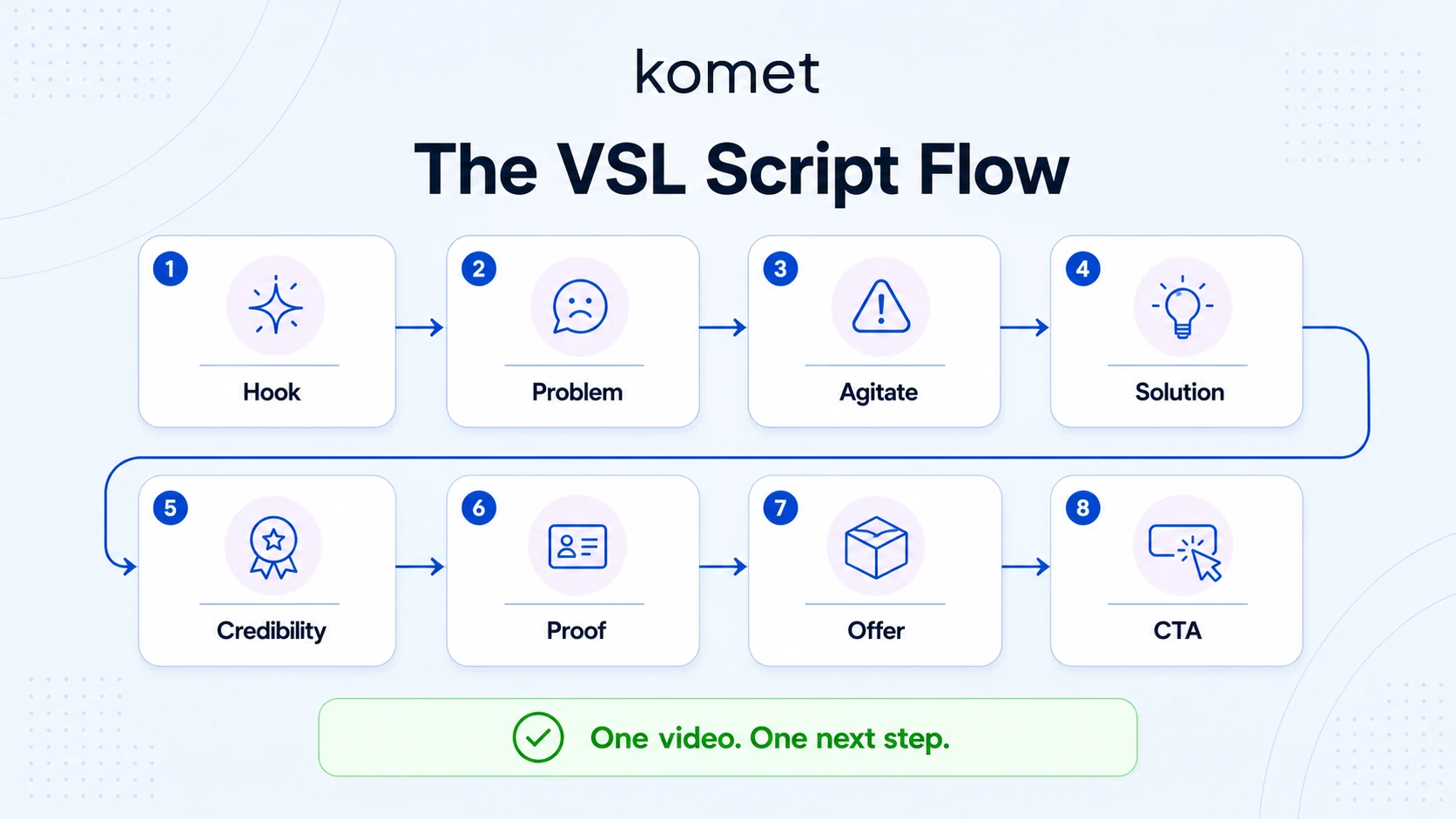
The eight-part structure that consistently converts:
- Hook: Open with a pattern interrupt, a bold claim, a sharp question, or a surprising stat that stops the viewer from clicking away.
- Your opening hook determines whether 85% of your viewers continue watching beyond the first 10 seconds, so it must immediately address a specific problem, desire, or curiosity gap.
- Problem: Name the specific pain the prospect is experiencing. Be precise. Vague problems produce vague interest.
- Agitate: Problem agitation follows your hook by intensifying the pain points your prospects experience, helping viewers recognize the full impact of their current situation while building emotional investment in finding a solution.
- Solution: Introduce your offer as the mechanism that resolves the problem. Wrap it in a brief origin story if possible.
- Credibility: Establish why you, and not someone else, are the right source of this solution.
- Proof: Testimonials, case study results, or specific customer metrics. VSLs without proof convert 40–60% lower. Even one specific customer result with real numbers outperforms ten minutes of feature explanation.
- Offer: State exactly what the prospect gets, at what price, and what the outcome is. Make the value-to-cost gap obvious.
- Call to Action (CTA): One video, one action. "Book a call, or visit our website, or follow us on LinkedIn" means they do nothing. Give them exactly one thing to do next.
- The emotional triggers in each section, urgency, social proof, scarcity, belonging, are not manipulation. They are the same psychological levers that influence every purchase decision. A well-built VSL simply sequences them deliberately.
VSL vs. Regular Sales Page: What's the Real Difference?
Video sales letters tap into fundamental psychological principles that make them remarkably effective at converting prospects into customers. When you watch a video, your brain processes visual and auditory information simultaneously, creating deeper engagement than reading text alone. This multi-sensory experience increases information retention by 400% compared to text-only content, making your sales message more memorable and persuasive.
The core practical difference is pacing control. A text page lets readers skip to the price and ignore the proof section. A VSL, especially one without a scrubber bar, forces sequential consumption. The prospect can't skip the objection handling. They can't jump to the CTA before they've absorbed the value proposition.
VSL funnels achieve higher conversion rates with audiences that prefer video content, which represents 78% of internet users in 2025. They build trust faster through personal connection and handle objections more effectively through tonality and visual demonstration.
For B2B founders and executives, the VSL also functions as a trust asset. Seeing the person behind the offer, their face, voice, and conviction, does more for buyer confidence than any static testimonial section ever could. This is where Komet Media's video marketing services come in: turning your existing expertise into a structured video asset that sells while you're in meetings.
How Long Should a VSL Be? The Honest Answer
Length is one of the most debated questions in VSL marketing. Here is the practical framework used by teams that actually test their way to results:
A 2025 Vidyard analysis of 850 B2B sales videos found that videos between 8 and 15 minutes had the highest engagement-to-conversion ratio.
However,
VSL length should align with your product complexity, price point, and audience familiarity. For straightforward products or lower price points, keep videos between 1–3 minutes and move quickly to the call-to-action. For complex solutions or enterprise offerings, longer videos of 5–10 minutes may be necessary to adequately explain capabilities, build trust, and address objections, because higher-priced solutions require more thorough education before prospects feel confident converting.
The right VSL length is exactly as long as it takes to answer every question the buyer has before making a decision. Not one second shorter, not one second longer.
For B2B outbound specifically, LinkedIn DMs, cold email, or short-form video ads, a good video sales letter is 60 to 120 seconds, opens with a specific hook the prospect can verify, names a stage-specific pain, shows visible proof, and ends with a low-friction ask.
The single biggest mistake founders make: building a 20-minute VSL for a $97 product or a 90-second VSL for a $25,000 service. Match depth to price point. Always.
How to Write a VSL Script: A Beginner's Step-by-Step Framework
Writing your first VSL script does not require a copywriting background. It requires disciplined use of a proven structure and honest knowledge of your buyer's problem. Here is the process:
- Define one conversion goal: Book a call, purchase a product, or sign up for a trial. One goal only. Split attention kills conversion.
- Write your buyer's problem in their exact words: Pull language from sales calls, reviews, or DMs. The closer your script mirrors how buyers describe their pain, the more it resonates.
- Draft the hook first: Start with the biggest result your offer produces or the sharpest version of the problem it solves. A 5-second logo intro costs you 30–40% of viewers before you say a word. Open with the hook immediately. Your brand name can come later when they care who you are.
- Build the problem-agitate-solution (PAS) block: Problem (name it), Agitate (show the cost of staying stuck), Solution (your mechanism, not just your product).
- Add proof as specifics, not generalities: Nobody cares that you have "AI-powered analytics." They care that they'll save 10 hours a week and close 20% more deals. Every feature needs a "which means..." after it.
- State the offer with full clarity: Price, deliverables, timeline, and the outcome they can expect.
- Write one CTA sentence: Direct, specific, low friction. "Click the button below to book a 20-minute call" beats "reach out to learn more."
- Record a rough cut first: Only upgrade production quality after you have validated the offer and script through conversion data. Start with a slide-based VSL and measure conversion rate against your baseline.
If you want an experienced team handling short-form video editing or full video editing services for VSL production, Komet Media builds these assets for B2B teams that already have great conversations, and need them packaged into video that converts.
What Makes a Good VSL? The Elements That Actually Drive Conversions
Most VSLs fail not because of production quality but because of structural gaps. Here are the elements that separate converting VSLs from expensive wallpaper:
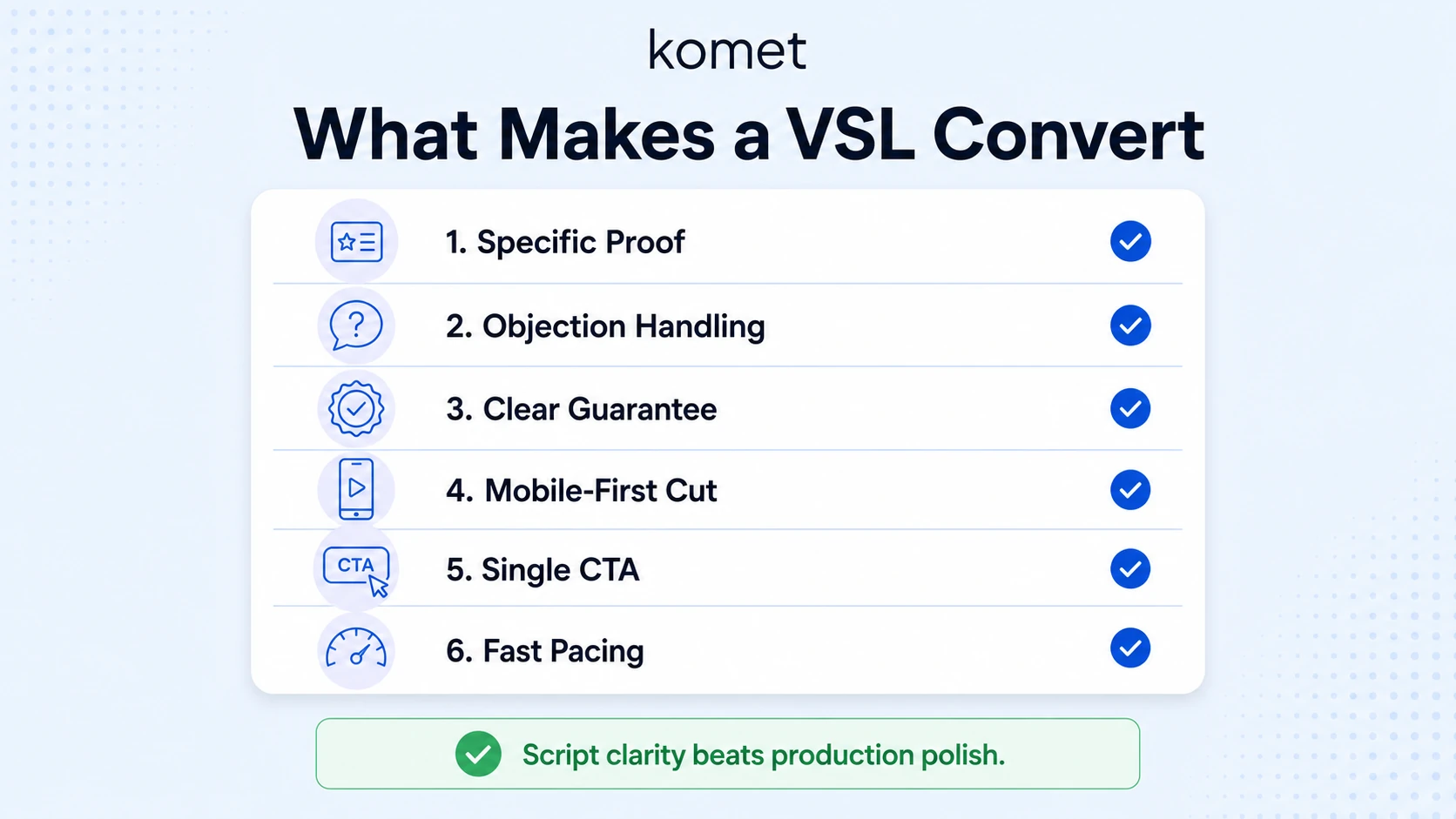
Specificity over polish: Polished visuals with vague claims lose to rough slides with specific, verifiable proof. Buyers trust detail. "We helped a SaaS founder close his first enterprise deal in 47 days" outperforms "we get results."
Objection-first structure: Analyze your CRM data, sales call notes, and customer support tickets to identify the top 3–5 objections prospects have. Address these directly within the first 30 seconds of your video to disarm skepticism and build credibility.
Guarantee messaging in the video itself: Many top-performing VSLs in 2025 and 2026 have incorporated money-back guarantee messaging directly into the video itself, a 2025 CXL Institute study found this alone increased conversion rates by 32%.
Mobile-first production: Mobile optimization is not optional. Mobile traffic accounts for 67% of video viewing in 2025. That means captions are mandatory, not optional. Vertical or square formats outperform widescreen for social placements.
A single, frictionless CTA: Giving viewers multiple next steps collapses conversion. One button. One ask. One action.
Pacing that respects the buyer's time: Dense, fast-moving scripts outperform slow explanatory ones in B2B. Your average executive buyer will not watch 18 minutes of build-up before reaching the offer. Get to value fast. For B2B founders building executive presence and authority, connecting your VSL strategy to a broader video advertising system is what converts one-time viewers into long-term buyers and hires.
What is a VSL without these elements? Just a video. With them, it becomes a repeatable revenue asset.
Conclusion
- A VSL is a structured persuasive video built around one conversion goal, one script framework, and one call to action.
- Pages featuring a VSL averaged a 12.7% conversion rate compared to just 4.8% for text-only pages. The performance gap is real and measurable.
- Length follows price point: 8–15 minutes for most B2B offers; 60–90 seconds for outbound video.
- Script wins over production: Validate with slides before investing in professional shoots.
- The best VSLs are built once and work continuously, the definition of a video system, which is exactly what we help serious B2B teams build at Komet Media.
Frequently Asked Questions
Q1: What is a VSL and how is it different from a product demo?
A product demo shows how a product works. A VSL is engineered to sell, it follows a persuasive script structure that moves the viewer from problem-aware to ready-to-buy. A demo explains features; a VSL sells outcomes and handles objections before they arise.
Q2: Do I need to be on camera for a VSL to work?
No. Some of the highest-converting VSLs use simple text slides and voice-over. On-camera builds more personal trust, which matters for high-ticket offers. Slides work well for validating the script before investing in production.
Q3: What is a VSL funnel, and do I need one?
A VSL funnel pairs the video with a dedicated landing page, an order or booking form, and optional follow-up sequences. The VSL landing page features your sales video prominently with minimal distractions, focusing entirely on getting prospects to watch and click your call-to-action. Design elements remain clean and simple, ensuring nothing competes with your video for attention.
Q4: Can a VSL work for B2B or only for online courses and digital products?
VSLs work across verticals. In B2B, they function as pre-call trust builders, proposal walkthroughs, and landing page anchors for high-ticket services. The script structure is the same, only the proof section, tone, and length shift to match a professional buyer's context.
Q5: How do I know if my VSL is working?
Track four metrics: play rate (are people pressing play?), drop-off point (where do they leave?), CTA click rate (do they act?), and conversion rate (do they buy or book?). Monitor key video analytics like play rate, drop-off points, and click-through rate, then use this data to constantly refine your scripts, test new formats, and optimize your messaging for maximum performance.
Q6: What is a VSL script template for beginners?
Start with the PAS + offer structure: Problem (name their pain), Agitate (show the cost of inaction), Solution (your mechanism), Proof (one specific customer result), Offer (what they get and for what investment), CTA (one action). Keep it under 1,200 words for an 8-minute delivery. Validate at low production quality first, then upgrade once conversion data confirms the script works. Reach out to Komet Media if you want a team to build it with you.