
🪄 AI Summary
Heading 1
Heading 2
Heading 3
Heading 4
Heading 5
Heading 6
Lorem ipsum dolor sit amet, consectetur adipiscing elit, sed do eiusmod tempor incididunt ut labore et dolore magna aliqua. Ut enim ad minim veniam, quis nostrud exercitation ullamco laboris nisi ut aliquip ex ea commodo consequat. Duis aute irure dolor in reprehenderit in voluptate velit esse cillum dolore eu fugiat nulla pariatur.
Block quote
Ordered list
- Item 1
- Item 2
- Item 3
Unordered list
- Item A
- Item B
- Item C
Bold text
Emphasis
Superscript
Subscript
Most B2B SaaS teams record a podcast, publish it, and move on. That is not a content strategy, it is a missed revenue opportunity. Podcast repurposing turns every recorded conversation into a compounding asset stack: short-form video for LinkedIn, SEO blog posts, email sequences, and sales enablement materials. If your team invests 45 minutes recording an episode and gets one asset out of it, you are leaving a pipeline on the table. This playbook shows you exactly how to fix that, step by step.
TL;DR
- Podcast repurposing is the practice of turning one episode into 10+ assets across channels to maximize reach, pipeline, and buyer trust.
- A single 30-minute episode can yield LinkedIn clips, a blog post, email sequences, audiograms, and sales enablement materials.
- The right repurposing workflow requires a clear content calendar, the right tools, and a distribution system built before you hit record.
- B2B SaaS teams that systematize repurposing generate significantly more inbound demand than those publishing and moving on.
What Is Podcast Repurposing and Why Does It Matter for B2B SaaS?
Podcast repurposing is turning a single episode into multiple content assets across channels, like SEO blog posts, transcripts, LinkedIn posts, short clips, email content, and sales enablement materials. For B2B SaaS specifically, it matters because your buyers do not live in one place. They scroll LinkedIn during lunch, search Google before demos, and forward clips to colleagues over Slack.
After hearing podcast episodes, 61% of podcast listeners feel more favorable toward a brand. Companies with branded podcasts achieve 89% higher brand awareness and 57% higher brand consideration. Those are not vanity metrics, that is buyer trust being built at scale.
The problem most SaaS teams run into is not content quality. It is a waste. Publishing to Apple and Spotify is not a distribution strategy; it is the bare minimum. Without strategic syndication across LinkedIn, email sequences, and sales enablement channels, your meticulously crafted episodes reach maybe 5% of their potential audience.
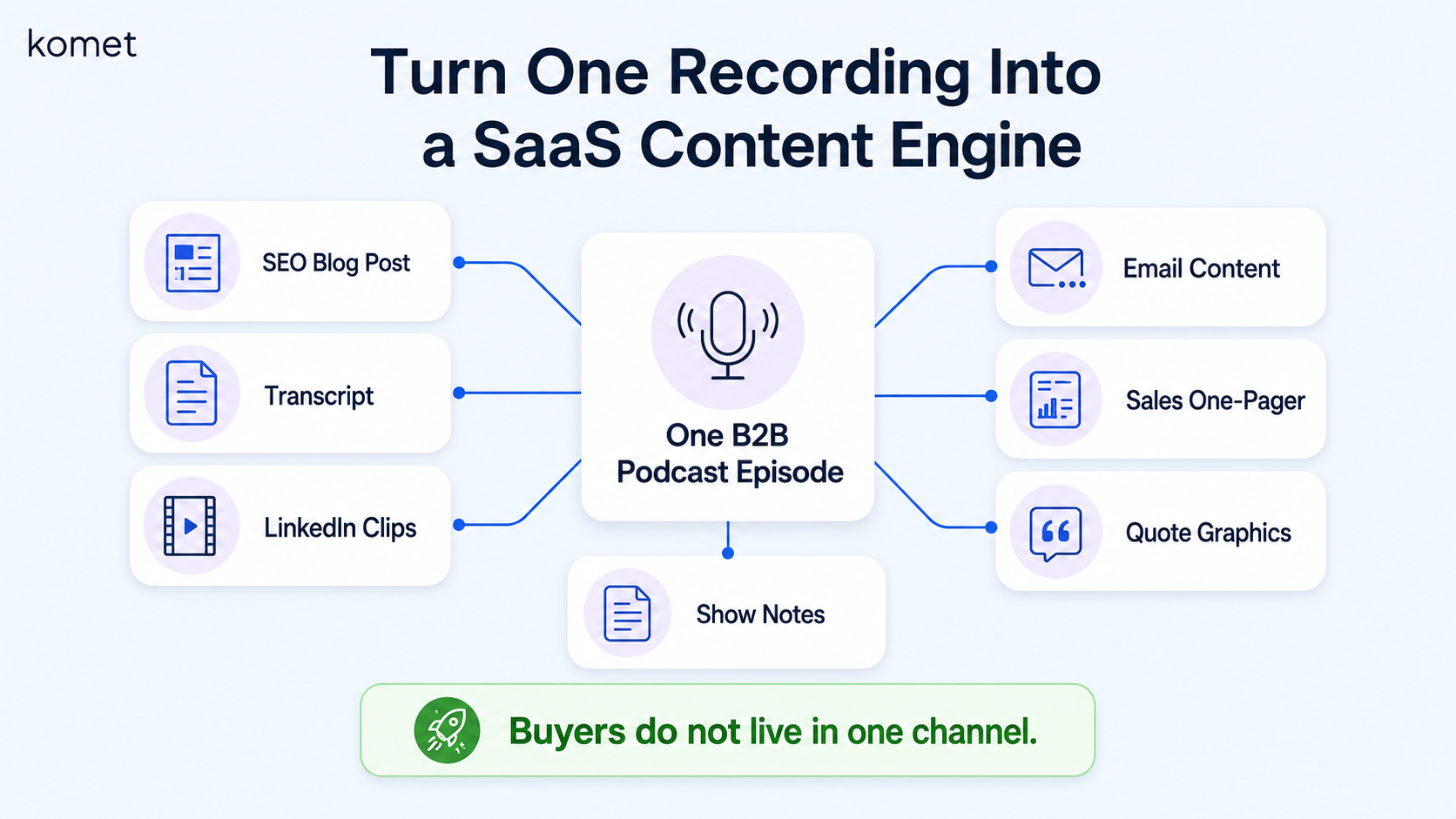
Podcast repurposing closes that gap. Effective content repurposing strategies transform a single asset into a full-scale marketing campaign, driving authority, engagement, and, most importantly, pipeline. For B2B companies, a podcast is an exceptionally powerful starting point.
From a demand generation standpoint, a well-repurposed podcast episode touches every stage of the B2B buyer journey. A short LinkedIn clip builds brand authority at the top of the funnel. An SEO blog post captures mid-funnel search intent. A sales enablement one-pager supports reps closing deals at the bottom. That is omnichannel distribution from one recording session.
Decision-makers are actively consuming podcast content, with 83% of senior executives listening to at least one podcast weekly. This executive engagement makes podcasting one of the most direct channels for reaching buyers with purchasing authority.
For founder-led SaaS teams especially, podcast repurposing accelerates thought leadership without requiring the team to produce net-new content every day. The Komet Media podcast repurposing service is built exactly for this use case: turning recorded conversations into a content engine your buyers actually engage with.
How to Repurpose Podcast Content for B2B SaaS Marketing: The Step-by-Step Workflow
Podcast repurposing only works at scale when it follows a repeatable system. Here is the production workflow we use at Komet Media with B2B SaaS teams:
- Record with repurposing in mind: Plan your episode structure around standalone ideas. Start with a long-form recording such as a webinar, podcast interview, or keynote. High-performing teams design the pillar with repurposing in mind, using modular sections and encouraging speakers to deliver clean, standalone ideas.
- Transcribe immediately: Run the raw audio through Descript or Riverside.fm to generate a full transcript. This becomes the raw material for everything downstream.
- Write SEO-optimized show notes: Create detailed, keyword-rich show notes and transcripts to attract organic search traffic. Komet Media's podcast show notes service handles this for you systematically.
- Build the primary SEO blog post: Create a primary SEO blog post with structured headings, internal links, and an FAQ. This is not a transcript dump, it is a rewrite targeting buyer search intent.
- Extract short-form video clips: Identify 60 to 90-second segments that contain one complete thought or a clear position. For LinkedIn, crop to 1:1 or 4:5, add burned-in captions, and use a contextual headline.
- Create audiograms for platforms without native video context: This includes creating audiograms for social media, pulling impactful quotes for graphics, and developing video versions to capture attention on platforms like YouTube and LinkedIn.
- Build email sequences from key episode insights: Pull three to five distinct takeaways and write a nurture sequence that references the full episode.
- Package sales enablement assets: Key frameworks and stats from the episode become one-pagers, battle cards, or call prep materials for your SDR team.
- Schedule across your content calendar: Strategically schedule your repurposed assets across different channels over several days or weeks to extend the life of each episode.
How to Turn One Podcast Episode Into 10+ Pieces of Content
Every B2B podcast episode contains 12+ pieces of pipeline-driving micro-content trapped inside. The question is whether your team has a system to extract them. Here is the complete asset breakdown from a single 30-45 minute episode:
Each 30-minute episode contains enough content for 15 LinkedIn posts, 3 blog articles, 5 email sequences, and 10 sales enablement assets. The important discipline here is sequencing, not just volume. Release the short video clip first to seed awareness. Follow with the blog post for search capture. Then use email and sales assets to convert. This is content atomization executed as a deliberate marketing funnel, not a scatter-shot posting schedule.
Our short-form video editing service and podcast editing service are built to plug directly into this workflow so your team does not become a production agency.
Podcast Repurposing Strategy: How B2B SaaS Teams Generate Pipeline
Podcast repurposing is not just a content efficiency play, it is a direct pipeline driver when structured correctly. The key is connecting each repurposed asset back to a pipeline outcome, not just an engagement metric. One SaaS company attributed 47% of enterprise deals to podcast listeners. That figure only holds when the podcast content is actively repurposed and distributed into the channels where those buyers already spend time.
Here is how the pipeline connection works in practice:
- Short-form video clips on LinkedIn create top-of-funnel awareness with your ICP, building the brand familiarity that makes cold outreach warm. B2B companies running a podcast see an average of 20 to 30% higher engagement on LinkedIn and other digital platforms compared to those that rely solely on written content.
- SEO blog posts derived from episodes capture buyers actively researching your category. One SaaS company's repurposed blog content now drives 34% of their organic pipeline.
- Sales enablement assets from episodes give your reps proof-of-expertise material to send prospects mid-deal. Linking to a podcast clip where the founder explains a key problem builds more trust than a generic one-pager.
- Dark social distribution compounds reach without paid spend. When executives share podcast content, 84% happens in private channels, WhatsApp groups, internal Teams channels, email forwards. By creating "dark social friendly" assets (executive summaries, quotable insights, shareable frameworks), you multiply your reach without increasing spend.
For B2B SaaS teams running webinar programs, the same repurposing logic applies. Visit Komet Media's webinar page for how we handle long-form repurposing from webinar recordings alongside podcast content.
Podcast Repurposing Tools for Marketing Teams
The right tool stack removes production friction and keeps your repurposing workflow consistent. Here is what we recommend based on function:
The AI audio editing market hit USD 2.02 billion in 2025. Tools like Descript and Adobe Podcasts remove background noise, balance audio levels, and even cut out filler words automatically.
For LinkedIn-specific workflow: LinkedIn favors native video content over external links. When you upload clips directly to the platform rather than sharing a Spotify or Apple Podcasts link, the algorithm gives your content more visibility. For LinkedIn's Shorts feed, vertical format (9:16 aspect ratio) performs best. Square format (1:1) works well in the main feed. The ideal length sits between 30 and 90 seconds. Where tools end, the process begins.
The biggest failure mode for SaaS marketing teams is assembling a tool stack and never building the workflow that connects them. Komet Media's video marketing service solves this by owning the production workflow end-to-end.
The Best Podcast Repurposing Workflow for a Small SaaS Marketing Team
Most SaaS marketing teams doing podcast repurposing are working lean, one to two people covering content, social, and enablement simultaneously. The workflow needs to be lean too.

Here is the minimum viable podcast repurposing system for a two-person team:
- Episode recorded (Day 0): Upload to Riverside.fm or Descript. Export transcript automatically.
- Transcript reviewed (Day 1): Highlight 3-5 strong moments for clips. Flag 2-3 key insights for LinkedIn text posts.
- Clips produced (Day 2-3): Cut 2-3 vertical clips (60-90 seconds each). Add captions and branded lower-thirds. Komet Media's hire a video editor service can own this step entirely.
- Blog post drafted (Day 3-4): Use the transcript as a base. Rewrite for search intent, add headings, embed the episode player.
- Show notes published (Day 4): SEO-optimized episode page goes live on your site. Internal links to relevant product pages and content.
- LinkedIn distribution (Day 5-10): Post Clip 1 on Day 5. Text insight post on Day 7. Clip 2 on Day 9. Audiogram on Day 10.
- Email newsletter (Day 6): Feature the episode insight as the primary story.
- Sales team activation (Day 7): Send the best clip and blog post URL to your SDR team with context on how to use it in outreach.
High-growth shows focus on refining what works, rather than blindly doing more. Growth requires intentional planning, not massive spending. The content calendar dimension matters here. Benchmarks suggest that posting two to three times per week supports ongoing growth. For most B2B teams, producing high-production video at that cadence is unrealistic without a repurposing system behind it. This workflow gives a small team a week's worth of content from a single recording session.
How to Turn Podcast Interviews Into Blog Posts, Show Notes, and Social Content
The transcript is the most underused asset in most B2B podcast workflows. Here is how to extract maximum value from it across three specific formats.
Blog posts from transcripts: The core idea is to transcribe your podcast episode and then refine that raw text into a polished blog post or series of articles. Transforming audio into text opens up your content to an entirely new audience segment. More importantly, it allows search engines like Google to crawl, index, and rank your content, dramatically boosting its visibility long after the episode has aired. The key rule: never publish a raw transcript as a blog post. Restructure it around buyer search queries, add headers, and include a FAQ section.
Show notes: SEO-optimized show notes serve two functions, they help listeners navigate the episode and they help Google understand the episode's topic. Include timestamps, key quotes, linked resources, and a one-paragraph summary targeting your primary keyword. Komet Media's podcast transcription service generates the raw material; our show notes service handles the editorial layer.
LinkedIn content from interviews: A podcast serves as a powerful content engine for LinkedIn. A single episode can be repurposed into dozens of assets: short video clips for the feed, text-based posts with key takeaways, and carousel posts visualizing data points discussed. This strategy amplifies your reach and reinforces your message.
For guest interviews specifically, activate the guest's network with a promo pack: one ready-to-post LinkedIn caption, one short clip, and one quote graphic. Guest-centric network building is one of the most powerful podcast marketing strategies for rapidly accelerating growth and authority. This approach centers on featuring influential guests who bring their own established audiences, credibility, and expertise. By borrowing their authority, your podcast not only gains exposure to new, relevant listeners but also builds a valuable professional network. This is where podcast repurposing crosses into founder-led growth and thought leadership territory, which is exactly where B2B SaaS pipeline comes from in 2026.
Conclusion
Podcast repurposing is the highest-leverage content move available to B2B SaaS marketing teams right now. Every episode you publish without a repurposing system behind it is a pipeline you are not capturing.
Key takeaways:
- One 30-45 minute episode can produce 10+ assets across video, SEO, email, and sales enablement.
- The right workflow sequences assets across the buyer journey, not just across platforms.
- Tools like Descript, Riverside.fm, and Transistor.fm remove production friction; process and editorial judgment are what create revenue impact.
- Founder-led and guest-driven podcast content, properly repurposed, builds the brand authority that shortens B2B sales cycles.
Ready to build the system? Explore Komet Media's podcast marketing services or contact us to get started.
Frequently Asked Questions
Q1: What is podcast repurposing and why does it matter for SaaS?
Podcast repurposing means turning a single episode into multiple content assets across channels, clips, blog posts, email content, and sales materials. For SaaS teams, it matters because it extends the reach of every recorded conversation without requiring additional production time, and builds buyer trust across the entire marketing funnel.
Q2: How many pieces of content can you get from one podcast episode?
From a single 30-minute recording, you can extract 3 LinkedIn articles, 10 social posts, 5 email sequences, 2 blog posts, and 15 sales enablement assets. The exact number depends on episode length, topic depth, and your distribution channels, but 10 to 20 usable assets per episode is a realistic baseline for most B2B SaaS teams.
Q3: What tools do B2B teams use for podcast repurposing?
The core stack includes Riverside.fm for recording, Descript for transcript-based editing, Transistor.fm or Buzzsprout for hosting, Opus Clip for AI-powered clip extraction, and Headliner for audiograms. Most teams also use a scheduling tool to manage their content calendar and publish clips natively to LinkedIn.
Q4: How does podcast repurposing support sales enablement?
Podcast clips and blog posts derived from episodes give sales reps credible, educational content to share with prospects mid-deal. A founder explaining a core product problem in a 90-second clip builds more trust than a generic deck. Repurposed assets also support SDR outreach sequences as contextual touchpoints.
Q5: How long does it take to repurpose one podcast episode?
With a defined workflow and the right tools, a two-person team can repurpose one episode, clips, blog post, show notes, LinkedIn posts, and email, in 4 to 6 hours total, spread across a week. Outsourcing clip production and show notes to a specialist like Komet Media can reduce internal time to under 1 hour per episode.
Q6: Is podcast repurposing different from content atomization?
They are closely related but not identical. Content atomization involves breaking episodes into their smallest valuable components and rebuilding them for specific channels and audiences. Podcast repurposing is the broader practice that includes atomization but also covers editorial decisions like how to restructure a transcript into an SEO blog post, which requires more strategic judgment than simply cutting clips.