
🪄 AI Summary
Heading 1
Heading 2
Heading 3
Heading 4
Heading 5
Heading 6
Lorem ipsum dolor sit amet, consectetur adipiscing elit, sed do eiusmod tempor incididunt ut labore et dolore magna aliqua. Ut enim ad minim veniam, quis nostrud exercitation ullamco laboris nisi ut aliquip ex ea commodo consequat. Duis aute irure dolor in reprehenderit in voluptate velit esse cillum dolore eu fugiat nulla pariatur.
Block quote
Ordered list
- Item 1
- Item 2
- Item 3
Unordered list
- Item A
- Item B
- Item C
Bold text
Emphasis
Superscript
Subscript
I'm Rajan Soni, Founder and Video Director at Komet Media. Every week I speak with SaaS founders and marketing heads who are sitting on webinar recordings, podcast episodes, and product demos that are doing nothing for their pipeline. This guide is The Video Marketing Playbook for B2B SaaS, the exact framework we use to turn that dormant content into buyer education, demo demand, and inbound trust. If your product is strong but your video presence isn't carrying its weight, this playbook is your starting point.
TL;DR
- 70% of B2B buyers watch video content during their purchasing journey, your buyers are already expecting it.
- Short-form, LinkedIn, and explainer video are the three highest-impact formats for SaaS pipeline in 2026.
- Repurposing existing long-form content (webinars, podcasts, demos) is the fastest path to video volume without blowing your budget.
- Measure video by pipeline influence and MQL-to-SQL lift, not view counts.
What Is Video Marketing for B2B SaaS, and Why It Hits Differently
Video marketing for B2B SaaS is the practice of using video content to educate buyers, generate qualified demand, and accelerate deals across every stage of the funnel. That definition sounds obvious. The execution is where most SaaS teams fall short. Unlike B2C, where a single viral clip can drive conversions, B2B SaaS video has to work across a buying committee, a long sales cycle, and multiple decision-makers who each need different proof.
Decision-makers now consume an average of 13 pieces of content before engaging with sales , and a growing share of those touchpoints are video. That means your video isn't competing with text, it's competing with other teams' video. 96% of B2B buyers say video is an important factor in deciding whether to advance in the buying journey. That's not a "nice to have" stat. That's a gate. If a buyer lands on your site, evaluates your LinkedIn presence, or sits in a discovery call and finds no video, you've already lost credibility with the majority of your market.
What makes SaaS video uniquely powerful is specificity. A 90-second clip showing exactly how your product solves one painful workflow beats a five-page whitepaper every time. 73% of B2B decision-makers prefer to watch product demo videos over reading whitepapers. That preference is shaping vendor selection, and it's why The Video Marketing Playbook for B2B SaaS has to address the full funnel, not just awareness.
The other thing that separates SaaS video from generic content marketing is compounding value. One 45-minute webinar becomes 10 short clips, a LinkedIn carousel, a sales enablement snippet, and an onboarding video. At Komet Media, that repurposing model is how we help teams achieve consistent video presence without building a media studio.
One long-form video becomes 5–10 short-form clips when you plan the content system in advance, which is exactly how founder-led growth teams punch above their weight on content volume. The bottom line: SaaS video is no longer a creative experiment. Companies using video grow revenue 49% faster than non-users. That gap will only widen as more teams build the habit.
How to Build a Video Marketing Strategy for SaaS
A SaaS video strategy isn't a content calendar, it's a pipeline system. Here's how to build one that actually converts.
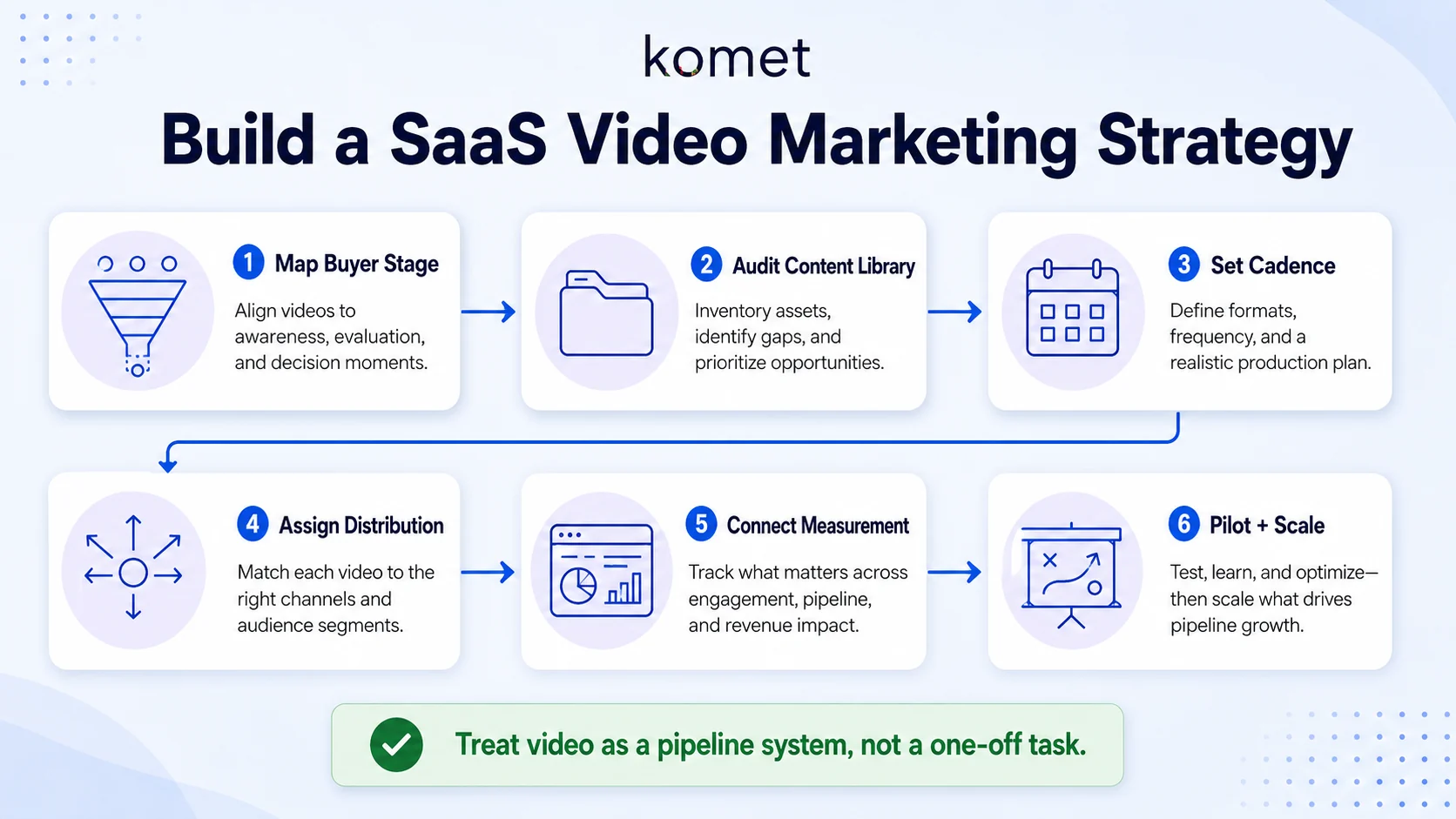
Step 1: Map content to buyer stage. Your buying committee has three distinct needs: awareness (what problem does this solve?), consideration (how does this compare?), and decision (can I trust this vendor?). Every video you produce should be tagged to one of these stages before a frame is shot.
Step 2: Audit your existing content library. Most SaaS teams already have 12–20 pieces of long-form content, webinars, demos, podcasts, customer calls, that have never been repurposed. This is your fastest path to video volume. Pull your podcast episodes and recorded webinars first.
Step 3: Define your production cadence. Ask whether you're producing one flagship asset per quarter or a continuous flow of short-form. For most SaaS teams, a hybrid works: one anchor video per month (demo, case study, or webinar) and four to six short clips redistributed weekly.
Step 4: Assign distribution ownership. Decide who owns distribution, marketing, sales, or both. Sales teams should have a library of ready-to-send video snippets (product walkthroughs, objection-handling clips) they can drop into email sequences the day a prospect goes cold.
Step 5: Set up your measurement stack before you publish. Connect Vidyard or Wistia to your CRM so that video engagement triggers lead scoring. Tools like Vidyard, Wistia, Vimeo Business, Brightcove, and YouTube Studio offer detailed insights into watch time, drop-off points, and interaction rates, and integrate with HubSpot, Salesforce, Marketo, and GA4.
Step 6: Pilot before scaling. Start with three content types: one explainer, one demo, one customer story. Measure click-through rate, watch time, and downstream demo requests for 60 days, then double down on the format that drives the most qualified pipeline.
This six-step process is the core of The Video Marketing Playbook for B2B SaaS because it treats video as a system, not a one-off production task.
What Types of Videos Work Best for B2B SaaS?
Not all video formats perform equally. Here's what moves the needle in 2026, mapped to the funnel stage.
68% of marketers create explainer videos, which remain a top format for reducing buyer friction, especially for SaaS and tech products where walkthroughs can directly influence conversion. Customer outcomes and results are the most persuasive proof type at 42.7%, ranking as the single most convincing proof format for B2B buyers according to Vidico's 2026 State of Creative in Tech report.
73% of B2B decision-makers prefer to watch product demo videos rather than read whitepapers or brochures. That makes your demo the highest-leverage asset in the consideration stage, not a sales-only tool. For distribution, LinkedIn is the new B2B video channel: 81% of B2B teams share video on LinkedIn, making it the top distribution platform for B2B, overtaking YouTube for the first time.
One format SaaS teams consistently under-invest in: founder-led video. Personal posts from executives generate up to 4x the engagement of standard brand posts, making founder-led short-form one of the highest-ROI content moves available to a funded startup.
How SaaS Companies Use Video to Generate Leads and Fill Pipeline
Lead generation is where The Video Marketing Playbook for B2B SaaS gets practical. Video isn't just brand awareness, it's a direct pipeline driver when placed at the right moments.
The highest-converting video placements for SaaS:
- Demo request landing pages: 82% of video marketers report that video delivers a positive ROI, and landing pages with embedded video see up to 86% higher conversion rates than those without.
- LinkedIn video ads: Used for account-based marketing (ABM), where you serve short, persona-specific clips to target accounts using Bombardo intent data or LinkedIn's own audience tools.
- Email sequences: Businesses that incorporate video into email campaigns experience a 26% increase in click-through rates.
- Webinar replays: Turn live webinar sessions into gated assets that capture MQLs, then clip the best 90-second moments for nurture sequences.
- Sales enablement libraries: Reps send a relevant product clip instead of a wall of text, response rates lift, and deals move faster.
On average, B2B video content shortens the sales cycle by 23%. For a SaaS company with an 84-day average sales cycle, that compression translates directly to faster CAC payback and improved pipeline velocity. 87% of marketers say video helped generate leads, and Wistia's research shows 38% of businesses use video primarily for lead generation and sales.
The SaaS-specific insight here: your most powerful lead-gen videos are not polished brand films. They are specific, problem-led clips that make a buyer think "that's exactly what we're dealing with." One strong founder POV clip on a painful workflow problem drives more inbound demo requests than a generic product overview ever will. Our short-form video editing service exists specifically to help SaaS teams produce that kind of content at volume and consistency.
Best Video Marketing Tactics for B2B SaaS in 2026
The market has moved. These are the tactics separating pipeline-generating SaaS video programs from ones that just look busy.
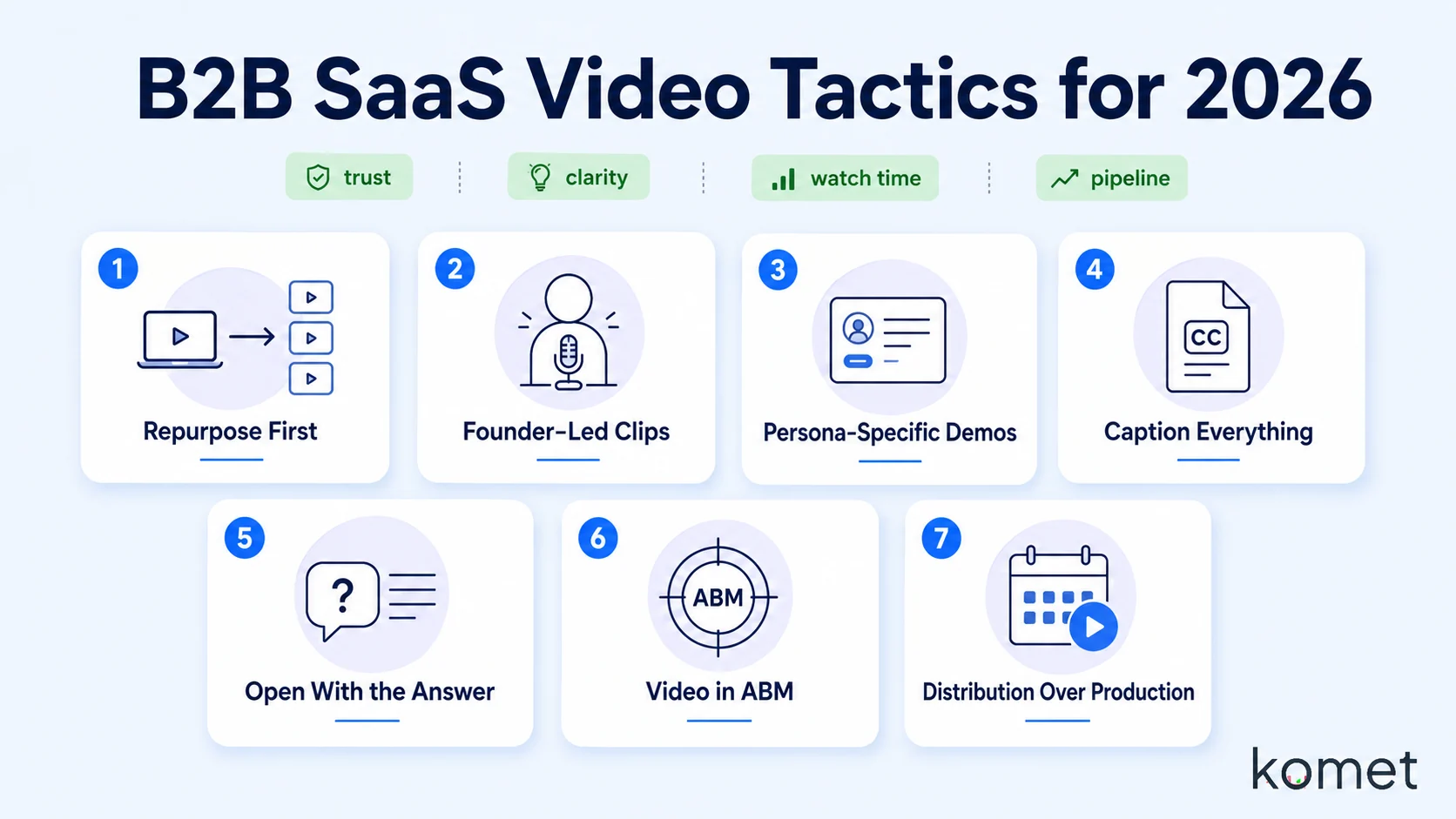
Repurpose-first production: Before filming anything new, extract clips from your existing webinar recordings, podcast episodes, and sales calls. One 45-minute webinar yields eight to twelve standalone clips when edited strategically.
Founder-led content: Buyers trust people before they trust products. Short, direct LinkedIn videos from the CEO or founder, speaking honestly about a problem the product solves, outperform scripted brand content on every B2B trust metric.
Persona-specific demos: A CFO evaluating a six-figure SaaS purchase wants a short, evidence-heavy ROI explainer. A practitioner wants a longer, hands-on product walkthrough. A CEO wants a peer testimonial. One demo video serving all three is serving none of them.
Caption everything: 80% of B2B video on LinkedIn is watched on mute, especially in office environments. Open captions are non-negotiable, they double comprehension and completion rate.
Open with the answer: B2B viewers decide whether to keep watching in the first six seconds. Open with the conclusion, the proof point, or the surprising claim, then unpack.
Video in ABM sequences: 58% of B2B marketers have integrated video into their account-based marketing strategies. A personalised Loom or short demo clip dropped into an outbound sequence after a prospect visits your pricing page consistently outperforms generic follow-up email.
Distribution over production: Most SaaS teams underinvest in distribution and overinvest in production. A good video posted once with no follow-through is dead on arrival. Build a content distribution strategy that ships each asset across LinkedIn, email, and your video marketing channel consistently.
How to Use Explainer Videos to Convert B2B SaaS Prospects
Explainer videos are the workhorses of the SaaS marketing funnel. When done right, they compress a buyer's understanding of your product from weeks of evaluation into under two minutes.
A SaaS explainer that actually converts does four things in sequence:
- Names the problem precisely. Don't open with your product. Open with the buyer's pain, the specific workflow bottleneck, the data gap, the manual process eating their team's time.
- Shows the current-state cost. Quantify what the problem is costing: time, revenue, headcount, churn. This anchors the value conversation before the product is introduced.
- Demonstrates the outcome, not the feature. Show what the buyer's world looks like after the problem is solved, not a product UI walkthrough, but the downstream result.
- Closes with a specific, low-friction CTA. "Watch a 3-minute demo" converts better than "Get started" for cold buyers. Give them the next logical step, not a commitment.
Video on landing pages increases conversions by 86%. The effect is strongest for complex products and services where video reduces cognitive load, B2B SaaS pages with explainer videos see conversion lifts exceeding 100% in controlled testing.
For format: keep consideration-stage explainers between 60 and 90 seconds for social distribution. For your website's product page, a 2–3 minute walkthrough works well because the viewer has already expressed intent by arriving there.
The mistake most SaaS teams make is building explainer videos around features rather than buyer outcomes. Your ICP does not care that you have 47 integrations. They care that your product eliminates the Tuesday afternoon reconciliation hell their ops team dreads every week. Lead with that. The features are the proof, not the hook.
How to Measure Video Marketing ROI for SaaS Products
Vanity metrics (views, impressions, likes) are not pipelines. Here is how to measure video as a revenue channel.
Metrics that matter by funnel stage:
Pipeline-tier metrics are the ones that move boardroom conversations: video-influenced opportunities created, multi-touch attributed revenue, sales cycle compression on deals where video was consumed, and content-source MQL-to-SQL conversion rate.
The MQL-to-SQL stage, where only 15–21% of leads convert, is where fixing the equation delivers the highest ROI. Video that educates buyers before they talk to sales consistently improves that conversion rate because reps spend less time explaining and more time closing.
For attribution, connect your video platform to your CRM from day one. Multi-touch attribution distributes credit across all interactions, offering a balanced view of influence throughout the funnel, which is essential for SaaS teams running video across LinkedIn ads, email, and organic content simultaneously.
Track video-influenced pipeline as a separate line item in your revenue reporting. If a video touches a deal before it closes, it deserves credit in the attribution model, not just the last-touch channel that booked the demo. 52% of B2B marketers identify video as their highest ROI content type. To prove that internally, you need the measurement infrastructure in place before you scale production, not after.
Conclusion
The Video Marketing Playbook for B2B SaaS comes down to three principles: build a content system (not a one-off production), distribute to the right buyers at the right funnel stage, and measure by pipeline outcomes rather than vanity metrics.
Key takeaways:
- Map every video to a specific buyer persona and funnel stage before producing.
- Repurpose existing long-form content first, webinars, demos, and podcasts are already full of short-form gold.
- Embed video on landing pages, in email sequences, and inside ABM outreach to drive measurable pipeline lift.
- Connect your video platform to your CRM so you can track MQL-to-SQL impact and sales cycle compression.
If you want to build a video system that actually supports the pipeline, Komet Media can help.
Frequently Asked Questions
Q1: What is The Video Marketing Playbook for B2B SaaS?
It is a strategic framework that maps video content types, production cadence, and distribution channels to each stage of the B2B buying journey, with the goal of generating qualified pipeline, not just views. It covers everything from explainers and demos to founder-led LinkedIn content and sales enablement snippets.
Q2: How many videos does a SaaS team need to produce each month?
Consistency matters more than volume. A realistic starting cadence is one anchor video per month (demo, case study, or webinar) plus four to six short-form clips repurposed from that anchor. This creates a steady LinkedIn and email presence without overwhelming a lean team or budget.
Q3: What is the best video format for SaaS lead generation?
Product demo videos and customer success stories drive the highest conversion intent for mid-to-bottom funnel buyers. The most effective B2B video formats for lead capture are product demos, customer testimonials, and webinars. Pair them with a low-friction CTA like a short demo booking link rather than a generic "contact us" form.
Q4: How does video affect SaaS sales cycle length?
B2B video content shortens the sales cycle by an average of 23%. Buyers who watch a product walkthrough or customer story before a sales call are better qualified, ask sharper questions, and require less rep explanation time, all of which compresses deal velocity.
Q5: Should SaaS founders create video content personally?
Yes. Founder-led video builds the kind of trust that polished brand content cannot replicate. Short, direct LinkedIn clips from a founder speaking authentically about a buyer problem consistently outperform company page posts on reach, engagement, and inbound demo conversion. Even Loom-style, low-production videos work well when the insight is sharp.
Q6: How do I repurpose a webinar into multiple video assets?
Start by identifying the three to five highest-value moments in the recording, a strong stat, a sharp answer to an audience question, a live product demonstration, or a counter-intuitive insight. Each becomes a standalone short clip (60–90 seconds) for LinkedIn. The full recording becomes a gated asset. Key quotes become text-overlay clips. One webinar can yield an entire month of video content with the right editing process.