
🪄 AI Summary
Heading 1
Heading 2
Heading 3
Heading 4
Heading 5
Heading 6
Lorem ipsum dolor sit amet, consectetur adipiscing elit, sed do eiusmod tempor incididunt ut labore et dolore magna aliqua. Ut enim ad minim veniam, quis nostrud exercitation ullamco laboris nisi ut aliquip ex ea commodo consequat. Duis aute irure dolor in reprehenderit in voluptate velit esse cillum dolore eu fugiat nulla pariatur.
Block quote
Ordered list
- Item 1
- Item 2
- Item 3
Unordered list
- Item A
- Item B
- Item C
Bold text
Emphasis
Superscript
Subscript
An Instagram growth playbook for funded startups has to answer a different question from the one most guides ask. The question is not how to collect followers. It is how to turn product knowledge, founder thinking and recordings you already own into a steady presence that buyers, candidates and investors can find. Most teams post sporadically after a funding announcement and then stop. This playbook gives you a system that survives a busy quarter.
Quick Answer: Instagram Growth for Funded Startups
The Instagram growth playbook for funded startups in one line: treat the profile as a landing page, pick three or four pillars, post three to four times weekly from recordings, and prove results before paying.
Why a Funded Startup Should Treat Instagram as a System
After a round, marketing pressure rises and time does not. Instagram becomes a checkbox: someone posts a launch graphic, a team photo and a hiring notice. None of that gives a buyer a reason to follow.
A system fixes this. It decides who you are speaking to, what you say, how often, and how you will know it worked. It also leans on what the company already has: demos, customer calls, webinars, investor updates and founder opinions. We often see startups sitting on dozens of hours of useful recordings while the Instagram account stays empty.
The platform is worth the effort for the right company. Meta's CEO said in September 2025 that Instagram had passed 3 billion monthly active users. That is a large audience, but size does not guarantee fit. It suits product-led, founder-driven and design-conscious companies better than deeply technical vendors with narrow, offline buying groups. If your buyers never touch social media, start elsewhere.
Build the Instagram Foundation First
Every Instagram growth playbook for funded startups starts by defining your position before you publish. Think of the profile as a landing page with a scrollable portfolio attached.
- Username: match your brand name so people find you.
- Bio: one line on what you do, one on who you help, and one clear next step.
- Link: one trackable destination, ideally a page built for Instagram visitors.
- Highlights: three to five Story Highlights covering product, proof and the founder story.
Next, write down your ideal customer profile: job title, industry, company stage and the problems they search for. This shapes tone, hashtags and who you engage with. Use a modest, relevant set of hashtags and rotate them by content pillar. Do not copy a long list from a template.
Then set a rhythm you can sustain. A Buffer analysis of roughly 2.1 million Instagram feed posts from about 102,000 accounts found that accounts posting three to five times per week had about 12% higher reach per post than accounts posting one or two. Buffer calls the link correlational, notes diminishing returns above that range, and says quality probably matters most. For most funded teams, three to four posts a week is a sensible ceiling. It is a number you can keep, which matters more than a number you can hit once.
Instagram Content That Moves Buyers, Not Followers
Follower count is easy to inflate and hard to cash in. Pipeline is the scorecard. Four types of content tend to move a buyer.
Short product walkthroughs, founder takes on a market problem and customer outcomes generate the kind of attention that leads to messages. Test every idea with one question: would a buyer send this to their team?
That question is not just a rule of thumb. Instagram's head, Adam Mosseri, has said that watch time, likes and sends are the top three ranking signals, and in 2026 he added that sends help posts reach people who do not follow you. Content a buyer forwards is content the platform is more likely to show to new people.
Build a calendar around three or four pillars. Map each pillar to a buyer stage: awareness content earns reach, consideration content earns saves, and decision content earns messages and profile visits.
Which Instagram Formats to Use
Choose formats by job, not by trend.
- Reels (30 to 90 seconds): founder takes, product moments, myth-versus-reality segments. Hook the viewer in the first two seconds and add captions, since many people watch muted.
- Carousels (6 to 10 slides): step-by-step education, benchmarks, frameworks and customer results. Each slide should stand alone.
- Stories (several a week): polls, questions, behind-the-scenes and link stickers.
- Static images: use them sparingly, for milestones and quotes.
The evidence for mixing formats is consistent. In Socialinsider's 2026 benchmarks, which draw on 2025 data, carousels averaged a 0.55% engagement rate, Reels 0.52% and images 0.37%, and carousels led on saves and views at every brand size. The same report notes engagement fell about 24% year over year. Engagement rate there is likes and comments divided by followers, so it understates saves and sends. Use it to compare formats, not to set a goal.
Buffer's study of more than 27 million posts from 273,000 accounts points the same way for accounts with 5,000 to 10,000 followers: carousels earned about 12% more engagement than Reels, while Reels reached about 39% more people. In plain terms, Reels help strangers find you, and carousels help people who already know you go deeper. A startup needs both.
How to Grow on Instagram From Zero Without Buying Followers
Growth from zero is a three-phase job, and the first phase is the slowest.
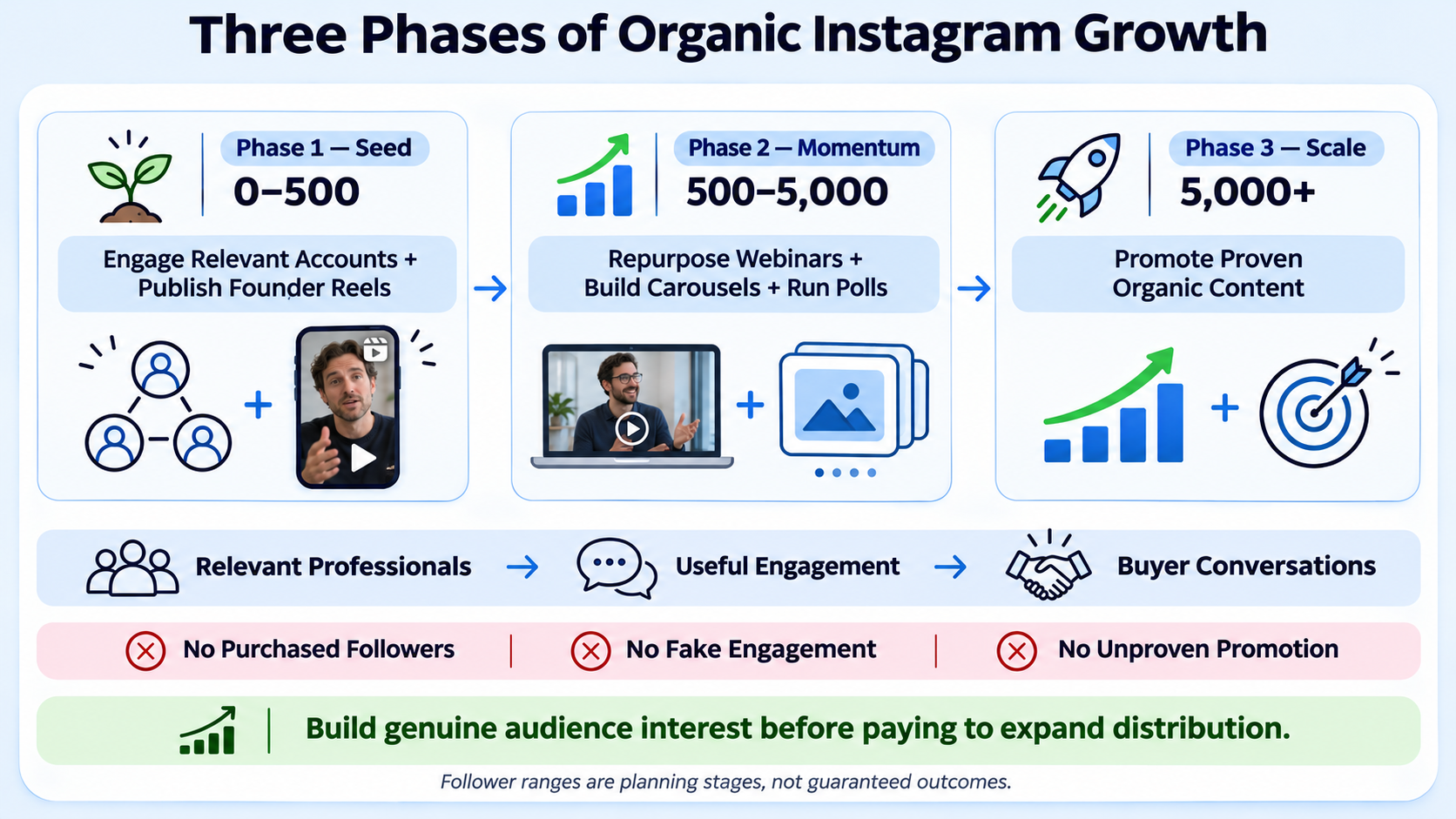
Phase 1: Seed (zero to roughly 500 followers). Identify about thirty accounts your ideal customers follow, and engage with them thoughtfully every day. Publish a handful of founder-perspective Reels in the first two weeks. Message new followers personally and do not pitch.
Phase 2: Momentum (roughly 500 to 5,000). Build a repurposing pipeline so each webinar, demo or podcast yields three to five assets. Launch carousels based on real questions from sales calls. Use Story polls to find topics.
Phase 3: Scale (5,000 and up). Put paid amplification behind your best organic posts. Do not pay to promote content you have not tested.
Set expectations carefully. Socialinsider reports that average audience growth rates in 2025 were about 22% for brand accounts with 1,000 to 5,000 followers, falling to about 11% for accounts with 100,000 to 1 million. Growth is faster when you are small and slows as you scale, so a flat month at 20,000 followers does not mean the same thing as a flat month at 800.
Avoid shortcuts. Instagram has said since 2018 that accounts using third-party apps to inflate popularity may see their experience affected. Fake or bought followers do nothing for pipeline and can damage reach.
Instagram and LinkedIn: Assign Roles
The useful question is not which platform wins. It is which platform plays which role. Instagram suits discovery and brand storytelling at the top of the funnel. LinkedIn suits relationship-building and sales conversations. I would build the Instagram content system first, then adapt the strongest performers for LinkedIn, because the repurposing work is the same.
For repurposing across channels, Wistia's 2026 State of Video report found that among teams that repurpose video into social clips, 67% post to LinkedIn, 49% to Instagram and 41% to YouTube, and 76% adjust the aspect ratio for each platform. That is survey data from Wistia's customers, so it describes common practice rather than best practice. It does support the idea that adapting a clip per channel is normal, not extra credit.
A Sample Instagram Week for a Small Startup Team
A lean team can run this without a full-time hire. The weekly rhythm below assumes one marketer, one founder who records, and an editor.
What can shrink: the Friday Stories, if time is short. What must not be skipped: the Monday review, because it is how the program learns.
Turning Product Knowledge Into Instagram Content
Funded teams often say they have nothing to post. In practice the content exists but sits in the wrong place. Mine these sources first:
- Sales calls and demos. The questions prospects ask repeatedly are the best carousel topics. Record, with permission, and pull the clearest answers.
- Webinars and customer calls. One hour usually holds several clips that stand alone.
- Support tickets and community threads. Common problems make good how-to Reels.
- Founder and engineering opinions. A short take on a decision the team made, and why, shows how the company thinks.
For each source, ask one question: would someone outside the company learn something useful in under a minute? If yes, it is a candidate. If it needs ten minutes of context, it belongs on your blog or in a webinar.
Security and confidentiality matter here. Strip customer names, internal metrics and unreleased roadmap items unless you have written permission, and agree a quick approval step with the customer-facing team.
Common Instagram Mistakes After Funding
- Polished brand content over real expertise. A founder explaining a real product problem usually beats a slick brand video.
- Optimizing for followers. Track profile visits, messages, link clicks and demo requests.
- Ignoring existing recordings. Past webinars, sales calls and internal talks are an untapped library.
- Running ads before organic proof. Test organically first, then spend on what worked.
- Skipping Stories. Feed-only accounts disappear between posts.
- Treating every platform the same. A LinkedIn post pasted into Instagram usually underperforms.
How to Allocate an Instagram Marketing Budget
There is no standard split, and I would not trust anyone who claims one. As a starting point to test, many funded teams put the largest share into content production, because that is what everything else depends on, then paid promotion for proven posts, then smaller amounts into creator partnerships and analytics. A simple order of priority is:
- Content production: editing and repurposing from what you already record.
- Paid promotion: only for posts with proven organic traction.
- Partnerships: a few relevant micro-creators or customers rather than one large name.
- Measurement: a weekly review of saves, sends, messages and profile visits.
Adjust the shares to your stage, your runway and how much usable footage you already have. Review the split every quarter, because the right mix changes as organic proof accumulates. A team with strong recordings and weak distribution should spend differently from a team with the opposite problem. If you want to see how a managed program is scoped, our Instagram growth service page describes the model.
The First 60 Days of Instagram Growth
This is how I would sequence an Instagram growth playbook for funded startups when the team has not posted consistently before.
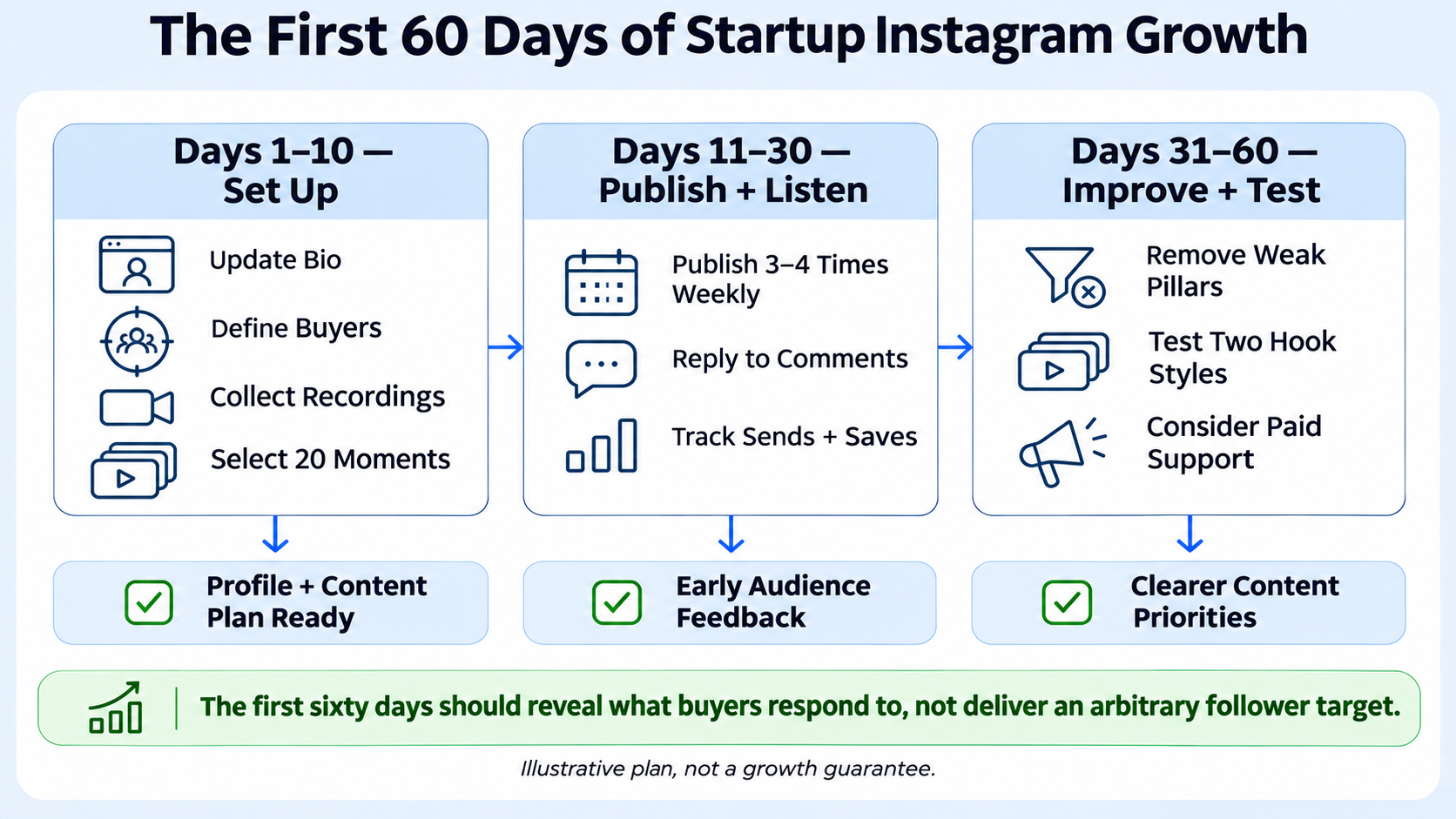
Days 1 to 10: set up. Rewrite the bio and link, create Highlights, and write the ICP in one paragraph. Collect recordings and pick twenty candidate moments.
Days 11 to 30: publish and listen. Ship three to four posts a week. Reply to every comment. Note which topics draw sends and saves, not only likes.
Days 31 to 60: tighten. Cut the weakest pillar, double down on the strongest, and test two hook styles. Decide whether any post justifies paid support.
The goal at day sixty is not a follower target. It is a clear view of which topics your buyers respond to and how much time the program takes.
Content Pillars Worked Through in Detail
Pillars keep the account from becoming random. These four suit most funded startups, and each has a specific job.
Problem education. Content that names a problem your buyer has and explains it better than they can themselves. Examples: a carousel on the five signs a process has outgrown spreadsheets, or a Reel on a common mistake in your category. This pillar earns saves and sends because it is useful on its own terms.
Product in context. Short demonstrations tied to a job to be done. Instead of walking through a feature list, show one task from start to finish. End on the result, not the interface.
Proof. Customer outcomes, with permission, and sourced numbers. Where you cite a market figure, name the source on the slide. Where you cite your own result, state what it measures and over what period.
Team and how we build. Hiring, decisions and values, which also support recruiting. Founders and engineers explaining a choice, a trade-off or a lesson are more convincing than polished culture videos.
For each pillar, keep a list of ten ideas drawn from sales calls, support threads and internal talks. A pillar with a bank of ideas is easier to run than one that depends on inspiration.
A Sample 30-Day Calendar for a Funded Startup
This template assumes three to four posts a week. It is a planning aid, not a benchmark.
Because the schedule is fixed, you can batch: record in one or two sessions per month, edit in a block, schedule in advance and leave time for live replies.
Using Instagram for Recruiting
Funded startups often hire quickly, and Instagram can support that without becoming a job board.
- Show how decisions are made. A short clip of a team member explaining a trade-off tells candidates what the work is like.
- Feature roles with a story. Instead of "we're hiring", describe the problem the new person will solve.
- Use Highlights for culture and roles, with a link to your careers page.
- Respect privacy. Get consent before showing colleagues, and avoid showing screens with customer data.
Track applications that mention content, and ask new hires what they saw before applying. This is a small sample for a long time, so treat the log as qualitative.
Rules for Paid Amplification
Paid support makes sense after organic content has proven itself. A few rules help:
- Promote what already works. Choose posts that earned sends and saves from the right audience.
- Define the audience. Use job titles, interests and lookalike audiences carefully, and exclude existing customers when the aim is acquisition.
- Set a test budget and an end date, and compare cost per useful outcome, such as a profile visit from a target account or a qualified conversation.
- Keep creative consistent with the organic account, so ads do not feel like a different company.
- Check platform policies for any category with restrictions.
For a deeper comparison of the two approaches, see our guide to organic versus paid Instagram growth for B2B.
Handling Internal Objections
"We should focus on LinkedIn." Do both, but start with one system. The same recordings feed both platforms, so the added cost is adaptation, not new production.
"Our product is too technical." Technical products can work if the content addresses the problem, not the architecture. Test with one or two simple explainers before deciding.
"Our CEO will not do video." Start with carousels and quotes, and use product leaders, engineers or customers as speakers. Ask the CEO for a single short recording a month.
"We have no time." A weekly review of thirty minutes and a monthly recording session are the minimum. If the team cannot spare that, the channel is not ready to run.
"How will we justify the spend?" Agree metrics in advance, show the log of buyer mentions, and set a review date at the end of the test period.
How to Measure Instagram Growth for Funded Startups
Match the metric to the purpose, and use several signals because attribution is imperfect.
- Awareness: views, retention, profile visits from non-followers.
- Engagement: sends, saves, replies and comments.
- Commercial: link clicks, demo requests, qualified conversations, and sales calls where the prospect mentions your content.
Ask your sales team to log when a prospect says they saw a post. Those notes will teach you more than a dashboard. Review them monthly with the founder and the head of sales, and write down which topics came up in real conversations. Over a quarter this becomes a short list of themes that reliably start buyer conversations, and that list should drive the next batch of recordings.
Conclusion: Instagram Growth for Funded Startups
An Instagram growth playbook for funded startups is not a posting schedule. It is a repeatable path from knowledge your team already has to content a buyer can use. Position the profile, set a rhythm you can keep, mix Reels and carousels, repurpose aggressively and prove performance before you pay to scale. Done steadily, this Instagram growth playbook for funded startups builds a visible body of work that supports sales, hiring and fundraising without adding a full content team.
FAQs on Instagram Growth for Funded Startups
What is an Instagram growth playbook for funded startups?
It is a plan for building an Instagram presence that supports pipeline: positioning, content pillars, formats, cadence, repurposing and measurement, adapted to a company that has raised capital and has limited time.
How much does it cost?
It depends on content volume, production difficulty, turnaround and whether publishing and distribution are included. Komet Media's typical working range for ongoing engagements is roughly $2,500 to $5,000, with final pricing based on scope.
How many times a week should a startup post?
Three to four posts a week is a realistic target. Buffer's data links three to five posts a week with higher reach per post than one or two, but quality matters more than volume.
How long until we see results?
Using this Instagram growth playbook for funded startups, plan on a few months of consistent publishing before you judge. The first weeks are for calibration. No result is guaranteed.
What deliverables should we expect from a partner?
Edited Reels, carousels, captions, exports for each platform, a content calendar and a regular performance review.
Should we hire a freelancer or an agency?
A freelancer can handle edits and design. An agency suits teams that want strategy, repurposing, distribution and review handled together. Compare options in our guide to freelance editors versus agencies for B2B.
Should this be in house or outsourced?
Keep the product knowledge and founder voice in house. Outsource production and distribution when capacity is the constraint.
How does Komet Media help funded startups?
Komet Media creates Instagram content from scratch and repurposes demos, webinars, podcasts and founder conversations for funded AI and tech startups, then handles distribution and reporting.