
🪄 AI Summary
Heading 1
Heading 2
Heading 3
Heading 4
Heading 5
Heading 6
Lorem ipsum dolor sit amet, consectetur adipiscing elit, sed do eiusmod tempor incididunt ut labore et dolore magna aliqua. Ut enim ad minim veniam, quis nostrud exercitation ullamco laboris nisi ut aliquip ex ea commodo consequat. Duis aute irure dolor in reprehenderit in voluptate velit esse cillum dolore eu fugiat nulla pariatur.
Block quote
Ordered list
- Item 1
- Item 2
- Item 3
Unordered list
- Item A
- Item B
- Item C
Bold text
Emphasis
Superscript
Subscript
Most B2B SaaS, AI, and tech startup teams producing video content in 2026 are bleeding budget quietly. Not from bad creative decisions, but from structural errors hiding in plain sight: wrong formats, wrong platforms, no repurposing, and zero measurement discipline. I've seen founders spend five figures on a brand film that never moved a pipeline. This breakdown covers the exact video marketing mistakes that waste the budget in 2026, and what to do instead.
TL;DR
- Skipping content repurposing means paying full price for every single asset, though teams without existing recordings can also build a video library entirely from scratch.
- No clear call to action kills conversion regardless of production quality.
- Chasing the wrong platform burns spend before a single buyer sees your content.
- Vanity metrics (views, likes) are not pipeline indicators, track what matters.
Mistake 1: Producing One-Off Videos with No Repurposing Strategy
This is the biggest budget leak I see consistently. A founder records a 45-minute product demo, the team clips one highlight, posts it once, and calls it a campaign. That's not a strategy. That's an expensive one-shot. 52% of B2B SaaS, AI, and tech startup marketers say video is the content type that delivers the highest ROI , but that ROI assumes you're extracting maximum value per production dollar. A single webinar, podcast episode, or product walkthrough can yield 15 to 20 distinct short-form assets when processed through a proper content repurposing strategy. LinkedIn clips. YouTube Shorts. Sales enablement snippets. Email embeds. Each one serves a different stage of the conversion funnel.
The winning playbook in 2026 is clear: whether you capture footage from scratch or repurpose existing recordings, version it by audience and ship consistently. The trap B2B SaaS, AI, and tech startup teams fall into is treating every video as a bespoke, unorganized production. What scales is a repeatable video production workflow: whether starting with research and original scripting or using long-form assets as source material. When you build that video engine with dedicated short-form video editing and production support, your cost-per-asset drops dramatically while distribution volume climbs.
The math is simple. If you spend $3,000 producing a webinar and get one clip out of it, your cost per asset is $3,000. If you get 20 clips, your cost per asset is $150. Same recording session. Radically different return on investment.
The fix: map every long-form content piece you already have (demos, podcasts, founder interviews, customer calls) or start fresh with scripted concepts if you have no existing content library. Your events and webinars—or newly scripted concepts—are the raw material for your growth.
Mistake 2: Ignoring Short-Form Video Entirely (or Over-Indexing on Long-Form)
Long-form video still has a role. But treating it as your primary budget allocation in 2026 is a costly strategic mistake. Marketers rank short-form video as the number one ROI format for the third consecutive year, and 57% of marketing budgets now include a dedicated short-form line item. If yours doesn't, you're behind most of your direct competitors before the first impression lands. Videos under 60 seconds generate 2.5x more engagement per impression than any other content type.
For B2B SaaS, AI, and tech startup teams specifically, short-form video does three things simultaneously: it builds buyer familiarity with your product, positions the founder or team as credible, and feeds the platform algorithm with the consistent output needed for organic reach.
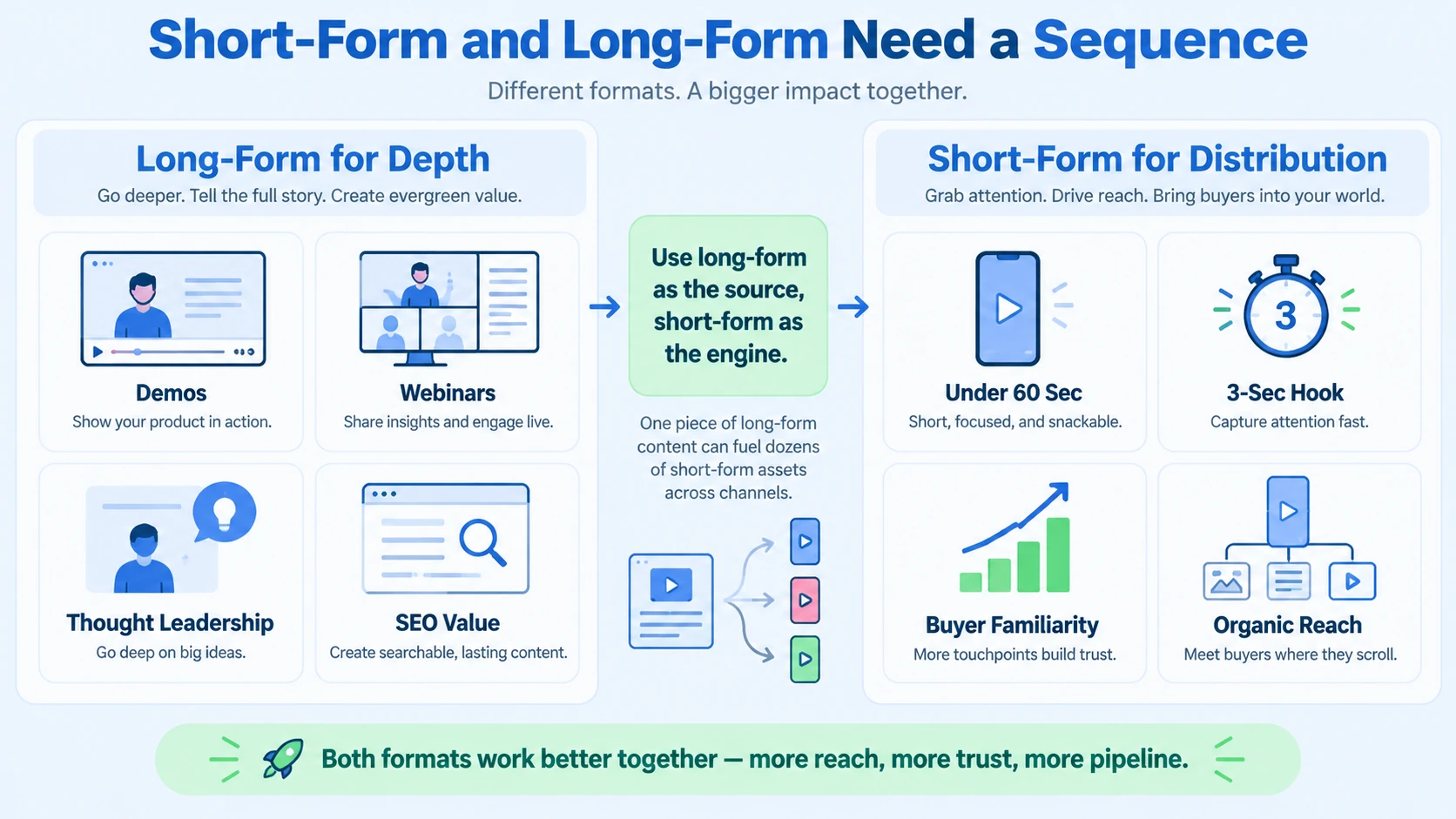
Nearly 6 in 10 short-form videos are watched for 41% to 80% of their total length, but only 30% achieve an average watch rate above 81%. That gap is where most teams lose, not in production, but in scripting and hook design. The first three seconds determine audience retention rate. If your opener is a logo or a "welcome back to our channel," you've already lost most of your audience.
Short-form dominates engagement and reach metrics. Long-form wins on SEO value, lead generation, and audience depth. The most effective video strategies in 2026 use both formats for complementary purposes.
The fix: use long-form for depth (demos, webinars, thought-leadership series), and use short-form as the distribution engine that drives traffic toward those deeper assets. Don't choose one. Sequence them.
Mistake 3: Paying for Video Ads with No Clear Call to Action or Conversion Path
Paid video spend without a functioning conversion funnel is the fastest way to burn budget. I see this constantly with funded SaaS, AI, and tech startups: $10K/month on Meta or LinkedIn video ads, driving to a homepage, with no A/B testing and no clear call to action. Results are predictably flat.
Website conversion rates increase from 2.9% to 4.8% with video, a 65% improvement in conversion performance that directly impacts lead generation and pipeline creation. But that lift only materializes when the video is paired with a page built to convert. A 90-second product overview ad driving to a generic homepage is not a campaign. It's an awareness tax.
The structure that actually works for B2B SaaS, AI, and tech startups:
- Short-form video ad (30–60 seconds) with a single, specific offer, demo booking, free audit, gated guide.
- Dedicated landing page that mirrors the video's message and audience segment.
- Retargeting sequence for viewers who watched 50%+ but did not convert.
- Performance review in Meta Business Suite or YouTube Analytics weekly.
- A/B testing on at minimum: hook (first 3 seconds), CTA copy, and landing page headline.
98% of B2B decision makers have watched explainer videos, and 87% of B2B buyers say video influenced their purchase decisions. The demand is there. The conversion path is what's broken in most campaigns. You can explore how Komet Media structures this through our video advertising services.
Mistake 4: Platform Mismatch, Publishing Everything Everywhere
Distributing the same video to every platform simultaneously sounds like efficiency. In practice, it's one of the video marketing mistakes that will waste the budget in 2026 because it treats LinkedIn, TikTok, and YouTube as interchangeable when they're fundamentally different environments. Instagram is the most effective video marketing platform for 61% of marketers, followed closely by LinkedIn at 59%.
For B2B SaaS, AI, and tech startup teams, LinkedIn and YouTube are where buyers actually live. TikTok reaches volume, but the buyer intent is different. Publishing a 60-second product walkthrough on TikTok without reframing it for that audience means your target audience segmentation is off from the start. Each platform has distinct algorithmic preferences:
71% of marketers say short-form videos in the 30-second to 2-minute range perform best. Format to platform. Don't just resize, reframe the message, the hook, and the caption for each context. Use YouTube Analytics and platform-native tools to confirm where your specific audience concentrates before scaling spend.
Mistake 5: Measuring Views Instead of Pipeline Impact
This might be the most strategically damaging mistake on this list. View counts feel good. They don't pay invoices.
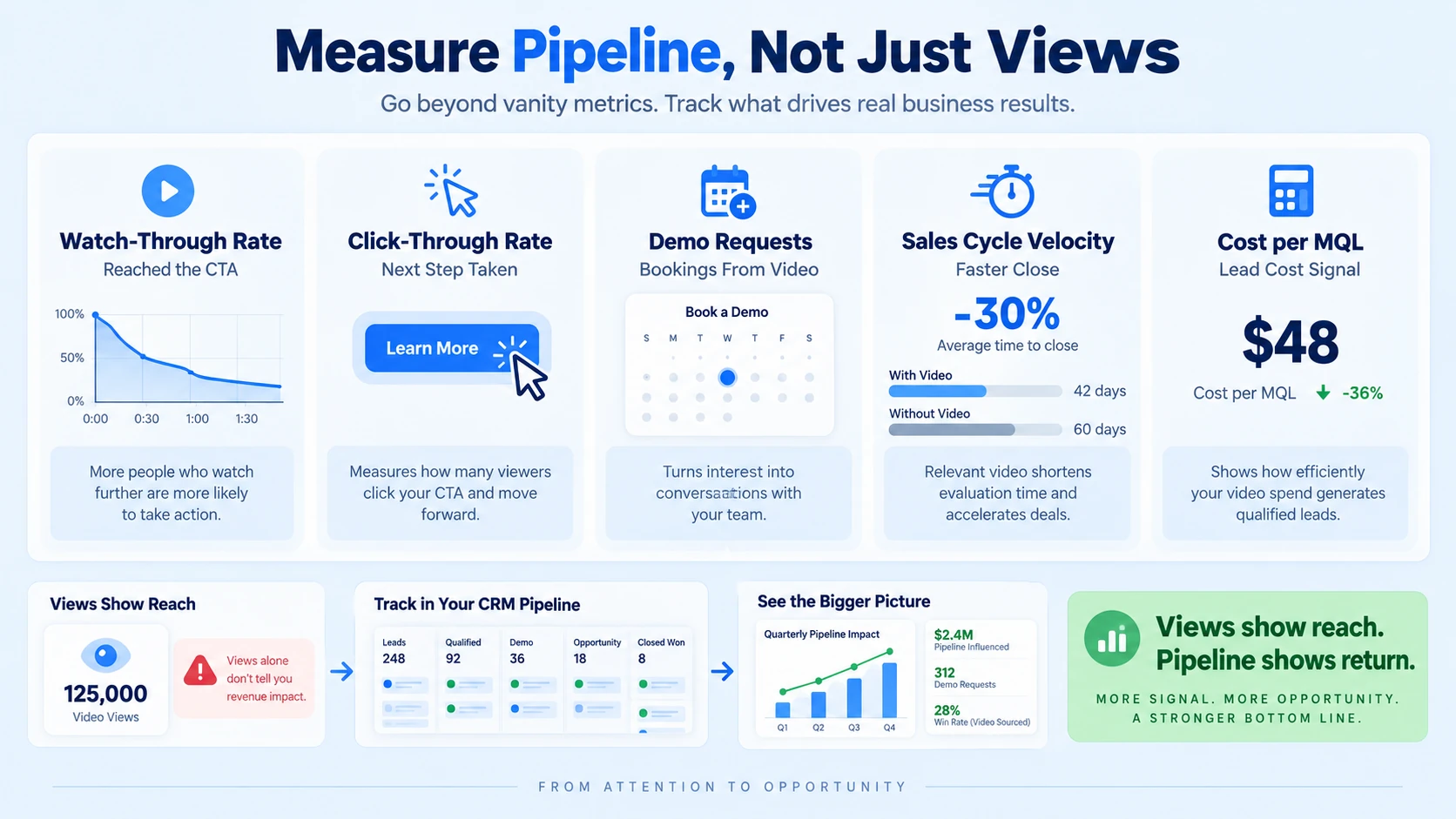
B2B organizations using video report 27% higher marketing-qualified lead rates than those that do not. But you'll never surface that lift if you're only tracking impressions and play rates. The performance metrics that actually map to pipeline for B2B SaaS, AI, and tech startup teams are:
- Watch-through rate: What percentage of viewers reached your CTA?
- Click-through rate: Are viewers taking the next step?
- Demo request volume: Did video-assisted touchpoints correlate with bookings?
- Sales cycle velocity: Are prospects who consumed video closing faster?
- Cost per marketing-qualified lead (MQL): Are video-influenced leads cheaper than other channels?
Wyzowl noted that ROI satisfaction from video fell from 93% in 2025 to 82% in 2026, not because video stopped working, but because more teams are holding video to stricter performance standards. That's the right direction. Vanity metrics hide waste. Connecting Google Search Console to your content analytics and tracking organic reach from video-driven pages gives you a clearer demand signal.
The fix: set one video-specific pipeline metric per quarter and build your reporting dashboard around it. Views are a leading indicator of reach, not a measure of return on investment. Treat them accordingly.
Mistake 6: Outsourcing Video Without a Clear Brief or Brand Storytelling Framework
Handing off video production without a defined brief is one of the most common video marketing mistakes that waste the budget in 2026 for growing SaaS, AI, and tech startup teams. The output comes back generic, off-message, and disconnected from the actual product narrative. You pay for revisions. You delay launches. You restart. The constraint in 2026 is not production cost. It's on-brand quality at volume.
AI tools have cut median production costs, reducing the median video production cost from $4,200 to $2,500 per finished minute. But cheaper production doesn't fix a missing brand storytelling framework. Generic videos underperform regardless of how polished they look.
A production-ready brief for B2B SaaS, AI, and tech startup video should include:
- The one-sentence value proposition the video must communicate.
- The specific ICP (job title, company stage, awareness level) watching this video.
- The single action the viewer should take after watching.
- Approved messaging around product differentiators, not feature lists.
- Tone reference: examples of content that sounds right, and examples that don't.
This is exactly why at Komet Media, we don't start with editing. Whether developing original video assets from scratch or repurposing long-form footage, we start with understanding what a SaaS, AI, or tech startup team needs buyers to believe after watching. That clarity drives every creative decision downstream. When you brief well, revision cycles collapse. When you skip it, you're paying full production cost for content that doesn't close the gap between awareness and intent.
Conclusion
The video marketing mistakes that waste the budget in 2026 are rarely about production quality. They're about system failures: no repurposing, wrong platforms, missing CTAs, vanity metrics, and briefs that don't exist.
Key takeaways:
- Build a video library from scratch or repurpose existing long-form assets before commissioning one-off, disconnected projects.
- Match format and message to the platform where your specific buyers spend time.
- Track pipeline metrics, not play counts.
- Brief any production partner with the same precision you'd use for a sales deck.
If your video isn't moving the pipeline, the problem is fixable. Start with a strategy conversation.
Frequently Asked Questions
Q1: What are the most common video marketing mistakes B2B SaaS, AI, and tech startup teams make?
The most common mistakes are producing one-off videos without a scalable workflow or repurposing plan, publishing without a clear call to action, and measuring views instead of pipeline metrics. Teams without existing footage can also partner to create structured video libraries from scratch. Each mistake burns budget without generating qualified demand or moving buyers toward a demo.
Q2: Why is my video marketing not getting ROI?
Usually it comes down to three issues: no conversion path after the video, publishing on the wrong platform for your buyer, or a brief so vague the content can't communicate a specific value proposition. Fix the system before increasing spend.
Q3: Are long-form videos still worth the budget in 2026?
Yes, for depth and SEO. Long-form wins on SEO value, lead generation, and audience depth, and the most effective video strategies in 2026 use both formats for complementary purposes. Don't abandon long-form; repurpose it into short-form distribution assets.
Q4: How do I stop wasting money on video ads that don't convert?
Build a specific landing page for each ad, A/B test your hook and CTA, retarget viewers who watched 50%+ but didn't click, and review performance in Meta Business Suite or YouTube Analytics weekly. Ads without a conversion funnel are awareness spend, not performance spend.
Q5: What video marketing strategies are outdated in 2026?
Producing only long-form hero videos, posting the same cut to every platform without adaptation, and skipping captions. Short-form formats now dominate ROI rankings, and AI is reshaping how teams script, edit, caption, and scale production. Static platform strategies from 2022 no longer map to current algorithm behavior.
Q6: How much should I spend on video marketing without wasting money?
There's no universal number, but the principle is: spend less on new production, more on distribution and repurposing existing content. 57% of marketing budgets now include a dedicated short-form line item. Start there. Build output volume before scaling paid amplification.