
🪄 AI Summary
Heading 1
Heading 2
Heading 3
Heading 4
Heading 5
Heading 6
Lorem ipsum dolor sit amet, consectetur adipiscing elit, sed do eiusmod tempor incididunt ut labore et dolore magna aliqua. Ut enim ad minim veniam, quis nostrud exercitation ullamco laboris nisi ut aliquip ex ea commodo consequat. Duis aute irure dolor in reprehenderit in voluptate velit esse cillum dolore eu fugiat nulla pariatur.
Block quote
Ordered list
- Item 1
- Item 2
- Item 3
Unordered list
- Item A
- Item B
- Item C
Bold text
Emphasis
Superscript
Subscript
Most founders record a podcast episode, publish it, then move on. That's leaving most of the episode's value on the table. Podcast repurposing is the system that turns one recorded conversation into a week or more of authority-building content across LinkedIn, email, YouTube, and beyond. If you're a founder, CEO, or tech executive who wants consistent visibility without recording constantly, this playbook is your exact blueprint.
TL;DR
- One podcast episode contains enough raw material to fuel an entire week of multi-channel content.
- Podcast repurposing is the highest-ROI content activity for time-constrained executives.
- A structured workflow, not more recording, is what separates visible founders from quiet ones.
- The right tool stack makes this achievable without hiring a large team.
What Is Podcast Repurposing and Why Does It Matter for Founders?
Podcast repurposing is the process of extracting clips, quotes, transcripts, and insights from a recorded episode and redistributing them across every channel your buyers use. It's not re-publishing the same audio. It's content atomisation: breaking one conversation into its smallest valuable components and rebuilding each piece for a specific platform and audience behavior.
This isn't just repurposing for the sake of volume. It's strategic content atomization designed to penetrate every channel where your buyers live. Every B2B podcast episode contains 12 or more pieces of pipeline-driving micro-content trapped inside. For founders and CEOs, this matters for three specific reasons.
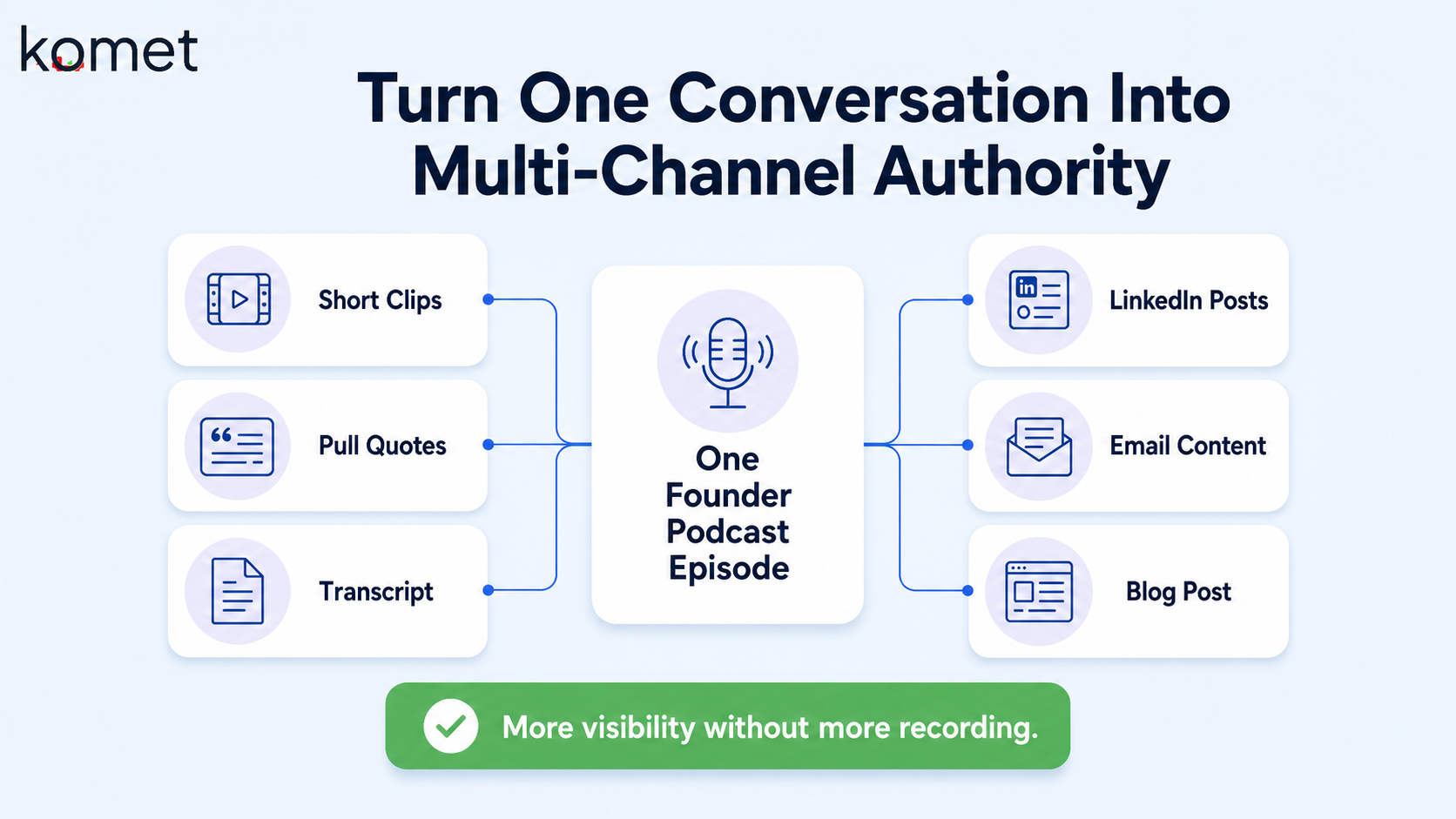
First, trust with buyers is built through repeated, visible touchpoints, not a single listen. After hearing podcast episodes, 61% of podcast listeners feel more favorable toward a brand, and companies with branded podcasts achieve 89% higher brand awareness and 57% higher brand consideration.
Second, your buyers are already consuming podcasts. Decision-makers are actively consuming podcast content, with 83% of senior executives listening to at least one podcast weekly.
Third, most founders are time-constrained. Recording fresh content every day isn't realistic. Podcast repurposing solves the consistency problem without multiplying your recording schedule. Gary Vaynerchuk popularized the "document, don't create" philosophy, and his content pyramid model is essentially podcast repurposing at scale: one anchor piece of content generates dozens of downstream assets. That principle is what makes your podcast the most efficient content investment you can make.
The result is omnichannel marketing from a single production session. Your buyers encounter your thinking on LinkedIn, in their inbox, on YouTube, and in search results, all from one conversation you had on a Tuesday morning.
The Podcast Repurposing Strategy Every Busy Founder Needs
The reason most founders abandon repurposing isn't effort. It's the absence of a repeatable system. Without a defined workflow, each episode becomes a new project instead of a predictable production run.
Here's the system I use and recommend for executive teams. Think of your podcast episode as anchor content, the raw material from which everything else is derived.
The three-tier content hierarchy:
- Tier 1 (Anchor): Full episode published on Spotify, Apple, and YouTube
- Tier 2 (Derivative): 3–5 short-form video clips, 1 blog post, 2–3 LinkedIn text posts, 1 email newsletter
- Tier 3 (Micro): Quote graphics, pull quotes, audiograms, LinkedIn carousels
From a single 30-minute recording, you can extract 3 LinkedIn articles, 10 social posts, 5 email sequences, 2 blog posts, and 15 sales enablement assets. That's weeks of content from one conversation.
The strategic principle that separates high-performing executive content from noise: optimize Tier 2 and Tier 3 assets for the channel first, not the content. A LinkedIn clip is not a horizontal YouTube video with a different caption. It's a vertical, captioned, 60-second standalone argument. Each format demands a native treatment. The prioritization rule that changes everything is to optimize for your highest-converting channel first. If LinkedIn drives 70% of your qualified leads, create LinkedIn-native content before touching any other platforms.
For most B2B founders, that means LinkedIn. Your short-form video clips, text posts, and carousels should all be LinkedIn-first, then redistributed to other channels as a secondary step. This is the core of a sustainable LinkedIn content strategy that doesn't require you to be in front of a camera every day.
How to Turn One Podcast Episode Into a Week of Social Media Posts
A 30-minute episode yields 3 two-minute video clips, 5 audiograms, 10 pull quotes, 3 LinkedIn articles, and 15 social posts.
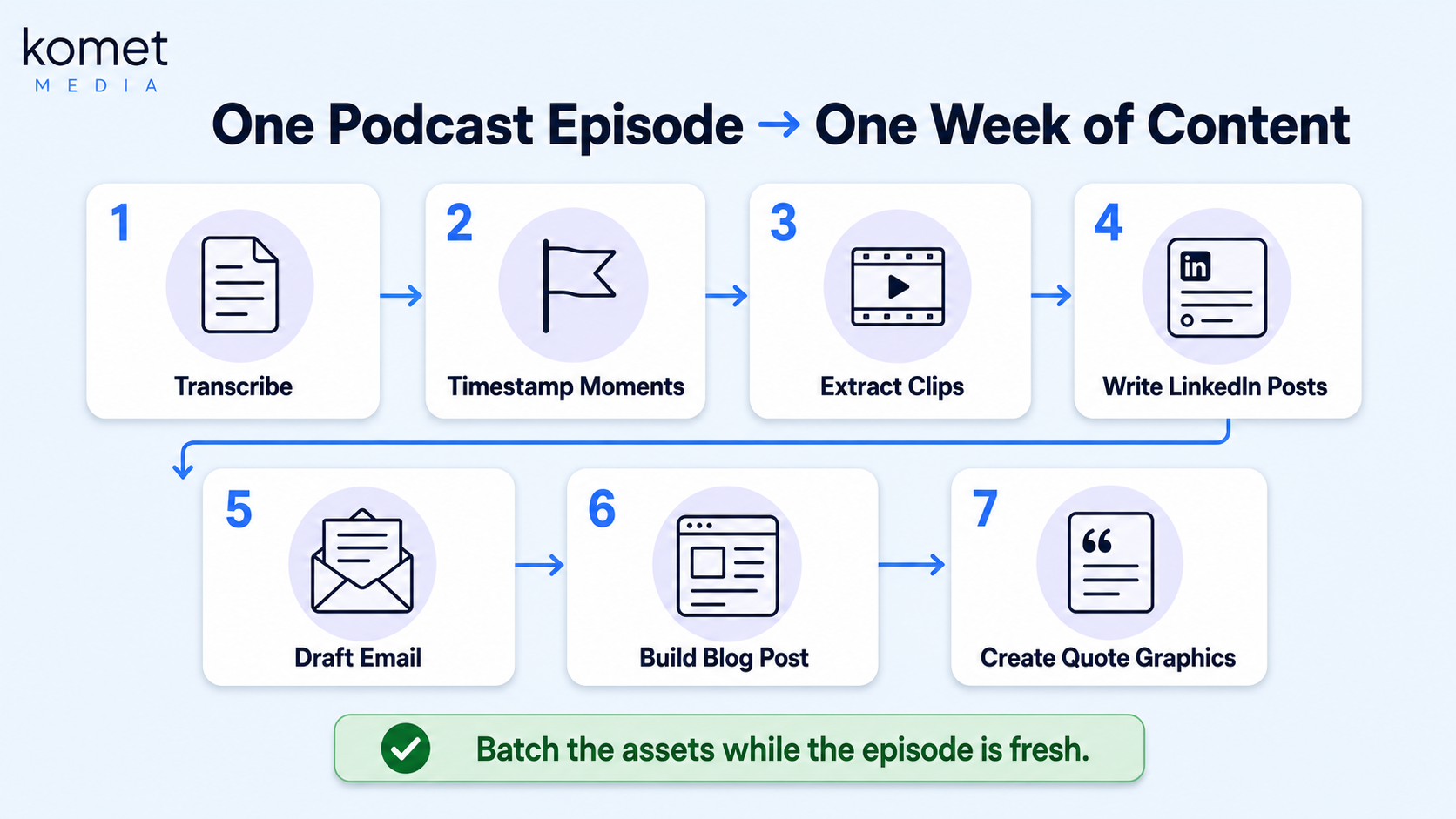
Here's the exact production sequence to make that happen.
- Transcribe immediately: Run the raw audio through Descript or Castmagic the moment recording ends. The transcript becomes your production map for every downstream asset.
- Timestamp your moments: Mark strong claims, contrarian takes, guest reactions, data points, and frameworks. These become your clip queue.
- Extract 3–5 video clips: Each clip should be 45–90 seconds, carry a complete micro-argument, and have burned-in captions. 85% of viewers watch videos without sound on social platforms, making captions non-negotiable for B2B audiences.
- Write 3 LinkedIn text posts: Pull the strongest argument from the episode. Write it as a standalone opinion piece. Don't summarize the episode. Make the point.
- Draft the email: Use one key insight as the hook. Link to the full episode at the end. Keep it under 200 words.
- Build the blog post: Use the transcript as a first draft, restructure it around a target keyword, add context, and publish. This fuels evergreen content that compounds in search over time.
- Create 5–8 pull-quote graphics: Static visuals for LinkedIn and Instagram. One quote per graphic, branded.
Batching beats perfection. Block two hours post-production to create all repurposed assets in one session. One two-hour block per episode is the entire execution cost. That's manageable for any founder.
Best Tools for Podcast Repurposing in 2026
The right tool stack removes friction from every stage: transcription, editing, clip creation, and distribution. Here's how the major platforms compare.
Descript sits in a different category from pure clippers. It's closer to a production desk for creators who repurpose from spoken content. If your raw material is podcasts, interviews, or webinars, text-based editing is a major advantage.
One of Riverside's standout features is how it handles clip creation. After recording, Riverside automatically creates clips, shorts, and longer segments without any prompting.
Repurpose.io is the right choice when the core problem isn't editing but distribution. If you've already got finished episodes and need them pushed into multiple channels without babysitting every upload, this is one of the most useful setups available.
For a lean founder workflow, the minimum viable stack is: Riverside.fm for recording, Descript or Castmagic for transcription and text assets, OpusClip for video clips, and Repurpose.io for automated distribution. You don't need all four from day one. Start with recording and transcription, then add clipping and distribution as your output grows. Our short-form video editing service can also handle the clip production for you if production time is the bottleneck.
How CEOs Use Their Podcast to Build Thought Leadership Content
Thought leadership isn't a title you assign yourself. It's the accumulated weight of visible, useful opinions held consistently over time. Podcast repurposing is the mechanism that makes that consistency possible without requiring a daily original-content habit.
B2B podcasting has matured into one of the most powerful tools for brand growth, authority building, and trust. It combines storytelling, education, and strategy into one of the most personal forms of marketing available.
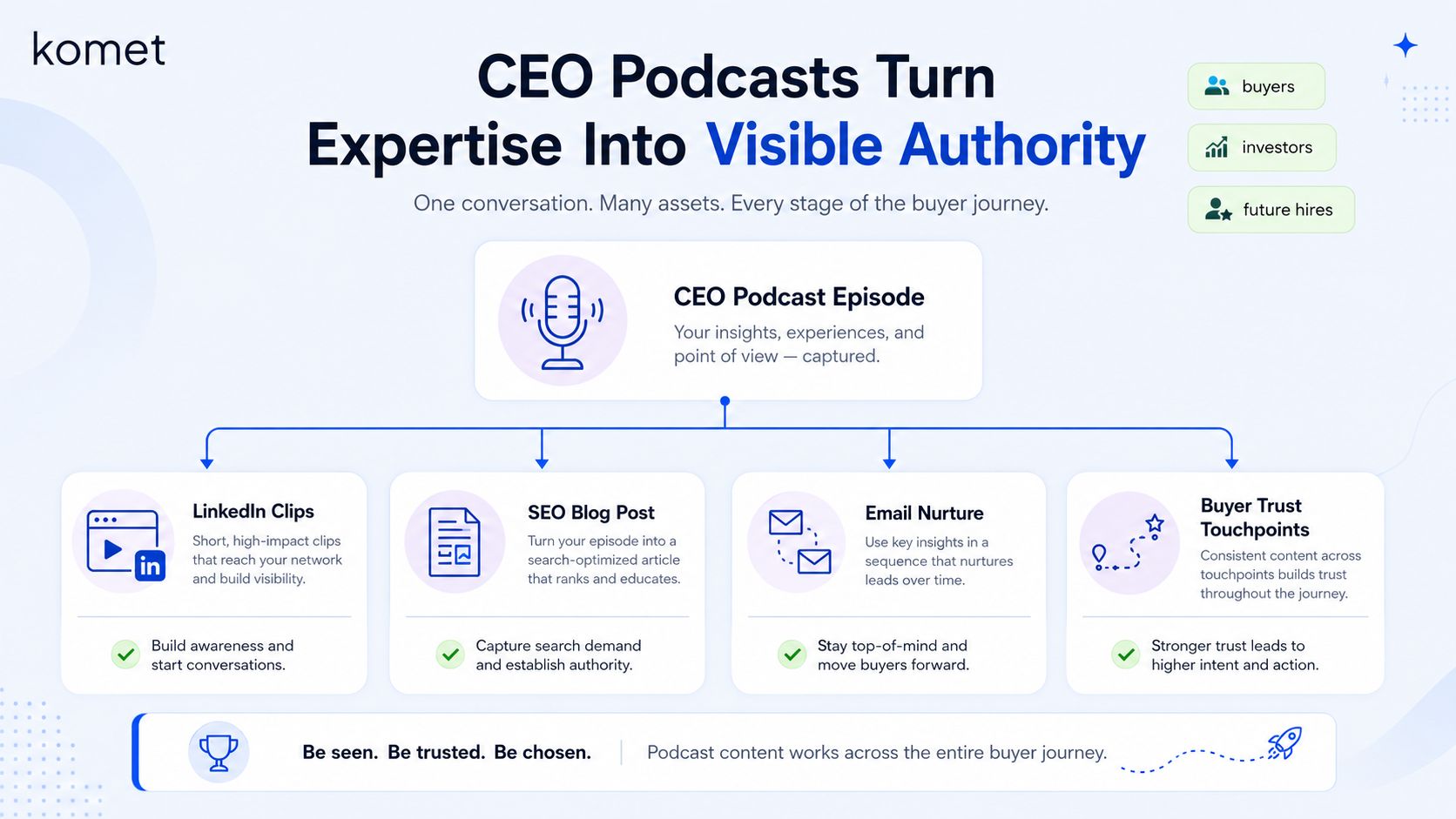
For a CEO, the podcast does three things simultaneously. It demonstrates domain expertise through conversation. It creates a documented archive of positions and frameworks. And it generates the raw material for every other content format.
Host credibility exceeds other content creators, with 59% of listeners rating podcast hosts as more trustworthy than influencers, making host-read content more effective than third-party endorsements.
The executive personal branding play works like this. Your episode is the proof-of-expertise artifact. The clips distributed on LinkedIn are the discovery mechanism. The blog post is the SEO asset. The email is the nurture sequence. Together, they build a compounding presence with buyers, investors, and future hires who encounter your thinking across multiple touchpoints before ever booking a call.
Parasocial relationships develop through regular listening, with 52% of audiences reporting feeling closer to podcast hosts than other media figures. This intimacy creates brand affinity that translates to customer loyalty and advocacy over time.
That's the real B2B content marketing value of podcast repurposing for executives: it makes trust scalable. One recorded conversation becomes dozens of touchpoints that work across the entire buyer journey. Check out our podcast marketing services to see how this gets built end-to-end.
Podcast to Blog Post: Conversion Best Practices
Converting a podcast transcript into a blog post is not copy-paste. Done correctly, it's one of the highest-leverage SEO moves in a B2B content strategy because it turns conversational expertise into searchable, evergreen content.
The most overlooked repurposing format is SEO-optimized blog posts derived from transcripts. These aren't lazy copy-paste jobs but strategic rewrites targeting high-intent keywords your buyers search.
Follow this process for every episode:
- Start with the transcript: Use podcast transcription to get a clean, accurate text version before attempting any rewrite.
- Identify the core argument: What is the episode's single strongest claim or framework? That becomes the article's thesis.
- Choose a target keyword: Match the episode's topic to a real search query your buyer would use. Not "leadership insights" but "how to build executive presence on LinkedIn."
- Restructure, don't transcribe: Reorganize the conversation into H2-led sections. Cut tangents. Strengthen weak transitions.
- Add context the audio couldn't: Embed data, external links, and visuals that the audio format couldn't carry.
- Write original show notes separately: Show notes and the blog post serve different purposes. Show notes are episode summaries. Blog posts are standalone arguments. Never conflate the two. Our podcast show notes service handles this distinction cleanly.
- Optimize and publish: Title tag, meta description, internal links, and one featured image minimum.
AI-generated transcriptions alone have boosted web traffic by 30% for early adopters, demonstrating concrete returns from AI integration in the repurposing workflow.
The audience development payoff compounds over months. Each blog post indexes independently, driving organic traffic to your brand without additional ad spend or recording sessions.
The Biggest Mistakes Founders Make With Podcast Repurposing
Most founders who try podcast repurposing and abandon it make the same predictable errors. Knowing them in advance is the difference between a system that compounds and one that collapses after two months.
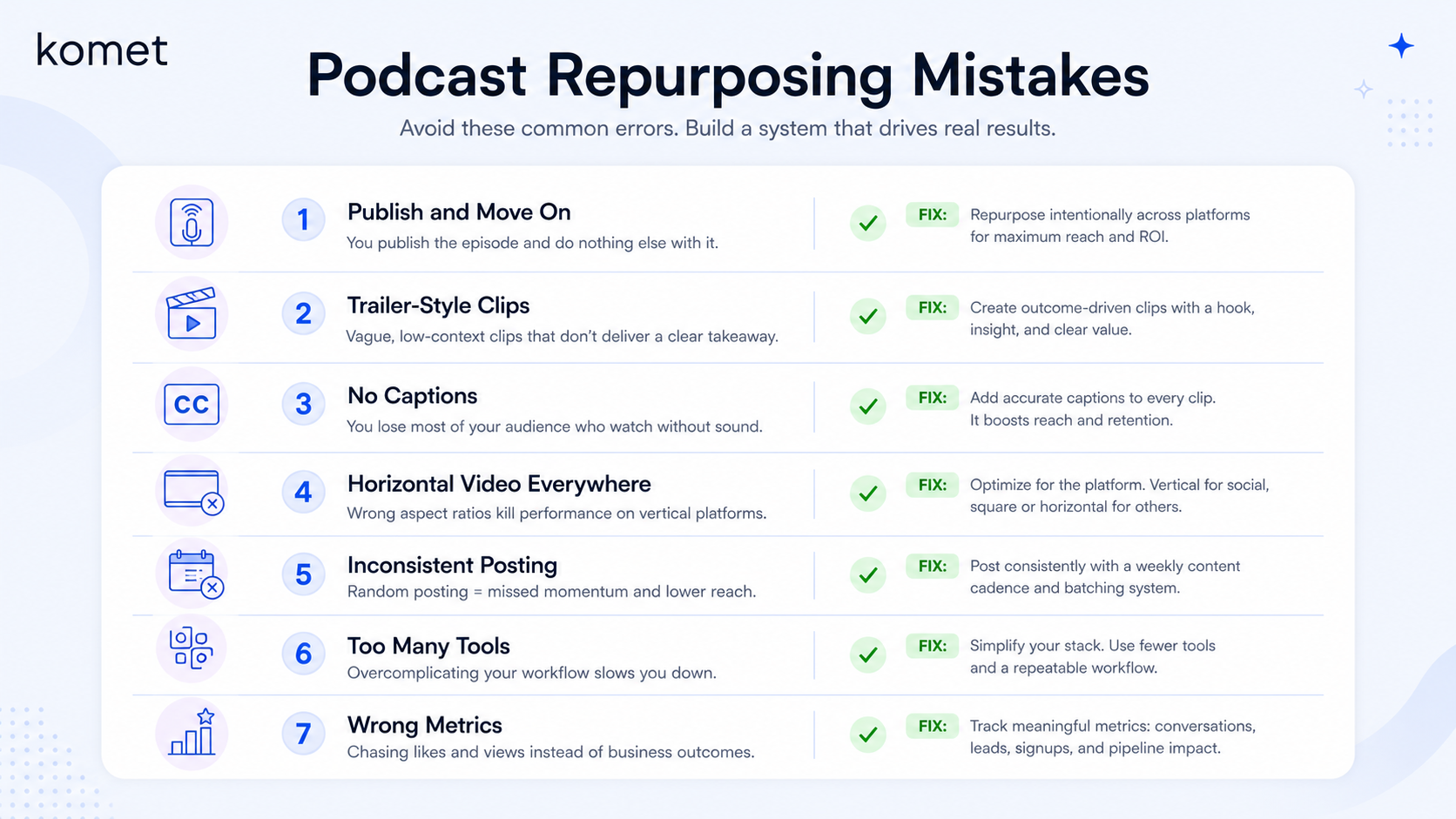
Publishing and moving on. Every B2B podcast episode contains 10–15 pieces of high-converting content, yet most marketing teams publish and pray, leaving 90% of their content's value untapped while competitors turn single episodes into multi-channel revenue engines.
Treating clips as trailers instead of standalone content. A clip that says "check out the full episode for more" is a missed opportunity. Every clip needs to deliver complete value on its own. Teasers perform poorly on LinkedIn. Arguments perform well.
Skipping captions. As noted above, 85% of viewers watch videos without sound on social platforms , so an uncaptioned clip loses most of its potential reach immediately.
Using horizontal video everywhere. LinkedIn, Instagram Reels, and YouTube Shorts all favor vertical 9:16 format. Exporting a horizontal widescreen clip and posting it without reformatting signals low production investment and gets punished by algorithms.
Inconsistent publishing cadence. Shows maintaining regular schedules achieve 3x faster audience growth than inconsistent competitors. The same principle applies to your repurposed social content. Sporadic posting breaks the compounding effect.
Over-tooling before the workflow exists. The mistake most creators make is stacking tools before the workflow exists. A creator buys a clipper, a scheduler, a transcript tool, and a writing assistant, then still posts inconsistently because the system isn't clear.
Measuring the wrong metrics. Download counts are a vanity metric for B2B founders. The metrics that matter are qualified conversations started, inbound leads that reference your content, and buyer trust signals like direct messages and deal acceleration.
Conclusion
Podcast repurposing is the highest-leverage content activity available to time-constrained founders and executives in 2026.
Here's the summary:
- One recorded episode, treated as anchor content, can fuel a full week of LinkedIn, email, blog, and video distribution.
- A consistent repurposing workflow, not volume of recording, is what builds compounding executive visibility.
- The right tool stack (Riverside, Descript, OpusClip, Repurpose.io) makes the process lean enough for a small team to manage.
- The founders winning on trust and authority aren't recording more. They're repurposing smarter.
If you want a done-for-you system, Komet Media builds this entire workflow for B2B founders and executive teams.
Frequently Asked Questions
Q1: What is podcast repurposing?
Podcast repurposing is the process of extracting clips, quotes, transcripts, and insights from a recorded episode and redistributing them as standalone assets across LinkedIn, email, YouTube, and search. It's the discipline of turning one conversation into a multi-channel content system.
Q2: How long does podcast repurposing take per episode?
With a defined workflow and the right tools, the repurposing production cycle for one episode takes roughly two to three hours. Blocking this time immediately post-recording, when the content is fresh, keeps the output quality high and the process consistent.
Q3: Do I need a big team to repurpose podcast content?
No. A solo founder with Descript, OpusClip, and Repurpose.io can execute a solid repurposing workflow. For higher output volume or more polished short-form video, partnering with a specialist agency removes the production bottleneck entirely without adding headcount.
Q4: What types of clips perform best on LinkedIn?
Clips that present a clear, counterintuitive argument or a specific framework in under 90 seconds consistently outperform general takeaways or episode summaries. Vertical format, burned-in captions, and a strong opening line in the first three seconds are non-negotiable for LinkedIn performance.
Q5: How is a blog post from a podcast different from show notes?
Show notes summarize the episode for existing listeners. A blog post is a standalone piece optimized around a search keyword that your buyer would use. It restructures the episode's best arguments into a readable, SEO-indexed article that works for people who have never heard your podcast.
Q6: How many assets should I get from each podcast episode?
A well-executed repurposing workflow should yield a minimum of 10–15 assets per episode: 3–5 video clips, 3 LinkedIn text posts, 1 email, 1 blog post, and 3–5 quote graphics. Teams running a full content atomization system regularly extract 30 or more assets from a single 45-minute recording.