
🪄 AI Summary
Heading 1
Heading 2
Heading 3
Heading 4
Heading 5
Heading 6
Lorem ipsum dolor sit amet, consectetur adipiscing elit, sed do eiusmod tempor incididunt ut labore et dolore magna aliqua. Ut enim ad minim veniam, quis nostrud exercitation ullamco laboris nisi ut aliquip ex ea commodo consequat. Duis aute irure dolor in reprehenderit in voluptate velit esse cillum dolore eu fugiat nulla pariatur.
Block quote
Ordered list
- Item 1
- Item 2
- Item 3
Unordered list
- Item A
- Item B
- Item C
Bold text
Emphasis
Superscript
Subscript
The Instagram growth playbook for VC firms starts with one decision: treat the account as a trust channel for founders, not a brand billboard. Deals are announced on LinkedIn, but founders often form an opinion about a firm earlier, from what its partners say and how they sound. A partner-led Instagram presence, built from conversations you already have, gives that opinion something real to rest on.
Quick Answer: Instagram Growth for VC Firms
The Instagram growth playbook for VC firms in short: pick one founder audience, put named partners on camera, publish from existing recordings, and judge by sends, saves and inbound conversations, not followers.
Why Instagram Deserves a Place in a VC Firm's Content Mix
I hear the same objection from many investment teams: Instagram is for consumers, and our audience is on LinkedIn. Half of that is right. LinkedIn remains the place for LP and co-investor communication. But founders, operators and talent also scroll Instagram, and Reels is the format Instagram uses to show content to people who do not follow you.
The platform is large enough that this is not a niche bet. Meta's CEO said in September 2025 that Instagram had passed 3 billion monthly active users. Size alone does not make it a fit for a fund, so the better question is what the channel does for you. For a VC firm, I see three jobs:
- Pre-qualify founders. A clear thesis in a 45-second Reel tells the right founder to reach out and the wrong one to skip.
- Humanize partners. Founders choose people. A partner who explains how they think is easier to trust than a logo.
- Extend the reach of work you already do. Podcasts, panels and fireside chats contain dozens of usable moments that never leave the recording.
There is also an honest limit. Instagram will not close a round. It shortens the distance between a stranger and a first conversation, and that is the right way to judge it.
Set the Instagram Foundation Before You Post
Most firms skip this and then wonder why content feels scattered. Every Instagram growth playbook for VC firms should define three things first.
One primary audience. Choose a single group for the first quarter: pre-seed founders, Series B operators, or LP family offices. A firm that tries to speak to all three produces content that fits none.
A thesis you can say in a sentence. For example, the sectors, founder profile or stage you back and why now. This becomes your bio, your pinned content and your Reel hooks. Use the thesis in the bio, not assets under management, and include the words a founder would search.
Named partners on camera. Individual partners usually outperform a firm-branded account in the content we see, because viewers respond to a person. The firm account then republishes and tags partner content. Not every partner needs to appear. One or two who are comfortable on camera are enough to start.
One note for the legal and compliance side. Rules about fund marketing differ by jurisdiction and fund type, so involve your compliance counsel before you publish performance claims, fundraising language or anything about unreleased portfolio news. Build that review into the workflow so it does not delay every post.
Three Instagram Content Pillars That Rotate Weekly
A simple structure keeps the account varied without becoming random.
Rotate them so a founder who finds you on a Tuesday sees a mix. The insight pillar does the heaviest lifting for deal flow. The portfolio pillar builds credibility because it shows your relationships. The culture pillar answers the unspoken question: what is it like to work with these people?
The Instagram Formats That Tend to Produce Inbound
These are the formats I would test first, in roughly this order.
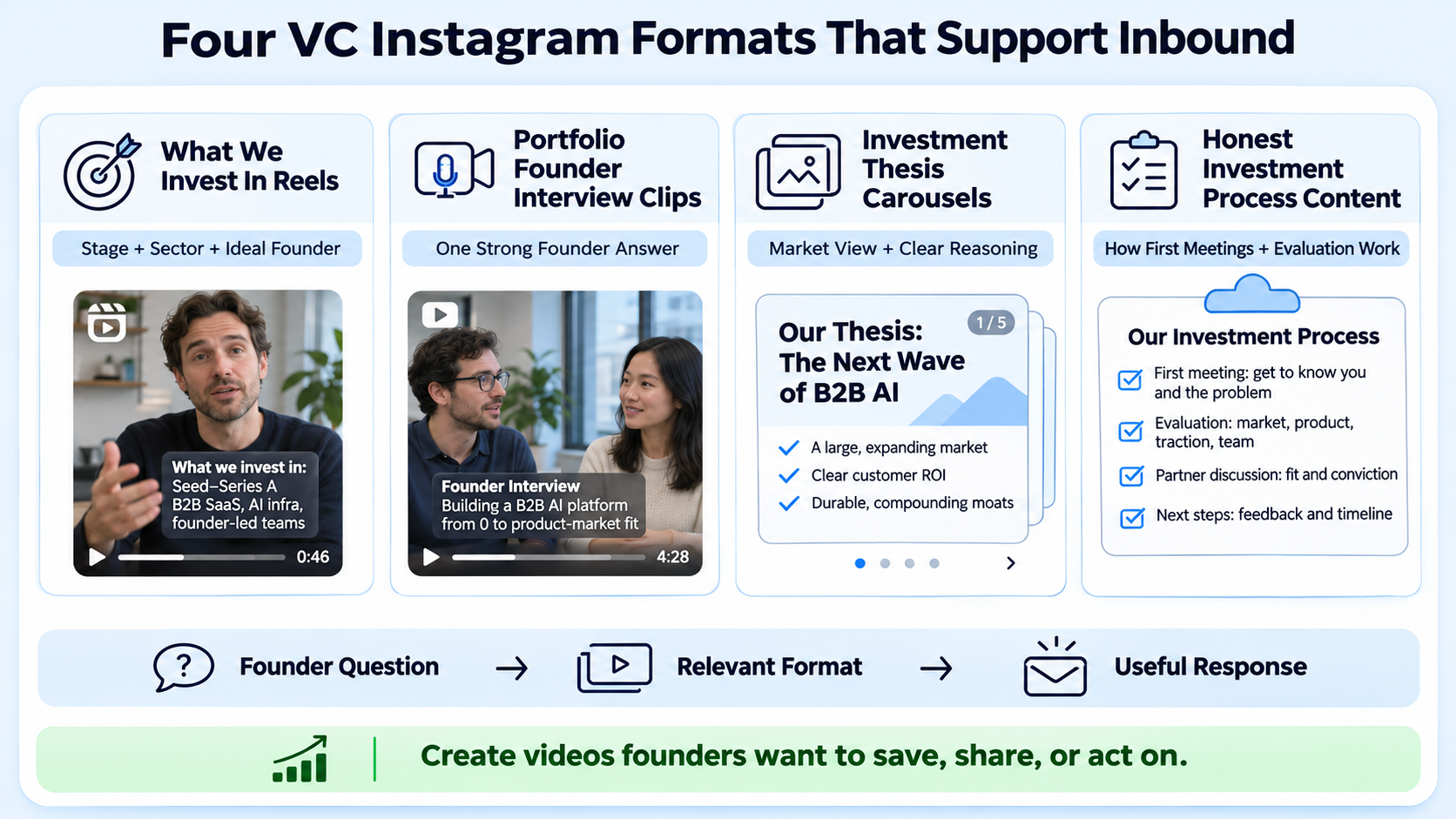
"What we invest in" Reels. A partner states the thesis, names the type of founder they want to meet, and says what a good first message looks like. Thirty to sixty seconds is enough. These pre-qualify and tend to bring more relevant inbound than generic content.
Founder interview clips. Pull one sharp answer from a podcast or webinar with a portfolio CEO. The question and the answer should make sense without context. Add captions, because many people watch without sound.
Thesis storytelling. Turn a memo, keynote or panel remark into a short sector breakdown. This is where carousels fit well, because a framework with numbered steps suits slides.
Honest process content. How you evaluate a deck, what makes a first call useful, what you look for in references. Founders save this kind of material.
For carousel design, the Socialinsider Instagram benchmarks are a useful reference point. In its 2025 data, carousels averaged a 0.55% engagement rate against 0.52% for Reels and 0.37% for single images, and carousels earned the most saves across brand sizes. Two caveats apply. That engagement rate counts likes and comments over followers, so it misses saves and shares. And the same report shows overall engagement fell about 24% year over year, so treat these numbers as a ranking of formats rather than a target.
A Weekly Instagram Cadence That a Partner Can Sustain
Volume matters less than regularity, but there is data on frequency. A Buffer analysis of about 2.1 million feed posts from roughly 102,000 accounts found reach per post was about 12% higher for accounts posting three to five times a week than for those posting one or two. Buffer notes this is correlational, that the sample likely reflects its own users, and that quality probably matters most. Read it as support for a modest, steady rhythm, not for posting as much as possible.
A realistic week for a firm with limited time looks like this:
- Two Reels cut from existing recordings.
- One carousel built from a memo, framework or sector note.
- Three to five Story frames: an event, a poll, or a short reaction.
- A fifteen-minute comment and message check from a team member within the first hour of posting.
What can shrink: Stories, if bandwidth is tight. What must not be skipped: partner-led Reels, because they carry the thesis.
What the Instagram Algorithm Rewards, and What to Do With That
Instagram's head, Adam Mosseri, said in January 2025 that the top three ranking signals are watch time, likes and sends, with likes weighing slightly more for followers and sends slightly more for non-followers. In May 2026, he added that creators should focus on engagement rates and that sends help content reach beyond existing followers.
For a VC firm, the practical reading is simple:
- Watch time: Open with the point. A partner who starts with a long introduction loses the viewer. The first line should state the idea or the problem.
- Sends: Make content a founder would forward to a co-founder. A clear sector take or a checklist for pitching is more sendable than a firm announcement.
- Likes from your audience: Keep topics tight, so the people who like it are the people you want.
Keep Reels in a range where the idea can land. Shorter is not always better, but padding is always worse.
The Instagram Repurposing and Creation Flywheel
The firms that run a durable Instagram growth playbook for VC firms do not start from a blank page each week. They record once and distribute many times, and when they lack source material, a partner can create new content from scratch. A typical flow, which we use at Komet Media with funds and founders, looks like this:
- Record or collect a long-form source: a podcast, panel, fireside chat or investor update.
- Mark the strongest moments and score them for clarity and founder value.
- Edit a master version, then cut five to eight shorts, each aimed at a different founder concern.
- Adapt each clip per platform: vertical for Reels, a tighter cut for LinkedIn, a quote card for Stories.
- Review performance and feed the lessons into the next recording.
If your firm already records content, short-form video editing is usually the quickest way to start without adding partner time. For fund-specific workflows, see our page on video editing for VC firms.
Instagram and LinkedIn: Use Both, With Different Jobs
This is not an either-or choice. LinkedIn is where partners reach LPs, co-investors and peers. Instagram is better at discovery among early-stage founders and operators who are not yet connected to you. The simplest way to run both is to record one long piece and adapt it natively for each platform, instead of posting the same file twice.
Evidence on B2B buying supports the broader point that thought leadership works beyond the decision-maker. The 2025 Edelman and LinkedIn B2B Thought Leadership Impact Report says hidden buyers, people who influence a purchase without signing it, actively consume thought leadership as much as target buyers do. That finding concerns B2B vendors, not funds, so I would apply it by analogy: the people who influence a founder's choice of investor, such as co-founders, advisors and earlier investors, also watch what you publish.
A 90-Day Rollout for the Instagram Growth Playbook for VC Firms
Firms ask how to start without disrupting partner calendars. This is the sequence I would use, and it assumes you already record some content.
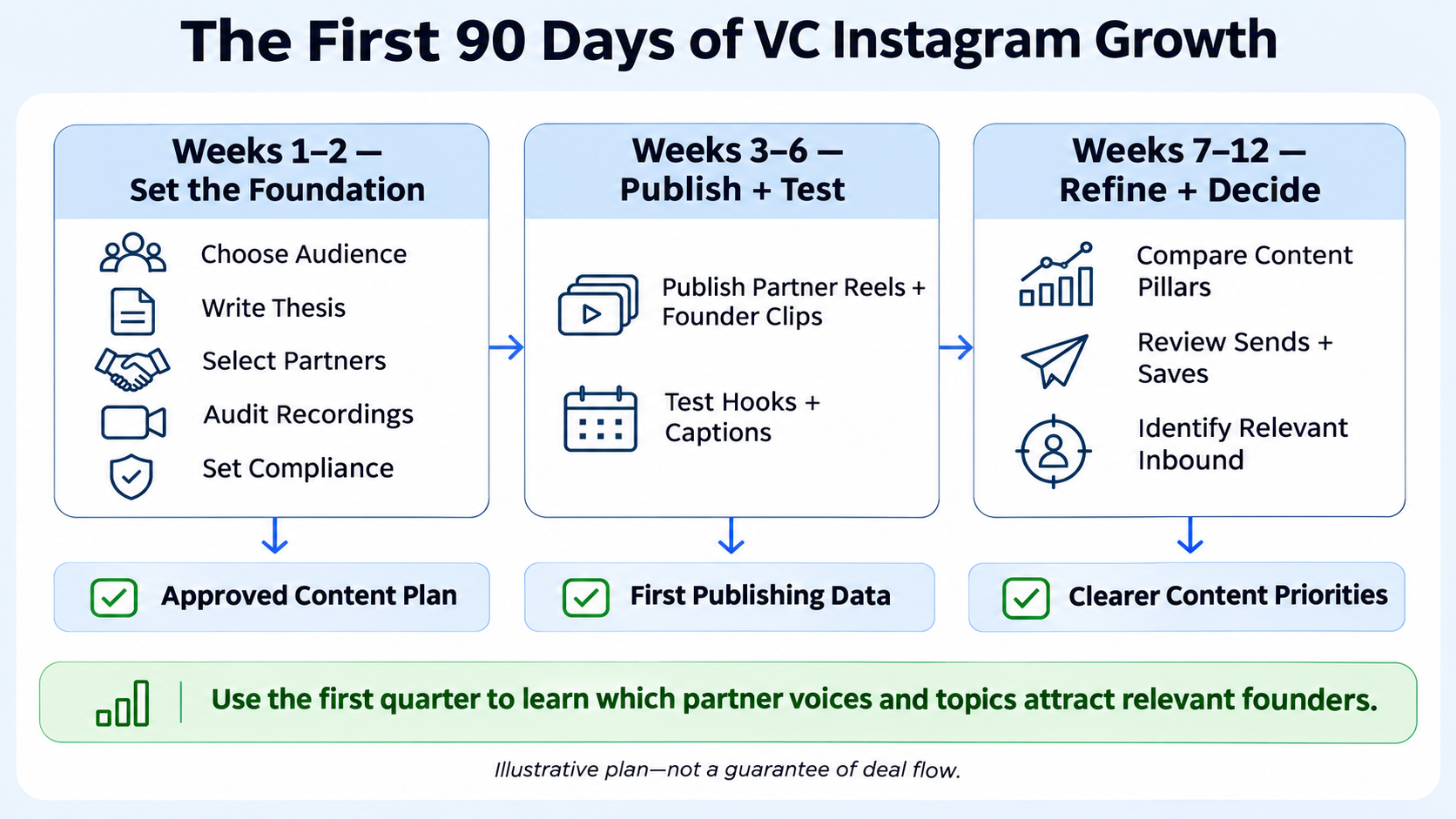
Weeks 1 to 2: set the base. Choose the audience, write the thesis sentence, and pick the one or two partners who will appear. Audit your recordings from the last year: podcasts, panels, fireside chats, portfolio founder interviews. List the ten moments a founder would most want to rewatch. Agree on a compliance review step and who owns it.
Weeks 3 to 6: publish and calibrate. Ship the first batch: two "what we invest in" Reels, a handful of founder clips, and one carousel built from a memo or sector note. Do not expect a pattern yet. Use this window to test hooks, caption length and cover frames, and to learn how long a partner needs to approve a batch.
Weeks 7 to 12: tighten and decide. Compare formats and partners. Keep the topics that draw sends and saves from the right people, and retire the ones that only draw polite likes. By the end of week twelve you should know three things: which partner voice resonates, which pillar brings inbound, and how much partner time the program really needs.
A useful rule for the whole period: if a piece takes a partner more than ten minutes to approve, the process is too heavy. Move approval to a short written checklist and a single reviewer.
How to Prepare a Partner for Instagram Video
Many partners are excellent in a room and stiff on camera. The fix is rarely media training. It is better questions and better editing.
- Ask one question at a time. A clip answers one question. If the recording ranges across ten topics, the editor has to hunt for a clean answer.
- Record answers that open with the point. Ask the partner to state the conclusion first and explain after. This helps retention and makes the clip easier to cut.
- Keep audio clean. Poor sound loses a viewer faster than a plain background. A lapel or shotgun microphone and a quiet room matter more than a camera upgrade.
- Record batches. One session with several short answers is easier to schedule than weekly filming, and it feeds a month of Reels.
Expect to discard some takes. That is normal and it is why repurposing from longer conversations works: a thirty-minute chat with a portfolio founder usually holds several clean moments, and a good editor finds them.
Handling Instagram Comments and Direct Messages
For a fund, the inbox is where Instagram turns into deal flow, so plan for it. Assign one person to check comments and messages within the first hour after publishing, and again later in the day. Reply to substantive comments with substance. When a founder sends a message about a pitch, route it into your normal intake process rather than discussing terms in the app, and reply with a short, clear next step.
Set a simple rule for what you will not do: no private commentary on competitor deals, no unreleased portfolio news, and no fundraising or performance claims without compliance sign-off. Having the rule written down protects partners who are unsure what they can say.
Script Frameworks for Partner Reels
Partners rarely need a written script. They need a structure. These four frameworks fit most VC content and can be filled in from a short conversation.
The thesis in 45 seconds. Open with the belief ("We think the next wave of company building in this sector will come from teams that..."). Give one reason it is true now. Name the kind of founder you want to meet. Close with how to reach you. Avoid naming unreleased deals and avoid return claims.
The honest first call. Describe what happens in a first meeting: what you read before it, what you ask, what makes you want a second call. Founders save this kind of content because it removes mystery from a process they find opaque.
The myth and the reality. State a common founder assumption about fundraising, then correct it with your experience. Keep to your own view and do not assert statistics you cannot source. If you cite a figure, name its source on screen.
The portfolio lesson. With the founder's consent, share one lesson from an operator you back. Ask the founder one question, let them answer in their own words, and keep your framing short. The founder is the story, not the firm.
For each, write three alternate openings and pick the one that states the point fastest. A hook that begins with the firm's name rarely beats one that begins with the founder's problem.
A Sample 30-Day Calendar for a VC Firm
The calendar below assumes two partners on camera, one marketing or platform lead and an editor. It is a planning template, not a benchmark.
At the end of the month, review which posts earned sends and saves from the right accounts, and which brought messages. Use that to set month two. If partner time is the limit, keep the Reels and drop the Stories.
Compliance and Governance in Depth
Compliance review is the part of the program most likely to stall it, so design it in the first week. Rules differ by jurisdiction and fund type, and I am not providing legal advice, so confirm your approach with counsel.
Define categories. Sort content into three types. Green content, such as general thoughts on how founders can prepare for a pitch, moves with a quick check. Amber content, such as portfolio company references, needs the founder's consent and a compliance look. Red content, such as performance claims, fundraising language and anything about unreleased deals, needs formal clearance or should not be published.
Name an owner. One person in compliance or operations should clear amber and red content, with a target turnaround. Without a named owner, content waits in several inboxes.
Keep a log. Record each post's approved caption, who approved it and the date. If a post is edited later, log the change.
Plan for comments. Replies to comments are public statements too. Give the person who replies a short list of safe phrases and a rule for what to escalate.
Consent for portfolio content. Get written permission from founders before using their name, face or company details, and agree on how long the permission lasts and how it can be withdrawn.
Handling Partner Objections
Programs often stall because one or two partners are unconvinced. These are the objections I hear most, with honest answers.
"Founders do not look for investors on Instagram." Some do not. The program does not depend on founders searching. It depends on founders seeing a partner's thinking in a short clip, forwarded by a peer, before a first call. You can test this with the log of founder comments.
"It will take too much of my time." A recording session of an hour or two, once a month, can feed a month of content. Approvals can be reduced to a short checklist.
"It might look unserious." Tone is controllable. Clean audio, a plain background and clear points read as professional. What looks unserious is hype and filler.
"We cannot say anything specific because of compliance." Much valuable content is general: how you evaluate teams, how to prepare for a first call, how you think about a sector. Specific deal content is not needed.
"We will not see a direct return." Correct, in the short term. Judge it on qualitative signals and conversations, review at twelve weeks, and decide with data.
How to Measure Instagram Growth for VC Firms
Do not judge a VC account by followers. Use several signals, and accept that attribution is imperfect.
- Awareness: views, completion, profile visits from non-followers.
- Engagement: sends, saves and substantive comments.
- Commercial: inbound messages from target founders, first calls that mention your content, intros from portfolio founders who saw it.
Keep a simple log. When a founder says they saw a Reel, record it. A short list of those moments is more persuasive internally than any dashboard, and it tells you which topics to repeat.
Review after eight to twelve weeks. In the first month you are calibrating tone and hooks. By the third month you can compare formats and partners with enough posts to see patterns.
Common Mistakes in VC Firm Instagram Growth
Posting firm announcements only. Funding news and hires are fine in moderation, but they do not give a founder a reason to follow.
Hiding the partners. A logo-only account feels like a brochure.
Over-polishing. Slick production can feel less trustworthy than a clear, well-captioned partner clip. Keep the audio clean and the edit tight, but do not chase a studio look.
Ignoring the comments. A fast, thoughtful reply is a signal of how the firm treats founders.
Measuring too early. One week of data tells you almost nothing. A good Instagram growth playbook for VC firms builds in a review at week twelve, not week one.
Conclusion: Instagram Growth for VC Firms
The Instagram growth playbook for VC firms is a repurposing system with a clear thesis at the center. Choose one audience, put partners on camera, rotate three pillars, and let existing conversations supply the material. Judge the channel by whether the right founders reach out, and review it on a quarterly rhythm. A firm that does this steadily builds a body of work founders can explore before the first call.
FAQs on Instagram Growth for VC Firms
What is an Instagram growth playbook for VC firms?
It is a repeatable plan for using Instagram to reach founders: a defined audience, a clear thesis, partner-led content, a weekly cadence and a way to measure inbound conversations.
How much does it cost to run Instagram for a VC firm?
Cost depends on how much content you record, how many clips you need and whether publishing is included. Freelancers, subscriptions and agencies are priced differently. Komet Media's typical working range is roughly $2,500 to $5,000 for ongoing engagements, with final pricing based on scope.
How often should a VC firm post?
A modest, steady rhythm works: two to three Reels and one carousel a week, plus Stories when you have something real to share. Consistency matters more than volume.
How long does it take to see results?
Expect the first eight to twelve weeks to be about calibration. Commercial signals, such as founders mentioning your content, usually appear later. No timeline is guaranteed.
What deliverables should we expect from a partner?
Edited Reels, carousels, captions, platform-specific exports, a publishing schedule and a simple performance review. A good partner also helps pick which moments to clip.
Should partners use personal accounts or the firm account?
Both can work. The firm account republishes and tags, while one or two partners post personally about their thesis, since people tend to follow people more than logos.
Should we run this in house or outsource it?
Keep the thesis and topic selection in house. Outsource editing and distribution if partner time is the constraint. See how in-house and outsourced editing compare for SaaS and funded teams.
How does Komet Media help VC firms with Instagram?
Komet Media creates content from scratch and repurposes podcasts, panels and partner conversations into Reels and carousels, handles distribution and reports on what is working, for VC and PE firms, founders and B2B teams.