
🪄 AI Summary
Heading 1
Heading 2
Heading 3
Heading 4
Heading 5
Heading 6
Lorem ipsum dolor sit amet, consectetur adipiscing elit, sed do eiusmod tempor incididunt ut labore et dolore magna aliqua. Ut enim ad minim veniam, quis nostrud exercitation ullamco laboris nisi ut aliquip ex ea commodo consequat. Duis aute irure dolor in reprehenderit in voluptate velit esse cillum dolore eu fugiat nulla pariatur.
Block quote
Ordered list
- Item 1
- Item 2
- Item 3
Unordered list
- Item A
- Item B
- Item C
Bold text
Emphasis
Superscript
Subscript
I'm Rajan Soni, Founder and Video Director at Komet Media. Every week, a SaaS founder or marketing head asks me the same thing: "Should we commit to a subscription or just pay per video?" The wrong answer wastes the budget and stalls the pipeline. This breakdown of subscription vs per-project video editing gives you the exact framework to decide, based on your team's volume, velocity, and revenue goals.
TL;DR
- Subscription wins when you publish consistently (8+ videos/month) and need a predictable video production workflow with a stable deliverable timeline.
- Per-project wins for one-off launches, seasonal campaigns, or when your content calendar is undefined.
- Most B2B SaaS teams underestimate total cost by ignoring briefing time, revision rounds, and editor management overhead.
- Your decision hinges on content volume, not budget alone.
How Does Subscription Video Editing Work for SaaS Clients?
A subscription video editing model replaces the per-quote, per-invoice process with a flat monthly retainer. You pay one monthly fee; your editor or dedicated team processes a queue of requests and returns finished videos within an agreed deliverable timeline.
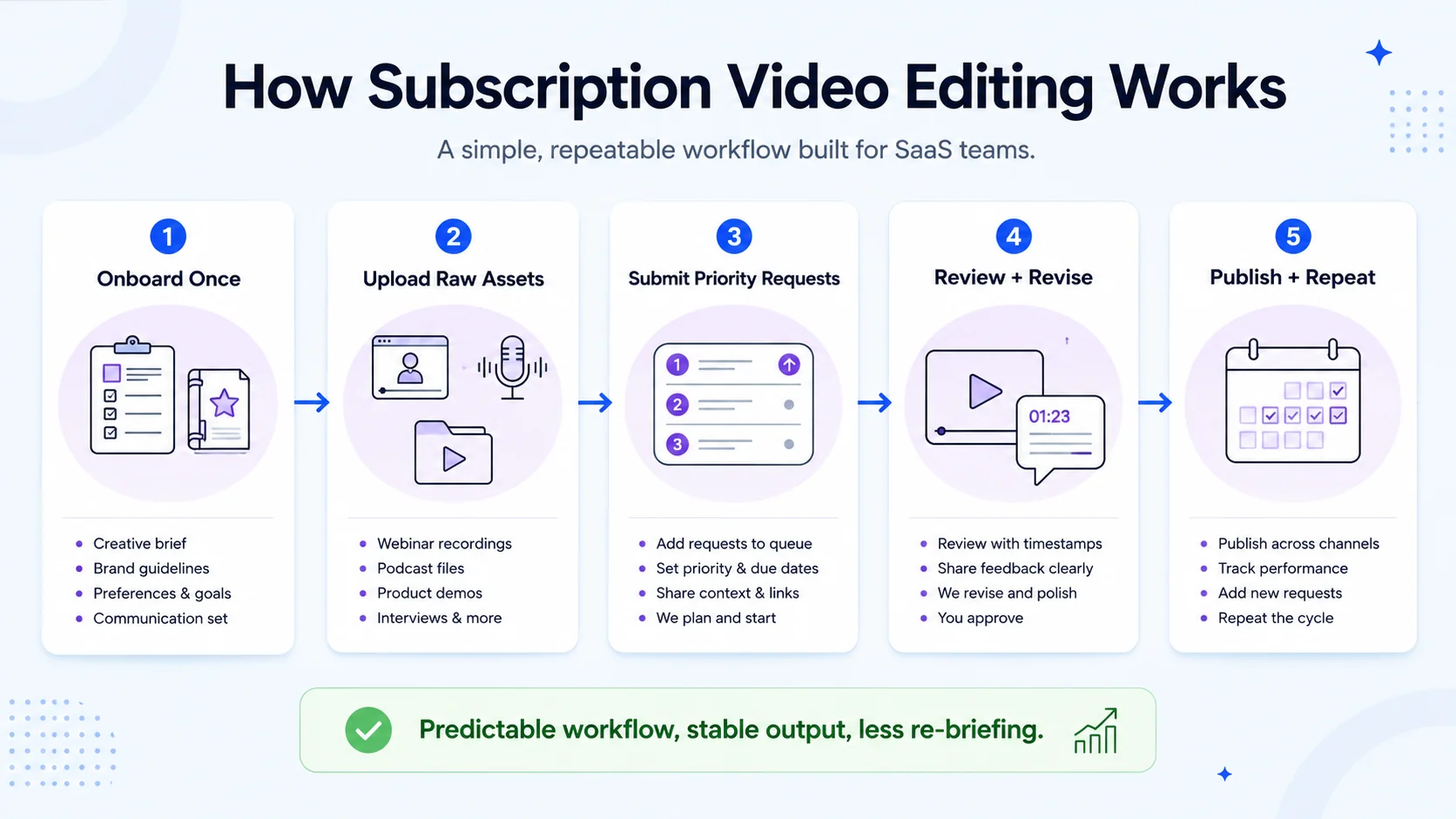
Here is how a typical subscription workflow runs for a SaaS team:
- Onboard with a creative brief: You share brand guidelines, sample footage, tone references, and past content. This is done once, not per project.
- Upload raw assets: Webinar recordings, podcast audio, product demos, or talking-head footage go into a shared folder or project management portal.
- Submit requests in priority order: Your editor works through the queue, one video at a time, usually turning around each asset in 24 to 48 hours.
- Review and revise: Most subscription services include defined revision rounds (or unlimited, depending on the plan) with timestamped feedback tools.
- Publish and repeat: Finished assets go live on your social media content calendar, LinkedIn, YouTube, or inside your sales enablement stack.
Subscription video editing services give you a dedicated editor or team for a flat monthly fee, with finished videos returned in 24 to 48 hours and predictable costs and predictable output. Subscription-based plans are best for businesses and content creators who need regular editing, with costs ranging from $500 to $3,000 per month. At the higher end of the market, monthly retainers range from $500/month for basic subscriptions handling 2 to 4 videos, all the way to $5,000+/month for premium agencies with dedicated teams handling 10 to 40+ videos.
The key SaaS-specific benefit: your editor learns your product, your ICP, and your messaging over time. That compound knowledge is what makes subscription the right structure for short-form video editing tied to ongoing pipeline goals. You stop re-briefing every month and start building a repeatable video production workflow that scales.
Per-Project Video Editing Pricing: Pros, Cons, and 2026 Rates
Per-project pricing works exactly as it sounds: you define a scope of work, receive a quote, and pay per deliverable. It has a clear use case, and a ceiling.
Where per-project video editing works:
- One-off product launch videos or investor demos
- Seasonal campaign assets with no recurring need
- Highly specialized work requiring a specific creative style
- Early-stage teams still testing whether video moves their pipeline
Where it breaks down:
- Flat project pricing is common for brands running one-off launches or seasonal campaigns, but costs scale quickly as volume increases.
- Generalist editors often don't understand B2B SaaS mechanics, and marketing managers spend 2 to 3 hours just writing the brief to explain basic SaaS concepts.
- Revision rounds outside the original scope of work often trigger additional invoices, making the final cost unpredictable.
2026 per-project rate benchmarks:
For project-based pricing, expect to pay $300 to $1,500 for a YouTube video, $250 to $1,200 for short ad creative, and $500 to $2,500 for event highlights. On an hourly basis, most freelance video editors charge between $25 and $150 per hour in 2026, with entry-level editors at $20 to $45/hour, mid-level at $45 to $85/hour, and senior editors with specialized skills at $85 to $150+/hour. The math shifts fast once you pass four to six videos per month. At that volume, per-project pricing stops being economical.
Subscription vs Per-Project Video Editing: A Direct Cost Comparison
The real decision comes down to cost-per-video at your actual production volume. Here is how the two models compare side by side for a B2B SaaS team.
At low volumes of 1 to 5 videos per month, freelancers are cost-effective. At higher volumes of 10+ videos per month, subscription services deliver the best value because the flat rate absorbs the volume. Hourly billing sounds transparent, but it incentivizes slower work. A skilled editor might complete your video in 4 hours where a cheaper editor takes 12. At $75/hour times 4 hours, you pay $300, versus $25/hour times 12 hours, also $300. You pay the same but get a dramatically different result, which is why per-video or retainer pricing often makes more sense for ongoing work.
Key insight: If your projected monthly video spend exceeds $2,500 at per-project rates, a subscription retainer will almost always produce a lower cost per asset and a faster deliverable timeline. For SaaS teams running video marketing programs tied to pipeline KPIs, the subscription model removes the budgeting friction that kills content consistency.
What Do Video Editors Charge for Monthly Subscriptions vs Single Projects in 2026?
Pricing varies significantly by service tier and what is included beyond raw editing. Here is a structured breakdown of what the market charges in 2026.
Subscription (monthly retainer) tiers:
Subscription video editing services run $849 to $5,000/month for ongoing video editing. Unlimited video editing companies typically price their plans starting around $1,000/month and ranging up to $4,000/month.
Single-project (per-project) reference points:
- Per-video pricing for one-time projects typically ranges from $50 to $600 per video depending on complexity.
- A documented freelance YouTube editor retainer covering 4 long-form edits and approximately 20 shorts runs $2,500 to $3,000 per month.
For B2B SaaS teams using tools like Adobe Premiere Pro, DaVinci Resolve, or CapCut for Business, the subscription model means the editor owns that toolchain; you never have to manage software licenses or hardware overhead. Compare that to the hidden costs of an in-house hire: a $4,500 editing workstation, $2,400/year in Adobe Creative Cloud licenses, $1,800/year in stock footage and music subscriptions, and benefits that push total compensation significantly higher than the base salary.
Is Subscription-Based Video Editing Worth It for B2B SaaS Teams?
The answer depends on one qualifier: are you committed to publishing consistently? If you have a defined social media content calendar, a video editing services partner on retainer is almost always worth it. Here is why:
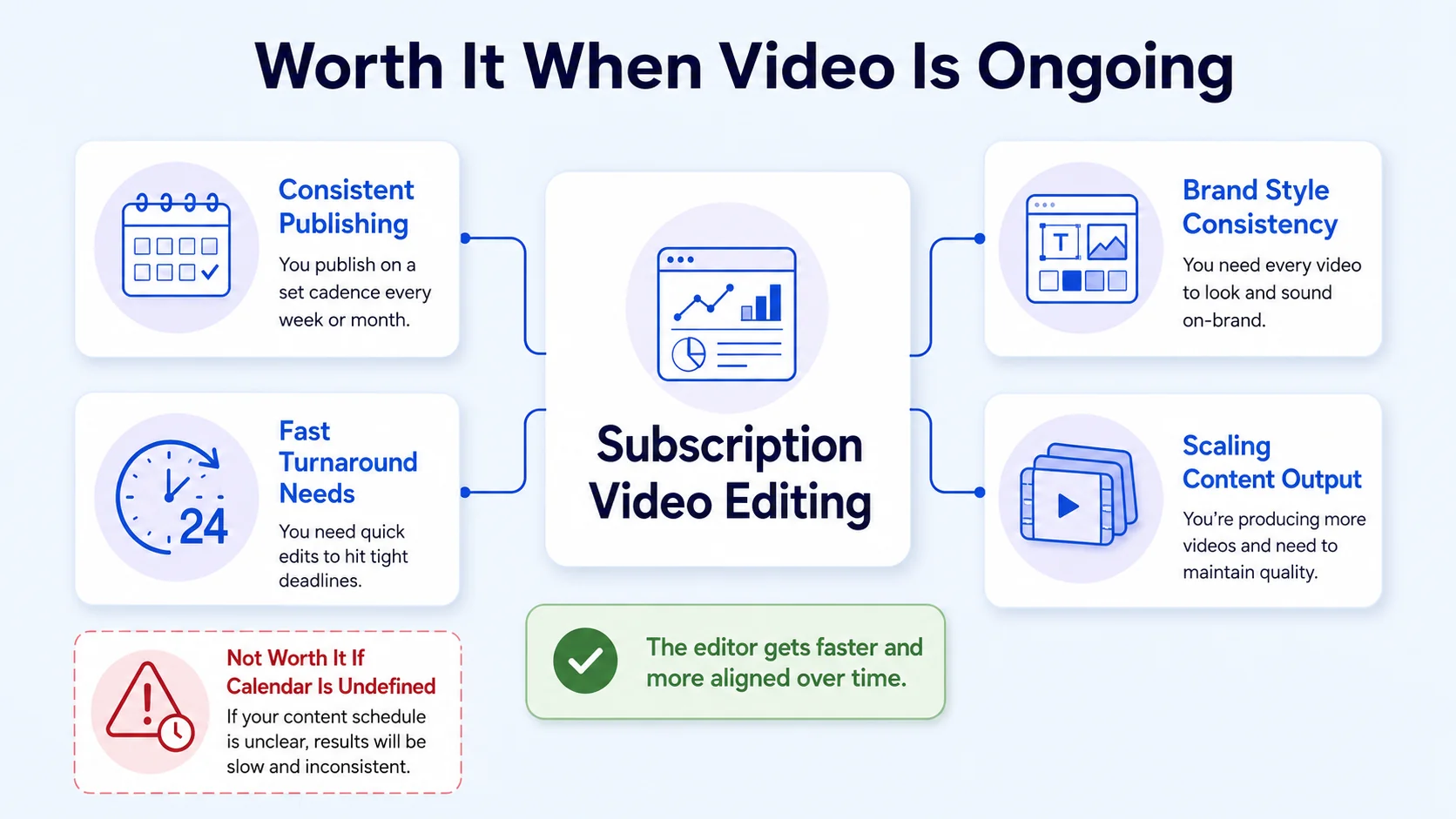
The case for subscription:
- Subscription-based video editing retainer pricing delivers predictable monthly costs, stable delivery timelines, and lower effective cost per video for high-volume brands.
- Subscription works best when you have consistent content needs, fast turnaround requirements, plans to scale your content, and a need for consistency in quality and style critical to your brand identity.
- While freelancers charge $75 to $150 an hour and often lack B2B SaaS expertise, resulting in costly revisions, a subscription model provides SaaS-native video editing for a flat monthly fee, eliminating hourly bloat.
When subscription is not the answer:
- Your content calendar is undefined or approval processes are slow, unutilized subscription capacity is wasted.
- You need fewer than 4 videos per month and your brief complexity is low.
- You are in a pre-product or pre-PMF stage where video type and messaging are still shifting.
For funded SaaS teams running founder-led growth or podcast production programs, subscription pays for itself within 60 days once the content system is running. The compounding effect: your editor gets faster and more aligned with your brand each month, reducing revision cycles and improving ROI of video content quarter over quarter.
How to Decide Between Subscription and Per-Project Video Editing: A Decision Framework
Run through this sequence before you commit to either model.
- Calculate your monthly video volume: How many finished short-form clips, repurposed webinar cuts, or Instagram Reels do you realistically need per month? Under 4? Per-project. Over 8? Subscription.
- Audit your brief quality: Can your team produce a clear creative brief with reference examples, platform specs, and tone direction? If not, a subscription partner who builds a brand profile for you closes that gap faster.
- Map your deliverable timeline requirements: Subscription services return finished videos in 24 to 48 hours through a dashboard-based request system. If you need same-day turnaround for live events, factor in rush fees for either model.
- Model total cost, not just invoice cost: Add briefing time, revision management, and re-onboarding costs (if your freelance video editor churns) to your per-project quote. Freelancers appear cheaper at $25 to $100/hour, but a freelancer editing 8 videos/month at $300 each costs $2,400 with you managing everything. An agency retainer at $2,500 to $5,000/month includes a dedicated team, project management, QC, and backup editors, and when you factor in management time, the costs are surprisingly similar.
- Check switching costs: Don't commit to annual contracts upfront, any reputable agency will let you start with a single month or even a trial project.
- Decide on scalability: Go with a subscription service if you need 10 to 40 videos per month, want predictable costs, and would rather focus on content strategy than managing editors.
For SaaS teams running YouTube video editing alongside TikTok growth strategy and Instagram Reels production, the subscription model is the only format that supports simultaneous multi-platform publishing without ballooning headcount.
Conclusion
- Subscription is the right model for SaaS teams producing 8+ videos/month with consistent pipeline and buyer education goals.
- Per-project is the right model for one-off launches, seasonal needs, or teams under 4 videos/month.
- Total cost is never just the invoice, factor in briefing time, revision rounds, and editor management overhead.
- The break-even point for most B2B teams sits around 5 to 6 videos per month; beyond that, subscription wins on cost per asset and deliverable consistency.
- Start with a trial month before committing to any annual retainer agreement.
Want to see how Komet Media structures subscription-based short-form video repurposing for SaaS teams? Visit our services page or contact us directly to map out your content system.
Frequently Asked Questions
Q1: What is the main difference between subscription and per-project video editing?
Subscription video editing uses a flat monthly retainer for ongoing deliverables with a set deliverable timeline. Per-project pricing quotes each video individually. Subscription favors high-volume, consistent teams; per-project suits one-off or sporadic needs.
Q2: Should I charge per project or monthly retainer for video editing as a freelancer?
Project-based pricing is increasingly the norm, especially for retainer work and YouTube channels. If you have a reliable client producing 4+ videos monthly, a monthly retainer creates stable income and reduces re-briefing time. Start per-project with new clients, then propose a retainer once trust is established.
Q3: How do I know if subscription video editing is worth it for my SaaS business?
If your team publishes consistently and your monthly per-project spend already exceeds $1,500, a subscription retainer will cost less per video and deliver faster. If you produce video content regularly, weekly or more, monthly pricing is almost always more cost-effective than per-video billing.
Q4: Can I switch from per-project to subscription video editing pricing mid-engagement?
Yes. Most reputable video editing agencies allow you to transition between models. The practical step: start with one or two per-project engagements to validate quality and fit, then propose a retainer agreement once you have confirmed output standards.
Q5: What is the average monthly cost of a video editing subscription for B2B teams in 2026?
Subscription video editing services run $849 to $5,000/month for ongoing video editing, with per-video pricing starting around $239. For B2B SaaS teams needing short-form content repurposing plus multi-platform export, mid-tier plans between $1,500 and $3,000/month are most common.
Q6: What are the biggest hidden costs of per-project video editing that SaaS teams miss?
The three most common are: (1) briefing time, marketing managers often spend 2 to 3 hours just writing the brief to explain basic SaaS concepts to a generalist editor; (2) revision rounds billed outside the original scope of work; and (3) re-onboarding costs when a freelance video editor churns between projects, resetting brand alignment from zero.