
🪄 AI Summary
Heading 1
Heading 2
Heading 3
Heading 4
Heading 5
Heading 6
Lorem ipsum dolor sit amet, consectetur adipiscing elit, sed do eiusmod tempor incididunt ut labore et dolore magna aliqua. Ut enim ad minim veniam, quis nostrud exercitation ullamco laboris nisi ut aliquip ex ea commodo consequat. Duis aute irure dolor in reprehenderit in voluptate velit esse cillum dolore eu fugiat nulla pariatur.
Block quote
Ordered list
- Item 1
- Item 2
- Item 3
Unordered list
- Item A
- Item B
- Item C
Bold text
Emphasis
Superscript
Subscript
Video editing for funded AI/tech startups solves a specific problem most other B2B categories do not have: explaining something genuinely new to a buyer who has never seen it before. A SaaS company can usually assume the buyer understands the category. An AI startup often cannot. I have watched technical founders try to compress a hard concept into a single clip and lose the entire point in the process. The edit has to carry more weight here than it does almost anywhere else in B2B video.
Quick Answer
Video editing for funded AI/tech startups works when it translates a technical idea into something a non-technical buyer or investor can follow in under a minute, without losing the substance that makes the product real.
Why Video Editing for Funded AI/Tech Startups Needs a Specific Approach
Buyers already expect to learn through video before they ever get on a call. Vidico's 2026 B2B video marketing data, citing Vidyard's Video in Business Benchmark Report, found that about 70% of B2B buyers watch video during their purchasing journey, and 96% have watched an explainer video specifically to learn about a product or service. For a category where the product itself is new to most buyers, that explainer video is often doing more work than it would for an established SaaS tool.
The data backs up what explainer content actually does. Wyzowl's 2026 State of Video Marketing report, summarized by Pixel8 Production, found that 93% of video marketers say video increased user understanding of their product, product demo videos produced a 46% increase in purchase intent, and explainer videos are used by 72% of marketers specifically to drive product understanding. The same report found LinkedIn video engagement up 44% year over year, with YouTube remaining the strongest channel for long-form educational content and buyer research.
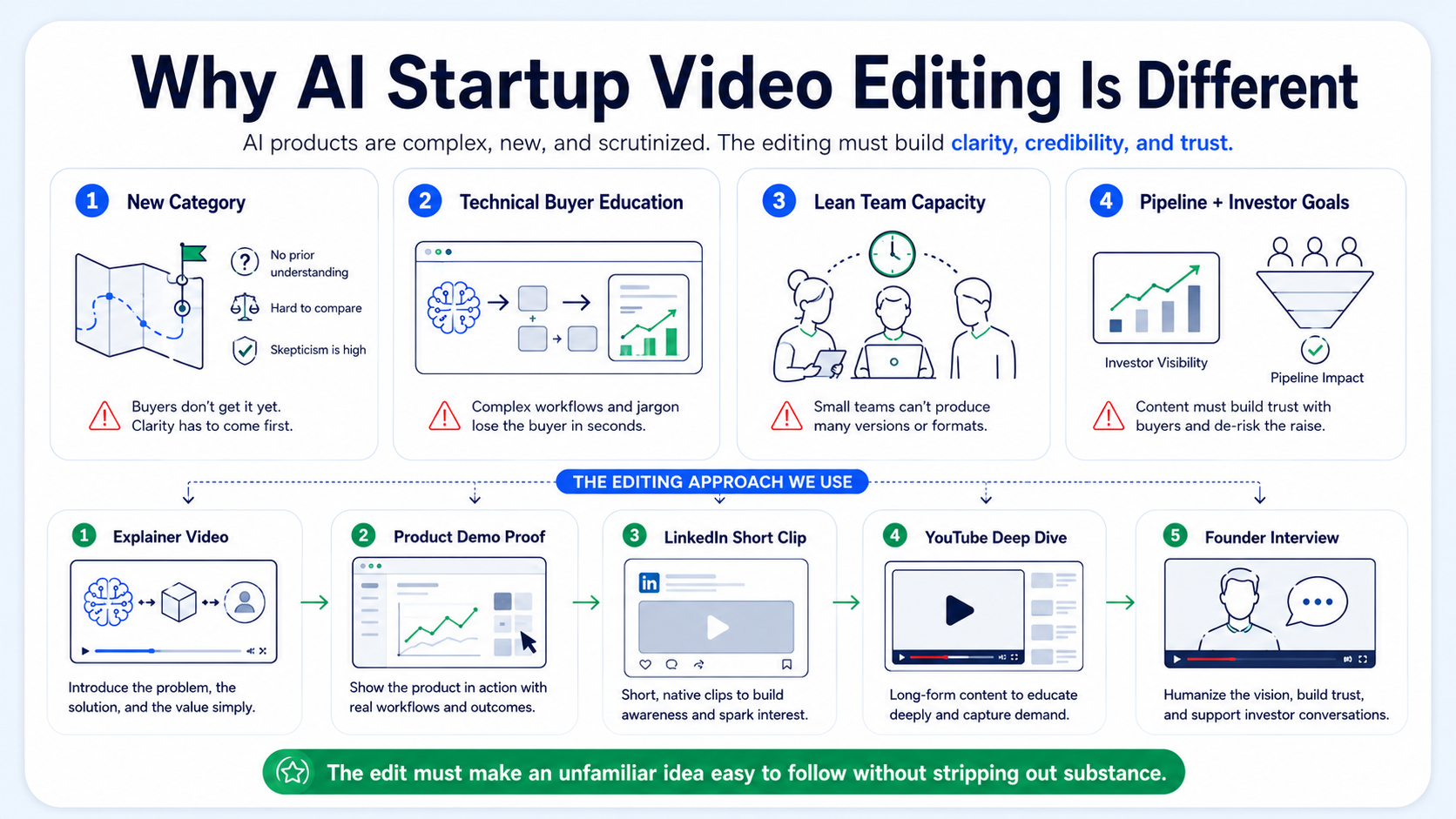
That split between platforms matters more for a technical product than for most. Lumira Studio's 2026 analysis of long-form video engagement found that long-form video accounts for roughly half of total audience engagement on YouTube despite being a small share of total uploads, and that founder and expert interviews tend to run 15 to 30 minutes when the topic justifies the length. A quick LinkedIn clip can earn attention. A longer YouTube video is often what actually convinces a technical buyer or investor the product is real.
Team size adds another layer. AI startups tend to run lean relative to their output. Thunderbit's 2026 AI startup statistics report found that top AI startups generate roughly 5 to 6 times more revenue per employee than leading SaaS firms, which usually means video has to compete for time against a small team's other priorities rather than sitting with a dedicated content function.
Video also does two distinct jobs for this category, and it helps to separate them before editing anything. One is building inbound pipeline, where a technical explainer needs to move a buyer toward a demo. The other is growing brand awareness ahead of a funding round, where the goal is recognition among investors and co-investors who may not be actively evaluating the product yet. Our guide on video marketing for AI and ML startups covers how these two goals typically shape a content plan for this category.
Where Funded AI/Tech Startups Get Video Editing Wrong
A handful of patterns explain most of the wasted production time.
- Explaining the technology instead of the outcome. A viewer rarely needs to understand the model architecture. They need to understand what changes for them.
- Cutting a technical explainer down to fit a trend length. Some ideas genuinely need 90 seconds or two minutes to land, and forcing them into 15 seconds strips out the part that made them convincing.
- Treating LinkedIn and YouTube as the same job. A quick LinkedIn clip earns attention. A longer YouTube video builds the depth of understanding a technical buyer or investor actually needs before committing.
- Publishing once around a launch and going quiet. A single strong video at launch does not build the audience a startup needs heading into its next funding round.
- Skipping the transcript and the plain-language pass. A script that only makes sense to someone who already understands the product will not land with the buyer who does not.
- Never repurposing founder talks and demo calls. Sales demos, investor updates, and internal talks usually contain a clearer explanation than anything scripted from scratch.
These mistakes tend to reinforce each other. A team that scripts a technical explanation from scratch instead of pulling from a real demo call also tends to force it into a trend-length clip that cannot hold the idea. Starting from what a founder actually says on a real call, rather than what the team wishes they had said, usually produces a clearer edit.
What Good Video Editing for Funded AI/Tech Startups Covers
Video editing for funded AI/tech startups usually spans three platforms, each doing a different job.
A reasonable production sequence uses the same source material across all three. One founder interview or product demo can supply a short LinkedIn clip within days, a longer YouTube upload within a week, and, if the startup runs a podcast, a full episode plus additional clips spread across the following weeks. Our guide to explainer videos for technical products and LinkedIn video strategy for funded startups go further into how the platforms differ in practice.
Most startups do not need all three platforms running at once from day one. A common starting point is LinkedIn alone, since it earns attention fastest and requires the least production time per piece. Once a team has a backlog of demo calls and founder talks worth a longer treatment, YouTube becomes worth adding. Our YouTube strategy guide for funded startups covers what changes when a team makes that move.
A Practical Workflow for a Small Team
Most funded AI and tech startups do not need a bigger content team to run this well. They need a system for pulling more out of what a small team already records.
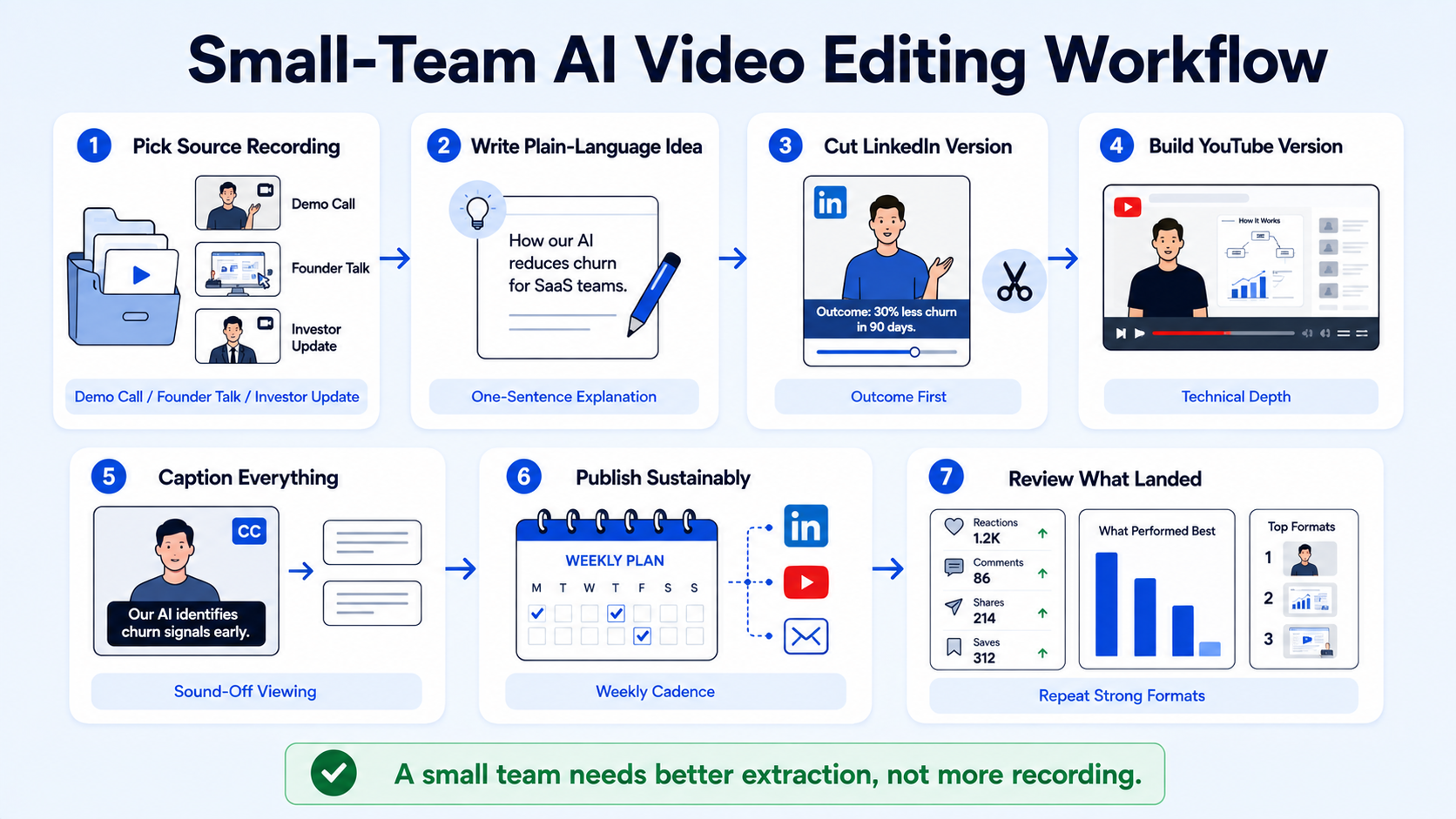
- Pick one recording to start from. A demo call, founder talk, or investor update usually contains a usable explanation already.
- Write a plain-language version of the core idea first. If the explanation cannot survive being said in one sentence to a non-technical person, the edit needs more work before it goes out.
- Cut the short version for LinkedIn. Open on the outcome, not the technology, and keep it under two minutes.
- Build the longer version for YouTube from the same source material. This is where the technical depth belongs, not in the short clip.
- Caption everything. Most short-form video gets watched with the sound off, so the LinkedIn clip especially needs to work as on-screen text.
- Publish on a cadence the team can actually sustain. A modest, consistent schedule beats a large batch released once and abandoned.
- Review what actually landed with the target audience. A technical explanation that resonated is worth repeating with a new example, not replacing with something unrelated.
This is the same discipline behind our video editing services and short-form video editing work, applied to what a lean AI or tech team already has recorded. Our guide on how a one-person marketing team can ship daily video covers the same team-size constraint in more depth.
What Changes the Price of Video Editing for Funded AI/Tech Startups
Cost depends mostly on scope, not on any single platform. The factors that move the price the most:
- Number of platforms covered. A LinkedIn-only cadence costs less than a system that also produces YouTube deep dives and podcast clips from the same source material.
- Motion graphics for technical concepts. Diagrams, UI walkthroughs, and system visuals take more editing time than a straight talking-head cut.
- Whether new footage needs to be filmed. Editing from existing demo calls and founder talks is faster than producing new interviews from scratch.
- Number of source recordings available each month. More demo calls, talks, and customer conversations to pull from generally means more finished videos from the same production cycle.
- Strategy and script support. Some engagements cover editing only, while others include help turning a technical explanation into something a general audience can follow.
Komet Media typically works with funded AI and tech startups through retainers in the range of roughly $2,500 to $5,000, with final scope set by the factors above rather than a fixed public package. Our B2B video editing pricing models resource breaks this down further, and our video editor cost guide compares freelancer, subscription, and retainer pricing.
Measuring What the Video Actually Produced
Views and watch time describe attention. They do not tell a startup whether a technical explanation actually landed. Match the metric to the purpose of the video.
Treat these signals together rather than relying on one number, since attribution is often imperfect. A buyer or investor may watch a founder's videos for months before a conversation ever gets logged as connected to them. Our notes on video KPIs B2B teams should track go further into building a measurement plan that connects video activity to pipeline and investor visibility over a full quarter.
Conclusion
Video editing for funded AI/tech startups works when the edit does the job of translation, turning a real but unfamiliar idea into something a buyer or investor can follow without losing what makes it worth paying attention to. A small team does not need to produce more. It needs a system that gets more finished video out of the demos, talks, and conversations it is already recording. We work with funded AI and technology startups on exactly this kind of system.
FAQ
What is video editing for funded AI/tech startups?
It is the process of turning a startup's existing recordings, demo calls, founder talks, and investor updates, into edited video for LinkedIn, YouTube, and podcast platforms, with particular attention to making a technical idea clear to a non-technical viewer.
How much does video editing cost for an AI or tech startup?
Cost depends on how many platforms the content covers, whether new footage needs to be filmed, and how much motion graphics work is involved in explaining technical concepts. Komet Media typically works in the $2,500 to $5,000 range per retainer. See our B2B video editing pricing models breakdown for detail.
What does the production process look like?
It usually starts with picking a source recording, writing a plain-language version of the core idea, cutting a short version for LinkedIn and a longer version for YouTube from the same material, captioning everything, and publishing on a sustainable cadence.
How long does it take to see results?
A single video rarely changes much on its own. Most startups need a few months of consistent publishing before reach, watch time, and any connection to demo requests or investor interest become clear enough to evaluate.
What deliverables should a startup expect?
Expect short, captioned LinkedIn clips, longer YouTube videos for topics that need more depth, and podcast-specific cuts if the startup runs a show, all built from the same underlying recordings where possible.
Is a freelancer or an agency better for this work?
A freelancer can work well for a startup producing content on one platform with a founder directing every edit closely. An agency tends to fit better once the team wants a repeatable system across LinkedIn, YouTube, and podcast without pulling a founder into every decision. Our freelancer versus agency comparison covers the trade-offs in more depth.
Does every AI or tech startup need video on every platform?
No. A team with limited recording time is usually better off doing one platform well, typically LinkedIn for reach or YouTube for depth, before adding a second. The approach should expand platform by platform as the underlying source material and team capacity allow.
Does Komet Media edit video for funded AI and tech startups?
Yes. We edit demo calls, founder talks, and investor updates into LinkedIn clips, YouTube videos, and podcast content for funded AI-native and technology startups, built from footage the team already has. You can see our approach on the video editing services page or book a call to talk through a specific product's content.