
🪄 AI Summary
Heading 1
Heading 2
Heading 3
Heading 4
Heading 5
Heading 6
Lorem ipsum dolor sit amet, consectetur adipiscing elit, sed do eiusmod tempor incididunt ut labore et dolore magna aliqua. Ut enim ad minim veniam, quis nostrud exercitation ullamco laboris nisi ut aliquip ex ea commodo consequat. Duis aute irure dolor in reprehenderit in voluptate velit esse cillum dolore eu fugiat nulla pariatur.
Block quote
Ordered list
- Item 1
- Item 2
- Item 3
Unordered list
- Item A
- Item B
- Item C
Bold text
Emphasis
Superscript
Subscript
SaaS marketing built its foundation on long-form blog content. That foundation is cracking. Buyers are skipping 2,000-word posts and watching 60-second clips instead. The shift from blogs to video in SaaS marketing is not a trend you can observe from the sidelines, it is a structural change in how B2B buyers research, evaluate, and trust software products. This guide covers why the shift is happening, what it means for pipeline, and exactly how to execute a video strategy that replaces and outperforms your old blog-first playbook.
TL;DR
- HubSpot's 2025 State of Marketing Report found that short-form video outperforms every other content type on ROI.
- When 82% of buyers say video influenced a software purchase decision, video is not just a marketing asset, it is a sales enablement tool.
- Repurposing existing long-form content (webinars, podcasts, demos) into short videos is the fastest path to video volume without starting from scratch.
- Blogging is not dead, but it is no longer the primary demand generation lever for SaaS teams.
Why Are SaaS Companies Moving from Blogs to Video Content?
The shift from blogs to video in SaaS marketing is driven by three converging forces that have nothing to do with creativity and everything to do with buyer behavior.
First, buyers have changed how they research. 51% of B2B software buyers now begin their research in an AI chatbot rather than Google, according to The Answer Economy: 2026 B2B Buyer Behavior Report (March 2026, n=1,076). That flips the entire editorial logic of SEO-first blogging. When buyers are asking AI systems instead of searching Google, the text-based blog posts optimized for keyword rankings carry less weight as a first touchpoint.
Second, video converts at levels written content simply cannot match. Landing pages with embedded video convert at 86% higher rates than text-only equivalents, with B2B SaaS pages featuring explainer videos seeing conversion lifts exceeding 100% in controlled testing. A blog post explains a product. A well-structured product demo video shows it working, collapses skepticism, and answers objections in real time.
Third, the algorithms favor video. Social media algorithms across Meta, LinkedIn, and X prioritize native video content over static images or external text links because video keeps users on-platform longer. This means a LinkedIn video post from a SaaS founder reaches a larger share of their existing audience than a blog link ever would. 91% of businesses now use video marketing in 2026, up from 89% in 2025.
For SaaS teams still allocating the majority of content budget to written posts, that number signals how far behind the market has already moved. The deeper issue is trust. Buyers no longer hand over budget to a company whose people they have never seen or heard. Video, especially founder-led and educational formats, builds the kind of familiarity that blog posts cannot replicate at scale.
Is Blogging Dead for SaaS Marketing in 2026?
No. But its role has changed significantly. Blogging is no longer the primary demand generation lever, it is now a supporting format inside a video-first content system. Here is what the data actually shows. Blog posts that include embedded video earn more backlinks, more social shares, and higher engagement metrics than text-only posts, which contribute to stronger search rankings over time. This means the smartest SaaS teams are not abandoning blogs, they are embedding video into them and using written content to support video discoverability rather than lead it.
The case for keeping a blog is about compounding SEO authority. The case for deprioritizing blog production is about where buyers actually spend time and form opinions. Those two realities can coexist. The shift from blogs to video in SaaS marketing does not require killing your editorial calendar, it requires rebalancing it. What is dying is the practice of producing 10 keyword-stuffed blog posts a month with no video, no founder voice, and no product education woven in. That approach produced organic traffic that never converted because it failed to build trust or demonstrate product value.
The replacement model looks like this:
- One core long-form video (webinar, demo, or podcast episode) per week
- Three to five short-form clips repurposed from that core video
- One supporting blog post embedding the core video with a written summary for SEO
- Distribution across LinkedIn Video, YouTube SEO, and email
Smart teams are squeezing more out of each webinar: 88% repurpose webinar content, 60% make replays available on landing pages, and another 60% pull social clips from them. This is not a content factory, it is a content system built around a single recording session.
Video vs. Blog Content for SaaS: Which Drives More Conversions?
The data consistently points in one direction.
Website conversion rates increase from 2.9% to 4.8% with video, a 65% improvement in conversion performance that directly impacts lead generation and pipeline creation. Wyzowl's 2026 report found that 83% of marketers report video has directly increased sales, and 82% say video has helped increase web traffic.
Pipeline reality: For SaaS teams with long sales cycles, video does not just support the top of funnel, it accelerates every stage, from first discovery through demo request to post-sale customer onboarding.
The conversion edge of video comes down to cognitive load. Video conveys tone of voice, emotion, body language, and visual context simultaneously. It takes 10 seconds to show a product working in a video, whereas it might take 3 paragraphs to describe that same functionality in text. For complex software products with multi-stakeholder sales cycles, this is not a minor advantage, it is the difference between a buyer who gets it and one who schedules a competitor demo instead. Komet Media helps B2B SaaS, AI, and tech startups & teams create video assets from scratch, edit existing footage, and repurpose content tailored to every stage of the funnel.
Best Video Content Types for SaaS Marketing
Not all video formats serve the same goal. The mistake most SaaS teams make is starting with brand films when they should start with educational content. Educational videos, product videos, social videos, and webinars were the most common types of videos created in 2025, with over half of companies creating them regularly. Teams also say these four have the biggest business impact, with product videos and webinars at the top and educational and social videos close behind.
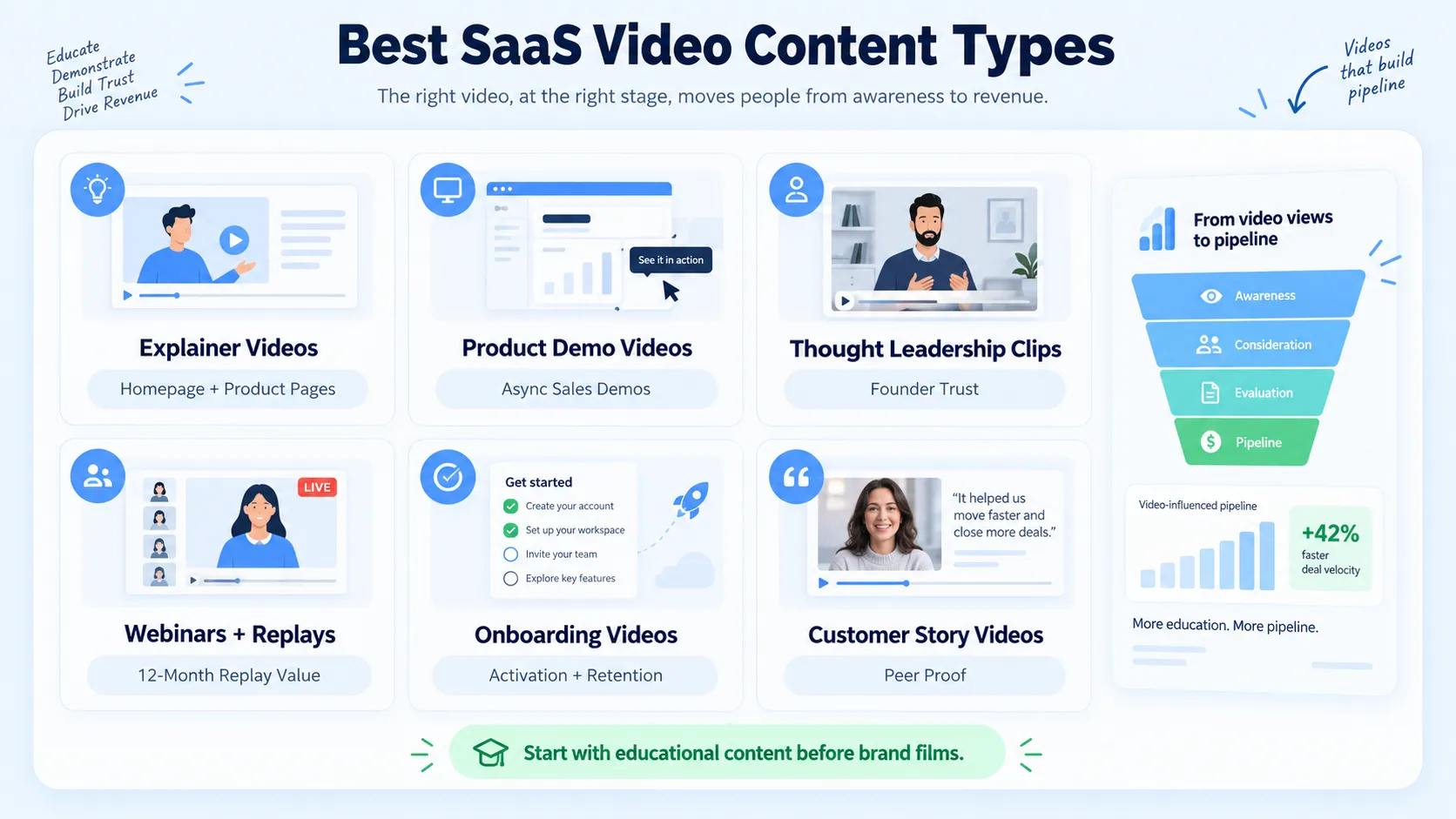
Here is how each format maps to pipeline goals for B2B SaaS:
- Explainer videos: Explainer videos are the workhorse format for conversion. 96% of consumers have watched an explainer video to learn about a product or service. Use these on your homepage, product pages, and in sales sequences.
- Product demo videos: Show the actual interface doing real work. Tools like Loom and Vidyard make async demo sharing standard in sales-led motions. A recorded demo seen by five stakeholders before a live call shortens cycles.
- Thought leadership clips: Founder and executive short-form content on LinkedIn Video drives demand generation and builds the brand trust that blog posts cannot replicate. Gong and Drift pioneered conversational video in B2B, the pattern works.
- Webinars and on-demand replays: On-demand webinars keep getting plays for up to 12 months after the live event. A single webinar session, properly repurposed, generates a month of short-form content.
- Customer onboarding videos: Reduce churn by replacing help docs with short instructional clips. Loom-recorded walkthroughs embedded in onboarding emails improve activation rates.
- Customer story videos: Buyers trust peers more than brands. A 90-second customer story video outperforms a written case study in almost every sales context.
Our video marketing and production services are built specifically for B2B SaaS, AI, and tech startups & teams around this format mix, helping create high-converting video content from scratch as well as edit and repurpose existing recordings into a multi-format video library.
How to Use YouTube for SaaS Top-of-Funnel Marketing
YouTube is not just a video hosting platform. YouTube is the world's second-largest search engine, which means video SEO is becoming as important as traditional text-based SEO. For SaaS teams that built their organic presence on Google-first blogging, this creates an entirely parallel channel worth building. Companies that use video in their marketing generate 41% more web traffic from search, and YouTube videos frequently rank in Google's organic results for commercial queries.
The top-of-funnel playbook for SaaS on YouTube works in three layers:
- Shorts for discovery: Shorts drive discovery with 5.91% engagement and reach 53% of B2B buyers before they request demos. Use 60-second clips to answer the exact questions your ICP types into Google before they know your product exists.
- Mid-form for credibility: Five to ten minute deep dives on product use cases, integrations, and category education. This is where buyers move from "I found this" to "I trust this."
- Long-form for conversion: Wistia's data shows longer videos (30 to 60 minutes) drive the highest conversion rates at 17%, particularly for webinars and extended product demonstrations.
YouTube's search engine functionality means that well-optimised long-form videos continue to generate traffic and leads for years after publication, giving them a compounding return profile similar to blog content. That compounding dynamic is the strongest argument for investing in YouTube SEO before competitors in your category do. For B2B YouTube marketing: target bottom-of-funnel keywords like reviews, comparisons, alternatives, and tutorials, and optimize video titles for Google search, since B2B buyers frequently discover YouTube videos through Google.
The video marketing services we build at Komet Media for B2B SaaS, AI, and tech startups & teams are designed around exactly this YouTube SEO structure: intent-mapped video topics, video creation from scratch, editing, keyword-optimized titles and descriptions, and a consistent publishing cadence that builds topical authority over six to twelve months.
How to Repurpose SaaS Blog Posts and Long-Form Content into Video
Repurposing is the most efficient entry point into video for SaaS teams that already have a content library. You do not need a studio. You need a system. The shift from blogs to video in SaaS marketing does not require burning your existing archive. It requires re-packaging it. Here is the process I use with clients at Komet Media:
- Audit your top-performing blog posts by organic traffic and conversion rate. These are already proven topics, the buyer intent is confirmed.
- Extract the core argument from each post. A 1,500-word blog post usually has one central insight and three supporting points. That is a 90-second video script.
- Record a talking-head clip or screen recording with the founder, product expert, or a subject matter lead. Tools like Loom make this a 20-minute process.
- Edit for platform: Vertical crop for LinkedIn Video and YouTube Shorts, horizontal for YouTube long-form. 76% of teams adjust aspect ratio depending on where they're posting, and half do it every time.
- Publish the video inside the original blog post and update the page. 60% of teams use repurposed social clips to link back to their website, making social video a traffic driver as much as an awareness play.
- Distribute across channels: LinkedIn Video, YouTube, email, and your sales team's outreach sequences.
Beyond blogs, the highest-leverage repurposing sources for SaaS teams are webinars, podcasts, and sales calls. A 45-minute podcast episode or webinar recording contains enough material to generate 8–12 short clips, a highlight reel, and a long-form YouTube cut. One long-form video can become 5–10 short-form clips without any additional recording time.
This is the exact model we run at Komet Media for B2B SaaS, AI, and tech startups & teams: whether producing brand-new video assets from concept to final cut or turning existing recordings into targeted clips, we build a scalable distribution system around your core message.
Common Mistakes SaaS Marketers Make When Shifting to Video
The shift from blogs to video in SaaS marketing fails most often because of execution errors, not strategy errors. Here are the mistakes I see repeatedly:
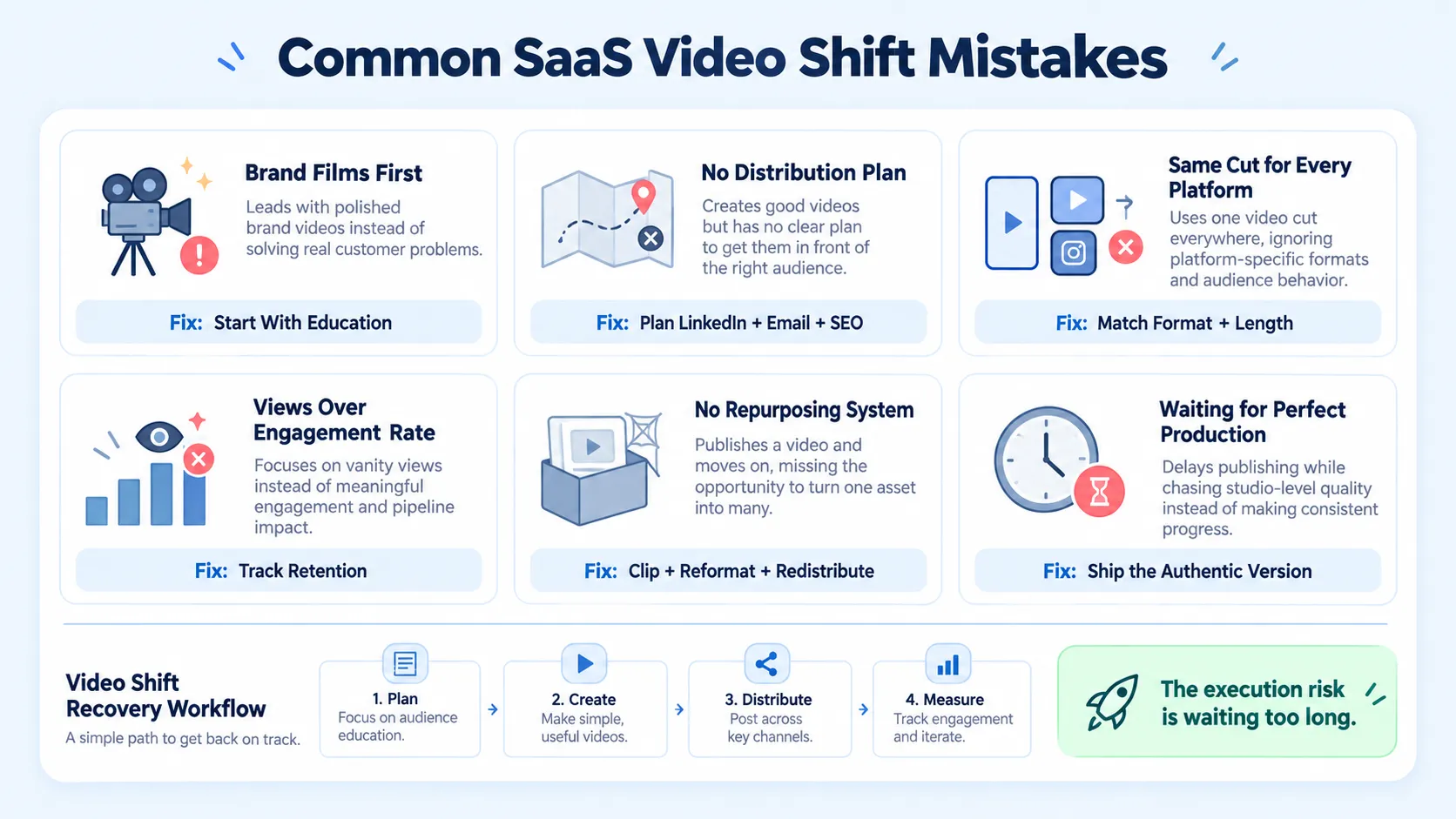
- Starting with brand films instead of education: Overproduced brand videos with motion graphics and stock music do not build pipeline. Educational clips that demonstrate product value and founder thinking do. Glossy explainers used to win, but now when B2B buyers spot corporate shine, they scroll past it.
- Publishing without distribution: Uploading a video to YouTube and hoping for organic traction is not a strategy. Every video needs a distribution plan: LinkedIn post, email clip, sales enablement asset, and YouTube SEO optimization.
- Treating every platform the same: A 10-minute YouTube deep dive posted natively to LinkedIn kills reach. Format, length, and hook structure differ by platform. 71% of marketers consider videos between 30 and 60 seconds the most effective length for social distribution.
- Ignoring video engagement rate: Most SaaS teams track view counts and stop there. Wistia's benchmark data shows videos under one minute achieve around 65% average engagement rate, this is the metric that tells you whether your message is actually landing.
- No repurposing system: Producing one-off videos without a workflow for clipping, reformatting, and redistributing wastes 80% of the asset's value. Lack of time is the top barrier at 33% of non-video marketers, but a repurposing system solves that problem at the source.
- Waiting until production is perfect: The founder thinking, product knowledge, and customer stories that SaaS teams hold internally are more valuable than any polished creative. Ship the authentic version first.
Our end-to-end video creation and editing services for B2B SaaS, AI, and tech startups & teams are built to remove the entire production bottleneck, so your team focuses on what only you can do (share product vision and insight) while we handle full-concept production, editing, and distribution.
Conclusion
The shift from blogs to video in SaaS marketing is not coming, it is here. The data, the buyer behavior, and the platform dynamics have all moved in the same direction.
Key takeaways:
- Video beats written content on conversions, pipeline influence, and buyer trust, in every major 2025–2026 dataset.
- Blogging stays in the mix, but as a support format for video, not the lead format.
- Repurposing existing long-form content (demos, webinars, podcasts) is the fastest path to video volume.
- YouTube SEO and LinkedIn Video are the two highest-leverage distribution channels for B2B SaaS in 2026.
- The biggest execution risk is not starting. If your competitors are building video systems now, every quarter you wait is compound interest paid to them.
Talk to the Komet Media team about building a video system for your B2B SaaS, AI, and tech startups & teams.
Frequently Asked Questions
Q1: Is the shift from blogs to video in SaaS marketing permanent?
All indicators point to yes. Buyer behavior, platform algorithms, and ROI data have structurally shifted toward video. Blogging will remain useful for SEO and thought leadership, but video is now the primary trust-building and demand-generation format for B2B SaaS teams.
Q2: How many videos should a SaaS company publish per week?
Start with one core long-form video per week (webinar, demo, or recorded insight) and repurpose it into three to five short clips. Consistency beats volume. A reliable weekly cadence over six months outperforms a burst of 20 videos followed by silence.
Q3: Do I need a professional video team to compete?
Not necessarily at the start. Loom, a good microphone, and a clean background produce credible content. But as volume and quality demands scale, partnering with a full-service video production partner like Komet Media ensures consistent output—from initial scripting and creation from scratch to editing and repurposing—without adding internal headcount.
Q4: What is the best video format for SaaS demand generation?
Educational short-form clips (30–90 seconds) for top-of-funnel discovery, product demo videos for mid-funnel evaluation, and customer story videos for late-stage trust. Explainer videos on landing pages drive the highest single-page conversion lift.
Q5: How does YouTube SEO differ from traditional blog SEO for SaaS?
YouTube SEO targets intent-mapped queries in video format, the same problems your ICP searches for in text. Optimize titles for Google search, use keyword-rich descriptions, add chapters, and publish Shorts to accelerate channel discovery. Videos compound in value the same way evergreen blog posts do.
Q6: Can I repurpose existing blog content into videos without starting from scratch?
Yes, and this is the recommended starting point. Take your top organic blog posts, extract the core argument, record a short talking-head or screen-recorded clip, and embed it back into the original post. One existing post can produce a YouTube video, a LinkedIn clip, and an email nurture asset in a single editing session.