
🪄 AI Summary
Heading 1
Heading 2
Heading 3
Heading 4
Heading 5
Heading 6
Lorem ipsum dolor sit amet, consectetur adipiscing elit, sed do eiusmod tempor incididunt ut labore et dolore magna aliqua. Ut enim ad minim veniam, quis nostrud exercitation ullamco laboris nisi ut aliquip ex ea commodo consequat. Duis aute irure dolor in reprehenderit in voluptate velit esse cillum dolore eu fugiat nulla pariatur.
Block quote
Ordered list
- Item 1
- Item 2
- Item 3
Unordered list
- Item A
- Item B
- Item C
Bold text
Emphasis
Superscript
Subscript
Most B2B SaaS teams treat LinkedIn like a content dumping ground. Blog links. Event announcements. The occasional text post from the founder. Meanwhile, buyers are scrolling past every single one. A LinkedIn video strategy for B2B SaaS is the mechanism that changes that. Video is the format that educates buyers at scale, builds trust before the first sales call, and fuels the kind of inbound demand that compounds over time. This guide covers exactly how to build it.
TL;DR
- Video content on LinkedIn registers a 5.90% engagement rate , well ahead of text-only posts, making it the clearest format advantage available to SaaS teams.
- Repurpose existing webinars, demos, and founder thinking into short clips, or produce net-new video content from scratch without creating extra workload for your team.
- Post 3–5 times per week, mix formats, and let the LinkedIn Algorithm compound your reach over 90 days.
- Tie every video type to a pipeline outcome: awareness, education, or demo demand.
How to Create a LinkedIn Video Strategy for B2B SaaS
Most teams skip the architecture and go straight to hitting record. That's why their content stalls after a few weeks. A proper A LinkedIn video strategy for B2B SaaS starts with four decisions made before a single frame is shot.
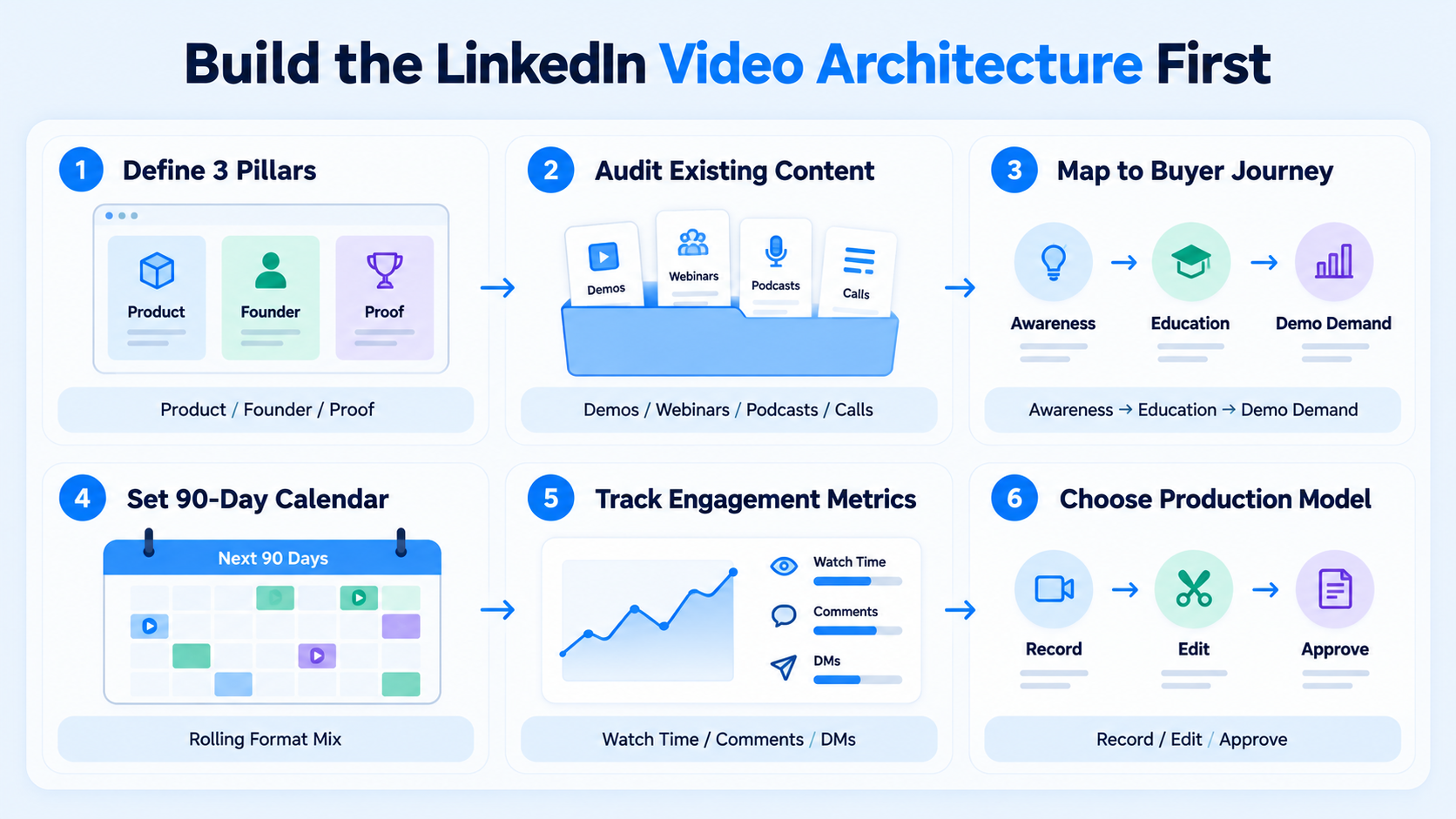
Step 1: Define your three content pillars. For SaaS, these almost always map to: product education (what your tool does and why it matters), founder or executive thought leadership (point-of-view content that builds trust), and buyer proof (customer outcomes, use cases, social proof). Every video you publish should belong to one of these three pillars.
Step 2: Audit existing assets or plan from scratch. Most funded SaaS teams sit on recorded demos, webinars, podcasts, and sales calls. If you have recordings, Komet Media maps your inventory to extract clips. If you have no footage, we build the system from scratch with research, scripting, and production support before editing.
Step 3: Map each video type to a stage in the buyer journey. Top of funnel gets awareness clips (hot takes, trend commentary, short founder observations). Middle of funnel gets educational walkthroughs and product explainers that address specific objections. Bottom of funnel gets testimonials, demo snippets, and case study clips that push the "book a call" decision.
Step 4: Set a 90-day content calendar. Consistency is what activates the LinkedIn Algorithm. The algorithm rewards accounts that generate sustained engagement, not accounts that post in bursts and disappear. Build a rolling calendar with a format mix planned in advance.
Step 5: Define your video engagement metrics. Watch time, comment rate, profile visits, and inbound DMs are the signals that tell you whether your strategy is working. Not follower counts.
Step 6: Choose your production model. Whether you're recording new content from scratch or repurposing existing long-form assets, decide upfront: who records, who edits, and who approves. Our short-form video editing service handles the entire pipeline end-to-end for teams that need full-service execution or editing support.
What Type of LinkedIn Videos Work Best for SaaS Companies?
Not all video formats carry equal weight in the B2B buyer journey. The ones that move pipeline for SaaS have a specific shape.
Founder talking-head clips (60–90 seconds): The highest-trust format on LinkedIn. Executive talking-head clips remain the highest-performing format on LinkedIn. These work because buyers are evaluating your company, not just your product. A founder who shows up consistently on LinkedIn builds familiarity that no ad can replicate. This is the engine of founder-led growth.
Product explainer clips (90 seconds–3 minutes): These are not demos. They answer one specific question a buyer has about your product. "How does [Feature X] handle [common workflow]?" That's a video. Short, focused, and tied directly to a real objection your sales team hears weekly.
Webinar and podcast clips (30–60 seconds): A well-edited 30-second highlight from a webinar can take an insight from a few hundred live attendees and distribute it everywhere on LinkedIn. Whether repurposing long-form footage or scripting fresh clips from scratch, explore how our podcast editing and webinar services make this systematic.
Customer proof clips (60–90 seconds): 62% of B2B buyers place their trust in LinkedIn video content. A customer speaking directly about a before-and-after outcome converts better than any case study PDF. One genuine customer clip is worth ten polished brand videos.
Hot takes and trend commentary (30–45 seconds): Expert snippets and micro-takes in the 30–45 second range work well for sharing perspectives on industry statistics, trends, or reports. These drive comments, which is the engagement signal that triggers broader algorithmic distribution.
The frame that ties all of these together: every video should answer a question your ICP buyer is already asking. If it doesn't do that, it's content for content's sake.
LinkedIn Video vs. Text Posts for B2B SaaS: Which Performs Better?
This question has a clear answer in 2026. Video posts register a 5.90% engagement rate while text-only posts have dropped to a 3.95% average engagement rate in Q2 2026. That's a meaningful gap, especially compounded across a consistent posting cadence. Socialinsider's 2025 benchmark puts LinkedIn video engagement at 6.00%, about 13% ahead of image posts and 33% ahead of text. But here is where the nuance matters for SaaS teams:
Source: Socialinsider LinkedIn Organic Benchmarks 2026
The practical implication: a mixed strategy wins. For most B2B SaaS companies, the strongest 2026 format mix is 40% founder-led text posts, 25% native documents or carousels, 15% short founder videos, 10% proof posts or diagrams, and 10% event, article, or offer distribution. Video does not replace text. It anchors the mix.
One more thing that almost no team accounts for: LinkedIn's algorithm still penalizes outbound links in the primary post body. Drop your links in the first comment, not the caption. This one change alone can meaningfully extend your video's organic reach.
How Often Should a B2B SaaS Company Post Videos on LinkedIn?
Frequency is the most commonly overthought variable in a LinkedIn video strategy for B2B SaaS. Here is what the data says. For Tech and SaaS specifically, 4–5 posts per week is recommended because it's a fast-moving space with high content consumption. That said, quality gates quantity. The LinkedIn Algorithm rewards accounts whose posts consistently generate engagement. Posting daily with mediocre content dilutes your engagement rate and hurts algorithm perception.
For video specifically, two to three high-quality clips per week outperform a daily posting grind. LinkedIn's algorithm favors sustained engagement windows, not raw output. A practical cadence for a funded SaaS team looks like this:
- Monday: Founder text post (POV, hot take, or observation)
- Tuesday: Short video clip (product explainer or repurposed webinar highlight)
- Wednesday: Native document or carousel (framework, guide, or checklist)
- Thursday: Short video clip (customer proof or founder narrative)
- Friday: Engagement-focused text post or poll
On timing, LinkedIn reports highest engagement between 7–9 AM and 12–1 PM on Tuesday through Thursday. Start there, then test against your own audience data after 30 days. Short vertical video with captions (30–90 seconds) is the exception to declining video reach, with vertical video reach up 80%. If you can only do one thing consistently, make it a 60-second vertical clip with burned-in captions, posted natively, twice a week.
Best LinkedIn Video Formats for B2B SaaS Demand Generation
Demand generation and brand awareness are different jobs. The video formats that build demand for a SaaS product have a specific set of characteristics. The format breakdown for LinkedIn video in 2026 maps as follows: short-form native video (30–90 seconds) for discovery and top-of-funnel awareness, long-form native video (2–5 minutes) for education and demand generation with warm audiences, LinkedIn Live for real-time engagement and thought leadership, and video ads (under 90 seconds) for paid awareness and lead generation.
For organic demand generation specifically, the formats that consistently drive inbound for SaaS teams are:
- Objection-busting clips: 60–90 seconds addressing the most common reason buyers don't buy. These generate DMs from in-market buyers.
- "Before and after" outcome clips: Show the problem your product solves, then the result. No jargon. No feature list.
- Process walkthrough clips: Take one workflow inside your product and show it in under two minutes. This educates buyers and shortens the evaluation cycle.
- LinkedIn Live sessions: Live videos on LinkedIn receive 7x more reactions and 24x more comments than regular videos. A monthly live Q&A with your founder or product lead is one of the highest-leverage demand generation moves available. Our events page covers how we help structure these.
Educational videos achieve 3x higher engagement on LinkedIn. The implication is clear for SaaS: your video content should teach something specific. Not "here's our product." Teach the concept that makes your product valuable. That's what creates buyer education at scale and shortens the sales cycle before your AEs ever get on a call. This is a LinkedIn video strategy for B2B SaaS that treats content as a sales asset, not a marketing checkbox.
How to Use LinkedIn Video to Build Pipeline for a SaaS Product
Pipeline attribution from LinkedIn video is the conversation every growth team wants to have and few know how to execute. The mechanism is not complicated, but it requires intentional architecture. The challenge is dark social. A large percentage of LinkedIn video views happen privately.
LinkedIn users watch 36% more video than the prior year, but video shares have declined. People consume video privately but don't share it publicly. This means last-click attribution undercounts LinkedIn video's true pipeline contribution. Your CRM will show "direct" or "organic search" as the source when a buyer who watched four of your videos finally books a demo.
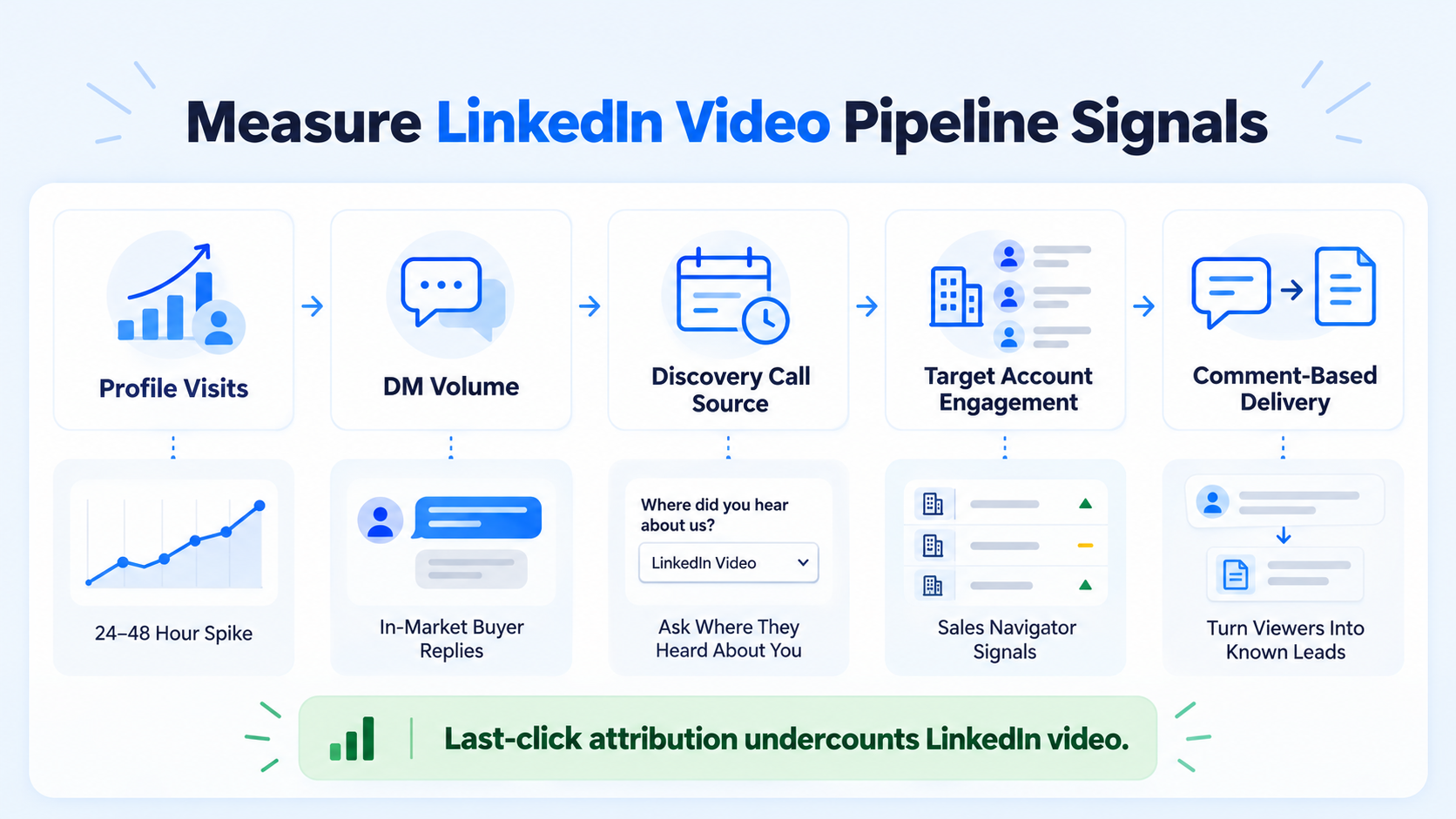
The workaround is a multi-signal approach:
- Track profile visits after video posts. A spike in ICP-profile visits in the 24–48 hours after a video is published is a leading indicator of pipeline intent.
- Monitor DM volume. Buyers who are seriously evaluating your product will reach out directly. Video drives this more than any other format.
- Ask in discovery calls. "Where did you first hear about us?" consistently reveals LinkedIn video as a touchpoint that self-reported pipeline surveys miss entirely.
- Use Sales Navigator to watch who from your target account list is engaging with your video content. Engagement from a target account is a buying signal worth acting on.
- Gate mid-funnel resources via comment-based delivery. Post a video that teases a framework or template. Ask viewers to comment on a specific word to receive it. This converts passive viewers into known leads with a name and context.
LinkedIn accounts for 46% of all social traffic to B2B websites, and delivers a 2.74% visitor-to-lead conversion rate, nearly 3x higher than Facebook or Twitter. Video is the format that drives the highest-quality share of that traffic because it pre-qualifies buyers before they land on your site. The brands that win pipeline from LinkedIn video are the ones that run it as a system through video marketing rather than a series of one-off posts. Consistency, not virality, is what builds a pipeline asset.
Conclusion
A LinkedIn video strategy for B2B SaaS is not a content experiment. It's a revenue system. The key takeaways:
- Video drives a 5.90%+ engagement rate on LinkedIn, outperforming every static format and building the brand trust that shortens sales cycles.
- The best-performing video types for SaaS—founder clips, objection-busters, repurposed webinar highlights, and customer proof—can be produced from scratch or extracted from existing recordings.
- Post 3–5 times per week with 2–3 native videos in the mix; prioritize short vertical clips with burned-in captions.
- Measure dark social signals (DMs, profile visits, Sales Navigator engagement) alongside standard video engagement metrics to capture true pipeline contribution.
If you're ready to turn your product knowledge and founder thinking into a consistent video system—whether by creating net-new content from scratch or repurposing existing assets—start here.
Frequently Asked Questions
Q1: How long should LinkedIn videos be for B2B SaaS?
The optimal length for LinkedIn video in 2026 is 90 seconds to 3 minutes, as the algorithm favors videos watched to completion. For feed content, keep it under 90 seconds. For warm audiences and educational content, 2–3 minutes is acceptable.
Q2: Should a B2B SaaS company post video from the founder's personal profile or the company page?
Personal profiles consistently outperform company pages, with executives posting thought leadership achieving 3–6% engagement compared to the company page average of 1.8–2%. Founder-first is the right model. Use the company page to amplify and repost.
Q3: Do LinkedIn video ads work for SaaS lead generation?
Yes, when paired with organic content. LinkedIn video ads boost purchase intent by 45%. Use organic video for trust-building and retarget warm audiences with paid video ads that push toward a demo booking or gated resource.
Q4: What is the role of captions in a LinkedIn video for SaaS?
With over 80% of videos consumed on mute, captions are non-negotiable for comprehension and retention. Always burn captions directly into the video file. Auto-captions on LinkedIn are inconsistent and should not be relied on.
Q5: How does content repurposing fit into a LinkedIn video strategy for B2B SaaS?
Repurposing existing webinars or podcasts can yield 8–12 standalone clips per session. For teams without raw footage, Komet Media provides research, scripting, and pre-production direction to produce new content from scratch. Both modes allow SaaS teams to maintain a consistent posting cadence without an in-house video production team.
Q6: How do I measure whether a LinkedIn video is actually contributing to the pipeline?
Track DM volume, profile visits from ICP accounts, Sales Navigator engagement from target accounts, and ask "where did you hear about us?" in every discovery call. Last-click attribution undercounts LinkedIn video's impact significantly. A multi-signal measurement model gives you a far more accurate read on what's actually driving demand.