
🪄 AI Summary
Heading 1
Heading 2
Heading 3
Heading 4
Heading 5
Heading 6
Lorem ipsum dolor sit amet, consectetur adipiscing elit, sed do eiusmod tempor incididunt ut labore et dolore magna aliqua. Ut enim ad minim veniam, quis nostrud exercitation ullamco laboris nisi ut aliquip ex ea commodo consequat. Duis aute irure dolor in reprehenderit in voluptate velit esse cillum dolore eu fugiat nulla pariatur.
Block quote
Ordered list
- Item 1
- Item 2
- Item 3
Unordered list
- Item A
- Item B
- Item C
Bold text
Emphasis
Superscript
Subscript
Video ads for funded AI/tech startups only work when the creative earns attention in the first three seconds and proves something specific about the product. I have watched well-funded AI companies burn ad budgets on polished videos that look expensive and explain almost nothing. A funded startup has one real advantage over an unfunded one: the budget to test creative fast and find out what works before competitors do. That advantage gets wasted without a clear system for building, running, and measuring video ads.
Quick Answer
Video ads for funded AI/tech startups work when creative leads with a proof point, not a logo, matches format to platform, and gets tested in small batches before spending scales.
Why Video Ads for Funded AI/Tech Startups Need a Different Playbook
Most video ad advice is written for consumer brands with a known product and a known buyer. Funded AI and tech startups usually have neither. The product may be new to the category, the buyer may not trust "AI" claims yet, and the founding team is often explaining something the market has not seen before.
Paid video also carries more weight in B2B budgets than it did two years ago. Vidico's 2026 B2B video marketing data puts US digital video ad spend on track to surpass $80 billion in 2026, growing faster than the overall ad market, and the IAB's 2026 Digital Video Ad Spend and Strategy Report confirms that digital video spend has crossed the same $80 billion mark this year. B2B video ad spending specifically is projected to reach $2.86 billion by 2027, or about 11.1% of total B2B digital ad spend, according to eMarketer data cited by Levitate Media.
That growth is not evenly funded across teams. Vidico's 2026 State of Creative in Tech report, summarized in its B2B video statistics roundup, found that 76% of B2B tech marketers say their creative production budget is growing and 74% say total marketing budget is rising, but only 29% have a formal AI governance policy covering how AI tools get used in production. Separately, Wistia's State of Video research, cited in the same roundup, found that 46% of marketing teams are running flat video budgets even as demand for video content keeps climbing, a gap Wistia calls the video capacity crisis.
For a funded AI or tech startup, this creates a specific opening:
- Category education is still happening, so a clear, honest explainer video can outperform a slicker but vaguer one.
- Buyers are wary of overclaiming from AI vendors, so proof (a screen recording, a real number, a named use case) does more work than a tagline.
- Budgets are growing faster than production capacity at most competitors, which rewards startups that build a repeatable video advertising system early instead of producing one-off campaigns.
The competitive set is also better funded than most founders expect. New Market Pitch's tracker of AI sales and marketing funding found that pure-play AI sales and marketing startups alone raised $575 million across 21 disclosed equity rounds between August 2025 and July 2026, with a median round of $17 million. That capital is showing up in ad accounts. eMarketer reporting on AI-powered ad spend projects AI-driven ad spend in the US will hit $57 billion in 2026, up 63% year over year and about 12% of the total US ad market. A funded AI startup is not just competing for a buyer's attention. It is competing against other funded AI startups running the same paid channels with similar budgets, which makes a clear, provable creative angle more important than a larger media budget.
Where Funded AI/Tech Startups Lose Money on Video Ads
Most wasted ad spend traces back to a small set of repeated mistakes, not to the platform or the targeting.
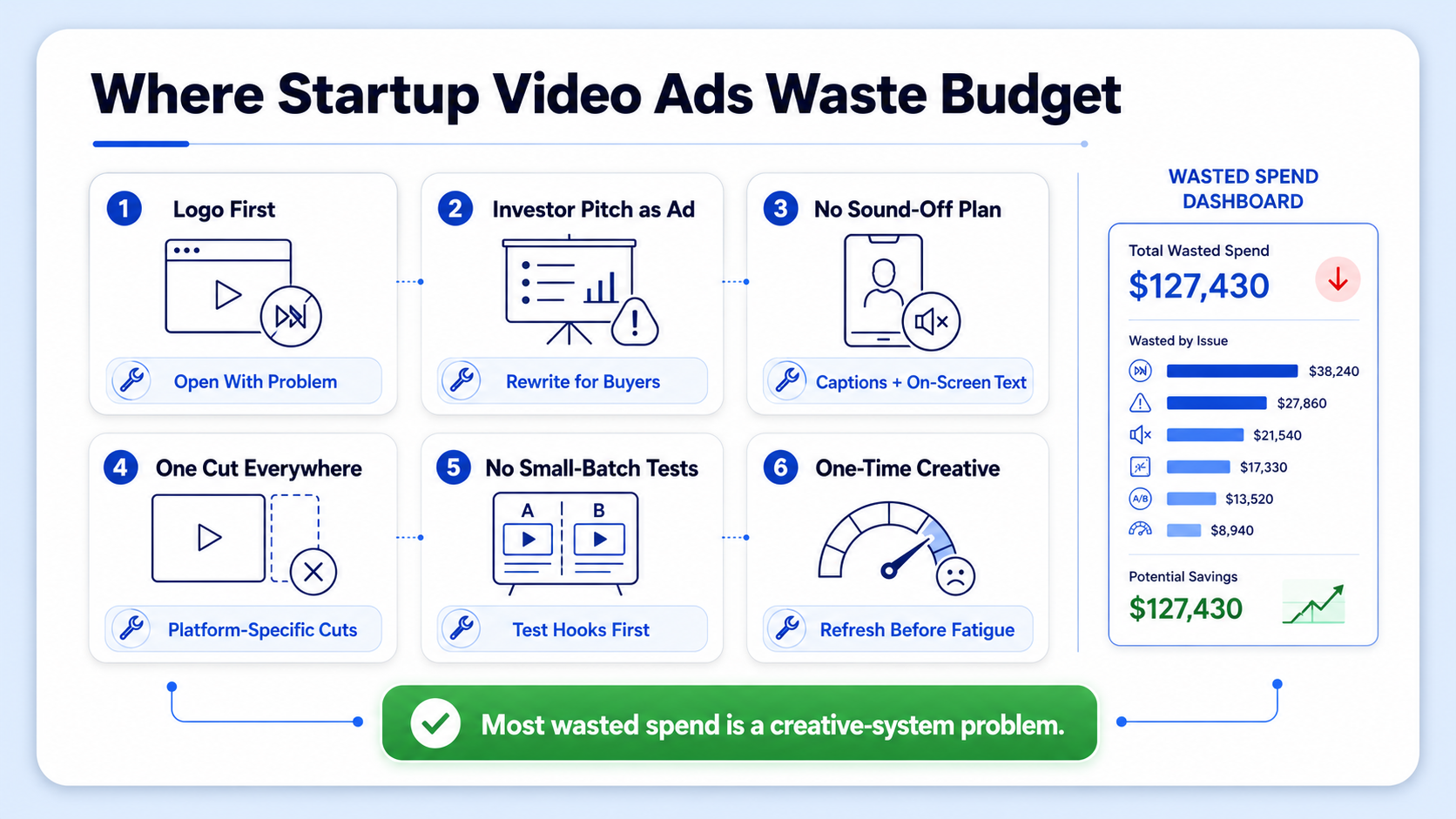
- Leading with the logo and brand story instead of the problem. Viewers decide whether to keep watching in the first few seconds. A cold open on a founder headshot or a company name does not earn that decision.
- Reusing a demo-day or investor pitch video as ad creative. A video built to impress investors is paced and worded differently from one built to stop a scroll and explain value to a buyer.
- Ignoring sound-off viewing. Research from Verizon and Publicis, referenced in Foundry CRO's 2026 landing page video benchmarks, found that 92% of mobile viewers and 83% of viewers across all devices watch video muted by default, and viewers with captions on are far more likely to watch to completion. A video ad that depends on audio to make its point loses most of its audience before the message lands.
- Running one video everywhere. LinkedIn, YouTube, and Meta reward different lengths, aspect ratios, and pacing. A single cut resized for every placement usually underperforms native-length creative on each one.
- Skipping small-batch testing. Wistia's 2026 analysis of 13 million videos found videos under one minute average roughly 52% engagement, with completion rates dropping below 50% past 90 seconds. Teams that never test length, hook, or proof point against that pattern keep guessing instead of learning.
- Treating the video ad as a one-time deliverable. A single winning video ad rarely stays a winner for more than a few weeks of active spend before frequency fatigue sets in.
Platforms, Formats, and Budget Benchmarks for Video Ads for Funded AI/Tech Startups
Funded AI and tech startups mostly run video ads across three platforms, and each one rewards a different creative approach.
LinkedIn carries the most weight in most funded AI/tech startup media plans, since B2B buyers spend more working time there than on consumer platforms. Dreamdata's 2025 LinkedIn Ads Benchmarks found LinkedIn's share of total B2B ad budgets grew from 31% in the first half of 2024 to 39% by year end, and reported LinkedIn generating the highest ROAS among major ad networks in its dataset, ahead of Google Search and Meta. Video now accounts for roughly 31.72% of LinkedIn ad budgets, according to benchmark data cited by Busylike's 2026 LinkedIn video ad playbook and Stackmatix's LinkedIn video ad guide.
The table below gives a working set of budget benchmarks for video ads for funded AI/tech startups planning LinkedIn spend, drawn from ZenABM's 2026 LinkedIn ABM Performance Benchmarks Report, which analyzed 161,256 LinkedIn ads and $5.5 million in spend across 211 B2B companies.
Thought Leader Ads run a real employee's post as paid media rather than a branded video, which is why the cost per click looks so different. Many funded AI/tech startups now pair a produced video ad for awareness with Thought Leader Ads for lower-cost engagement in the same campaign structure.
A Production Workflow That Keeps Creative Testing Fast
A repeatable process matters more than any single "winning" video ad, because a video ad system needs to keep producing new tests as old creative fatigues. A workflow that holds up for most funded AI and tech startups looks like this.
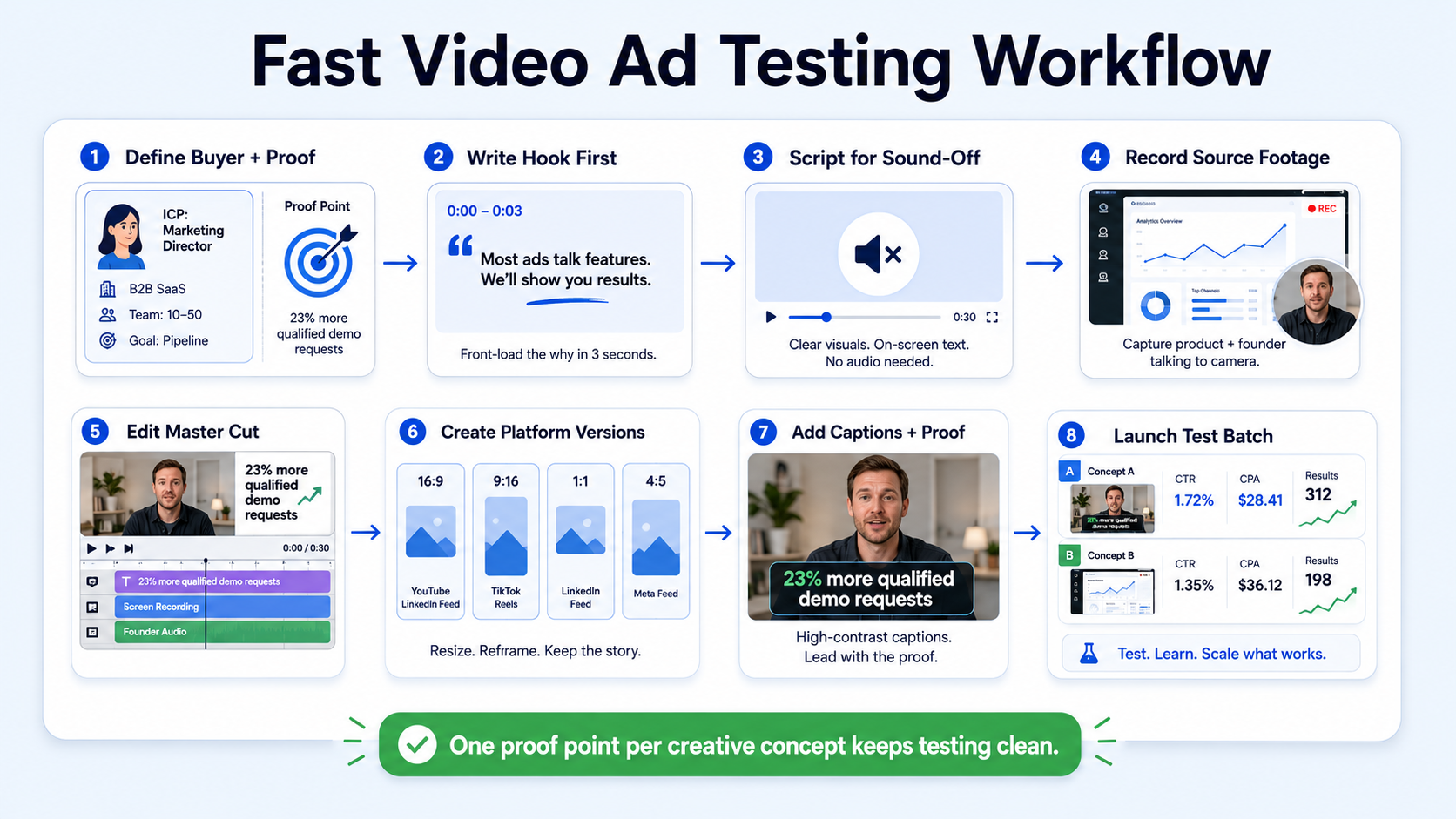
- Define the buyer and the one thing the ad needs to prove. A single ad cannot cover every feature. Pick one proof point per creative concept.
- Write the hook before the script. The first line on screen and the first line of narration decide whether the rest of the video gets watched. See our guide to writing hooks that stop the scroll for a working framework.
- Script for sound-off viewing. Build the message into on-screen text and visuals, not only narration, given how many viewers watch muted.
- Record clean source footage. Screen recordings, product UI, customer quotes, and founder-to-camera footage all need to be captured at a quality level that survives multiple aspect-ratio cuts.
- Edit a master cut, then platform-specific versions. A LinkedIn cut, a YouTube in-feed cut, and a Reels cut should share a message but not share a runtime or pacing.
- Add captions and on-screen proof. Captions are not optional for paid social video given how much of the audience watches muted.
- Launch in small test batches. Run two or three hook variations against a limited budget before committing to a full media spend.
- Review performance and feed it into the next batch. Kill underperforming creative early rather than letting it run out of habit.
This is the same discipline behind short-form video editing and motion graphics work more broadly, applied specifically to paid creative instead of organic posting.
What Changes the Price of a Video Ad Project
Cost for video ads varies more by scope than by vendor type. A few factors move the price the most:
- Number of concepts, not just number of videos. Three hooks tested against one proof point cost less to produce than three unrelated concepts.
- Whether footage exists or needs to be shot. New product demos, founder-to-camera footage, or customer interviews add production time that repurposed footage does not.
- Motion graphics and UI animation. AI and tech products often need animated explanations of features that cannot be filmed directly.
- Platform-specific versioning. Each additional aspect ratio and length adds editing time, even from a shared master cut.
- Revision rounds and turnaround requirements. Faster turnaround and more revision rounds both add cost.
- Distribution and campaign support. Some engagements cover creative only; others include platform setup, testing structure, and reporting.
Komet Media typically works with funded AI and tech startups through retainers in the range of roughly $2,500 to $5,000, with final scope set by the factors above rather than a fixed public package. Our B2B video editing pricing models resource breaks this down in more detail, and our video editor cost guide covers freelancer and subscription pricing for comparison.
Measuring What Video Ads for Funded AI/Tech Startups Actually Produced
Views and impressions describe reach. They do not describe whether the ad moved a buyer closer to a decision. Match the metric to what the ad was actually built to do.
Treat attribution as directional rather than exact. A single dashboard rarely captures the full picture, especially on LinkedIn where a Thought Leader Ad and a produced video ad often influence the same buyer at different points. Our guide to video KPIs B2B teams should track and measuring ROI on short-form video go deeper on building a measurement plan, and our notes on attribution for video and podcast content cover how to combine signals when no single metric tells the whole story.
Conclusion
The honest test of video ads for funded AI/tech startups is simple: does the creative make a specific claim a buyer can verify, and does the media plan give that claim a fair chance to be seen and tested. Funded status buys the room to test faster than competitors, not permission to skip the discipline of hooks, proof, and platform fit. We work with funded startups and B2B SaaS teams on exactly this kind of system, building the video ad and testing it against real spend rather than treating it as a single finished asset.
FAQ
1) What are video ads for funded AI/tech startups?
They are paid video creative run on platforms like LinkedIn, YouTube, and Meta to build awareness or generate leads for a startup that has raised funding and needs to move faster than organic reach allows. They differ from organic video because the creative has to earn attention against a cold, often skeptical audience within the first few seconds.
2) How much do video ads cost for a funded AI or tech startup?
Cost depends on the number of concepts, whether new footage needs to be shot, how much motion graphics work is involved, and how many platform-specific versions are needed. Komet Media typically works in the $2,500 to $5,000 range per retainer, with scope set by these factors rather than a fixed package. See our B2B video editing pricing models breakdown for more detail.
3) What does the production process for a startup video ad look like?
It usually moves from defining the buyer and proof point, to scripting the hook, to recording or sourcing footage, to editing a master cut and platform-specific versions, to captioning, to launching small test batches, then reviewing results before scaling spend.
4) How long does it take to launch a video ad campaign?
A first batch of creative usually takes one to three weeks depending on whether new footage needs to be shot. Ongoing production, once a workflow is in place, can turn around new test batches on a weekly or biweekly cadence.
5) What deliverables should a startup expect from a video ad project?
Expect a master edited video plus platform-specific cuts (different aspect ratios and lengths for LinkedIn, YouTube, and Meta), captioned versions, and often a short set of hook or opening variations built for testing.
6) Is a freelancer or an agency better for startup video ads?
A freelancer can work well for a single project with a clear brief and a founder who has time to direct the edit closely. An agency tends to fit better once a startup needs multiple concurrent concepts, platform-specific versioning, and a repeatable testing cadence, since that requires more coordinated capacity than one freelancer usually offers.
7) Do early-stage or pre-seed AI startups need video ads?
Not usually as a first move. Paid video ads work best once there is a clear buyer, a working product to show, and budget to run real tests. Pre-seed and pre-funding teams are often better served by organic founder-led content until they have funding and a validated message worth paying to scale.
8) Does Komet Media produce video ads for AI-native and tech startups?
Yes. We build and edit video ads for funded AI-native companies, B2B SaaS teams, and technology startups, covering everything from hook scripting and motion graphics to platform-specific versioning. You can see our approach on the video advertising service page or book a call to talk through a specific campaign.