
🪄 AI Summary
Heading 1
Heading 2
Heading 3
Heading 4
Heading 5
Heading 6
Lorem ipsum dolor sit amet, consectetur adipiscing elit, sed do eiusmod tempor incididunt ut labore et dolore magna aliqua. Ut enim ad minim veniam, quis nostrud exercitation ullamco laboris nisi ut aliquip ex ea commodo consequat. Duis aute irure dolor in reprehenderit in voluptate velit esse cillum dolore eu fugiat nulla pariatur.
Block quote
Ordered list
- Item 1
- Item 2
- Item 3
Unordered list
- Item A
- Item B
- Item C
Bold text
Emphasis
Superscript
Subscript
Video ads for private equity mean something different than they do for a SaaS company, and firms that miss that distinction waste budget fast. Most paid video work in this industry happens at two levels: helping portfolio companies grow, and helping the firm itself reach the specific operators and advisors who drive deal flow. It rarely means running ads at limited partners, since fundraising communication carries real compliance considerations that sit outside what a video team should be advising on. Getting the use case right matters more than getting the creative right.
Quick Answer
Video ads for private equity work mainly at two levels: paid growth campaigns for portfolio companies, and precisely targeted deal-sourcing video aimed at business owners and advisors, not general LP-facing brand ads.
Why Video Ads for Private Equity Work Differently
Most B2B video ad advice assumes a company selling a product to a buyer who can be reached with open targeting. Private equity does not work that way. A fund is not selling shares to the public, and firm-level video aimed at limited partners or prospective investors runs into general solicitation rules that vary by offering type and exemption. This is not a legal opinion, and any firm considering paid video aimed at investors should get its own counsel involved before launching anything. The far fewer restrictions sit one level down, at the portfolio company.
Digital paid advertising has become a standard growth lever for PE-backed businesses. WebFX's 2026 guide to private equity digital marketing describes paid advertising as one of the core strategies operating partners now use to help portfolio companies reach qualified leads faster after acquisition. Craig Group's research on ROI-driving digital strategies for PE portfolio companies points to targeted campaigns on LinkedIn, Google, and Meta as a way to accelerate revenue growth inside the hold period, which is exactly the kind of measurable lever operating partners are expected to pull.
The other real use case is deal sourcing, and here the industry has a visibility problem worth understanding before spending anything. Greenbrook's Private Markets Digital Report 2026 tracked 300 leading firms and found their LinkedIn audiences grew by an average of 33% over the past year, reaching a combined 13.2 million followers. The report makes a sharp point: that audience is mostly the industry talking to itself, LPs, competitors, and advisors, not the business owner deciding whether to finally take a call from a PE firm. Paid video, precisely targeted rather than broadcast to an existing follower base, is one of the few ways to reach that operator directly.
The broader B2B video ad market backs up why this is worth doing carefully rather than skipping. eMarketer data cited by Levitate Media projects B2B video ad spending will reach $2.86 billion by 2027, about 11.1% of total B2B digital ad spend, and Vidico's 2026 B2B video marketing data puts US digital video ad spend on track to surpass $80 billion in 2026. That growth means the operators and advisors a PE firm wants to reach are seeing more paid video in their feeds generally, which raises the bar for a campaign that is not built around a specific, credible value-add. Our guide on how private equity firms build inbound pipeline with video and how they grow brand awareness covers the organic side of this same distinction in more depth.
Where Private Equity Firms Get Video Ads Wrong
A handful of mistakes explain most of the wasted spend in this category.
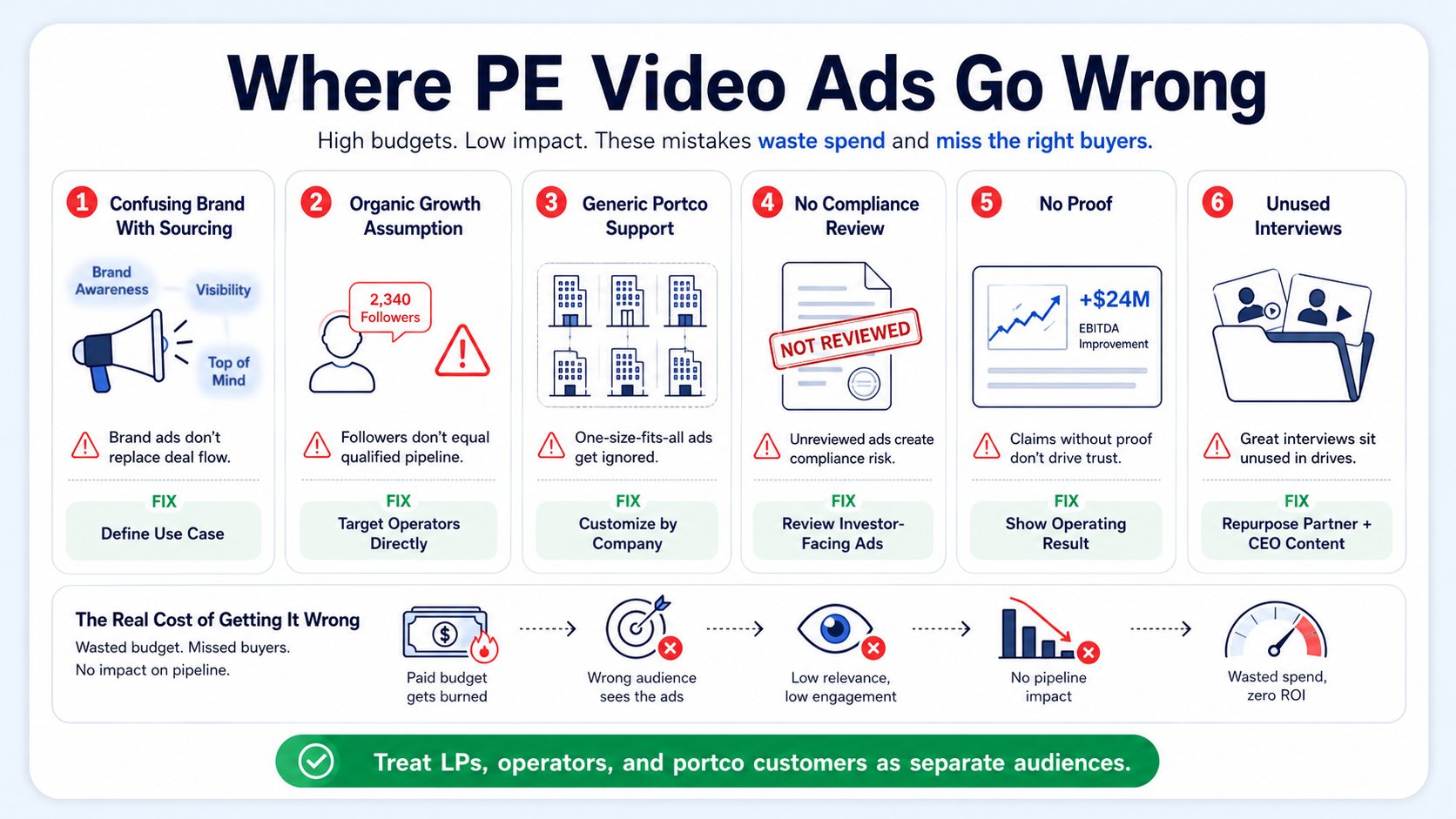
- Confusing firm-brand awareness with deal sourcing. A polished video about the firm's track record does little for a target operator who has never heard of the fund and is not looking for reassurance about its reputation.
- Assuming organic LinkedIn growth solves the reach problem. As Greenbrook's data shows, a growing follower count often means more industry visibility, not more access to the specific business owners a deal team wants to reach.
- Treating portfolio company ad support as one generic service. A portfolio company in healthcare and one in industrial services need different proof points, different platforms, and different targeting, not the same templated campaign.
- Running ads with no compliance review for anything investor-facing. Any campaign that could reach or target current or prospective LPs needs legal sign-off before it launches, not after.
- Skipping proof entirely. A video ad built around a claim with no operating result behind it does not move a skeptical operator or a data-driven acquisition target.
- Never repurposing existing interviews. Partner interviews, portfolio CEO conversations, and panel appearances often contain the proof points a deal-sourcing or portco campaign actually needs.
These mistakes usually trace back to the same root cause: treating private equity as a single audience instead of two very different ones. A campaign built for LPs, a campaign built for operators, and a campaign built for a portfolio company's own customers each need their own plan, not one video reused across all three.
What Good Video Ads for Private Equity Actually Look Like
Video ads for private equity split cleanly into two audiences, and the format should follow the audience.
LinkedIn carries the most weight for the deal-sourcing and authority use cases, since that is where operators, advisors, and co-investors already spend research time. Dreamdata's 2025 LinkedIn Ads Benchmarks found LinkedIn's share of total B2B ad budgets grew from 31% in the first half of 2024 to 39% by year end, with LinkedIn generating the highest ROAS among major ad networks in its dataset, ahead of Google Search and Meta. ZenABM's 2026 LinkedIn ABM Performance Benchmarks Report, based on 161,256 ads and $5.5 million in spend across 211 B2B companies, found Thought Leader Ads running at a 2.68% CTR and $2.29 CPC, roughly 77% cheaper per click than standard single-image ads, which fits a partner-led, executive-voice approach better than a produced brand spot.
Executive commentary works especially well here because it draws on material a firm often already has. Our thought leadership video examples for executives collection shows how other firms have built this kind of content from partner talks and panel appearances rather than from a scripted brand video.
A Practical Workflow for Deal-Sourcing and Portfolio Video Ads
The production process differs slightly depending on which use case a campaign is built for.
- Decide which use case the campaign serves. Portfolio company growth and deal sourcing need different messaging, targeting, and often different approval chains.
- Pull proof from existing material. Partner interviews, portfolio CEO conversations, and panel appearances usually contain a usable claim or result already.
- Write the hook around a specific value-add. For deal sourcing, that means naming the sector expertise or operating support the firm actually brings, not a general reputation statement.
- Route anything investor-facing through compliance first. This step should happen before creative is finalized, not as a final check.
- Edit for the platform and the audience. A deal-sourcing video for LinkedIn and a portfolio company product ad for Meta should not share the same pacing or length.
- Target narrowly. Precision matters more than reach for deal sourcing specifically, since the goal is a small, specific audience of operators and advisors.
- Test in small batches before scaling spend. This applies especially to portfolio company campaigns, where creative and targeting can be iterated quickly against real conversion data.
- Review results against the original use case. A deal-sourcing campaign and a portco growth campaign should be judged on different metrics entirely.
This is the same discipline behind our video advertising work more broadly, applied to the specific constraints and opportunities private equity firms operate under. Our account-based marketing with video guide covers the precision-targeting approach that deal-sourcing campaigns depend on.
What Changes the Price of Video Ads for Private Equity
Cost depends heavily on which use case the campaign serves. The factors that move the price the most:
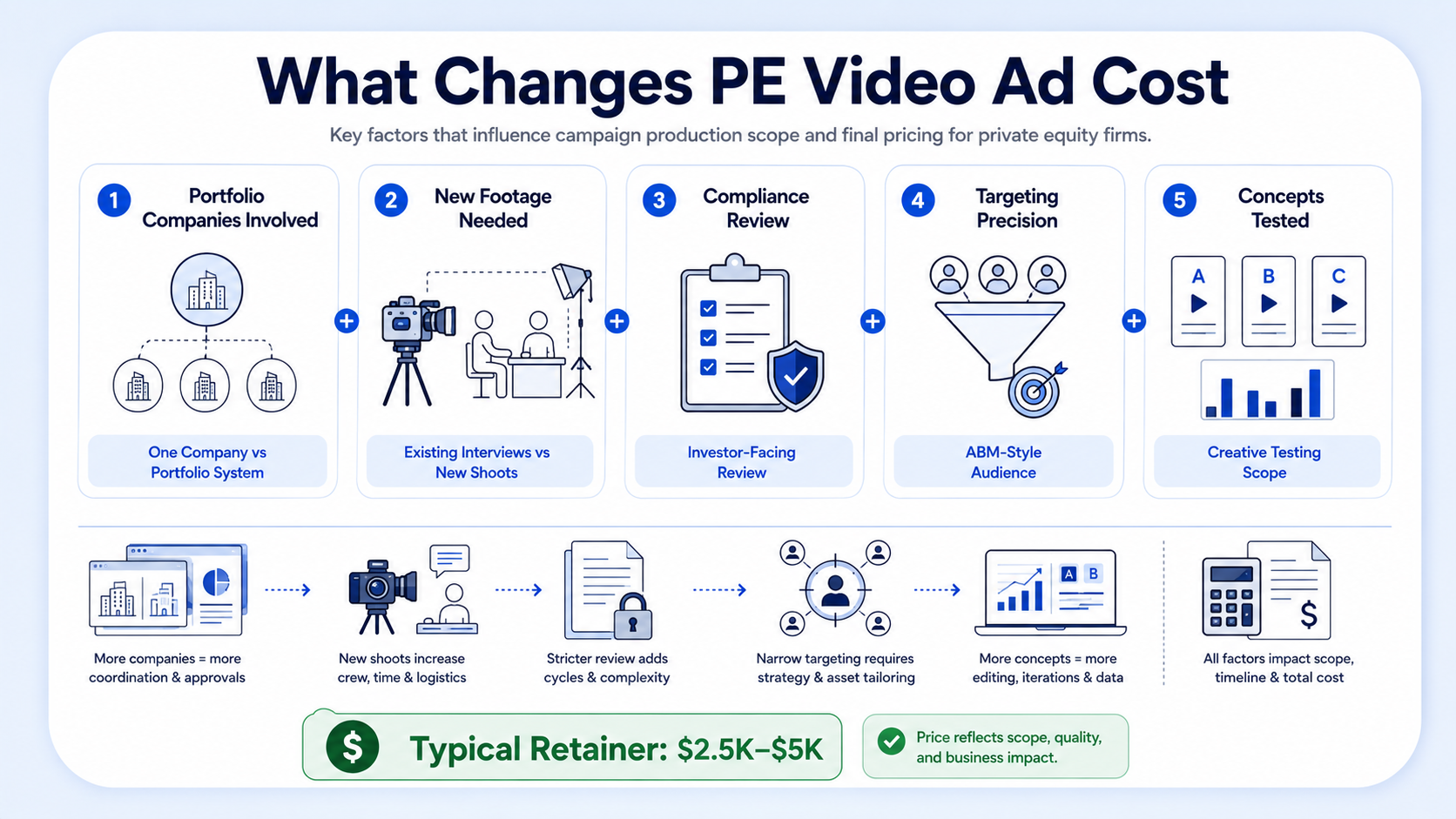
- Number of portfolio companies involved. Supporting one portfolio company's ad campaigns costs less than building a repeatable system across several.
- Whether new footage needs to be produced. Deal-sourcing campaigns built from existing partner interviews cost less than new executive shoots.
- Compliance review requirements. Anything that could reach or target investors typically adds legal review time to the production timeline.
- Targeting precision. Narrow, ABM-style targeting for deal sourcing generally costs more per impression than broad portfolio company campaigns, since the audience is smaller and more specific.
- Number of concepts tested. Portfolio company campaigns benefit from testing multiple creative concepts, which adds production scope beyond a single finished ad.
Komet Media typically works with private equity firms through retainers in the range of roughly $2,500 to $5,000, with final scope set by the factors above rather than a fixed public package. Our B2B video editing pricing models resource breaks this down further, and our video editor cost guide compares freelancer, subscription, and retainer pricing.
Measuring What Video Ads Actually Produced
Views and reach measure attention, not whether a campaign did the job it was built for. Match the metric to the use case.
Treat these signals separately rather than combining them into one dashboard, since a deal-sourcing campaign and a portfolio company growth campaign are answering completely different questions. Our notes on video KPIs B2B teams should track and attribution for video and podcast content go further into building a measurement plan that holds up across both use cases.
Conclusion
Video ads for private equity work when a firm is honest about which of the two real use cases a campaign serves, portfolio company growth or precisely targeted deal sourcing, rather than defaulting to a general brand awareness play. Anything that touches investors needs legal review before it launches. We work with private equity firms on both sides of this, from portfolio company campaign support to the partner-led video that deal-sourcing outreach depends on.
FAQ
1) What are video ads for private equity?
They are paid video campaigns used mainly for two purposes: helping portfolio companies grow through targeted ads on platforms like LinkedIn, Google, and Meta, and helping a firm reach specific operators or advisors for deal sourcing. They are generally not used to solicit limited partners directly, due to compliance considerations that sit outside general marketing advice.
2) How much do video ads cost for a private equity firm?
Cost depends on which use case the campaign serves, how many portfolio companies are involved, whether new footage needs to be produced, and how narrow the targeting needs to be. Komet Media typically works in the $2,500 to $5,000 range per retainer. See our B2B video editing pricing models breakdown for detail.
3) What does the production process look like?
It usually starts with deciding which use case a campaign serves, pulling proof from existing partner or portfolio interviews, routing anything investor-facing through compliance, editing for the specific platform and audience, and testing in small batches before scaling spend.
4) How long does it take to see results?
Portfolio company growth campaigns can show conversion data within weeks, similar to any performance marketing effort. Deal-sourcing campaigns typically take longer, since the goal is building recognition with a narrow group of operators who may not be ready to sell for months.
5) What deliverables should a firm expect?
Expect platform-specific edited videos for whichever use case applies, portfolio company product or service ads for Meta and Google, or deal-sourcing videos built around sector expertise for LinkedIn, along with the targeting and testing structure needed to run them.
6) Is a freelancer or an agency better for this work?
A freelancer can work for a single portfolio company running one campaign with clear direction. An agency tends to fit better once a firm wants a repeatable system across multiple portfolio companies or an ongoing deal-sourcing campaign that needs regular creative refreshes. Our freelancer versus agency comparison covers the trade-offs in more depth.
7) Does every private equity firm need video ads?
No. A firm without an active operating model for portfolio companies, or one that sources deals almost entirely through brokers and existing relationships, may get more value from organic thought leadership than from paid campaigns. Video ads earn their place once a firm has a specific growth or sourcing goal that precise targeting can actually move.
8) Does Komet Media produce paid video campaigns for private equity firms?
Yes. We build video ad campaigns for portfolio company growth and edit partner-led content for deal-sourcing use, always within the scope of general marketing production rather than compliance advice. You can see our approach on the video advertising service page or book a call to talk through a specific firm's needs.