
🪄 AI Summary
Heading 1
Heading 2
Heading 3
Heading 4
Heading 5
Heading 6
Lorem ipsum dolor sit amet, consectetur adipiscing elit, sed do eiusmod tempor incididunt ut labore et dolore magna aliqua. Ut enim ad minim veniam, quis nostrud exercitation ullamco laboris nisi ut aliquip ex ea commodo consequat. Duis aute irure dolor in reprehenderit in voluptate velit esse cillum dolore eu fugiat nulla pariatur.
Block quote
Ordered list
- Item 1
- Item 2
- Item 3
Unordered list
- Item A
- Item B
- Item C
Bold text
Emphasis
Superscript
Subscript
Reels for B2B SaaS sounds like a mismatch until you look at where software buyers actually spend their attention before a demo call. I have had SaaS founders ask me, half joking, whether Instagram is even worth their time. The honest answer is that it depends entirely on the format. A dancing logo does nothing for a SaaS brand. A 30 second product explainer or a clear feature demo, cut for a platform where Reels now get more than double the reach of a static post, does real work.
Quick Answer
Reels for B2B SaaS work when they show a real product, feature, or customer result in under a minute, not when they chase entertainment trends unrelated to the software.
Why Reels for B2B SaaS Is Not as Strange as It Sounds
Instagram still reads as a consumer platform first, and for most feed content that instinct is correct. Reels changes the math because Instagram actively pushes the format to people who do not already follow an account. Reels carry an average reach rate of roughly 30.81%, more than twice the rate of carousels, image posts, and Stories, according to data compiled by Digital Applied's 2026 Instagram statistics report and corroborated in Loopex Digital's 2026 Instagram Reels statistics roundup. Reels also carry the highest engagement rate of any Instagram format, at roughly 2.7 to 2.8%, per the same reporting.
Several established B2B software companies already treat this as normal. Vidico's 2026 Instagram Reels statistics report notes that teams at Slack, Canva, HubSpot, and Notion use Reels for product demos, tutorials, and behind-the-scenes culture content. The same report, drawing on Vidico's 2026 State of Creative in Tech survey of more than 230 B2B tech marketers, found that customer-proof video and paid-social video were named the highest-impact formats for the year, ahead of purely promotional content.
The buyer behavior backs this up. Komet Media's own analysis of B2B Instagram growth statistics found that 78% of software buyers research a brand's social media presence before requesting a demo. That lines up with broader B2B research: Sopro's 2026 B2B buyer statistics put the share of B2B purchase decision makers who use social media to help them decide at around 70%. A buyer who lands on a SaaS company's Instagram profile and finds nothing but a logo and a launch announcement from two years ago is not seeing a company that looks active.
Scale still matters, though. Influencer Marketing Hub's 2026 Reels statistics report found that Reels reach smaller accounts particularly well, while carousels tend to overtake them once an account crosses roughly 50,000 followers. Most B2B SaaS accounts sit well under that mark, which works in their favor for Reels specifically.
The advertising side reinforces the same pattern. Digital Applied's 2026 Instagram statistics reports that Reels ad placements currently run about 18% lower CPM than standard feed placements while generating roughly 22% higher engagement, since more advertisers have not yet shifted budget toward the format. That pricing gap will not last indefinitely as more brands catch on, which is part of why the current window matters for a B2B SaaS team deciding whether to test Reels now or wait.
None of this means every SaaS company needs an aggressive Instagram presence. It means the format itself is no longer disqualifying for B2B, even though the platform's broader audience skews consumer. The decision should rest on whether the company has product, customer, or founder content worth repurposing, not on a general assumption that Instagram is off limits for software brands.
Where B2B SaaS Teams Get Reels Wrong
A handful of mistakes account for most of the wasted effort.
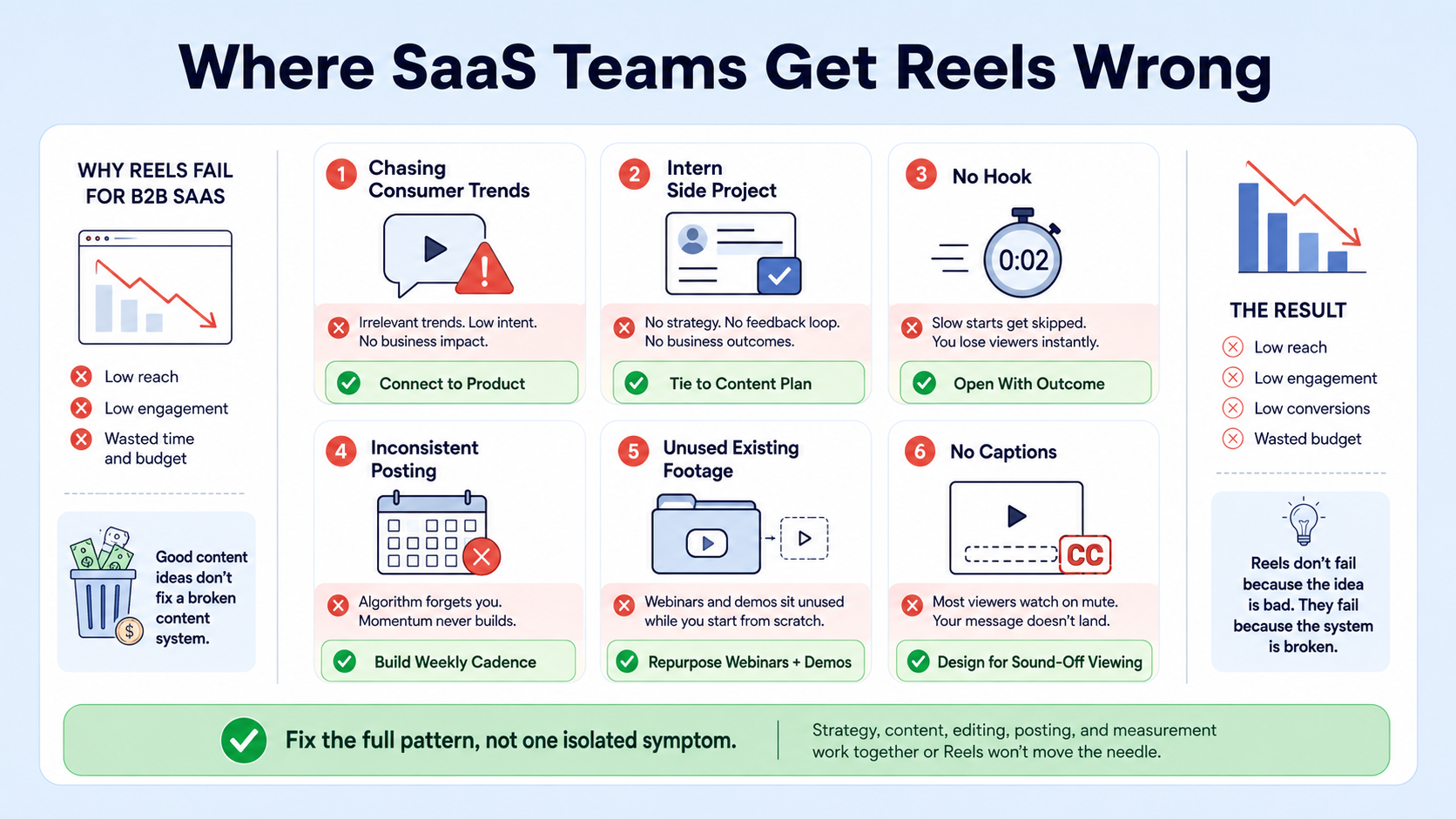
- Chasing consumer trends with no product connection. A trending sound or format that has nothing to do with the product usually confuses the exact audience a SaaS brand needs to reach.
- Treating Reels as a marketing intern's side project. Reels tied to nothing in the broader content plan rarely get the selection or editing attention that makes them worth watching.
- Skipping the hook. The first two seconds decide whether the format even gets a chance, and a slow logo intro loses that window immediately.
- Posting inconsistently. A handful of Reels in a burst, then silence for months, does not build the recognition that a steady cadence does.
- Never repurposing existing footage. Most SaaS teams already have webinar recordings, demo videos, and customer calls sitting unused, which is a faster starting point than filming new Reels from scratch.
- Ignoring captions. Most social video gets watched with the sound off, so a Reel that depends on narration to explain the product loses viewers before the message lands.
These mistakes usually compound. A team that skips captions and also ignores its own webinar footage ends up filming new content from scratch, on an inconsistent schedule, without a hook that earns attention in the first place. Fixing any one of these problems in isolation rarely moves performance much. The pattern has to change as a whole.
What Good Reels for B2B SaaS Actually Look Like
Reels for B2B SaaS work best when they map to a small set of proven formats rather than trying to cover everything at once.
Influencer Marketing Hub's 2026 benchmark analysis found the strongest performance in the 30 to 60 second range, with Reels between 45 and 60 seconds producing the highest engagement and median views in large-scale testing. That range fits product explainers and customer proof clips especially well, since both need enough time to make a real point without losing the viewer.
Most SaaS teams do not need to run all five formats at once. A reasonable starting point is one product explainer and one customer proof clip per week, then adding founder POV or culture content once the first two formats find their footing. Our Instagram Reels strategy guide for B2B brands and collection of B2B Instagram Reels examples walk through how other software companies have sequenced this in practice.
A Practical Workflow for Turning Existing Content into Reels
Most SaaS teams do not need to film new content to start. They need a system for pulling Reels out of what they already record.
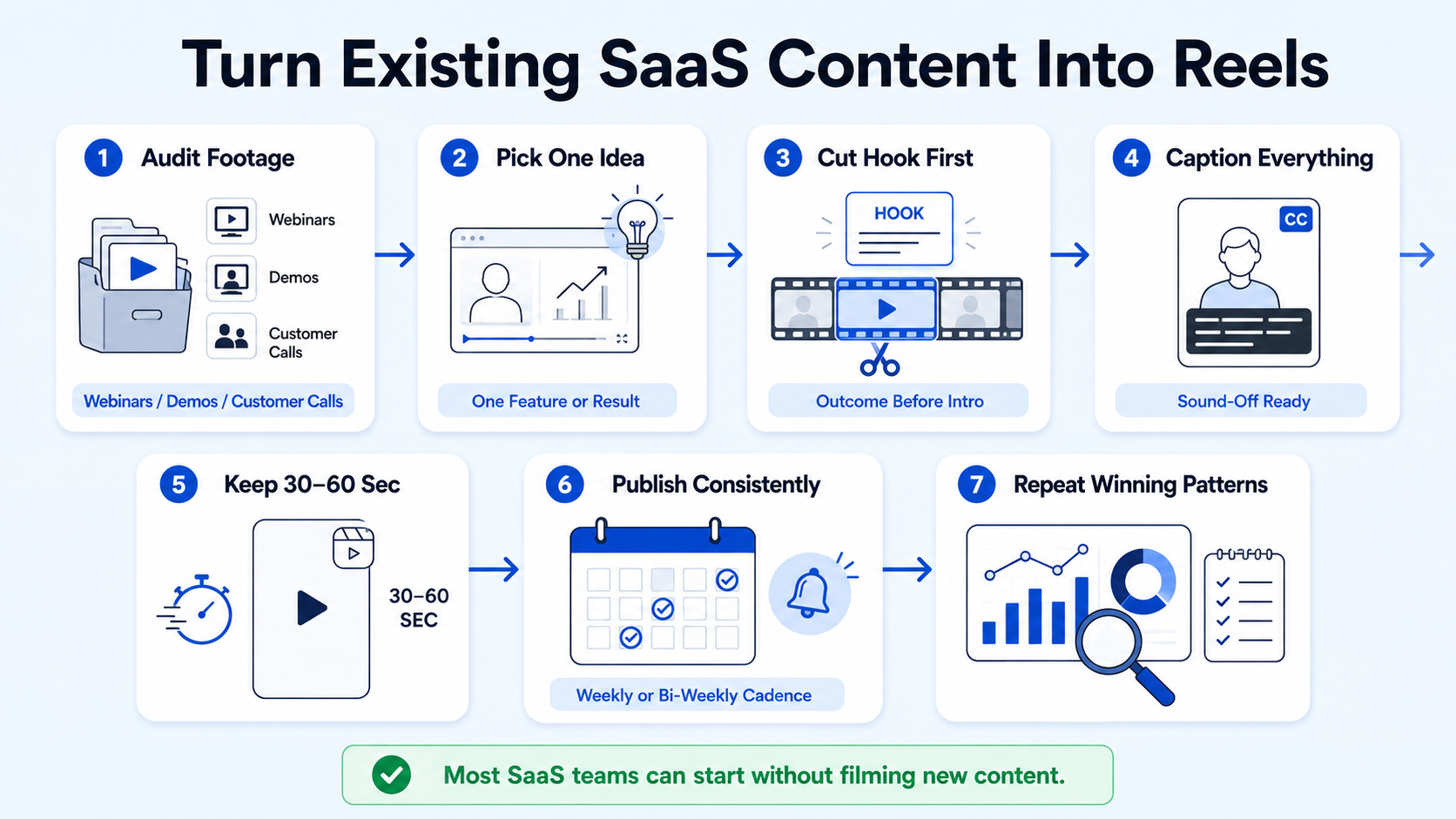
- Audit what already exists. Webinars, demo calls, onboarding sessions, and customer interviews usually contain several strong clips nobody has pulled out yet.
- Pick one clear idea per Reel. A single feature, a single customer result, or a single opinion works better than trying to summarize an entire product.
- Cut for the hook first. Open on the specific outcome or claim, not a company introduction.
- Caption everything. Build the message into on-screen text so it holds up without sound.
- Keep it in the 30 to 60 second range for most formats. Shorter product explainers can run closer to 15 seconds when the idea is simple enough.
- Publish on a consistent cadence. A steady weekly or biweekly rhythm outperforms sporadic bursts of activity.
- Review what performed and repeat the pattern. A format that lands with the target audience is worth running again with a new example, not replaced with something entirely different.
This is the same discipline behind our short-form video editing and Instagram growth work, applied specifically to what a SaaS team already has on hand.
What Changes the Price of Reels for B2B SaaS
Cost depends mostly on scope, not on the platform itself. The factors that move the price the most:
- Number of Reels per month. A handful of clips from existing footage costs less than a full weekly publishing cadence across multiple formats.
- Whether new footage needs to be filmed. Product explainers and demos built from existing screen recordings are faster to produce than net-new customer interviews or founder shoots.
- Motion graphics and on-screen text design. Reels that need custom animated captions, callouts, or branded lower thirds take more editing time than a clean talking-head cut.
- Number of source recordings per month. More webinars, demo calls, or interviews to pull from generally means more Reels can come out of the same production cycle.
- Strategy and content planning support. Some engagements cover editing only, while others include selecting which moments to turn into Reels in the first place.
Komet Media typically works with B2B SaaS teams through retainers in the range of roughly $2,500 to $5,000, with final scope set by the factors above rather than a fixed public package. Our B2B video editing pricing models resource breaks this down further, and our video editor cost guide compares freelancer, subscription, and retainer pricing.
Measuring What Reels Actually Produced
Reach and views describe attention. They do not describe whether Reels are doing commercial work for the business. Match the metric to what a given Reel was built to do.
Treat these signals together instead of relying on one number. Reels tend to serve two different jobs for a SaaS brand, and it helps to know which one a given post is meant to do before judging its performance. One job is building inbound pipeline, where the metric that matters most is whether Instagram traffic is turning into demo requests. The other is growing brand awareness among a broader audience that is not ready to buy yet, where reach and repeat viewership matter more than immediate conversion. Our notes on video KPIs B2B teams should track go further into building a measurement plan that connects social activity to pipeline over a full quarter, not a single post.
Conclusion
Reels for B2B SaaS is not about competing with consumer creators for entertainment value. It is about giving software buyers who are already researching a company something worth watching in the format Instagram now rewards most. We work with B2B SaaS teams on turning existing demo, webinar, and customer content into exactly this kind of Reel, without asking anyone to film something new every week.
FAQ
1) What are Reels for B2B SaaS?
They are short vertical videos, typically 15 to 60 seconds, published to Instagram to show a product feature, customer result, or team insight. For SaaS companies, they work best as product explainers and customer proof rather than entertainment content.
2) How much does it cost to produce Reels for a SaaS company?
Cost depends on how many Reels get produced per month, whether new footage needs to be filmed, and how much motion graphics or captioning work each one needs. Komet Media typically works in the $2,500 to $5,000 range per retainer. See our B2B video editing pricing models breakdown for detail.
3) What does the production process look like?
It usually starts with auditing existing footage such as webinars, demos, and customer calls, picking one clear idea per Reel, cutting for the hook, captioning for sound-off viewing, and publishing on a consistent cadence.
4) How long does it take to see results?
A single Reel rarely changes anything on its own. Most SaaS teams need a few months of consistent weekly or biweekly publishing before reach and engagement patterns become clear enough to act on.
5) What deliverables should a SaaS team expect?
Expect a set of captioned, vertical Reels per month, typically pulled from existing recordings, formatted to the 30 to 60 second range that performs best, with on-screen text built for sound-off viewing.
6) Is a freelancer or an agency better for this work?
A freelancer can work well for a company producing a handful of Reels a month with one point of contact directing every edit. An agency tends to fit better once a team wants a repeatable weekly system pulling from multiple source recordings. Our freelancer versus agency comparison covers the trade-offs in more depth.
7) Does every SaaS company need to be on Instagram?
Not automatically. A company with almost no video footage and no plan for consistent posting will likely get more value starting with LinkedIn, where most B2B buyers already spend research time. Instagram earns its place once a team has product or customer content worth repurposing and wants to reach a younger or more visually driven segment of its buyers.
8) Does Komet Media produce Instagram Reels for SaaS companies?
Yes. We edit product explainers, customer proof clips, and founder content into Reels for SaaS teams, usually built from webinars, demos, and interviews the company already has. You can see our approach on the Instagram growth service page or book a call to talk through a specific product's content.