
🪄 AI Summary
Heading 1
Heading 2
Heading 3
Heading 4
Heading 5
Heading 6
Lorem ipsum dolor sit amet, consectetur adipiscing elit, sed do eiusmod tempor incididunt ut labore et dolore magna aliqua. Ut enim ad minim veniam, quis nostrud exercitation ullamco laboris nisi ut aliquip ex ea commodo consequat. Duis aute irure dolor in reprehenderit in voluptate velit esse cillum dolore eu fugiat nulla pariatur.
Block quote
Ordered list
- Item 1
- Item 2
- Item 3
Unordered list
- Item A
- Item B
- Item C
Bold text
Emphasis
Superscript
Subscript
Reels for VC firms is a narrower question than it looks. Most venture firms get more value from LinkedIn, where limited partners, co-investors, and enterprise founders already spend their research time. Instagram earns its place for a smaller group: funds sourcing deals outside the usual tech networks, and firms backing consumer, CPG, or lifestyle brands where the portfolio itself lives on the platform. I have seen partners assume Instagram is off limits for a fund, then miss exactly the kind of founder who never shows up on LinkedIn in the first place.
Quick Answer
Reels for VC firms work mainly for two cases: sourcing deals from operators outside traditional tech circles, and supporting or amplifying consumer-facing portfolio companies, not as a general brand play for every fund.
Why Reels for VC Firms Matters for a Specific Kind of Fund
Sourcing is the strongest case. Forbes reporting from May 2026 profiled Animal Capital founder Marshall Sandman, who described social media, including Instagram, as one of the most effective sourcing tools available to smaller and mid-sized venture firms. Sandman's argument is specific: the strongest businesses to back are often the unsexy ones building outside Silicon Valley and New York, and those founders rarely show up in a closed network built on warm introductions. Instagram surfaces them earlier, before a broker or a competing fund does.
That gap exists because most VC content still talks to the same audience. Elasticity's research on venture capital content marketing found that only about 10% of firms maintain a real content footprint at all, despite evidence that content-driven strategies improve deal quality and LP relationships. Of the firms that do publish consistently, most concentrate on LinkedIn, and Greenbrook's Private Markets Digital Report 2026 found that the resulting LinkedIn growth mostly reaches other investors, competitors, and advisors rather than the operator deciding whether to take a call. Instagram, used deliberately, reaches a different pool of founders entirely.
The platform mechanics support this for the right content. Reels carry an average reach rate of roughly 30.81%, more than twice the rate of carousels, image posts, and Stories, according to Digital Applied's 2026 Instagram statistics report. That reach advantage matters more for a fund trying to reach founders who do not already follow it than for one broadcasting to an existing audience.
Portfolio support is the second real case, and it applies to a specific type of fund. A firm backing consumer, CPG, direct-to-consumer, or lifestyle brands is investing in companies whose own growth often depends on Instagram. A fund that understands the platform well enough to help a portfolio company's content team, or to amplify a portfolio win through its own Reels, is offering something closer to real operating support than a firm posting generic market commentary.
These two use cases connect to the broader reasons video matters for venture firms at all. Our guide on how VC firms build inbound pipeline with video covers the sourcing angle in more depth, while growing brand awareness through video covers the case for funds building visibility more generally. Reels sit inside both goals, but only for the subset of firms where the platform actually reaches the right audience.
Where VC Firms Get Reels Wrong
A handful of mistakes account for most of the wasted effort here.
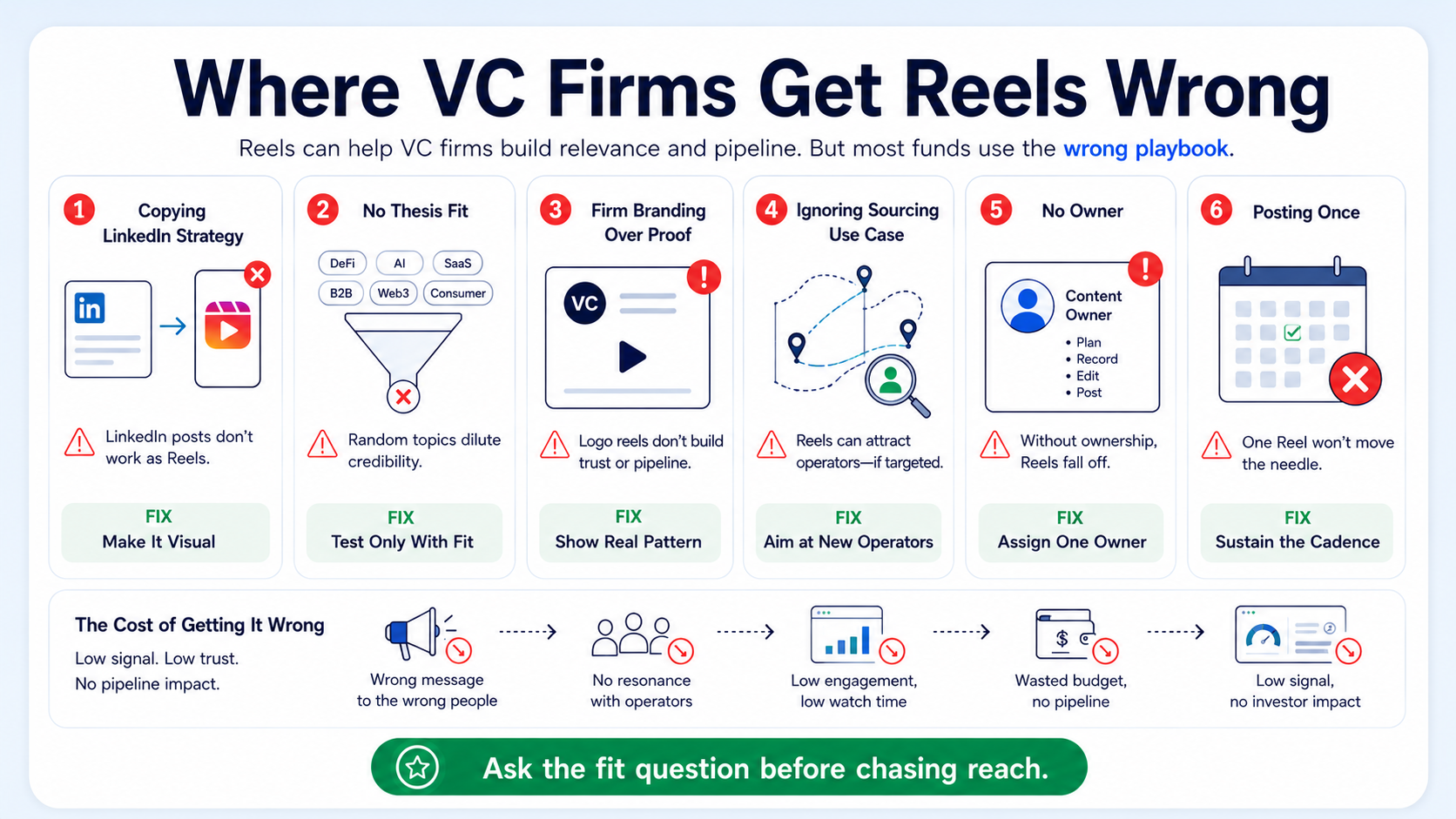
- Treating Reels as a LinkedIn strategy copied onto a new platform. Investment thesis commentary that works on LinkedIn usually falls flat as a Reel, since the audience and the format both expect something more visual and specific.
- Trying it without a clear thesis fit. A generalist enterprise SaaS fund chasing Instagram reach with no consumer angle is solving a problem it does not have.
- Posting firm branding instead of proof. A polished fund logo video does little compared to a partner walking through a real pattern seen across portfolio companies.
- Ignoring the sourcing use case entirely. Firms that only think of Instagram as a brand channel miss the deal-flow argument that makes it worth trying in the first place.
- No plan for who runs it. Reels take a different production rhythm than a quarterly LinkedIn post, and a partner squeezing this in between calls rarely sustains it.
- Publishing once and stopping. A single Reel proves nothing either way. The sourcing and portfolio-support cases both depend on a real, sustained presence.
Most of these mistakes trace back to skipping the fit question entirely. Our guide to common Instagram growth mistakes for B2B brands covers the broader pattern, since a fund with no consumer thesis chasing Reels reach usually runs into the same problems as any B2B brand on a platform its buyers do not use.
What good Reels for VC firms actually look like
Reels for VC firms tend to fall into a small set of formats, and the right one depends heavily on the fund's thesis.
Influencer Marketing Hub's 2026 Reels benchmark analysis found that Reels reach smaller accounts particularly well, with the strongest engagement in the 30 to 60 second range, which fits founder spotlights and partner-led content better than a quick brand clip.
Most funds testing this format start with one use case rather than both at once. A sourcing-focused firm typically leads with founder and operator spotlights, while a consumer-focused fund usually starts by amplifying portfolio company wins before adding original partner content. Our thought leadership video examples for executives collection shows how partner-led content has worked for other investors testing a new platform.
What Good Reels for VC Firms Actually Look Like
A Practical Workflow for Sourcing and Portfolio Support with Reels for VC Firms
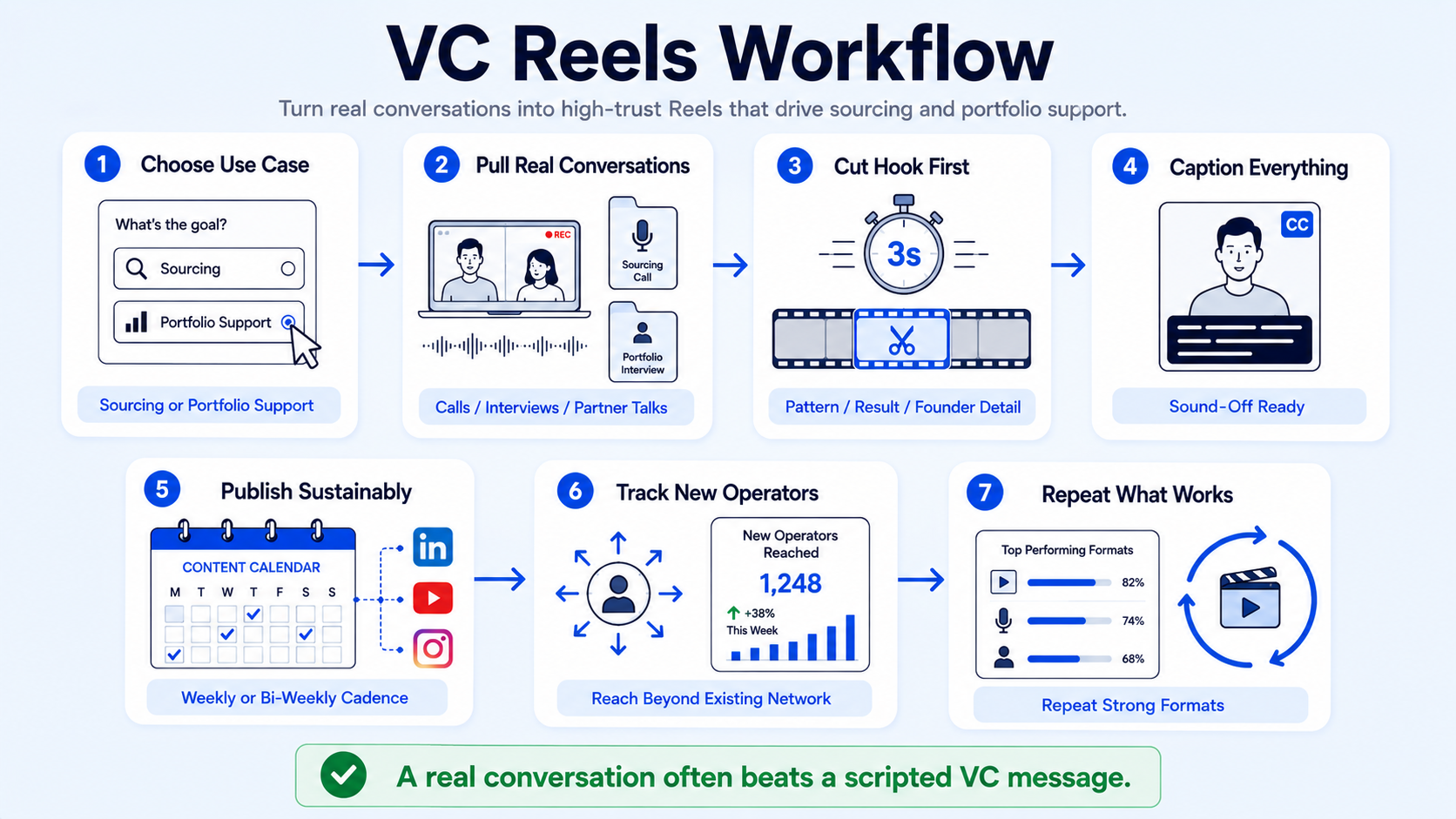
- Decide which use case the fund is testing. Sourcing and portfolio support need different content, different audiences, and often different people running them.
- Pull from real conversations, not scripted content. Sourcing calls, portfolio interviews, and partner talks usually contain a sharper moment than anything written from scratch.
- Cut for the hook first. Open on the specific pattern, result, or founder detail, not a firm introduction.
- Caption everything. Most Reels get watched with the sound off, so the message needs to hold up as on-screen text.
- Publish on a cadence someone can actually sustain. A modest, consistent rhythm from one dedicated person beats a burst of posts from a partner squeezing it into spare time.
- Review what actually reached new founders or operators, not just existing followers. For the sourcing use case, reach outside the fund's network is the signal that matters most.
- Feed what works back into the next batch. A format that surfaces a real inbound conversation is worth repeating with a new example.
This is the same discipline behind our short-form video editing and Instagram growth work, applied to what a fund's partners and portfolio companies are already producing.
What Changes the Price of Reels for a VC Firm
Cost depends mostly on which use case a fund is testing. The factors that move the price the most:
- Number of Reels per month. A handful of clips from existing sourcing calls or partner talks costs less than a full weekly cadence.
- Whether the fund also supports portfolio company content. Editing for portfolio companies adds scope beyond the fund's own account.
- Whether new footage needs to be filmed. Reels built from existing calls and interviews are faster to produce than new sourcing-focused shoots.
- Captioning and branded styling. Consistent formatting across a growing library takes setup time upfront.
- Strategy and selection support. Some engagements cover editing only, while others include deciding which conversations are worth turning into Reels in the first place.
Komet Media typically works with venture firms through retainers in the range of roughly $2,500 to $5,000, with final scope set by the factors above rather than a fixed public package. Our B2B video editing pricing models resource breaks this down further, and our video editor cost guide compares freelancer, subscription, and retainer pricing.
Measuring What Reels Actually Produced
Views and follower growth describe attention. They do not tell a fund whether Reels are producing better deal flow or stronger portfolio support. Match the metric to the use case.
Treat these signals separately, since sourcing and portfolio support are answering different questions. Attribution is often imperfect for the sourcing case specifically, since a founder may see a fund's Reels for months before ever sending a cold message that gets logged as connected to them. Our notes on video KPIs B2B teams should track go further into building a measurement plan that holds up across both use cases.
Conclusion
Reels for VC firms is not a fit for every fund, and it should not be treated as one. It earns its place for firms sourcing deals outside traditional tech networks and for funds backing consumer, CPG, or lifestyle brands where portfolio companies already live on the platform. We work with venture capital firms on turning sourcing calls, partner talks, and portfolio moments into exactly this kind of content, without recommending it where the fit is not there.
FAQ
What are Reels for VC firms?
They are short vertical videos, typically 15 to 60 seconds, published to Instagram to support two main goals for a fund: sourcing deals from founders outside traditional networks, and amplifying or supporting consumer-facing portfolio companies.
How much does it cost to produce Reels for a VC firm?
Cost depends on how many Reels get produced per month, whether the engagement also covers portfolio company support, and whether new footage needs to be filmed. Komet Media typically works in the $2,500 to $5,000 range per retainer. See our B2B video editing pricing models breakdown for detail.
What does the production process look like?
It usually starts with deciding whether the fund is testing sourcing or portfolio support, pulling from real conversations rather than scripted content, cutting for the hook, captioning everything, and publishing on a cadence the team can sustain.
How long does it take to see results?
A single Reel proves little either way. Most funds need a few months of consistent publishing before reach outside the existing network, or measurable portfolio company lift, becomes clear enough to evaluate.
What deliverables should a fund expect?
Expect a set of captioned Reels per month, pulled from sourcing calls, partner talks, or portfolio company moments, formatted for the platform rather than repurposed unchanged from LinkedIn content.
Is a freelancer or an agency better for this work?
A freelancer can work for a fund testing the format with one person directing every edit. An agency tends to fit better once a fund wants a repeatable system, especially if it also involves supporting portfolio company content. Our freelancer versus agency comparison covers the trade-offs in more depth.
Does every VC firm need to be on Instagram?
No. A generalist enterprise or B2B SaaS fund with no consumer thesis will likely get more value from LinkedIn, where its actual audience of founders, LPs, and co-investors already spends time. Reels earn their place for funds actively sourcing outside traditional networks or backing consumer-facing portfolio companies.
Does Komet Media produce Reels for venture capital firms?
Yes. We edit sourcing calls, partner talks, and portfolio company moments into Reels for funds where the platform genuinely fits the thesis, rather than recommending it as a default. You can see our approach on the video editing for VC firms solution page or book a call to talk through a specific fund's content.