
🪄 AI Summary
Heading 1
Heading 2
Heading 3
Heading 4
Heading 5
Heading 6
Lorem ipsum dolor sit amet, consectetur adipiscing elit, sed do eiusmod tempor incididunt ut labore et dolore magna aliqua. Ut enim ad minim veniam, quis nostrud exercitation ullamco laboris nisi ut aliquip ex ea commodo consequat. Duis aute irure dolor in reprehenderit in voluptate velit esse cillum dolore eu fugiat nulla pariatur.
Block quote
Ordered list
- Item 1
- Item 2
- Item 3
Unordered list
- Item A
- Item B
- Item C
Bold text
Emphasis
Superscript
Subscript
Most B2B teams record a strong podcast episode, publish it once, and move on. That's the most expensive mistake in content marketing. Going from one podcast episode to ten pieces of content isn't a theory, it's a documented, repeatable system that serious SaaS and funded tech teams use to fill pipeline without producing more raw content. This guide breaks it down step by step.
TL;DR
- A single 30-minute episode contains enough content for 15 LinkedIn posts, 3 blog articles, 5 email sequences, and 10 sales enablement assets, yet most teams leave 90% of that value untapped.
- The system: one anchor episode becomes short clips, a blog post, show notes, a newsletter, audiograms, quote cards, a YouTube video, sales enablement assets, and a LinkedIn thought leadership thread.
- Tools like Riverside.fm, Descript, and Repurpose.io automate most of the extraction work.
- You don't need more recording time. You need a smarter distribution system.
What Content Can You Actually Create From One Podcast Episode?
The question most founders ask is whether going from one podcast episode to ten pieces of content is realistic. It is, and ten is a floor, not a ceiling. Gary Vaynerchuk's content strategy is built on a "reverse pyramid" model, starting with one piece of pillar content and allowing his team to repurpose it into dozens of smaller pieces optimized for each distribution platform. His team documented turning one keynote into over 30 pieces of content across 20 platforms, resulting in over 35 million views.
For B2B SaaS teams, the episode becomes your anchor. Here's the full map of what one recording produces:
Micro-content multiplication transforms one episode into an omnichannel campaign, from a single 30-minute recording, teams extract LinkedIn articles, social posts, email sequences, blog posts, and sales enablement assets. This is content atomization in practice, not theory.
How to Repurpose a Podcast Episode Into a Blog Post
The blog post is your highest-durability asset. SEO blog posts are often the most durable repurposed asset because they give each episode a chance to rank, earn links, and support internal linking.
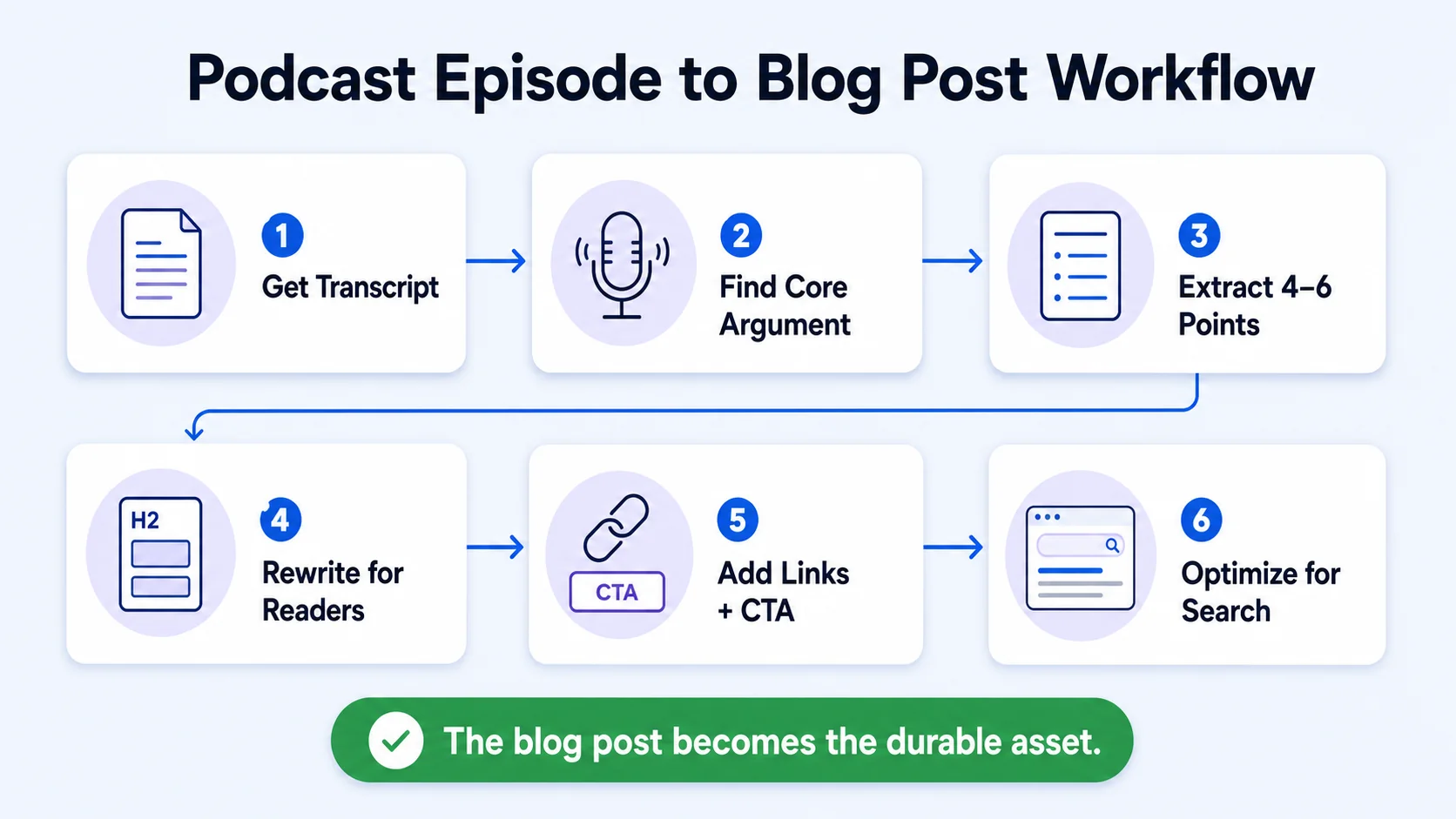
Here's the conversion process:
- Get the full transcript: Use Riverside.fm's built-in AI transcription or export to Descript. Descript automatically generates editable transcripts that can be turned into show notes, blog posts, or captions.
- Identify the core argument: What is the single clearest claim or framework from the episode? That becomes your H1 and article thesis.
- Extract 4–6 supporting points: Each major talking point from the episode becomes an H2 section in the post.
- Rewrite for the reader, not the listener: When adapting podcast content for a blog post, don't just publish the transcript, reframe the content as a standalone article with an introduction and conclusion so the piece flows logically without relying on the original audio for context.
- Add internal links and a CTA: Link to related service pages, like Komet Media's podcast editing service or short-form video editing, and close with a next step for the reader.
- Optimize for search: Add your target keyword in the title, first 100 words, and one H2. Publish with proper metadata and schema.
The blog post also feeds three more assets downstream: the email newsletter pulls its intro from the post, the show notes page links to it, and quote cards pull from its best lines.
How to Turn Your Podcast Into Short-Form Social Media Content
Gen Z listeners discover podcasts through clips on YouTube, TikTok, and Instagram, but this applies equally to B2B buyers who scroll LinkedIn between meetings. Cross-channel campaigns using both video and audio yield 23% higher ROI. Going from one podcast episode to ten pieces of content means pulling 3–5 short clips per episode. Here's how to do it without wasting hours:
- Identify clip-worthy moments during recording: Flag timestamps where your guest or co-host says something counterintuitive, quotable, or emotionally sharp. These are your clips.
- Cut to 60–90 seconds: That's the sweet spot for LinkedIn and Instagram Reels. YouTube Shorts performs best under 60 seconds.
- Add captions before anything else: The best tools for auto-captioning podcast clips are Submagic (for animated, TikTok-style captions), Zubtitle (for captions plus video resize), and Riverside.fm (which adds captions as part of its built-in workflow).
- Reformat for each platform: Vertical 9:16 for Reels and TikTok, square 1:1 for LinkedIn, horizontal 16:9 for YouTube.
- Write a platform-native caption: The clip carries the visual; the caption carries the hook and CTA.
For the audiogram, take the strongest 30–45 second audio moment, add a waveform animation and branded background, and publish it as a static visual post on LinkedIn. This is one of the fastest ways to extend reach without video production overhead.
Our short-form video editing service handles this extraction and formatting end-to-end for SaaS teams who want clips without the editing bottleneck.
How to Create a Newsletter and Show Notes From a Podcast Transcript
These two assets are consistently underbuilt by B2B teams, and they're among the easiest to produce.
Show notes are not a summary. They're a structured reference page that lives on your website and ranks in search. A strong show notes page includes: the episode title and guest bio, 5–7 key takeaways in bullet form, relevant links mentioned during the episode, a full or partial transcript excerpt, and a CTA to subscribe or book a call. Our podcast show notes service builds these at scale for clients who publish weekly.
The newsletter works differently. Don't just summarize the episode, extract three to five standalone insights, each strong enough to anchor its own nurture email, with a clear "so what" connecting the insight to a decision the buyer faces.
The newsletter format that works for B2B SaaS:
- One sharp subject line referencing the episode's core argument
- A 2–3 sentence context paragraph introducing the guest or topic
- Three bullet takeaways pulled directly from the transcript
- A quote card image embedded inline
- One CTA: listen to the full episode, read the blog post, or book a demo
When executives share podcast content, 84% of that sharing happens in private channels, WhatsApp groups, internal Teams channels, email forwards, meaning "dark social friendly" assets like executive summaries and shareable frameworks multiply reach without increasing spend.
Your newsletter is exactly this type of asset.
Podcast to YouTube Video: The Repurposing Workflow
YouTube is Gen Z's most-used podcast platform, slightly ahead of Spotify, and video-based listening is becoming the norm for younger audiences. For B2B teams targeting buyers under 45, YouTube is not optional.
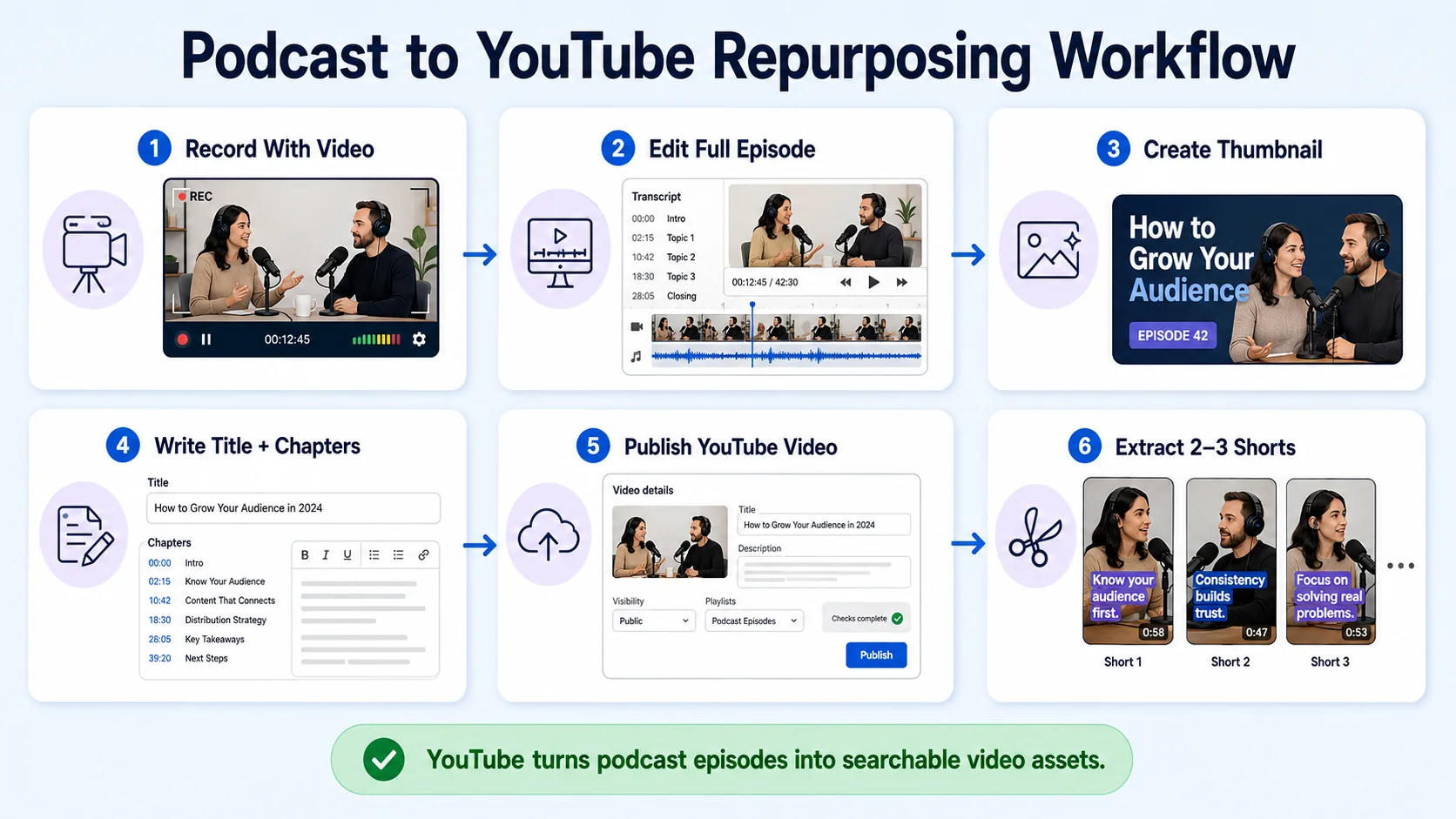
Here's the workflow for turning a podcast episode into a YouTube video:
- Record with video from the start: Use Riverside.fm, which records lossless audio and up to 4K video locally on each participant's device, so quality doesn't degrade due to internet connection issues.
- Edit the full-length video: Remove filler words, long pauses, and off-topic tangents. Descript's transcript-based editing is particularly efficient, instead of scrubbing through a timeline, you highlight filler words in the transcript and press delete, and the video edits itself.
- Create a YouTube-specific thumbnail: Use the guest's headshot, one bold line of text from the episode, and your brand colors.
- Write keyword-rich title, description, and chapters: Pull chapter timestamps from the transcript. This is where the podcast transcription service pays off for SEO.
- Extract 2–3 YouTube Shorts from the full video: Pull the same clips you cut for Reels and Shorts. Repurpose.io then automatically publishes those clips to TikTok, Instagram Reels, YouTube Shorts, and LinkedIn simultaneously, a true set-and-forget automation system for podcast-to-social distribution.
YouTube has emerged as the leading podcast platform in the United States, with over 1 billion monthly podcast listeners. Ignoring it means ceding search and discovery to competitors who are already there.
What Tools Help Repurpose Podcast Content Automatically?
The right stack removes the bottleneck between "we have a recording" and "we have ten pieces of content." Here's how the tools stack up:
Riverside offers an end-to-end workflow, you can record, edit, repurpose, live stream, host, and distribute podcasts without switching tools, with automated transcription, clip generation, filler-word removal, and audio enhancement significantly reducing production time.
Repurpose.io is a web-based platform designed to automatically transform long-form content such as podcasts and videos into shorter, platform-optimized formats, and it integrates with YouTube, TikTok, Instagram, Facebook, and LinkedIn as well as podcast hosting services for seamless distribution.
Most B2B teams don't have a content volume problem. They have a system problem. One episode with the right stack and a clear workflow produces a full week of omnichannel content. For teams that want the output without managing the stack, Komet Media's video marketing service handles the full repurposing workflow, from raw recording to published assets across every channel.
Podcast Repurposing Strategy: Building the System That Scales
Going from one podcast episode to ten pieces of content once is a tactic. Doing it every week for 52 weeks is a content repurposing strategy. The difference is a documented production system tied to a content calendar.
Here's the week-by-week cadence that B2B teams at Komet Media use:
- Day 1 (record): Episode goes live via Riverside.fm. Transcript generated automatically.
- Day 2 (edit and clip): Full video edited in Descript. 3–5 short clips identified and captioned.
- Day 3 (write): Blog post drafted from transcript. Show notes page written and published.
- Day 4 (design): 3 quote cards created in Canva. Audiogram exported.
- Day 5 (distribute): LinkedIn thought leadership post goes live. Email newsletter sends. Repurpose.io pushes clips to Reels, Shorts, and TikTok. Sales team receives the one-pager.
Repurposing turns podcast conversations into long-term marketing assets that continue generating value long after the interview ends, instead of publishing once and moving on, a strategic approach allows each conversation to fuel marketing efforts for weeks or months.
Effective content repurposing strategies transform a single asset into a full-scale marketing campaign, driving authority, engagement, and, most importantly, pipeline. For B2B SaaS teams with long sales cycles, this compound effect is the real ROI: podcast-engaged prospects close 23% faster than non-engaged ones.
The teams that execute this system consistently are the ones that dominate LinkedIn thought leadership in their category, rank for product-adjacent search terms, and give their sales reps content that supports every stage of a deal. Explore Komet Media's full content repurposing services to see how we build this system for B2B SaaS and funded tech teams.
Conclusion
- Going from one podcast episode to ten pieces of content is a system, not a sprint, build the workflow once and run it every week.
- The ten assets (full episode, blog post, short clips, show notes, newsletter, audiogram, quote cards, YouTube video, sales one-pager, and social thread) all flow from a single transcript.
- Tools like Riverside.fm, Descript, and Repurpose.io remove the manual bottleneck at every stage.
- For B2B SaaS teams, this isn't a content marketing exercise, it's a pipeline and trust-building engine that works between sales calls.
Frequently Asked Questions
Q1: Can one podcast episode really become ten pieces of content?
Yes, without extra recording time. A single transcript produces a blog post, show notes, a newsletter, 3–5 short clips, quote cards, an audiogram, a YouTube video, a sales one-pager, and a social thread. The work is in the extraction and formatting, not the recording.
Q2: How long does it take to repurpose one podcast episode into ten assets?
With the right stack (Riverside.fm, Descript, Repurpose.io, and Canva), a structured team can complete the full repurposing workflow in 4–5 hours across a week. Agencies like Komet Media compress this further by running a dedicated production system.
Q3: What's the best tool to automatically repurpose podcast content?
Riverside.fm handles recording, AI clip generation, transcription, and show notes in one platform. Repurpose.io then automates distribution to TikTok, Instagram Reels, YouTube Shorts, and LinkedIn. Together they cover 80% of the technical workflow automatically.
Q4: How do I turn my podcast into a LinkedIn thought leadership post?
Pull the single sharpest insight from the episode. Write a 5–8 line hook using that insight as the opening statement. Follow with 3–4 supporting observations from the episode. Close with a question to drive comments, and link to the full episode or blog post.
Q5: Is podcast repurposing worth it for B2B SaaS teams with small audiences?
Audience size is irrelevant at the start. Repurposed content builds SEO authority, feeds sales enablement, and educates buyers who are already in your pipeline. The compounding effect of consistent distribution matters far more than day-one download numbers.
Q6: What's the difference between content repurposing and content atomization?
Repurposing adapts a finished piece for a new format after publication. Atomization is a pre-planned strategy where the anchor content is designed from the start with fragmentation in mind, systematically mapping every derivative asset before production begins. For B2B teams, atomization is the more scalable and ROI-positive approach.