
🪄 AI Summary
Heading 1
Heading 2
Heading 3
Heading 4
Heading 5
Heading 6
Lorem ipsum dolor sit amet, consectetur adipiscing elit, sed do eiusmod tempor incididunt ut labore et dolore magna aliqua. Ut enim ad minim veniam, quis nostrud exercitation ullamco laboris nisi ut aliquip ex ea commodo consequat. Duis aute irure dolor in reprehenderit in voluptate velit esse cillum dolore eu fugiat nulla pariatur.
Block quote
Ordered list
- Item 1
- Item 2
- Item 3
Unordered list
- Item A
- Item B
- Item C
Bold text
Emphasis
Superscript
Subscript
I'm Rajan Soni, founder of Komet Media. The question I hear most from B2B founders and marketing heads is whether short-form video is worth the investment, or whether it's just a B2C play dressed up in a suit. Spoiler: it's the highest-ROI content format in 2026, and the data is no longer ambiguous. Here's everything you need to know before you build, budget, or push back internally.
TL;DR
- Is short-form video worth it for B2B? Yes. It delivers the highest ROI of any content format for the third consecutive year.
- Short-form video under 90 seconds now drives stronger pipeline signals than most mid-funnel assets.
- LinkedIn is your primary channel; YouTube Shorts compounds over time; Reels amplifies personal brand reach.
- The real question isn't whether to invest, it's how to build a repeatable system.
Does Short-Form Video Actually Work for B2B Companies?
The scepticism is understandable. B2B deals are complex, cycles are long, and your buyers aren't teenagers on TikTok. But that framing is the wrong lens. Short-form video is often associated with consumer marketing, yet the latest research shows strong performance across B2B environments, because decision-makers increasingly consume content through social platforms before engaging with vendors or entering formal buying processes.
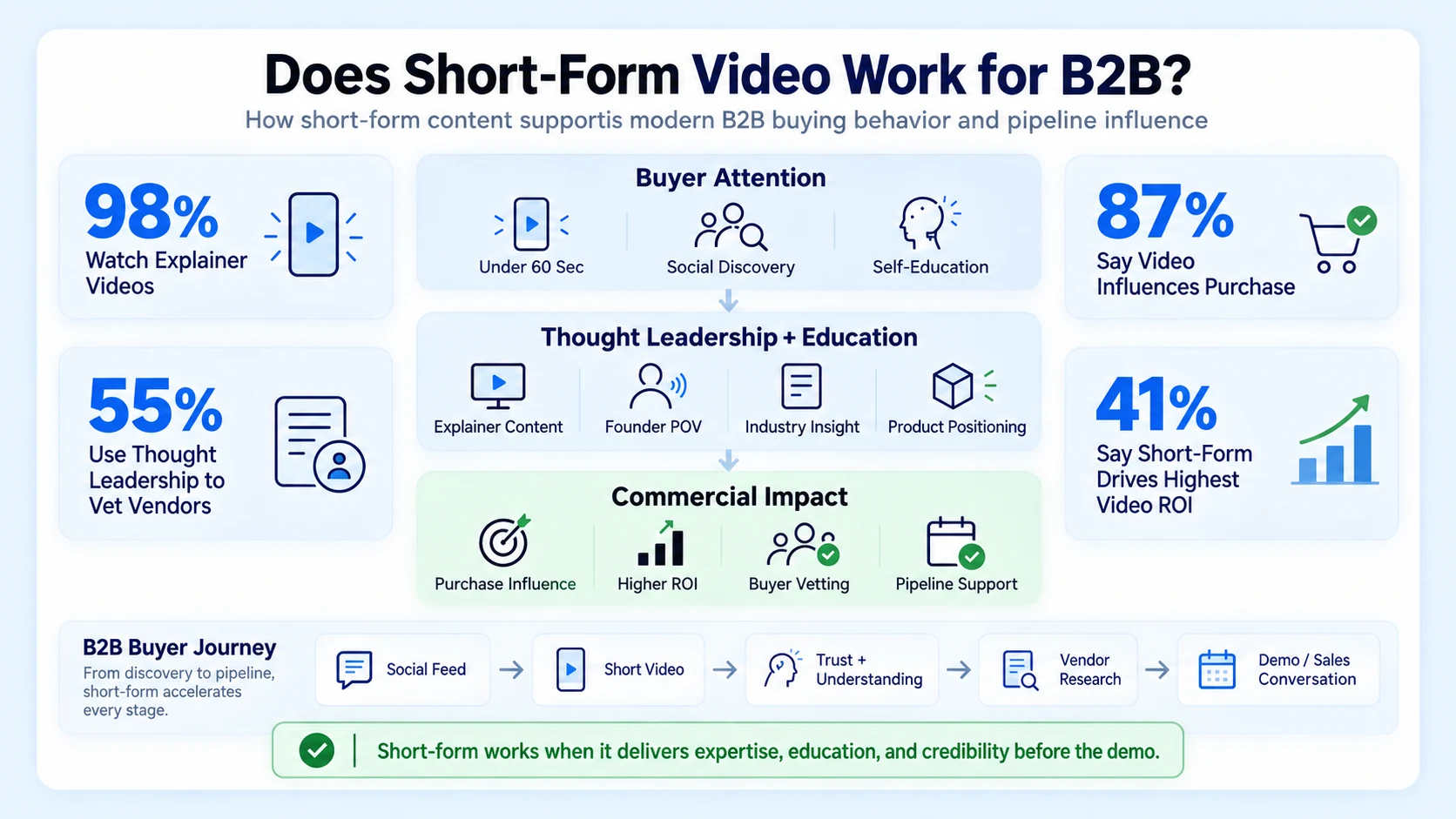
Short-form video (typically under 60 seconds) is the top-performing content format in 2026, delivering the highest ROI of any content type and used by 30% of both B2B and B2C marketers. That's not a trend, marketers rank short-form video as the number one ROI format for the third consecutive year, and 57% of marketing budgets now include a dedicated short-form line item. The buyer-side evidence is equally clear.
Video is central to B2B buyers' research behavior, 98% of B2B decision-makers have watched explainer videos, and 87% of B2B buyers say video influenced their purchase decisions. These aren't passive views. The 2025 Edelman x LinkedIn Thought Leadership Impact Report revealed that 55% of decision-makers use thought leadership content as part of their vetting process. Short, punchy video is the delivery mechanism for that thought leadership. The format also fits how modern buyers self-educate.
A successful short-video B2B strategy focuses on delivering value through expertise, education, and industry insight, allowing organisations to communicate expertise in a format that fits naturally into professional audiences' daily content consumption habits. That maps perfectly to what SaaS buyers need: fast answers, clear product positioning, and visible credibility, before they ever book a demo. 41% of B2B marketers say short-form video drives the highest ROI of any video format. (LinkedIn B2B Marketing Benchmark 2025)
The verdict: yes, short-form video works for B2B. The companies still debating it are ceding ground to those who stopped asking the question two years ago.
Short-Form Video ROI for B2B Brands: What the Numbers Say
ROI in B2B video is real, measurable, and compounding. Over half, 52%, of B2B marketers cite video as the content type generating the highest ROI. That number holds even when you control for company size and sector. 93% of marketers say video has given them a good ROI, with 49% ranking short-form video as the top ROI format. 82% of businesses say video increased web traffic, 85% report it generated leads, and 83% say it directly boosted sales.
For conversion-focused teams, the downstream impact is significant. Videos under 60 seconds generate 2.5x more engagement per impression than any other content type. Landing page impact is equally measurable, adding video to a landing page can boost conversion rates by up to 80%, transforming passive visitors into engaged prospects. The length sweet spot matters for B2B specifically.
Short-form content remains king, with videos under 90 seconds holding viewer attention at a solid 50% retention rate. In a world of skim readers and mobile-first browsing, brevity wins. The key is to deliver one clear signal per video, not an entire product tour. What's changing the ROI equation in 2026 is production cost.
AI-powered editing, scripting, voiceover, and generation tools have reduced the median video production cost from $4,200 to $2,500 per finished minute. When combined with a content repurposing workflow, turning one webinar into 10 short clips, the economics flip in your favour fast.
From a pipeline standpoint, the signal is clear: short-form video saw a 48% lift in click-through rate year-over-year, while long-form webinars continue to drive the highest B2B conversion rates. That's not either/or, it's a funnel. Short-form opens the door; long-form closes.
Is LinkedIn Short-Form Video Effective for B2B?
LinkedIn is where short-form video worth it for B2B becomes less of a question and more of a certainty. LinkedIn is currently considered the top B2B video channel, with 8 in 10 teams identifying it as their primary medium for sharing video, surpassing even YouTube. 93% of B2B marketers use LinkedIn for content marketing, and LinkedIn video watch time grew 36% year over year.
That growth is being driven by a structural algorithm shift: native video earns 5x more engagement than text posts, according to LinkedIn's own platform data published in early 2026, and short-form video under 90 seconds is now prioritised in the LinkedIn algorithm above longer uploads. The professional context is an edge no other platform offers. The professional context of the LinkedIn feed shortens the trust gap significantly, a viewer who sees your clip is already in work mode, not entertainment mode.
That matters enormously for founder-led content, product explainers, and sales enablement clips. There's also a structural advantage for individual voices over brand pages. Personal profiles generate 8x more engagement than company pages, posts from individual profiles receive 8x the engagement of identical content from company pages. This is the core argument for founder-led growth on LinkedIn: your face, your voice, and your POV outperform your brand handle every time.
The distribution edge compounds further: for B2B content distribution specifically, LinkedIn drives more social referral traffic, 46%, than all other social platforms combined. If you're only going to invest in one channel for B2B short-form video, LinkedIn is it. Our short-form video editing service is built specifically around LinkedIn-first content that earns pipeline, not just impressions.
How to Use TikTok, Reels, and YouTube Shorts for B2B Lead Generation
The channel question matters less than having clear intent behind each platform. Here's how they stack up for B2B in 2026:
YouTube Shorts works well for B2B and educational content, helping brands establish credibility that translates into long-term opportunities.The compounding advantage is significant: while TikTok and Instagram content typically sees most engagement within 24–48 hours of posting, YouTube Shorts can continue attracting views and engagement for weeks or months through search and recommendation algorithms.
For Reels, the audience qualifier matters. Instagram Reels is the strongest channel for personal brand warmth, but only if your core audience skews under 45. For enterprise B2B, it is a secondary amplifier, not a primary pipeline driver. TikTok for Business has a lower floor for B2B intent. Only 8% of B2B marketers planned to invest in TikTok in 2025 (HubSpot).
However, for SaaS brands targeting a younger buying committee or building organic reach efficiently, it remains a viable awareness channel, especially when content is repurposed from LinkedIn and Shorts anyway. The production cost of multi-platform distribution drops to near-zero when you have a video repurposing system in place.
The universal rule: 92% of people watch mobile video with the sound off, so burned-in captions are non-negotiable on every platform.
What Types of Short-Form Video Work Best for B2B Audiences?
Not all formats convert equally. For SaaS and funded tech teams, the hierarchy is clear:
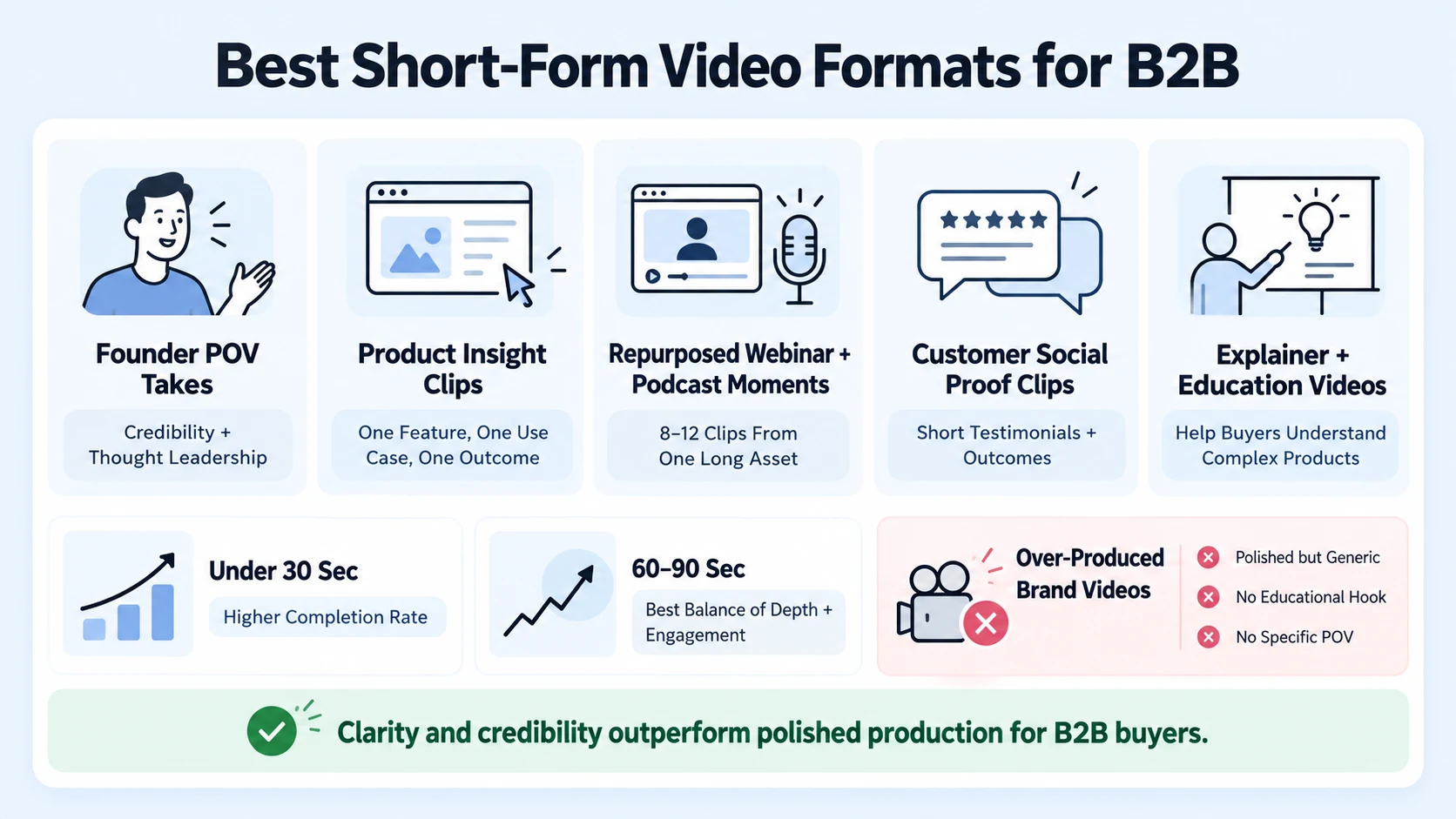
Top-performing B2B short-form video formats:
- Founder POV takes: A 60-second opinion on a problem your ICP has daily. No slides, no production, just credibility. This is where thought leadership actually lives in 2026.
- Product insight clips: One feature, one use case, one outcome. Not a demo, a glimpse. These drive demo demand without the friction of a full walkthrough.
- Repurposed webinar and podcast moments: The single highest-leverage move in B2B content marketing. One 45-minute webinar or podcast episode generates 8–12 short clips with zero net-new recording time.
- Customer social proof clips: Short testimonials or outcome statements. Product demo videos and customer testimonials are particularly effective, with homepage video viewers showing 97% higher conversion rates than non-viewers.
- Explainer and education videos: 96% of marketers agree videos help audiences understand products better, making education-first content the safest bet for complex SaaS products.
Short videos under 30 seconds achieve the highest completion rates but may lack depth for complex product explanations. Mid-length videos (60–90 seconds) balance engagement with substantive content, making them ideal for most B2B use cases.
The formats that consistently underperform are over-produced brand videos, polished visuals with no specific point of view, no educational hook, and no reason for a busy VP to stop scrolling. 2026 research from HubSpot found that 76% of marketers say authentic content outperforms polished production on social. B2B buyers want clarity and credibility, not a film reel.
How Do B2B Companies Measure Success with Short-Form Video?
Measuring whether is short-form video worth it for B2B requires connecting platform metrics to pipeline signals, not stopping at views. Here's the framework:
Phase 1, Awareness metrics (track weekly):
- View count and unique reach (which hooks and topics resonate)
- Completion rate (quality signal, a 90% completion on a 30-second clip beats 20% on a 60-second one)
- Follower growth rate (compounding distribution advantage)
Phase 2, Engagement and intent metrics (track bi-weekly):
- Comments and DMs (direct buyer signals, the highest-value metric in early pipeline)
- Save rate and share rate (saves signal research intent; shares indicate positioning resonance)
- Profile visits from video content
Phase 3, Pipeline metrics (track monthly):
- Click-throughs to landing pages with UTM parameters
- Demo requests and inbound form fills attributed to video touchpoints
- Video-influenced pipeline (tracked via HubSpot or Vidyard CRM integration)
The most important question is whether any of that viewing behavior actually impacted the pipeline, if you can't answer it, you're tracking vanity metrics, not video intelligence. Completion rates matter more than views, because B2B videos often deliver complex information, and pipeline contribution connects video to revenue, the metric executives actually care about.
The fastest path to pipeline attribution: tag every link in your video bio and description with UTMs, route engaged viewers into a retargeting audience, and use tools like HubSpot or Vidyard to close the loop between a view and a closed deal. Our video marketing services include this full attribution setup, not just production.
Short-Form vs Long-Form Video for B2B Marketing: Which Wins?
Both. But they serve different jobs, and confusing those jobs is where most B2B teams waste budget.
The short-form vs long-form debate has evolved beyond simple preference into a data-driven allocation question. Short-form dominates engagement and reach metrics. Long-form wins on SEO value, lead generation, and audience depth. The most effective video strategies in 2026 use both formats for complementary purposes.
The system I recommend to every SaaS team: record one high-quality long-form asset (a webinar, an event session, a podcast interview) and extract 8–12 short clips from it. The long-form lives on YouTube and gated pages for SEO and deep-funnel conversion. The short clips run on LinkedIn and Shorts for organic reach and demand generation. One recording session. Two distribution engines.
Short-form videos under two minutes typically retain 60–80% of viewers to completion, while long-form content above five minutes often sees retention drop to 30–50% unless the audience is already engaged. That delta is exactly why short-form earns the top-of-funnel job, and long-form earns the close. The brands winning in 2026 aren't choosing one. They're running both as a connected system, not separate campaigns.
Conclusion
Short-form video is worth it for B2B, not as an experiment, but as a core pipeline and demand generation channel. Here's what matters:
- ROI is proven: Short-form video leads all content formats for the third year in a row, with 52% of B2B marketers confirming it delivers their highest content ROI.
- LinkedIn is your primary channel: 8 in 10 B2B teams name it their top video platform, and native video earns 5x more engagement than text.
- Repurposing is the leverage point: One webinar or podcast becomes 10+ short assets, without new recording time.
- Measure pipeline, not just views: Completion rate, demo demand, and UTM-tagged click-throughs are the metrics that justify budget.
If you're a SaaS founder or marketing leader ready to build a system, not just post occasionally, talk to the Komet Media team.
Frequently Asked Questions
Q1: How long should short-form B2B videos be?
The proven sweet spot is 30–90 seconds for most LinkedIn and YouTube Shorts content. Under 30 seconds maximises completion rate; 60–90 seconds gives enough space for one clear value point. Avoid the two-minute mark, engagement drops sharply for B2B audiences without a strong hook.
Q2: Can a small SaaS team produce short-form video without a studio?
Yes. Most high-performing B2B short-form content in 2026 is shot on a phone or laptop camera with good lighting. Authentic and unpolished consistently outperforms over-produced on LinkedIn. The production leverage comes from repurposing existing recordings, demos, webinars, and podcasts, rather than shooting net-new content.
Q3: Is TikTok for Business relevant for B2B SaaS companies?
It depends on your ICP. Only 8% of B2B marketers invested in TikTok for Business in 2025. For most enterprise-focused teams, LinkedIn and YouTube Shorts deliver stronger pipeline ROI. TikTok works best for broader awareness when your buying committee skews under 35 or you're already repurposing content cross-platform at no incremental cost.
Q4: What's the fastest way to start a B2B short-form video program?
Start by clipping your existing content, your last three webinars, demos, or podcast episodes likely contain 20+ short video moments. Tag each clip with UTM parameters, post natively on LinkedIn, and track completion rate and profile visits weekly. Build the habit before building the production stack.
Q5: How does short-form video support sales enablement specifically?
Short clips, product explainers, customer outcome snippets, founder POV takes, give your sales team shareable assets that educate buyers between touchpoints. Video in sales outreach also improves click-through rates significantly. This reduces time-to-trust and shortens the decision cycle for complex SaaS products.
Q6: Should I hire in-house or work with a specialist agency for B2B short-form video?
In-house works for raw, founder-led content posted directly. A specialist agency adds value through editing systems, repurposing workflows, and platform-specific optimisation, especially when you need to consistently produce 8–15 clips per month without pulling your team off core work. Komet Media's short-form video service is built specifically for SaaS and funded tech teams with this exact use case.