
🪄 AI Summary
Heading 1
Heading 2
Heading 3
Heading 4
Heading 5
Heading 6
Lorem ipsum dolor sit amet, consectetur adipiscing elit, sed do eiusmod tempor incididunt ut labore et dolore magna aliqua. Ut enim ad minim veniam, quis nostrud exercitation ullamco laboris nisi ut aliquip ex ea commodo consequat. Duis aute irure dolor in reprehenderit in voluptate velit esse cillum dolore eu fugiat nulla pariatur.
Block quote
Ordered list
- Item 1
- Item 2
- Item 3
Unordered list
- Item A
- Item B
- Item C
Bold text
Emphasis
Superscript
Subscript
Most B2B SaaS teams spend their entire production budget in the middle of a video nobody finishes. The hook is where the real work happens. 71% of viewers decide within the first few seconds whether a video is worth continuing, which means your opening line is either doing pipeline work or killing it. These tips for writing better video hooks in 2026 are built specifically for founders, marketing leads, and growth teams who need short-form video to convert attention into qualified demand.
TL;DR
- The first three seconds are the "swipe or stay" window, if your retention curve drops there, your opening frame and first spoken words aren't earning attention.
- A strong hook opens a loop, names a pain, or breaks a pattern, never starting with "Hey everyone."
- B2B hooks must speak to outcomes, not features.
- Test every hook against one question: would your ideal buyer pause their scroll for this?
What Is a Video Hook and Why Does It Matter for B2B Growth?
A video hook is the first line, frame, or moment that decides whether a viewer stays or scrolls. For B2B SaaS teams, it isn't a creative nicety, it's the entry point to your pipeline. Short-form video drives the highest ROI among all video formats for 41% of B2B social media marketers. But that ROI only materializes when someone actually watches. Over 33% of viewers drop off in the first 30 seconds if the intro isn't engaging. That means a third of your potential buyers never see your product demo, never hear your founder's insight, and never click through to your pipeline asset.
The hook is also an algorithm signal. TikTok found that more than 63% of videos with the highest click-through rates highlighted the central message or product within the first three seconds. The same principle applies on LinkedIn Reels and YouTube Shorts, platforms your B2B buyers use every day.
For the short-form video content we produce at Komet Media, the hook is the first decision we make in the edit, not the last. I've seen technically polished videos with great product demos tank because the opening 3 seconds said nothing specific to the right buyer. Here's what a hook actually does mechanically:
- Opens a curiosity gap the viewer must resolve by watching.
- Signals that this content is for them specifically (role, pain, situation).
- Creates enough pattern interruption to delay the scroll reflex.
- Promises a payoff the viewer believes they'll actually receive.
98% of B2B decision makers have watched explainer videos, and 87% of B2B buyers say video influenced their purchase decisions. The hook is the gate to all of that influence. Without it, your best content never gets seen.
How to Write a Video Hook in the First 3 Seconds
Three seconds is not a guideline. It's the hard deadline your buyers set before you ever hit record. Here's a repeatable process for writing hooks within that window.
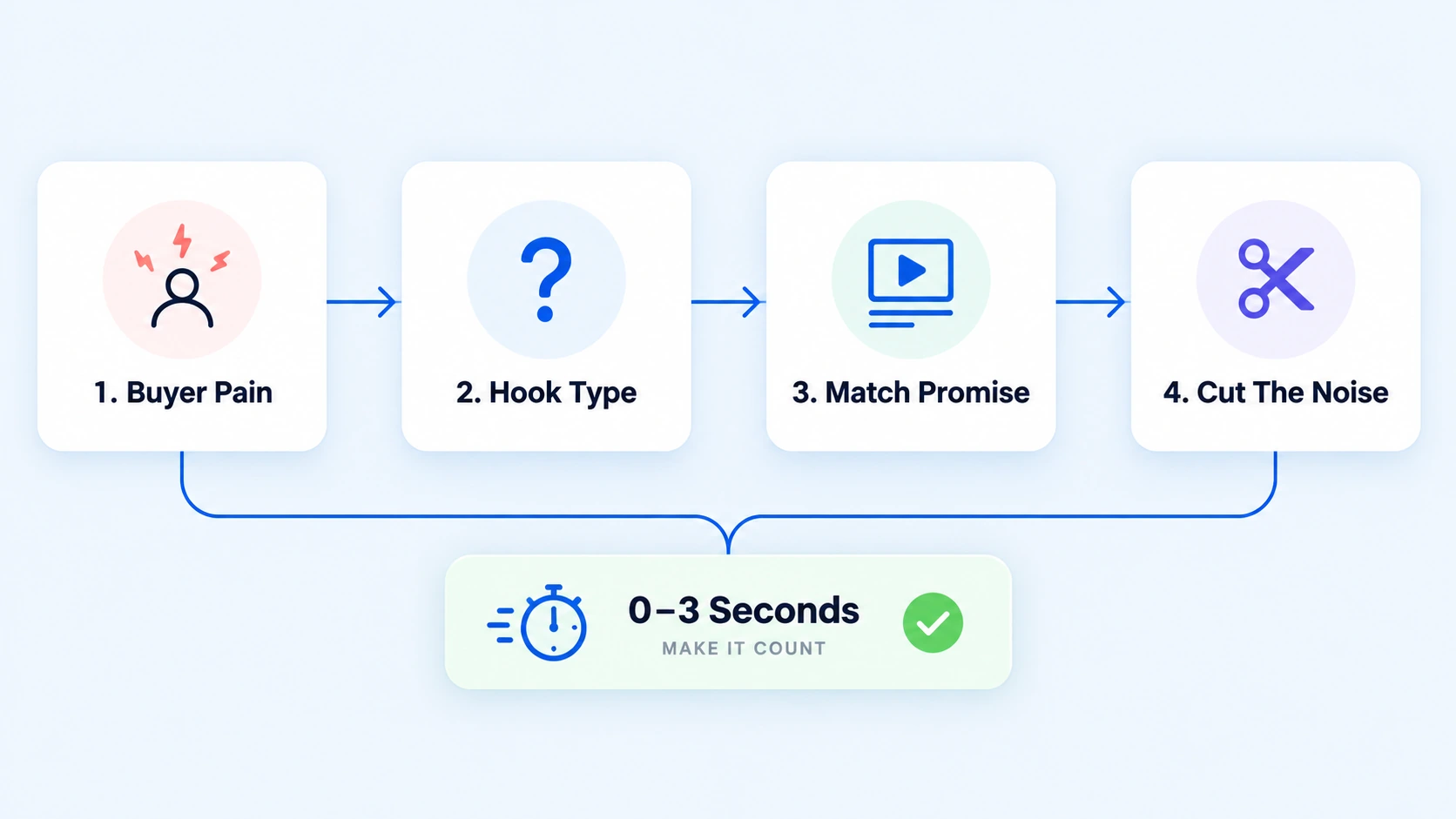
Step 1: Start with your buyer's exact pain, not your product.
The fastest way to earn a stranger's attention is to say something that sounds like it came from inside their head. For a SaaS marketing head, that might be: "Your demo isn't converting because your prospects don't understand what your product does in the first 60 seconds." That's specific, painful, and personal.
Step 2: Choose one of three hook mechanisms.
Every effective hook runs on at least one of these:
- Curiosity gap: State a result or outcome without explaining how. Forces the viewer to stay for the answer.
- Pattern interrupt: Open with something visually or contextually unexpected. Use pattern interrupts like graphics, B-roll, and visual changes to maintain attention.
- Bold claim or contrarian take: Challenge a belief your buyer holds right now.
Step 3: Match the hook to the thumbnail promise.
Videos where the thumbnail promise matches the hook content within 3 seconds see 40–60% higher completion rates than videos with a disconnect between thumbnail and opening. Your first spoken or captioned line must deliver on whatever the viewer clicked for.
Step 4: Cut everything before the hook.
No logo bumpers. No "welcome back." No context-setting. Starting with "Hey everyone" or "So in today's video" signals unedited, low-effort content, and videos with generic greetings average 23% lower retention than videos that open with content.
Step 5: Read it aloud and count.
If it takes more than 3 seconds to read your hook line at a natural speaking pace, cut it. If the viewer needs prior context to understand it, rewrite it. The tips for writing better video hooks in 2026 that actually work are ruthlessly compressed.
Best Video Hook Formulas That Actually Work This Year
Formulas aren't shortcuts, they're structures that work because they match how buyers process information. Here are the six we use most often in our video work with B2B teams.
Videos using curiosity hooks go viral 22% more often, and for B2B teams, "viral" means seen by the right 500 people, not the wrong 500,000. The Nir Eyal Hook Model reinforces this: trigger (internal or external), action, variable reward. Your hook is the trigger. For B2B buyers, the internal trigger is almost always anxiety about pipeline, positioning, or product adoption. Build your hook around that. Videos with hooks in the first second get 41% higher retention, so the formula matters less than the timing. Get specific, get personal, and get there immediately.
Why Do My Video Hooks Fail to Grab Attention?
Most B2B video hooks fail for the same handful of reasons. Recognizing them is half the fix. The most common cause is a mismatch between your thumbnail or title and actual content, viewers expected something different. Other culprits include slow intros, lengthy branding sequences, or burying the value too deep.
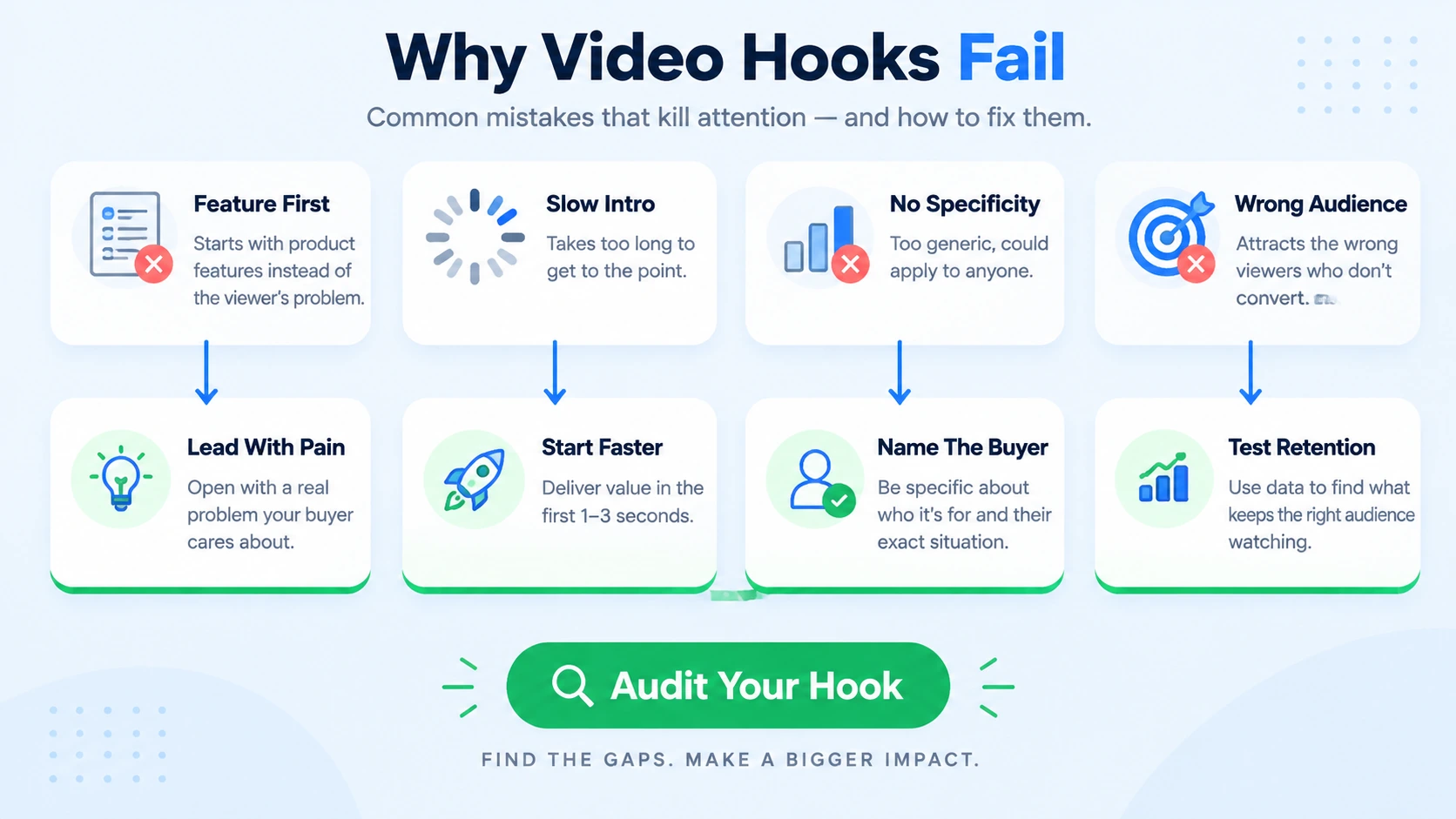
Here are the other failure patterns I see consistently across SaaS video content:
- Feature-led openings: Starting with what your product does rather than what your buyer's problem is. Buyers don't care about features until they believe you understand their pain.
- Overpromising: Audiences in 2026 punish hooks that overpromise. 58% of users reported unfollowing accounts that consistently used "misleading hooks," and TikTok's algorithm now tracks early exit rate as a negative signal.
- Slow text reveals: Text that types out letter by letter or fades in word by word was engaging in 2022, in 2026, viewers scroll past before the sentence finishes.
- No specificity: Saying "we help businesses grow with video" tells the viewer nothing. Name the role, the problem, or the outcome with an exact number.
- Viewer retention rate ignored: Most teams never look at the drop-off curve in Wistia video analytics or YouTube Studio. Study your retention curve to identify exact drop-off points, then restructure or cut those sections.
The tips for writing better video hooks in 2026 that stick are the ones that treat the hook as a hypothesis, written, tested, measured, and rewritten. Not a one-time creative call. For B2B SaaS teams specifically, the failure often comes from writing hooks for a general audience instead of a named buyer. A hook that works for everyone usually works for no one. Get specific: "If you're a head of marketing at a Series A SaaS company with a long sales cycle, this is for you" will out-retain a generic "video marketing tip" every time.
Video Hook Examples and Best Practices for YouTube and LinkedIn
Platform context changes how a hook performs. What works on TikTok's For You Page doesn't always translate to YouTube's algorithm or LinkedIn's feed. Here's how to adapt.
YouTube Shorts and long-form YouTube: For videos under 5 minutes, a healthy average percentage viewed is 50–70%. Below 50% indicates a structural problem with either the hook or the pacing. For YouTube, the hook must also match the title and thumbnail with zero ambiguity, the viewer arrived with an expectation. Reels engagement signals on Shorts reward completion and replay. Open with the payoff, not the setup.
LinkedIn video: LinkedIn buyers are in work mode. Hooks that open with a specific business outcome ("here's how we cut demo no-show rate by 40%") consistently outperform curiosity-bait on this platform. 55% of decision-makers use thought leadership as part of their vetting process, which means your founder-led hook is also a trust signal to the buying committee.
Instagram Reels: Reels between 60 and 90 seconds consistently deliver the highest engagement rates for business accounts, while Reels under 30 seconds are best for reaching new audiences. For awareness hooks on Reels, go shorter and more provocative. For retargeting or warm audiences, you can afford a two-sentence setup.
Best practices across all platforms:
- Put your most scroll-stopping visual in frame 1, not frame 5.
- Use captions, TikToks with subtitles see 24% more shares.
- B-roll sequencing matters: cut to a new visual within 2–3 seconds to support attention span optimization.
- Test two versions of the same hook, same content, different first line, using Wistia video analytics or native platform tools to compare viewer retention rate.
For our video marketing clients, the best-performing hooks in 2026 have one thing in common: they sound like something the buyer would say to their manager, not something a brand would post.
Common Mistakes When Writing Video Hooks for B2B Social Media
The tips for writing better video hooks in 2026 are only useful if you know what to actively avoid. Here are the eight mistakes that cost B2B SaaS teams the most viewers.
- Writing for virality instead of the buyer: Chasing broad appeal produces hooks that don't resonate with anyone specific. Your ideal buyer is a 38-year-old VP of Marketing at a funded SaaS company. Write for her.
- Treating the hook as a summary: A hook is not a table of contents. It's a tension builder. Don't explain the video, create the need to watch it.
- Skipping the open loop: Open loop storytelling is the mechanism behind every hook worth watching. If the viewer feels complete after your first sentence, they'll scroll. Leave the loop unresolved.
- Ignoring the first frame: The first three seconds are the "swipe or stay" window, if your Shorts retention curve shows a sharp drop there, the opening frame and first spoken words aren't earning attention. This applies to every short-form platform.
- Writing long first sentences: On mobile, viewers read and process faster than you think. Long opening sentences feel like work. Keep it under 10 words.
- No emotional trigger words: Emotional trigger words (save, avoid, mistake, secret, proven) activate the curiosity gap principle and increase initial dwell time. Use them with restraint, and always deliver on them.
- No hook testing system: To test hooks systematically, upload variations changing only the intro technique, the version that retains the highest percentage of viewers past the 30-second mark is the superior hook.
- Faceless video strategy without a verbal hook: Faceless videos can work for B2B, but they depend entirely on the spoken or captioned hook since there's no human face to hold attention by default.
This applies equally when teams repurpose webinars, podcasts, and demos through our short-form video production services, the raw content is good, but the hook has to be rebuilt for the format every single time.
Conclusion
The tips for writing better video hooks in 2026 come down to one discipline: earn the next second before you ask for the next minute.
- Specificity beats cleverness: Name the exact buyer, pain, or outcome in the first 3 seconds.
- Measure viewer retention rate: Drop-off data tells you exactly where your hook fails. Use it.
- Match every hook to its platform: LinkedIn, YouTube, and Reels reward different opening mechanics.
- Never stop testing: The winning hook from Q1 2026 is your baseline for Q2, not your final answer.
If your current video content isn't building a pipeline, the hook is the first thing to audit. Fix that before spending another dollar on production.
Frequently Asked Questions
Q1: What is the "first 3 seconds rule" for video hooks?
The first 3 seconds rule states that viewers decide whether to keep watching or scroll within the opening 3 seconds of any video. More than 63% of videos with the highest click-through rates highlighted the central message within the first three seconds. If your hook doesn't land there, the rest of the video doesn't matter.
Q2: How long should a B2B video hook be?
One to two sentences maximum, ideally deliverable in under 3 seconds at natural speaking pace. The average B2B video length has compressed from 168 seconds in 2024 to just 76 seconds in 2026 , which means buyers expect the entire video to be tight. The hook has even less runway than it used to.
Q3: Can I reuse the same hook across YouTube, LinkedIn, and Reels?
You can reuse the hook line, but you'll need to adapt the visual treatment and pacing per platform. A LinkedIn buyer is in work mode; a Reels viewer is in browse mode. The core pain point stays the same, the framing and energy shift. Always test per platform with native analytics.
Q4: What makes a hook "clickbait" versus genuinely compelling?
Clickbait overpromises and underdelivers. A compelling hook makes a specific, accurate promise and delivers it. Audiences in 2026 punished hooks that overpromise, 58% of users unfollowed accounts using "misleading hooks." The test: does your video fully deliver on exactly what the hook claimed? If yes, it's a strong hook.
Q5: How do I write hooks for repurposed content like webinars or podcast clips?
The original content rarely has a usable hook. Pull the sharpest insight or most provocative statement from anywhere in the webinar, then write a new 2–3 second opening around it. That insight becomes the hook, not the original introduction. This is the core of our content repurposing approach at Komet Media.
Q6: How often should I test new video hooks?
Every publication is a test. For teams producing consistent short-form content, run a hook variation test every 4–6 videos, same topic, different opening mechanism (curiosity gap vs. bold claim vs. direct address). Use viewer retention rate at the 3-second and 15-second marks as your primary signal, not total views.