
🪄 AI Summary
Heading 1
Heading 2
Heading 3
Heading 4
Heading 5
Heading 6
Lorem ipsum dolor sit amet, consectetur adipiscing elit, sed do eiusmod tempor incididunt ut labore et dolore magna aliqua. Ut enim ad minim veniam, quis nostrud exercitation ullamco laboris nisi ut aliquip ex ea commodo consequat. Duis aute irure dolor in reprehenderit in voluptate velit esse cillum dolore eu fugiat nulla pariatur.
Block quote
Ordered list
- Item 1
- Item 2
- Item 3
Unordered list
- Item A
- Item B
- Item C
Bold text
Emphasis
Superscript
Subscript
Most VC firms record sharp partner conversations and let them die in a podcast feed. That's a missed opportunity. Podcast repurposing takes a single episode and turns it into a content engine that builds founder trust, LP confidence, and deal flow, without scheduling another recording session. This guide covers the exact system I use at Komet Media to help investment firms extract maximum signal from every hour of audio they already have.
TL;DR
- Podcast repurposing transforms one episode into 10+ assets: clips, audiograms, show notes, transcripts, and LinkedIn posts.
- VC firms that publish consistently become the firms founders and LPs find first.
- LinkedIn short-form video is the highest-leverage distribution channel for GP storytelling in 2026.
- A systematic repurposing workflow eliminates the content creation bottleneck without adding recording time.
What Is Podcast Repurposing and Why Does It Matter for VC Marketing?
Podcast repurposing means deconstructing a single audio episode into numerous micro-assets and distributing them across channels where your target audience is already active. For VC firms, that target audience is three distinct groups at once: founders evaluating which partner to call, LPs deciding whether to re-up, and platform teams building market point of view.
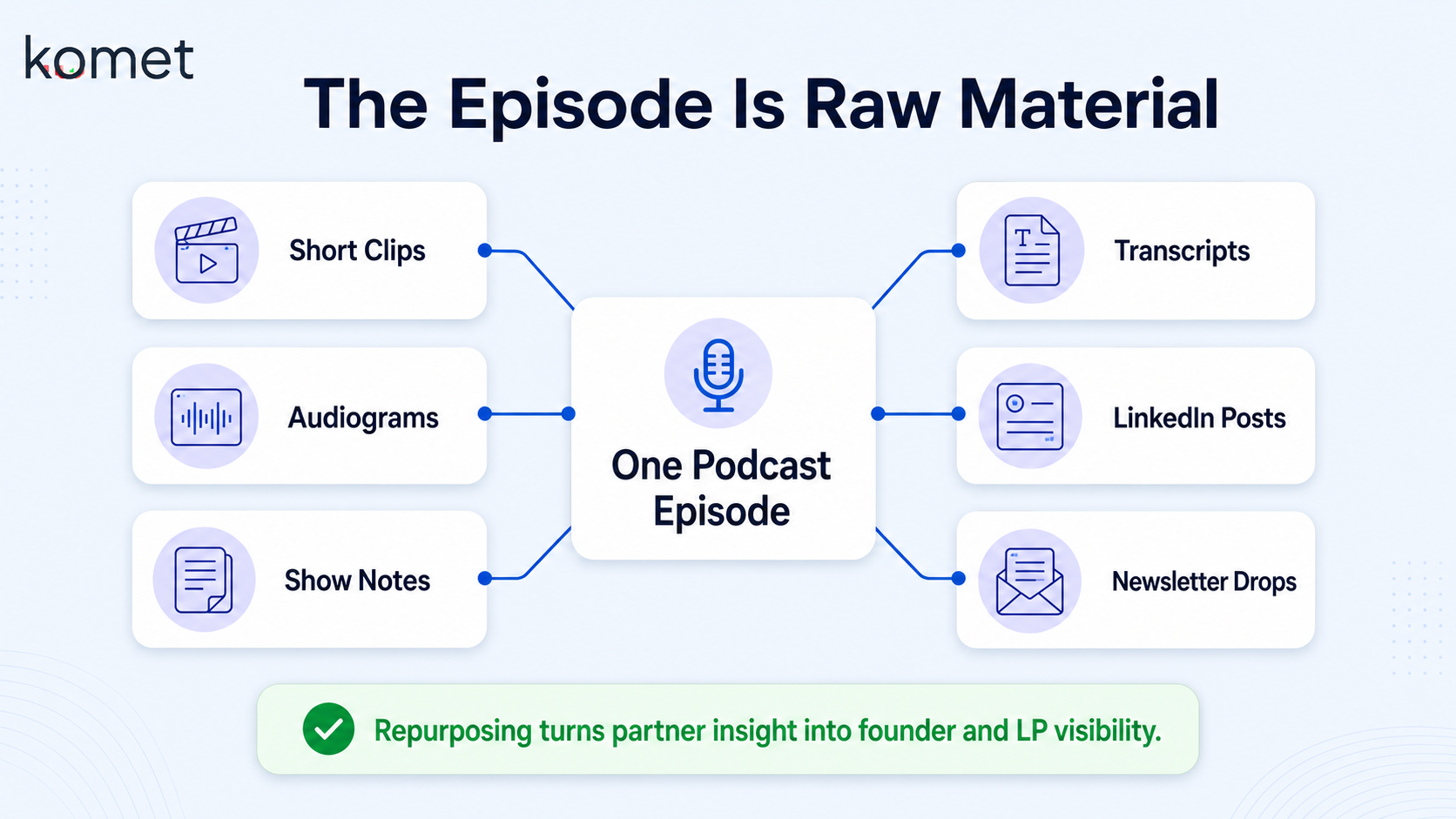
The problem is that most firms treat a podcast episode as the deliverable. It isn't. The episode is the raw material. The deliverable is every piece of content that flows from it, clips, quotes, show notes, transcripts, audiograms, LinkedIn posts, and newsletter drops. With over 630 active micro-VC firms competing for attention, simply having capital to deploy is no longer enough to win the best deals.
Podcast repurposing is how emerging fund managers and established GPs alike cut through that noise without manufacturing fake thought leadership. The insight already exists inside the conversation. Repurposing just surfaces it across every channel a founder or LP checks before they decide to engage.
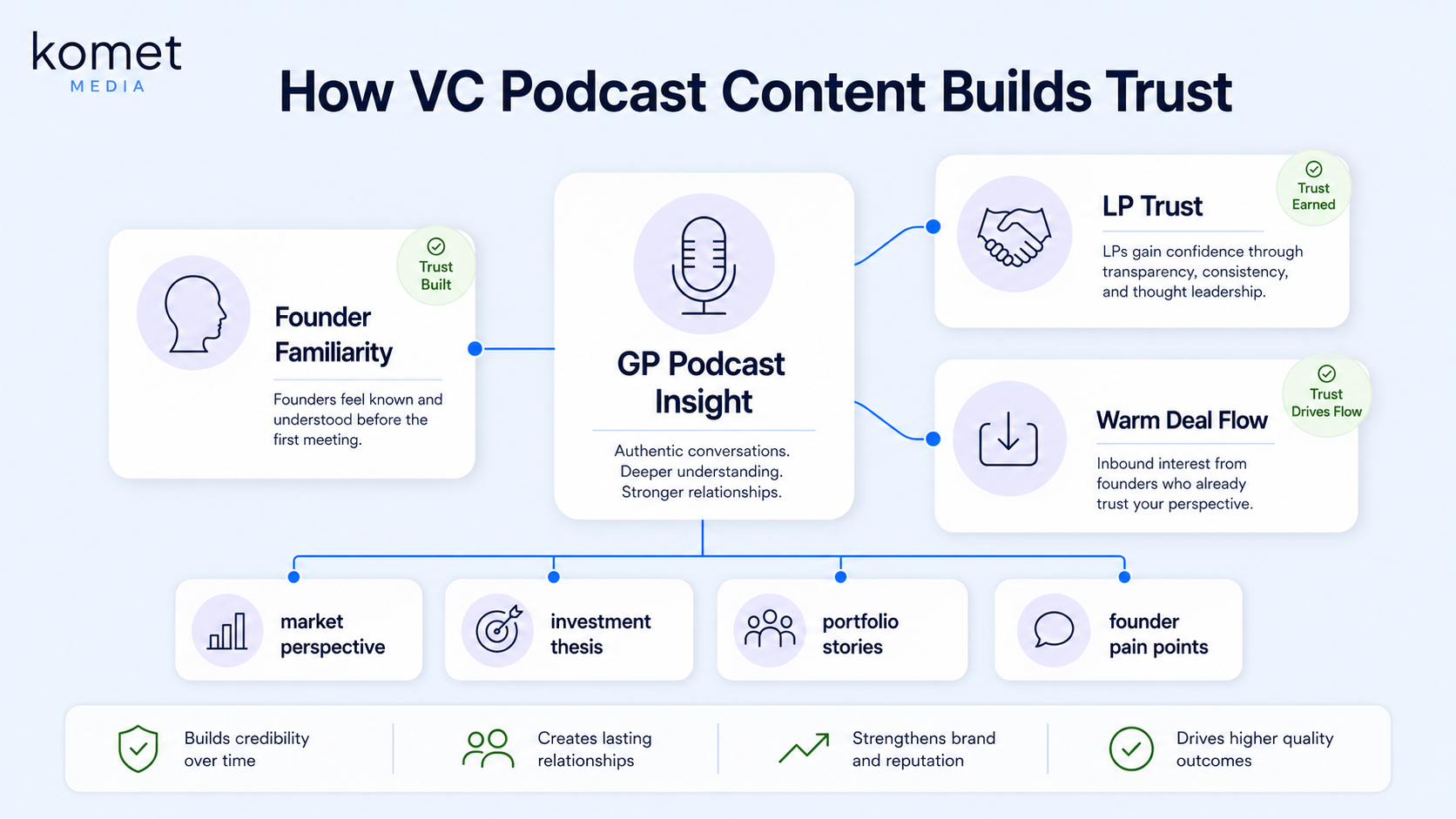
Research shows over 70% of founders consume at least three pieces of content before even considering engaging with a VC firm. Your content is often their first impression of your expertise, network, and value. Effective thought leadership addresses real founder pain points and questions, positioning your firm as a trusted advisor before the first meeting ever happens.
For B2B firms, this is one of the most efficient content repurposing strategies as it maximizes the ROI of a single recording session, turning one podcast episode into a multi-channel campaign that drives brand awareness and establishes thought leadership. That ROI argument maps perfectly to venture logic. Every hour a GP spends recording should yield weeks of content distribution. That's the leverage VC firms inherently understand applied to marketing.
Podcast Repurposing Strategy for Venture Capital Firms: The Core Framework
The framework I run for VC clients at Komet Media is a four-layer stack built around content atomization. This model treats long-form content as a source asset from which many smaller assets are extracted, adapted, and distributed over time.
Here's the stack in order of execution:
- Record the pillar: GP interview, founder conversation, LP Q&A, or panel from a portfolio event. Capture on Riverside.fm for clean separate audio tracks.
- Transcribe and edit: Run through Descript for transcript generation and audio/video cleanup. This step produces your raw text and cleaned video simultaneously.
- Identify clip moments: Flag three to five standalone 60–90 second segments containing one clear, opinionated point. These become your short-form video assets.
- Produce derivative assets: From the transcript and clips, generate show notes, a newsletter section, LinkedIn post copy, and quote graphics.
- Schedule and distribute: LinkedIn video first (highest GP visibility), then newsletter, then show notes on your podcast page, then audiogram cross-posts.
Five tools worth noting for this workflow: Descript for converting podcasts to blog posts and video clips, Canva for creating social visuals from report data, Repurpose.io for automating distribution across platforms, Headliner for creating audiograms from podcast highlights, and Notion for organizing content assets and tracking repurposing opportunities.
The critical discipline is treating the transcript as a content mine, not just a search optimization tool. Every sentence a partner speaks is a potential post, thread, or caption. Transcript repurposing alone can produce six to eight LinkedIn text posts per episode before you touch a single video clip.
How to Turn a Single Podcast Episode into 10+ Pieces of Content
This is the section most VC platform teams need to see in a board deck before they'll greenlight a podcast repurposing program. Here's the exact asset map from one 45-minute episode:
The long-form to micro-content atomization strategy involves breaking down substantial content like a podcast or webinar into numerous smaller, highly focused assets. These micro-content pieces are individually optimized for social media platforms, email newsletters, and other fast-paced channels. The goal is to capture attention quickly and drive traffic back to the original, comprehensive content asset.
For VC firms specifically, the internal portfolio brief is underutilized. If a GP discusses a market thesis in an episode, packaging that into a one-pager for portfolio companies turns one piece of content into direct portfolio support, a metric most platform teams track. A single well-structured podcast episode, when fully repurposed, covers six to eight weeks of consistent LinkedIn posting for a managing partner without a single additional recording session.
How VC Firms Use Podcasts to Attract LPs and Founders
Podcasts have become a game-changer for venture capital firms looking to create deeper, more personal connections with their audience. Unlike blogs or whitepapers, podcasts allow you to speak directly to your audience, often for 30 minutes or more each week.
But the podcast itself is not the trust-builder. The clips are. Most LPs and founders never listen to a full episode. They see a 60-second clip on LinkedIn, watch it to the end, and form an impression of the partner's judgment and communication style right there.
Harry Stebbings built relationships with top founders and investors through content that eventually enabled him to raise $140 million for his own fund by age 24. Content didn't just improve his deal flow, it created his entire career.
That trajectory is replicable at the firm level. The mechanics are the same: a consistent stream of short-form video content derived from authentic partner conversations builds the kind of ambient familiarity that makes a cold outreach feel warm. For LP communications specifically, podcast repurposing solves a compliance-adjacent problem.
Unlike many industries, VCs face SEC restrictions on how they discuss performance, fundraising activities, and investment opportunities. Repurposed clips focused on investment thesis, market perspective, and portfolio company stories stay safely inside those guardrails while still demonstrating the depth of a firm's thinking to prospective LPs. For limited partners, investing in your fund is fundamentally an act of trust. A GP who shows up in a LinkedIn feed three times a week with sharp 60-second takes on market dynamics builds that trust faster than any pitch deck.
Best Practices for Repurposing Podcast Clips on LinkedIn for Investors
Consistency is now a prerequisite for sustainable performance. Benchmarks suggest that posting two to three times per week supports ongoing growth. For most B2B teams, producing high-production video at that cadence is unrealistic. Podcast repurposing is the only practical solution.
Here's what I've learned optimizing LinkedIn video clips for VC audiences at Komet Media's short-form video editing service:
- Hook in five seconds: The first sentence of the clip must state a specific, opinionated point. "Most Series A pitches fail for one reason" beats "Today we're going to talk about fundraising."
- Format for 4:5: Optimize clips for LinkedIn at 4:5 aspect ratio. Full vertical (9:16) works for YouTube Shorts, but 4:5 occupies more feed real estate on LinkedIn desktop.
- Add captions: A meaningful portion of LinkedIn video is watched without sound. Burned-in captions are non-negotiable.
- Keep clips to 60–90 seconds: While short videos of 30–60 seconds perform well due to reduced attention spans, insightful content can go up to 2–3 minutes. For VC audiences who expect intellectual substance, 90 seconds is the practical ceiling before drop-off.
- Post natively: Upload the video file directly to LinkedIn rather than sharing a YouTube link. Native posts receive significantly stronger organic distribution.
- Use the caption to add context: The post caption should not repeat the clip, it should add one additional insight the clip doesn't cover. This drives comments from founders and LPs who want to continue the conversation.
Personal branding is becoming a more effective strategy on LinkedIn. Video posts naturally capture attention, which means your audience is more likely to interact by liking, commenting, or sharing. Such actions push your content to their connections, expanding your visibility.
For a managing partner, that secondary distribution to first-degree founder networks is where deal flow content strategy starts to compound.
Podcast Repurposing Tools for Investment Firms
The right tool stack eliminates friction at every stage of the workflow. Here's what performs well for VC-specific use cases:
Descript deserves special mention for VC teams. It lets non-technical staff edit video by editing text, delete a sentence in the transcript and the corresponding video segment disappears. That dramatically lowers the barrier for in-house platform teams who want to support podcast production without a full video editor on staff.
For teams that want fully managed podcast editing and podcast transcription without building internal capability, outsourcing to a specialist agency like Komet Media means the episode is ready for distribution within 24–48 hours of recording, with every derivative asset included.
Short-form videos offer the opportunity for long-form podcasts to be repurposed into multiple content pieces that can be distributed across multiple platforms rising in popularity such as TikTok, YouTube Shorts, and Instagram Reels. For most VC firms, LinkedIn is primary and YouTube Shorts is secondary, but the same clip works across both with a format crop.
How to Build a Content Flywheel from a VC Podcast
The content flywheel is what separates firms doing podcast repurposing tactically from those doing it strategically. A flywheel means each piece of content feeds the next cycle of recording. The core loop is a video podcast engine: record a live Q&A or podcast-style conversation, clip high-signal moments framed as strong opinions, optimize clips for LinkedIn and other platforms, then let clip performance inform future topics, effectively aligning production with audience demand.
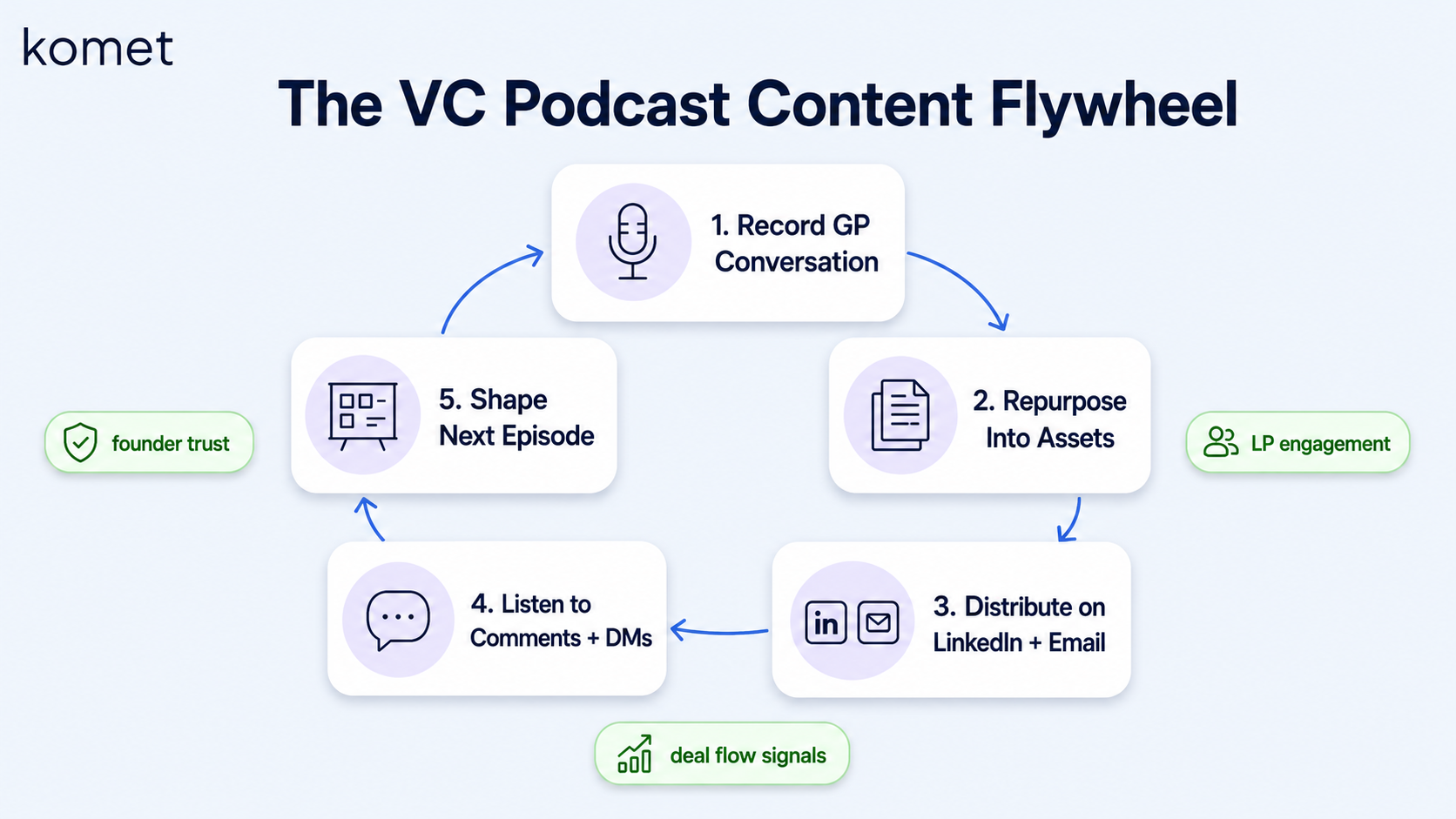
Here's how that flywheel runs for a VC firm over a quarter:
- Record: GP records a 45-minute conversation on a current investment thesis, say, the state of AI infrastructure at the seed stage.
- Repurpose: Komet Media turns it into five LinkedIn, Instagram or YouTube shorts clips, a newsletter section, show notes, and a transcript. Podcast show notes are optimized for SEO so the episode ranks for queries founders and LPs actually search.
- Distribute: Clips go out over three weeks on the GP's LinkedIn. The newsletter drives the LP audience back to the full episode.
- Listen: Comments, DMs, and inbound inquiries signal which angle resonated. A founder who comments "this is exactly the question I'm wrestling with" becomes the next episode guest.
- Repeat: The next episode is shaped by what the market responded to, not what the GP assumes they want to hear.
This is GP storytelling tied directly to deal flow content strategy. Well-executed content strategies don't just build brand authority, they create a steady pipeline of high-quality investment leads. The compounding effect kicks in around months four to six. By that point, a firm posting three LinkedIn clips per week from repurposed podcast content has sixty-plus pieces of video indexed on their profile. Every new founder who lands on that profile sees depth, consistency, and a clear investment point of view, all before the first call.
For VC firms running events, panels, and webinars alongside the podcast, every one of those recordings is additional raw material. Komet Media's events repurposing and webinar services extend the same system to every live touchpoint a firm produces.
Conclusion
Podcast repurposing is the highest-leverage content move available to VC firms in 2026. Here's what to take away:
- One 45-minute podcast episode produces 10+ distinct content assets across LinkedIn, email, and search.
- Short-form video clips on LinkedIn are the primary trust-building mechanism with founders and LPs, not the full episode.
- The right tool stack (Riverside.fm, Descript, Headliner) removes friction; a managed service removes the bottleneck entirely.
- A disciplined podcast repurposing flywheel compounds over quarters, turning a single recording habit into a firm-wide visibility and deal flow engine.
If you want to see how this system works for your firm's specific content, reach out to Komet Media to talk through the build.
Frequently Asked Questions
Q1: What exactly is podcast repurposing for a VC firm?
Podcast repurposing is the process of extracting multiple content assets from a single recorded episode, clips, show notes, transcripts, audiograms, and social posts. For VC firms, it turns one GP conversation into weeks of founder-facing and LP-facing content without additional recording time.
Q2: How many assets can one podcast episode realistically produce?
A standard 45-minute episode produces ten or more assets: three to five short video clips, audiograms, show notes, a full transcript, quote graphics, a newsletter section, and LinkedIn posts. A systematic workflow at Komet Media's podcast marketing service delivers all of these within 48 hours of recording.
Q3: Which platform should a VC firm prioritize for distributing repurposed podcast content?
LinkedIn is the primary channel in 2026 for reaching founders, LPs, and co-investors. Native short-form video clips posted to a managing partner's personal profile consistently outperform firm page posts. YouTube Shorts serves as a secondary discovery channel, particularly for founder audiences.
Q4: Do VC firms need a podcast before they can start repurposing content?
No. Firms can start with partner panel recordings, event footage, founder interviews, or webinar recordings. Any long-form conversation involving a GP or portfolio founder qualifies as raw material. The podcast is simply the most structured and repeatable format for producing that material consistently.
Q5: How is podcast repurposing different from what competitors like Vidpros or TastyEdits offer?
Those services focus on subscription-based video editing. Komet Media builds a complete repurposing system: from podcast editing and transcription through to short-form video, distribution strategy, and show notes optimized for search. The output is a content flywheel, not just edited clips.
Q6: How long before podcast repurposing starts generating measurable deal flow impact for a VC firm?
Consistent distribution typically produces visible results, inbound founder inquiries, LP engagement, and LinkedIn follower growth, between months three and six. The compounding effect of indexed video content and search-optimized show notes accelerates after that point, building a durable inbound channel rather than a one-off campaign.