
🪄 AI Summary
Heading 1
Heading 2
Heading 3
Heading 4
Heading 5
Heading 6
Lorem ipsum dolor sit amet, consectetur adipiscing elit, sed do eiusmod tempor incididunt ut labore et dolore magna aliqua. Ut enim ad minim veniam, quis nostrud exercitation ullamco laboris nisi ut aliquip ex ea commodo consequat. Duis aute irure dolor in reprehenderit in voluptate velit esse cillum dolore eu fugiat nulla pariatur.
Block quote
Ordered list
- Item 1
- Item 2
- Item 3
Unordered list
- Item A
- Item B
- Item C
Bold text
Emphasis
Superscript
Subscript
New York investment firms and tech startups sit on hours of valuable recordings. Yet, most of these webinars, founder interviews, and podcasts never reach the right buyers. The problem is rarely a lack of ideas. It is a broken production system. When searching for the best video editing companies New York offers, B2B leaders often hire vendors who only cut files. You need a partner who understands platform distribution and buyer intent. I have spent years helping executives turn long recordings into repeatable pipelines. Here is how to choose the right production partner for your commercial goals.
Quick Answer: Top 10 Video Editing Companies in New York (2026)
The best video editing companies New York businesses can hire focus on B2B distribution, not just cutting footage. Top options include Komet Media for from-scratch production and recurring content systems, Vidico for brand campaigns, and Vidpros for dedicated editor subscriptions.
Which Are the 10 Best Video Editing Companies in New York for B2B Businesses?
When you review this list, pay attention to the delivery model. Some agencies focus on one-off brand videos. Others provide ongoing content operations. The right choice depends on whether you need a single polished asset or a dependable publishing system.
1) Komet Media: Production & Repurposing
Komet Media is a video production and content distribution partner built specifically for venture capital firms, private equity firms, B2B SaaS companies, and AI/tech startup founders. We specialize in both creating high-impact video from scratch and connecting content selection, platform adaptation, and distribution into one workflow.
I built Komet Media because I saw too many B2B marketing teams struggling with production gaps and long recordings that produced little business value. We provide a full-service solution: capturing new material from scratch and helping teams turn one master recording into short clips, LinkedIn videos, and YouTube Shorts that support sales conversations and inbound pipeline.
Our work typically runs through mid-tier retainers ranging from $2,500 to $5,000 per month. This model gives VC firms and technology executives a dependable production pipeline without the overhead of hiring an internal media team.
2) Vidico
Vidico is a production agency that focuses on high-quality brand videos, product explainers, and commercial campaigns. They are a strong option for technology startups preparing for a major product launch or a new funding announcement.
Vidico handles scriptwriting, live-action production, and animation. They also provide short-video editing to adapt hero campaigns for social channels. Their model is heavily project-based, though they do offer retainer options for companies that need ongoing campaign support. If you need a premium, heavily produced explainer video for your homepage, they are a solid choice.
3) Spoke
Spoke focuses on repurposing recordings into video and supporting marketing assets. Their model is tailored for marketing teams that have existing long recordings but lack the time to turn them into platform-ready assets.
They operate on a subscription model, which provides a predictable cost structure for growing marketing teams. Spoke is best suited for teams that need standard repurposing workflows and want to turn webinars or company town halls into readable and watchable social assets.
4) ShortVids
ShortVids provides monthly short-video editing for businesses and creators. They focus entirely on vertical video formats like Instagram Reels, TikTok, and YouTube Shorts.
Their service is built around a predictable monthly subscription. This makes them a practical choice for founders or marketing managers who want to test short-form video without committing to a massive production retainer. They are a volume-driven provider, meaning they work well if you have a clear strategy and simply need a reliable team to cut the files.
5) TastyEdits
TastyEdits operates as a subscription editing service. They handle commercial-intent video editing for a wide range of clients, including creators and traditional businesses.
They provide a straightforward dashboard where clients can submit raw footage and receive edited files within a few days. This model works for businesses that generate a lot of raw video and have an internal manager to handle the strategy, quality control, and publishing. It is a highly operational service focused on speed and reliable file delivery.
6) Vidpros
Vidpros offers a dedicated editor subscription model. Instead of submitting tickets to a random pool of editors, you are assigned a specific editor who works on your files every day.
This model is excellent for B2B teams that want the consistency of an in-house hire without the payroll complications. Because you work with the same person, they learn your brand guidelines, pacing preferences, and graphical style over time. You are still responsible for your own content strategy and distribution, but Vidpros solves the capacity problem.
7) Motionvillee
Motionvillee specializes in short-video editing and motion graphics, particularly for startup-focused video services. They are highly skilled at explaining complex software or technical concepts through animation.
If your SaaS product is difficult to demonstrate through simple screen recordings, Motionvillee can build animated explainers that clarify the value proposition. They handle project-based work as well as ongoing visual support for tech startups that need to simplify their messaging.
8) Casual Films
Casual Films is a corporate video production company that works with enterprise businesses. They are highly experienced in producing recruitment videos, internal communications, and large-scale brand films.
While they serve large accounts globally, their New York presence makes them a strong candidate for financial services firms and Fortune 500 companies needing polished corporate communications. They operate strictly on a project basis and handle end-to-end production, from on-set filming to final delivery.
9) Skeleton Productions
Skeleton Productions is another strong corporate video agency. They focus on promotional videos, brand films, and high-level corporate messaging.
They are best suited for established brands that need a highly polished visual identity. Like Casual Films, their work is primarily project-based. They bring a full production crew to your office, handle all lighting and sound, and deliver a cinematic final product. They are not built for daily social media content, but they excel at high-stakes brand assets.
10) Blue Chalk Media
Blue Chalk Media takes a documentary-style approach to business video. They work with brands that want to tell deep, human-led stories rather than standard corporate talking-head videos.
If a private equity firm wants to profile the turnaround story of a portfolio company, Blue Chalk Media has the journalistic and cinematic skills to capture that narrative. They are a premium, project-based agency for brands that want to build trust through authentic, documentary-style storytelling.
Why Can't Video Editing Alone Solve Your B2B Distribution Problem?
Many marketing leaders believe their video problem is a capacity issue. They assume that if they simply hire an editor to cut their raw footage faster, their pipeline will grow. In my experience, editing is rarely the only problem. The real issue is a lack of alignment between the content, the platform, and the buyer.
A polished video with no distribution plan is still an underused asset. When evaluating the best video editing companies New York offers, you must look beyond their software skills. You need to know if they understand how B2B buyers consume information.
A report by Wistia in 2025 noted that business videos under two minutes retain the majority of their viewers, but only if the hook directly addresses a known industry problem. A standard editor will cut out the pauses and add a logo. A strategic partner will identify the exact 45 seconds where your founder answers a common sales objection, format that clip for LinkedIn, and write a caption that drives the reader to your newsletter.
I would rather produce six strong clips that clearly articulate your product value than fifteen weak clips that just look busy. B2B buyers are not looking for entertainment. They are looking for expertise, clarity, and proof. Your video production process must be designed to deliver those three things consistently.
How Do You Evaluate the Best Video Editing Companies in New York?
Choosing the right partner requires more than looking at a portfolio reel. A highlight reel only shows the final output. It does not show how many revisions it took, how much management time the client spent, or whether the video actually generated any qualified leads.
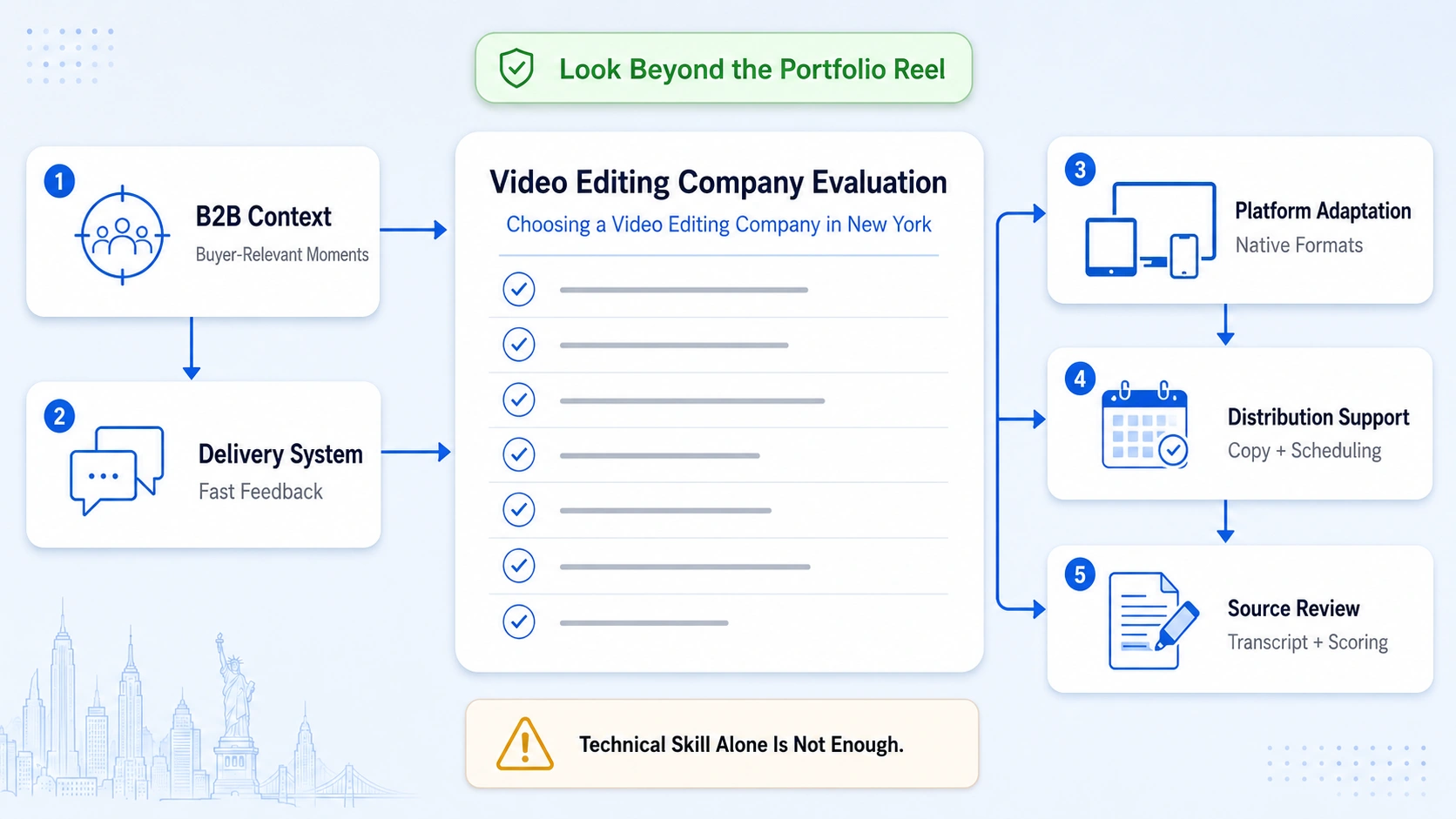
When you review potential partners for your B2B SaaS video editing needs, use these criteria to make a sound commercial decision.
- Do they understand B2B context? Ask them how they would select a clip from a technical webinar. If their answer focuses purely on finding the loudest or most energetic moment, they do not understand B2B buyers. The best moment is usually a calm, specific explanation of a complex problem.
- What is their delivery system? Find out exactly how files are shared, reviewed, and approved. A disorganized feedback loop will waste your internal team's time. Look for partners who use dedicated review tools where you can leave timestamped comments.
- Do they handle platform adaptation? A clip cut for YouTube Shorts requires a different pacing and visual structure than a video formatted for the LinkedIn feed. Verify that the agency adapts the asset for the specific platform rather than just changing the aspect ratio.
- Do they support distribution? Check if the agency provides captions, written post copy, and scheduling support. If they just drop a large video file into a shared folder and walk away, your marketing team is still doing half the work.
- How do they handle source material? Ask how they process a long podcast episode. A strong partner will clean the audio, review the transcript, and score moments based on buyer value before they start timeline editing.
What Is a Reliable B2B Video Production Workflow for Marketing Teams?
We have seen SaaS teams publish more consistently once they stop handling every asset as a separate project. You need a system. A reliable workflow turns the unpredictable creative process into a manageable business operation.
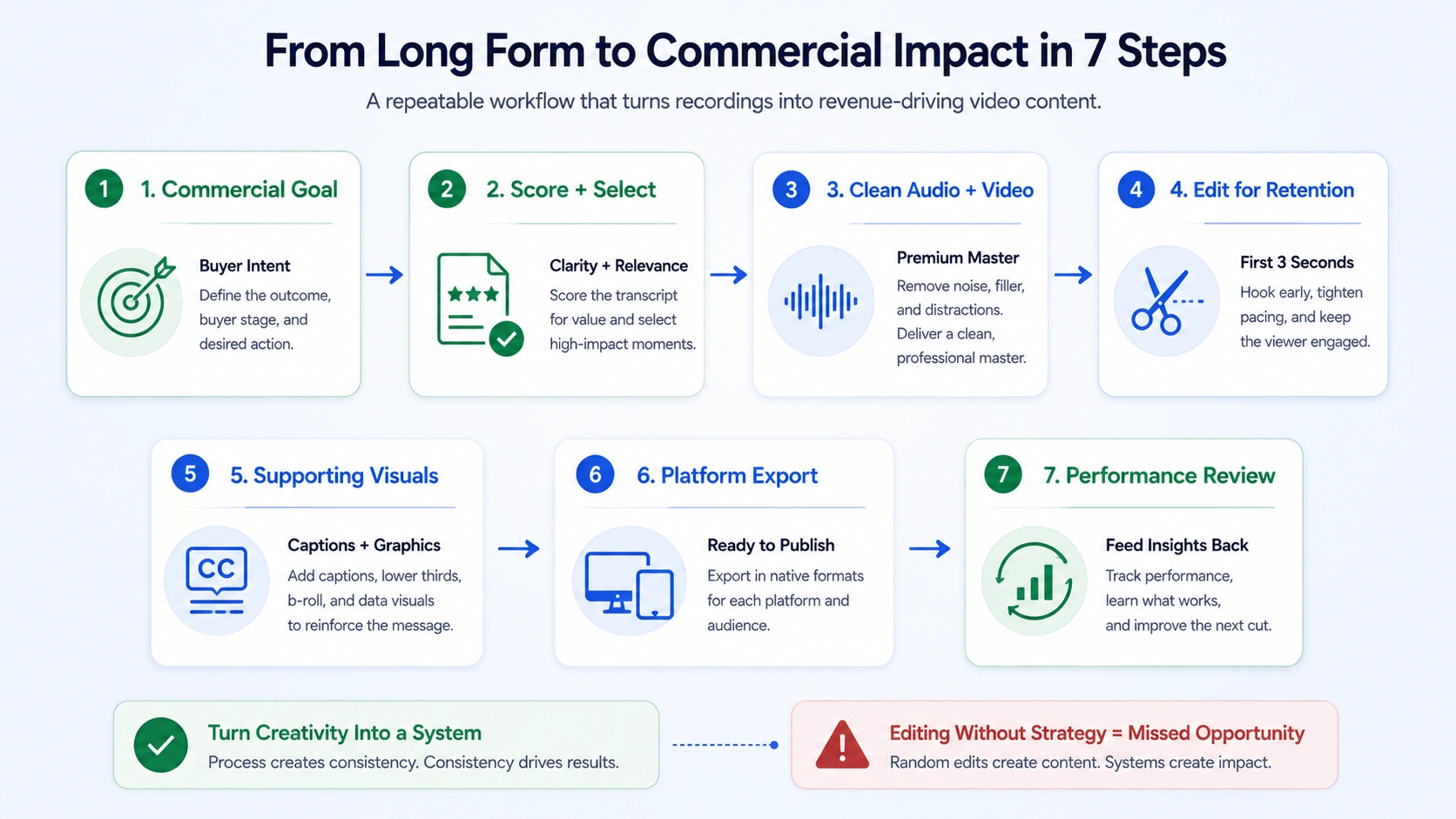
Here is the workflow we use when managing podcast distribution and video repurposing for our clients.
Step 1: Define the commercial goal
Before looking at the footage, we define what the video needs to achieve. Is this asset meant to support an ongoing sales conversation, drive registrations for an upcoming event, or build general category authority for the founder? The goal dictates which moments we select from the master recording.
Step 2: Score and select the master asset
We review long-form recordings, such as a webinar or podcast interview. We read the transcript and mark the strongest moments. We score these moments based on clarity, relevance to the buyer persona, and how well they stand alone without extra context.
Step 3: Audio and visual cleanup
Before cutting clips, the master file must be cleaned. We remove background noise, level the dialogue, and correct the color grading. This ensures that every subsequent clip pulled from this timeline maintains a premium, professional standard.
Step 4: Edit for retention and clarity
We cut the selected moments into short clips. In B2B video, the hook is critical. The first three seconds must state exactly what the viewer will learn. We remove filler words and tighten the pacing, but we never alter the speaker's original meaning.
Step 5: Add supporting visuals and formatting
We apply the client's brand guidelines. This includes adding readable captions, branded lower thirds, and subtle motion graphics to explain abstract technical points.
Step 6: Platform-specific export
We export the final assets in the correct formats for LinkedIn, Instagram Reels, and YouTube. We also prepare the supporting written copy so the client's internal team can schedule the posts immediately.
Step 7: Performance review
After the content has been live for a few weeks, we review the metrics. We look at watch time and engagement to understand which topics resonated with the audience. These lessons are fed directly into the planning for the next recording session.
How Can You Measure the Commercial Value of B2B Video?
Most teams measure video success using consumer metrics. They look at view counts and follower growth. While these numbers matter for broad brand awareness, they are poor indicators of commercial success for a private equity firm or an enterprise software company.
You must match your metrics to the purpose of the asset. I usually advise clients to track performance across three distinct categories.
Awareness metrics
These metrics tell you if the platforms are serving your content to a relevant audience.
- Impressions and reach in the feed
- Viewer retention and completion rates
- Profile visits generated from the video
Engagement metrics
These metrics show whether your content is actually resonating with the viewer or just playing in the background.
- Saves and shares (A saved video usually indicates the buyer found the framework or data highly useful)
- Detailed comments and direct replies
- Watch time across the series
Commercial metrics
This is where video proves its business value. Video attribution is rarely perfect, but these signals show commercial impact.
- Qualified leads mentioning a specific founder video on a discovery call
- Newsletter signups directly following a video prompt
- Content being actively shared by your sales team in their outbound emails
- Pipeline influenced by prospects who consumed multiple podcast clips
According to 2026 data from Demand Gen Report, B2B buyers consume an average of seven pieces of content before making a purchasing decision. Your short videos act as touchpoints along that journey. If your sales team feels confident sending a video clip to a prospect to answer a technical question, that video has generated commercial value, regardless of its public view count.
Conclusion
A strong video strategy requires more than basic editing software. It requires a clear understanding of your buyer, a dependable production workflow, and a plan for platform distribution. When you evaluate agencies, look past their flashy transitions. Ask how their work will support your sales and marketing objectives.
If you have valuable recordings sitting on hard drives, do not let them go to waste. Finding the right partner among the best video editing companies New York offers will turn those hidden assets into a consistent pipeline of authority-building content.
What Are Common Questions About B2B Video Editing Services?
1) What makes the best video editing companies New York offers different from freelancers?
Agencies usually provide a complete production system rather than just file execution. While a freelancer might cut a video based on your exact timestamp instructions, a strong B2B agency will help select the best commercial moments, format the video for multiple platforms, and write the supporting post copy for distribution.
2) How much do B2B video editing retainers typically cost?
Costs vary based on volume and strategic support. A dedicated remote editor might cost around $1,500 to $2,000 per month. Mid-tier retainers that include content repurposing, strategy, and distribution support typically range from $2,500 to $5,000 per month. Highly produced brand campaigns are priced individually and can run much higher.
3) How long does it take to turn a podcast into short clips?
In a well-managed workflow, turning a one-hour podcast into a polished long-form asset and several short clips usually takes between five and seven business days. This timeline allows for proper audio cleaning, strategic moment selection, editing, captioning, and client approval.
4) Do we need to record in a professional studio to get good results?
No. Many founders and executives record high-quality content from their home offices or conference rooms using modern webcams and USB microphones. A capable editing partner can enhance the audio, correct the lighting in post-production, and use graphics to elevate the final look.
5) Should we hire an internal editor or an external agency?
An internal editor makes sense if you are producing hours of complex, highly secure internal video every week. However, an external partner is usually more cost-effective for marketing and social content, as you gain access to a team that understands current platform trends and distribution strategies without the overhead of a full-time salary.
6) Does Komet Media require a long-term contract?
We typically work on ongoing monthly retainers because a content system requires consistency to generate business value. However, we do not lock clients into restrictive multi-year contracts. We believe in earning our place in your workflow by consistently delivering assets that support your commercial goals.
7) What deliverables should we expect from a webinar repurposing project?
A strong webinar repurposing project should yield multiple assets. You should expect the full cleaned recording, an audio-only podcast version, three to five short vertical clips for social media, and horizontal highlight clips suitable for embedding in follow-up email campaigns.
8) How do we know if our short-form video is actually working?
Look beyond view counts. If you are targeting B2B buyers, track how many prospects mention your videos on discovery calls. Monitor your LinkedIn profile visits, track newsletter signups attributed to video links, and see if your sales team is actively using the clips in their outbound communications.