
🪄 AI Summary
Heading 1
Heading 2
Heading 3
Heading 4
Heading 5
Heading 6
Lorem ipsum dolor sit amet, consectetur adipiscing elit, sed do eiusmod tempor incididunt ut labore et dolore magna aliqua. Ut enim ad minim veniam, quis nostrud exercitation ullamco laboris nisi ut aliquip ex ea commodo consequat. Duis aute irure dolor in reprehenderit in voluptate velit esse cillum dolore eu fugiat nulla pariatur.
Block quote
Ordered list
- Item 1
- Item 2
- Item 3
Unordered list
- Item A
- Item B
- Item C
Bold text
Emphasis
Superscript
Subscript
AI and ML startups have a credibility problem that more content alone will not solve. Buyers hear bold claims every day, and most of them sound the same. A podcast is one of the few places where your founders and researchers can show how they actually think. Podcast repurposing turns those conversations into short clips that explain the product, prove the expertise, and reach the whole buying committee. Whether creating video content from scratch or repurposing existing episodes, this guide covers how I select moments, keep claims accurate, and distribute clips for AI-native companies.
Quick Answer
Podcast repurposing for AI and ML startups means turning episodes into short, accurate clips that explain the product and show real expertise. It works when you avoid hype, make technical ideas visual, and distribute clips to specific buyer roles.
Why AI Startups Need More Than Another Launch Post
The AI market is loud. Every week brings new models, new agents, and new claims about productivity. Buyers have become skeptical, and they have good reason to be.
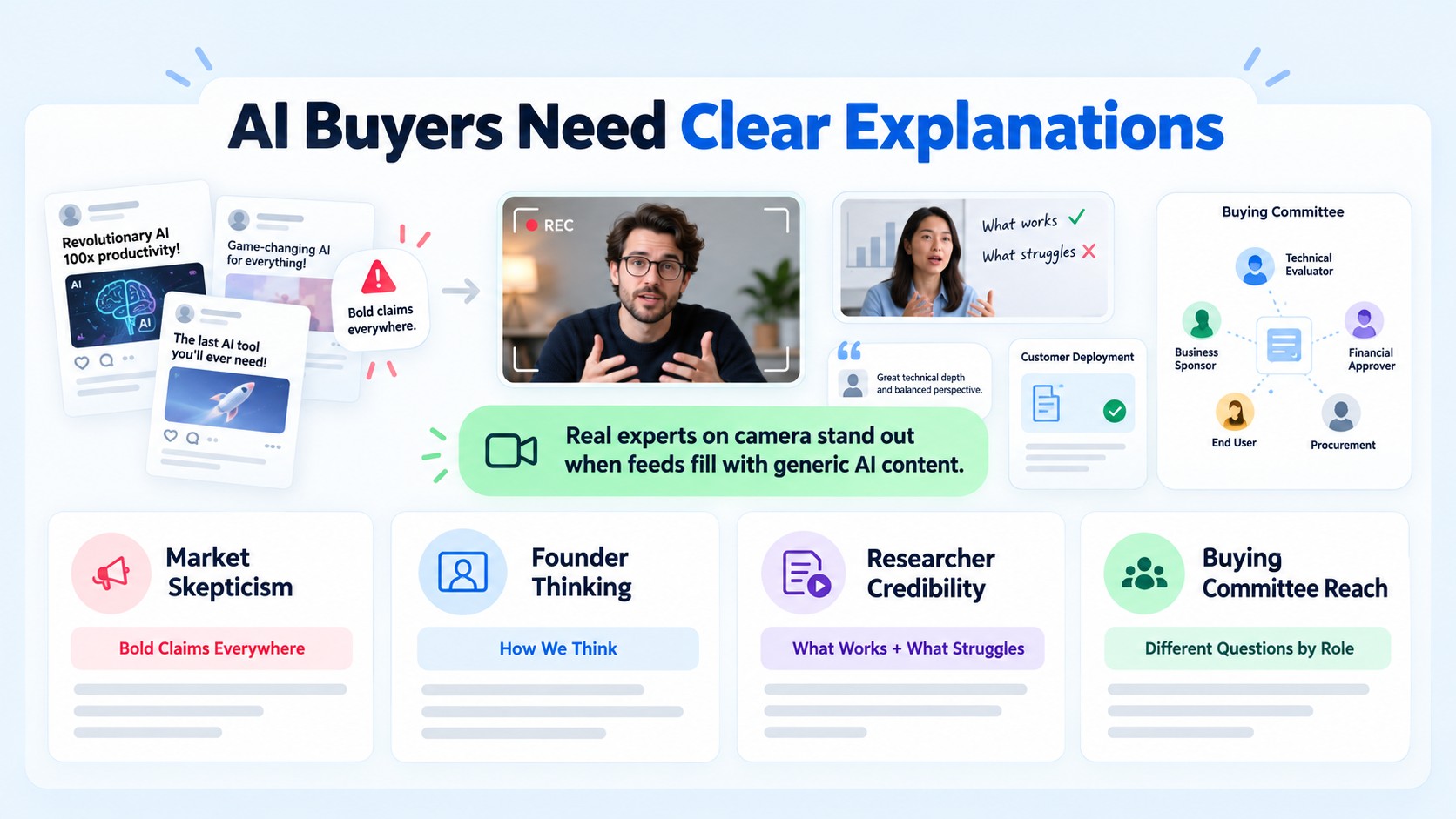
That skepticism creates an opening for teams that can explain things clearly. A 70-second clip of your head of research describing what your model does well, and where it still struggles, often earns more trust than a polished launch video.
The audience for this kind of content is large and engaged. The Infinite Dial 2026 from Edison Research at SSRS found that 57% of Americans age 12 and older have used a generative AI assistant. The same study reported that more than half of AI users are weekly podcast consumers, compared with roughly one-third of non-users. That is a correlation, not proof that AI users choose podcasts because of AI. It does suggest that people curious about AI already spend time with long conversations.
There is also a content quality problem. In its B2B Content and Marketing Trends: Insights for 2026 research, based on a survey of more than 1,000 B2B marketers, the Content Marketing Institute reported that 9 in 10 marketers use AI to produce content, but fewer than 4 in 10 say it has improved performance. When feeds fill with generic AI-written posts, a real expert speaking on camera stands out.
The raw material is usually richer than teams realize. AI startups record founders explaining their thesis, researchers discussing trade-offs, design partners describing real deployments, and customers talking about adoption. Each of those voices answers a different buyer question. Podcast repurposing is how those answers reach people who will never press play on a 50-minute episode.
The Accuracy Problem: Clips That Overclaim
One mistake I see repeatedly is a clip that makes the product sound more capable than the guest intended. A founder says, "In the right setup, this can cut review time significantly." The edit becomes, "This cuts review time." The qualifier was the truth, and it got cut for pace.
This matters more in AI than in most categories. Regulators are paying attention to AI marketing. In September 2024, the FTC announced Operation AI Comply, a law enforcement sweep against companies using AI hype or deceptive AI claims. The agency stated plainly that there is no AI exemption from existing law. I am not a lawyer, and your legal team should set your review rules, but the production lesson is clear: clipped claims need the same scrutiny as written ones.
Here is what we watch for in AI clips:
The fix is not to make clips timid. Confident clips work well. The fix is to keep confidence attached to what is actually true.
Making Technical Ideas Easy to Watch
AI and ML conversations often include concepts that are hard to picture: retrieval, fine-tuning, evaluation, inference costs, agent orchestration. Talking-head footage alone can lose viewers when the idea is abstract.
The best clips I have worked on for technical teams do three things. They open with the outcome or problem, not the method. They define one concept per clip. They add a simple visual when the idea needs one.
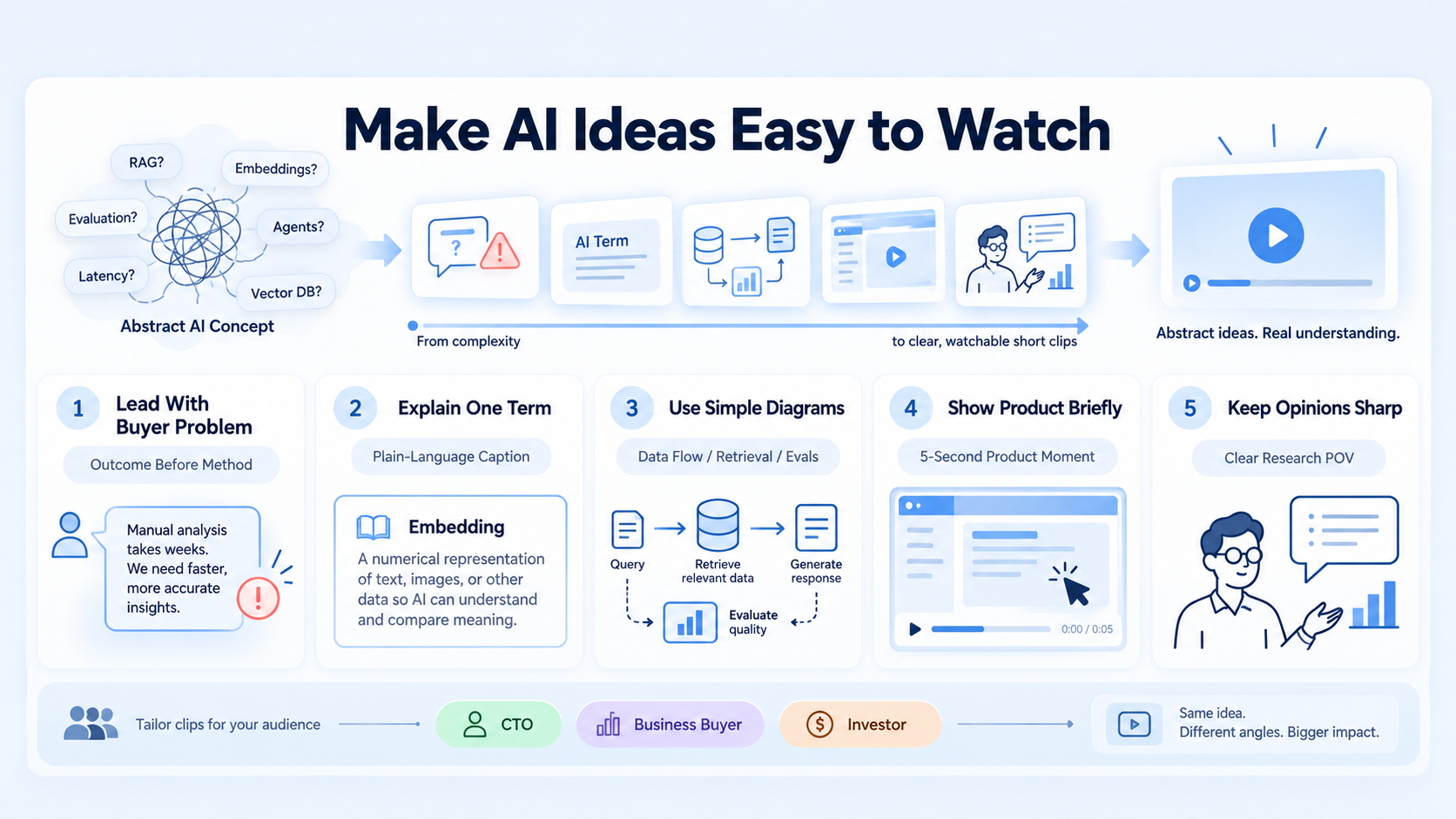
Practical techniques that work:
- Lead with the buyer's problem. "Why your chatbot gives confident wrong answers" lands better than "an overview of retrieval-augmented generation."
- Explain terms in plain words. If the guest says "evals," a short caption can add "how we test model quality."
- Use simple animated diagrams. A clean visual of how data flows through a system often explains more than a screen recording. Our guide to explainer videos for technical products covers this in more depth.
- Show the product briefly and clearly. A five-second, readable product moment beats a 40-second scroll through a dense interface.
- Keep opinions sharp. A researcher saying "most teams evaluate models on the wrong tasks" will hold attention better than a neutral overview.
Different clips also serve different readers. A CTO wants architecture and trade-offs. A business buyer wants outcomes, risk, and cost. An investor wants the market thesis. I tag each moment by audience before editing, so the final set covers the whole buying committee rather than five versions of the same point.
Captions deserve extra care in AI content. Automatic transcription often mangles model names, framework names, and acronyms. A caption that misspells the technology your buyer uses every day tells them nobody checked the work. We keep a running glossary for each client so names and terms stay consistent across every clip.
A Podcast Repurposing Workflow for AI-Native Teams
Most podcast repurposing fails before editing starts, because the team has not decided who each episode is for. AI startups add another challenge: the product changes fast, so clips can go out of date.
This is the cycle I recommend:
- Define the audience and goal. Technical evaluators, business buyers, or investors?
- Brief the guest. Ask them to define terms out loud and to separate shipped features from the roadmap.
- Record clean audio, video, and screen capture separately so editors can reframe visuals later.
- Create an accurate transcript. Model names, framework names, and acronyms often need a manual check.
- Mark and score moments. I score on clarity, audience value, whether it stands alone, and accuracy risk.
- Get a technical review of the moment list. Someone close to the product confirms nothing is overstated or out of date.
- Edit the master episode.
- Cut clips, add visuals, and caption them.
- Adapt for each platform.
- Final check and archive. Confirm terms, numbers, and that no customer data is visible.
- Schedule distribution.
- Review performance and feed lessons into the next recording.
Small teams can merge steps 5 and 6 when the person selecting clips is technical. I would not skip the technical review or the final check. Those steps protect your credibility with buyers who notice mistakes.
Add one extra habit for fast-moving products: a shelf-life check. Before scheduling a clip that mentions specific features, pricing, or model versions, confirm it is still accurate. Evergreen clips about problems, principles, and opinions can stay in rotation much longer.
Batching helps lean teams. Rather than handling each clip as its own project, review a full episode's moment list in one session, approve it in one pass, and schedule the clips across several weeks. We have seen startup teams publish more consistently once they stop treating every asset as a separate request.
What one strong episode can usually become:
These are planning ranges, not promises. A guest with clear opinions and specific examples gives you far more usable material than a general overview.
Distribution: Where AI Buyers Actually Pay Attention
A polished clip with no distribution plan is still an underused asset. AI buyers are spread across several channels, and each one rewards something different.
LinkedIn is usually the main channel for enterprise AI. CTOs, heads of data, and operations leaders evaluate vendors there. LinkedIn video has also grown: Digiday reported that total video viewership on LinkedIn rose 36% year over year for the period from October 30, 2024, to January 29, 2025, based on company figures. Our guide to LinkedIn video for AI and ML startups covers formats and posting.
YouTube works for depth and search. Many technical buyers go there to learn how something works. YouTube reported more than 1 billion monthly active viewers of podcast content as of January 2025. That is a platform-wide number, not an AI-specific one, but it supports publishing full episodes there with search-friendly titles.
X and technical communities matter for developer-facing and research-heavy companies. Share clips that teach something specific, credit the guest, and take part in the discussion. Promotional clips get ignored in these spaces.
Sales enablement is the most underused channel. Organize clips by objection: security, accuracy, integration, cost, and change management. A 60-second clip of your CTO answering "how do you handle hallucinations?" can be a stronger follow-up than another slide deck.
Investor and recruiting audiences also watch founder content. For venture-backed AI startups, especially in San Francisco and Silicon Valley, founder clips often support fundraising and hiring alongside sales. One clip can serve all three if the point of view is clear.
For more on short-form formats specifically, see our guide to short-form video for AI and ML startups.
Email newsletters deserve a place too. A short monthly email with two clips and one written takeaway gives investors, customers, and prospects an easy way to follow your thinking. It is also a channel you control when social reach changes.
How to Measure Whether It Is Working
Do not judge AI clips only by views. A clip watched by a few hundred engineering leaders at target accounts may matter more than one with broad reach among casual AI enthusiasts.
Watch the questions people ask in comments and sales calls after a clip goes out. If prospects start repeating a phrase from your researcher's explanation, the clip is shaping how the market talks about the problem. That is one of the strongest signals you can get.
Attribution will be imperfect, especially with product-led growth. Combine platform data with a "how did you hear about us" field, sales notes, and community feedback. Review results monthly.
Over time, podcast repurposing should change what you record. If clips about evaluation and reliability consistently start conversations, plan more episodes around them. If launch clips fade quickly, shift effort toward evergreen problems and opinions.
Conclusion
AI and ML startups do not need louder claims. They need clearer explanations from credible people, delivered where buyers already look. A podcast gives you that raw material every time you record.
The decision that matters is to run podcast repurposing as a disciplined system. Protect accuracy, make technical ideas visual, separate roadmap from reality, and give every clip a specific audience. That is how a single conversation builds trust well beyond the week it is published.
FAQ
What is podcast repurposing for an AI startup?
It is the process of turning podcast episodes into shorter assets such as clips, explainer videos, founder posts, and sales follow-up videos. For AI startups, it also means checking technical claims and keeping capability statements accurate.
How much does it cost?
Freelancers often charge per clip or per hour, subscriptions charge a flat monthly fee for editing volume, and agencies price by scope. At Komet Media, engagements typically fall in the range of about $2,500 to $5,000, depending on episode volume, clip count, motion graphics, turnaround, and distribution support.
How long does it take to turn one episode into clips?
It depends on episode length, clip count, and how much visual work is needed. Clips with animated diagrams take longer than talking-head clips. Agree on a technical review turnaround early so approvals do not become the bottleneck.
What deliverables should we expect from one episode?
A typical plan includes the full edited episode, several short clips, one or two explainer clips with visuals, a founder point-of-view clip, and show notes or a technical write-up. The mix should follow your buyers and channels.
Should we hire a freelancer or an agency?
A skilled freelancer can edit well at low volume. An agency fits better when you need moment selection, technical visuals, platform adaptation, and distribution handled together. Ask any partner how they check technical accuracy, not just how their edits look.
Can our internal team handle this?
Yes, if someone has editing skills and time every week. In fast-moving AI startups, content usually pauses during launches and fundraising, which is often when visibility matters most.
How do we keep clips from going out of date?
Separate evergreen clips about problems and principles from clips about specific features or versions. Check feature clips for accuracy before each scheduled post, and retire them when the product changes.
How does Komet Media work with AI and ML startups?
We handle moment selection, editing, motion graphics, captions, platform adaptation, and distribution support, with technical review built into the workflow. We create original content from scratch as well as repurposing existing long-form material. We can also help you launch a podcast if you do not have one. If you want to talk through your show, you can book a call with our team.