
🪄 AI Summary
Heading 1
Heading 2
Heading 3
Heading 4
Heading 5
Heading 6
Lorem ipsum dolor sit amet, consectetur adipiscing elit, sed do eiusmod tempor incididunt ut labore et dolore magna aliqua. Ut enim ad minim veniam, quis nostrud exercitation ullamco laboris nisi ut aliquip ex ea commodo consequat. Duis aute irure dolor in reprehenderit in voluptate velit esse cillum dolore eu fugiat nulla pariatur.
Block quote
Ordered list
- Item 1
- Item 2
- Item 3
Unordered list
- Item A
- Item B
- Item C
Bold text
Emphasis
Superscript
Subscript
I've been watching the B2B podcast space closely, and the numbers no longer leave room for skepticism. Podcast Growth Trends for B2B Brands are running hot: the global listener base is approaching 620 million, ad spend just cracked major new thresholds, and the decision-makers your team is trying to reach are already tuned in daily. Whether you're a SaaS founder building a pipeline or a growth team trying to move buyers through a long deal cycle, this guide covers what's happening, what works, and what to avoid.
TL;DR
- The worldwide podcast audience is projected to reach 619.2 million listeners in 2026.
- 75% of B2B decision-makers listen to podcasts, with 51% listening daily.
- US podcast advertising revenue hit $2.86 billion in 2025, a 17.6% gain over 2024.
- Podcasts are now a pipeline tool, not just a brand-awareness play, but only with the right repurposing system behind them.
What Are the Latest Podcast Growth Trends for B2B Brands?
The numbers reframe how seriously B2B teams should treat podcasting as a channel. eMarketer projects roughly 619 million podcast listeners globally in 2026, up from an estimated 584 million in 2025, a 6.8% year-over-year gain. For B2B specifically, the adoption curve is steeper. B2B podcast production has increased by over 45% in the last two years, and over half of B2B brands now allocate part of their marketing budget to podcast production or guest appearances.
The ad market tells the same story. The IAB and PwC put US podcast advertising revenue at $2.86 billion for 2025, a 17.6% gain over 2024, with the 2026 forecast calling for 9.6% growth, pushing the channel through the $3 billion mark for the first time. Deloitte suggests that global ad revenue for "podcasts and vodcasts" will reach $5 billion in 2026, up 20% year-on-year.
What's driving B2B investment specifically? Three structural shifts:
- Audience quality: Edison Research's Podcast Consumer 2025 report puts 47% of monthly podcast listeners above $75,000 in annual income.
- Executive reach: 83% of senior executives reported listening to a podcast in the past week.
- Satisfaction: In 2025, 91% of marketers planned to maintain or expand their podcast and audio content investments, and 90% of companies investing in their brand's podcast are satisfied with their results.
For B2B SaaS teams building founder-led growth, this is the channel where buyers are already spending their attention, on their own time, in depth.
Why Are B2B Brands Investing More in Podcasting?
The answer is trust, and trust converts. Podcast Growth Trends for B2B Brands consistently point to one advantage no other channel replicates at scale: sustained, undivided buyer attention. While video content struggles with 12% completion rates, podcasts command 80%+ listener retention through entire episodes.
Branded podcasts achieve up to 90% completion rates, compared to 60–70% for typical B2B podcasts. That means a prospect is sitting with your thinking, your positioning, and your product perspective for 20 to 45 minutes per episode, repeatedly, across a buying cycle that might take months. The brand impacts compounds.
After hearing podcast episodes, 61% of podcast listeners feel more favorable toward a brand, and companies with branded podcasts achieve 89% higher brand awareness and 57% higher brand consideration. The trust signal runs deeper than awareness.
Host credibility exceeds other content creators, with 59% of listeners rating podcast hosts as more trustworthy than influencers. 67% of B2B buyers use industry-specific podcasts when researching vendors for purchases over $50K. For SaaS teams with long sales cycles and high-ACV deals, this matters. Firms doing it right are seeing 2.7x higher pipeline impact and closing seven-figure deals directly sourced from podcast relationships.
Key fact:
One SaaS client found 23% of their enterprise leads cited their podcast as the primary trust-builder during sales conversations, data invisible in standard podcast analytics. Podcasting is also a demand generation engine that runs warm. Rather than cold outreach into an inbox, you're building a position in your buyer's mind before the first sales call ever happens. That's why founders, marketing heads, and growth teams are treating their podcast less like content and more like infrastructure.
B2B Podcast Marketing Trends and Statistics: The Numbers That Matter
Here's a consolidated view of the most relevant Podcast Growth Trends for B2B Brands heading into 2026:
The growth rate of podcast advertising at 12.4% year-over-year continues to outpace overall digital advertising at 8.1%. Mid-roll podcast ads pull premium CPMs around $25–$50, and on the B2B side, certain niche shows can even exceed $100 CPM because the audiences are higher value. For teams running podcast advertising campaigns, CPM pricing model matters, niche B2B audiences command significantly higher rates than mass consumer shows.
The 2025 Cumulus Media and Signal Hill Insights Podcast Download report found YouTube was the most-used podcast platform among weekly podcast consumers at 41%, followed by Spotify at 25% and Apple Podcasts at 11%. Distribution across Spotify for Podcasters, Apple Podcasts, and Buzzsprout via RSS feed remains baseline, but YouTube is now the growth lever.
How to Grow a B2B Podcast from Zero to Thousands of Listeners
The mechanics matter more than most teams realize. Here's the sequence I recommend for B2B SaaS teams starting from zero or relaunching a stalled show:
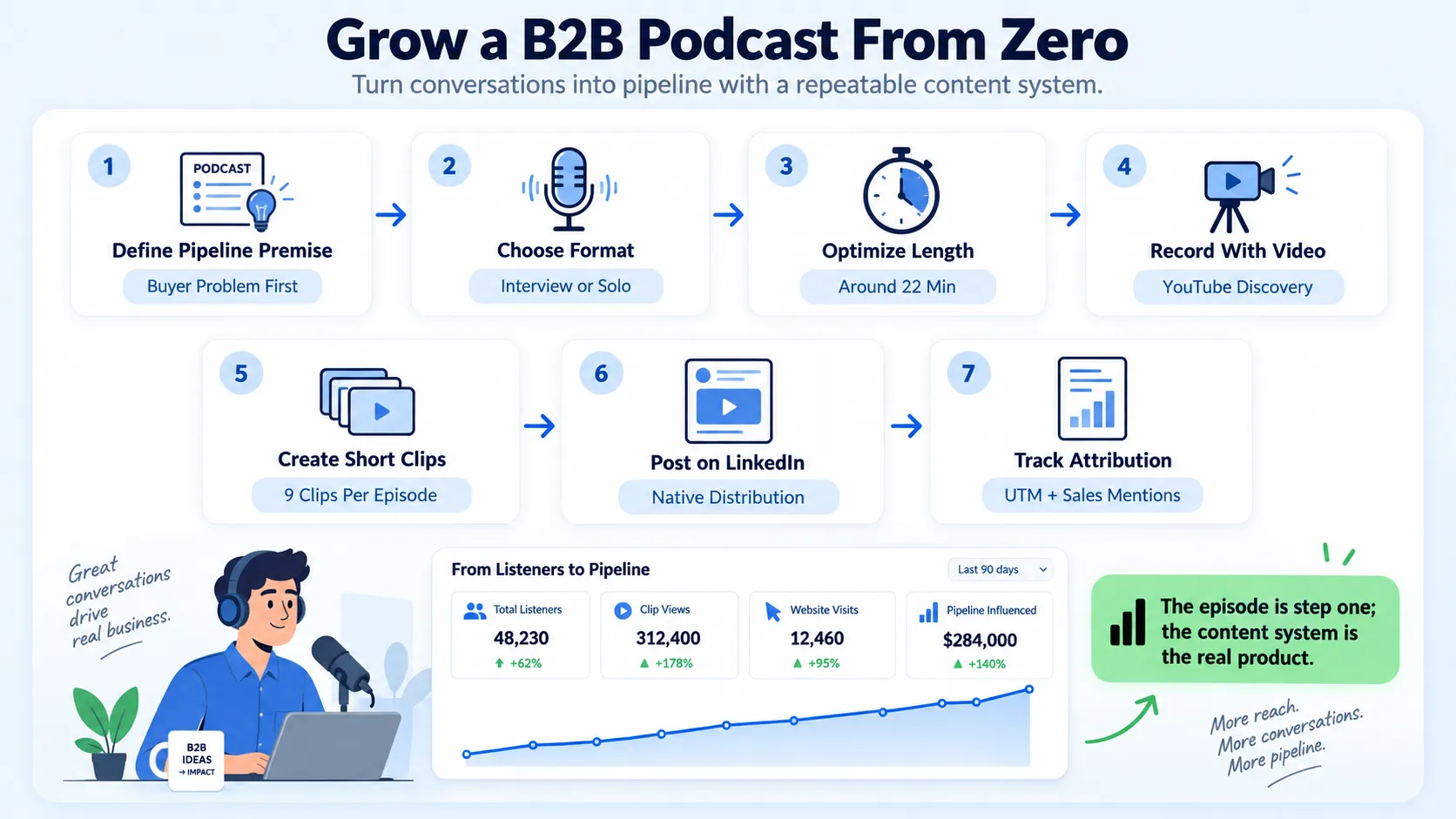
- Define a pipeline-first premise: Your show's topic should map directly to the problem your product solves. Not "industry trends", that's too broad. Think: who are your ideal buyers, and what are they trying to figure out before they buy?
- Choose your format for your goal: One-on-one interviews accelerate trust for relationship building, while solo episodes establish your unique point of view for building category authority.
- Optimize episode length: Episodes of around 22 minutes achieve 85% completion rates among C-suite listeners, versus 45% for hour-long shows.
- Record with video from day one: 44% of new podcast audiences found their first podcast through YouTube, and publishing an audio-only show in 2026 means being absent from the platform where both discovery and consumption have already relocated.
- Turn every episode into short-form clips: One recorded episode produces three clips per platform across LinkedIn, YouTube Shorts, and Instagram Reels, yielding nine pieces of distributed content from a single recording session.
- Distribute on LinkedIn natively: LinkedIn video posts are shared 20x more than other content types, which is why clips outperform static posts for reach.
- Measure with first-party attribution: Track podcast-specific UTM codes in demo request forms, note podcast mentions in sales call summaries, and build episode-specific content offers with their own landing pages.
At Komet Media, this is exactly how we approach podcast production and podcast marketing for B2B teams, whether repurposing existing footage or creating full video content systems from scratch; the content system it powers is the real product.
B2B Podcast Growth Strategies That Actually Work
Podcast Growth Trends for B2B Brands consistently reveal a gap between teams that get results and teams that just publish episodes. The gap is almost always strategy and distribution, not audio quality.
Strategies that move the needle:
- Guest-as-pipeline: Invite target accounts as guests. The average guest-to-client conversion rate on B2B podcasts is 10%, with top performers converting 48% of strategically selected guests into pipeline opportunities. A guest slot is a 45-minute sales conversation that the prospect asked for.
- Repurpose every episode into short-form video: In 2026, podcast clips are no longer promotional extras, they are the main distribution engine. At Komet Media, our short-form video editing workflow creates video content from scratch or pulls 5–8 clips per episode, each formatted for LinkedIn, YouTube Shorts, and Instagram Reels.
- Align episodes to Account-Based Marketing (ABM) plays: Build episodes around the exact pain points of the accounts your sales team is working. Use that episode as a warm outreach asset.
- Publish Podcast SEO assets: Turn every episode into a detailed blog post, podcast show notes, and a podcast transcription. This drives organic discovery via Podcast SEO and feeds demand generation funnels with high-intent content.
- Prioritize LinkedIn Ads retargeting: Run short clips as LinkedIn Ads to warm audiences. Buyers who've already heard your thinking in a 3-minute clip are far easier to convert with a demo offer.
- Measure shows that prioritize guest relationships: According to Fame's analysis of 100+ B2B podcasts, shows that prioritize guest relationships over audience size generate 25–50% higher ROI within the first year.
B2B companies running a podcast see an average of 20–30% higher engagement on LinkedIn and other digital platforms, compared to those that rely solely on written content. That lift compounds when you combine the long-form show with a short-form distribution system.
Common Mistakes B2B Brands Make When Starting a Podcast
Most B2B podcasts fail quietly. They launch, publish 8–12 episodes, see flat download numbers, and stop. Here's what goes wrong:
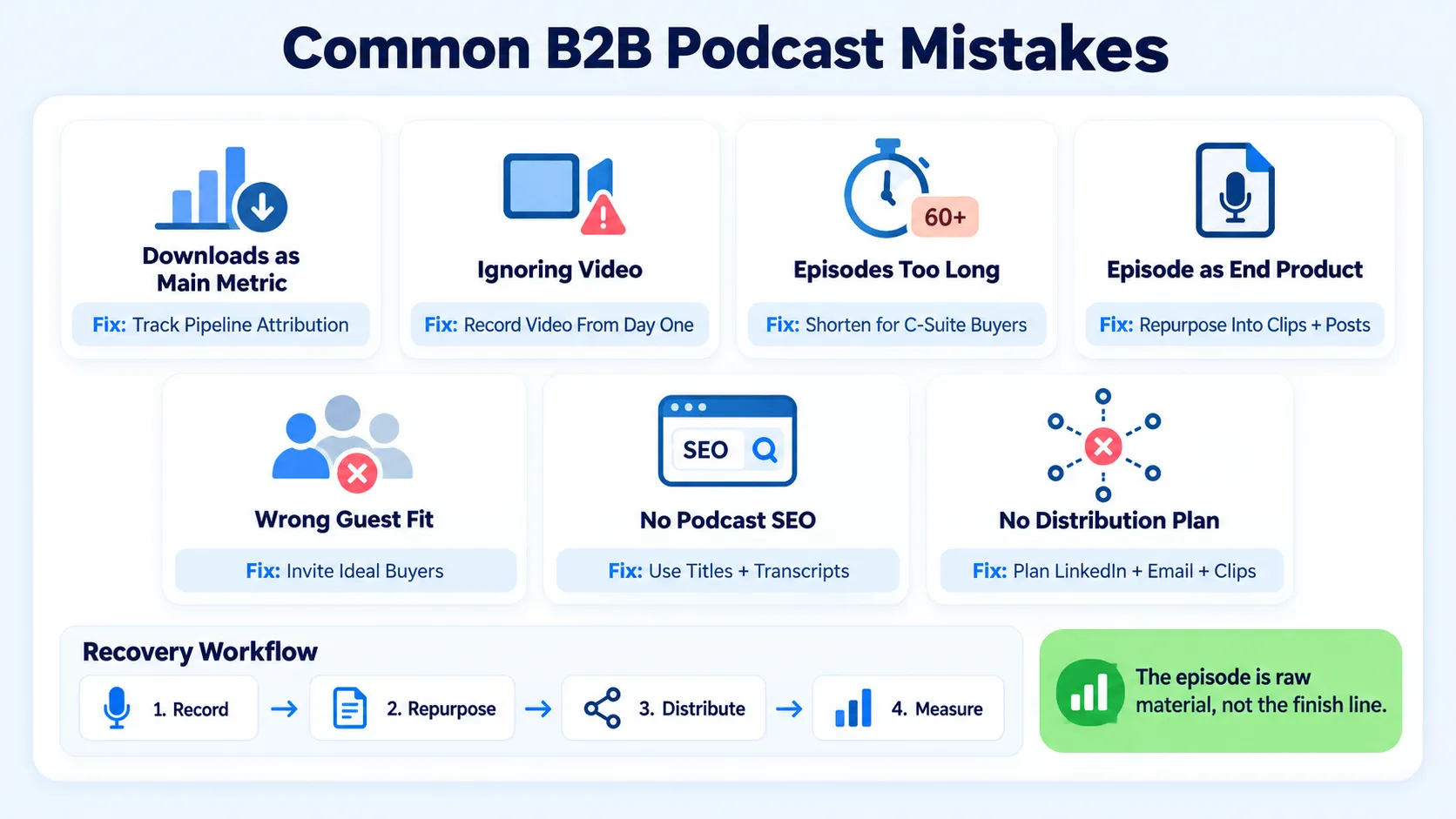
- Tracking downloads as the primary metric: Downloads are reach, not revenue. 87% of B2B podcasts generate zero attributable pipeline due to lack of proper measurement frameworks. Without UTM tracking, CRM tagging, and self-reported attribution in sales calls, the show's real impact stays invisible.
- Ignoring video: Research suggests that users who watch video podcasts consume 1.5x more content than those who just listen. An audio-only launch in 2026 misses the primary discovery channel.
- Episode lengths mismatched to audience: C-suite buyers don't finish 60-minute episodes. Shorter episodes build trust and complete listenership. If your completion rate is under 50%, the show is too long or the topic isn't focused enough.
- Treating the episode as the end product: The episode is raw material. Without a video editing services workflow that turns each episode into clips, posts, and search-optimized written assets, you're capturing a fraction of the available value.
- Choosing guests for audience size, not strategic fit: Inviting guests with large followings but no overlap with your ICP generates vanity downloads. Inviting 20 ideal buyers as guests generates pipeline.
- No Podcast SEO strategy: Titles, descriptions, and transcripts all feed search engines. Platforms like Spotify for Podcasters and Podbean surface shows based on keyword relevance. Teams using Riverside.fm to capture clean audio and video also get better raw assets for repurposing.
- Skipping distribution planning: Publishing to RSS feed alone and hoping Anchor FM or Podbean algorithms do the work is not a strategy. Active distribution, clips, LinkedIn posts, podcast marketing, email sequences, is what builds audiences.
Conclusion
Podcast Growth Trends for B2B Brands point in one direction: this is no longer an experimental channel. The audience, the engagement depth, and the pipeline data all confirm that B2B podcasting is now core infrastructure for serious growth teams.
Key takeaways:
- The global audience reaches 619 million in 2026, with B2B decision-makers listening daily at rates that dwarf other content formats.
- Completion rates, trust metrics, and guest-to-client conversion benchmarks all favor podcasting over blogs, display, and most paid channels.
- The teams winning are those combining long-form episode depth with a short-form video repurposing system that distributes across LinkedIn, YouTube, and beyond.
- Measurement is the unlock: without attribution frameworks, even the best show generates invisible pipeline.
If you're ready to build a system that turns podcast content into buyer trust and demo demand—whether from existing recordings or built completely from scratch—explore Komet Media's podcast production and video services.
Frequently Asked Questions
Q1: How many B2B decision-makers actually listen to podcasts?
75% of B2B decision-makers listen to podcasts, with 51% listening daily. 83% of senior executives reported listening to a podcast in the past week. The audience quality and attention depth make podcasting one of the strongest channels for reaching buying committees.
Q2: What is a good episode completion rate for a B2B podcast?
If you're consistently hitting 50%+ completion, you're in a strong position. Branded podcasts achieve up to 90% completion rates, compared to 60–70% for typical B2B podcasts. Aim for tighter, more focused episodes to push that number up.
Q3: How does podcasting compare to blogging for B2B pipeline?
Podcasting drives 25x more conversions than blogs and produces 2.7x higher close rates from podcast-engaged leads. The key difference is attention depth and the parasocial trust that builds over multiple episodes of listening.
Q4: What platforms should B2B brands distribute their podcasts on?
Start with Spotify for Podcasters and Apple Podcasts via RSS feed, but prioritize YouTube. YouTube was the most-used podcast platform among weekly consumers in 2025 at 41%, followed by Spotify at 25% and Apple Podcasts at 11%. LinkedIn native video clips are equally critical for B2B reach.
Q5: How quickly can a B2B podcast generate pipeline results?
Shows that prioritize guest relationships over audience size generate 25–50% higher ROI within the first year. Using target accounts as guests and tracking self-reported attribution in sales calls is the fastest path from episode to pipeline.
Q6: Do B2B brands need video for their podcast, or is audio enough?
Video, even a single locked-off camera, is no longer optional if you want the audience to grow. Vodcast viewers consume 1.5x more content than audio-only listeners, and YouTube is now the dominant discovery platform. Audio-only limits both reach and repurposing potential.