
🪄 AI Summary
Heading 1
Heading 2
Heading 3
Heading 4
Heading 5
Heading 6
Lorem ipsum dolor sit amet, consectetur adipiscing elit, sed do eiusmod tempor incididunt ut labore et dolore magna aliqua. Ut enim ad minim veniam, quis nostrud exercitation ullamco laboris nisi ut aliquip ex ea commodo consequat. Duis aute irure dolor in reprehenderit in voluptate velit esse cillum dolore eu fugiat nulla pariatur.
Block quote
Ordered list
- Item 1
- Item 2
- Item 3
Unordered list
- Item A
- Item B
- Item C
Bold text
Emphasis
Superscript
Subscript
Most B2B teams record hours of valuable content, demos, podcasts, webinars, founder interviews, and then let it sit. One long-form video can fuel an entire quarter of social content, but only if you know how to extract it correctly. This guide covers the exact workflow I use at Komet Media to repurpose long-form video into short clips that drive buyer education, demo demand, and pipeline, without starting from scratch every week.
TL;DR
- One long-form video can generate 10–20 short clips across LinkedIn, YouTube Shorts, and Reels.
- The best tools for automated clip extraction in 2026 are Opus Clip, Descript, and CapCut.
- Repurposing works best when clips are formatted natively for each platform, not just trimmed.
- B2B teams that repurpose consistently compound visibility without compounding content spend.
How to Repurpose Long-Form Video into Short Clips: The Core Workflow
Repurposing is not editing. It is a deliberate strategy to extract the highest-value moments from long-form content and reformat them for short-form distribution. Here is the exact workflow I follow with every client.
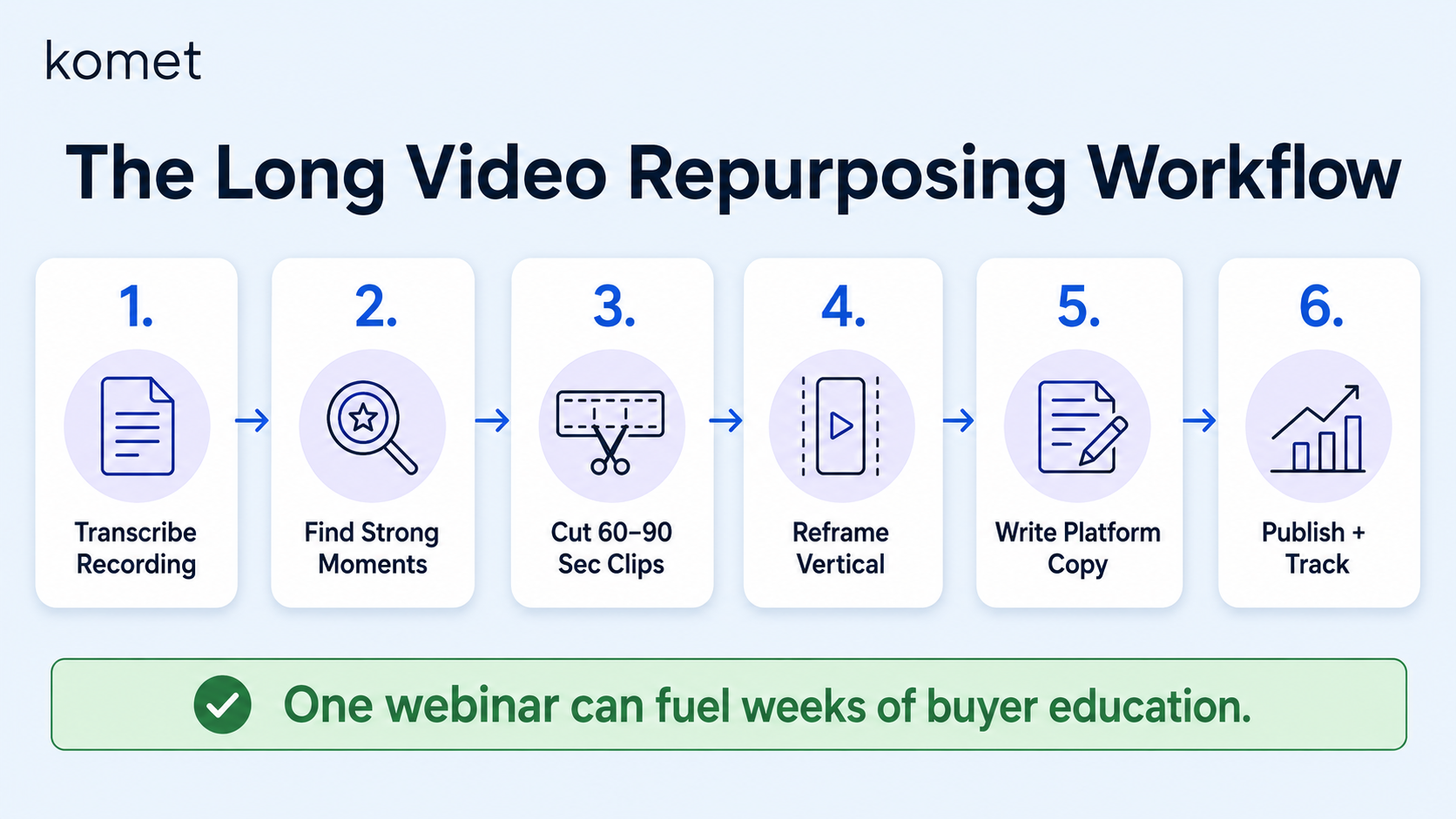
Step 1: Transcribe the full recording. Upload your video to Descript or Riverside.fm. Both generate accurate transcripts automatically. The transcript becomes your map, you scan it for strong quotes, clear explanations, and sharp moments rather than rewatching the full video.
Step 2: Identify clip-worthy moments. Look for segments that do one of the following:
- Answer a specific buyer question
- Contain a counterintuitive or surprising claim
- Demonstrate the product in action
- Feature a strong founder or executive POV
- Tell a short story with a clear outcome
Step 3: Extract clips at 60–90 seconds. Shorter clips (under 30 seconds) work for hooks and awareness. Clips between 60–90 seconds perform well for education and trust-building on LinkedIn and YouTube Shorts.
Step 4: Reformat for vertical. Export at 9:16 for Reels, TikTok, and YouTube Shorts. Use CapCut or Adobe Premiere Pro to add captions, reframe the speaker, and adjust the frame. Captions are non-negotiable, a significant portion of social video is watched without sound.
Step 5: Write platform-native copy. The clip caption on LinkedIn is not the same as a YouTube Shorts title. Write copy that fits the platform's context, not a generic description of what the video contains.
Step 6: Publish and track. Distribute across platforms on a consistent schedule. Track which clip types drive the most engagement, saves, and (for B2B) inbound messages or demo requests.
A single 45-minute webinar, processed correctly, can yield 12–18 clips that feed content calendars for 6–8 weeks without producing any new raw footage.
This is the content multiplication framework that separates teams who are always behind on content from those who consistently show up in their buyers' feeds.
Best Tools for Cutting Long Videos into Social Media Clips in 2026
Choosing the right tool depends on your team's technical comfort, output volume, and budget. Here is how the leading options compare.
Opus Clip is currently the strongest tool for automated clip extraction at scale. It uses AI to score moments based on engagement potential, then exports clips with captions already applied. Opus Clip's own documentation on YouTube Shorts at scale demonstrates how the tool handles batch processing for high-volume teams.
Descript is the tool I rely on most for B2B work. Editing the transcript edits the video directly, which means you can cut dead air, filler words, and off-topic tangents without touching a timeline. For founders or executives who are not comfortable in traditional editing software, Descript dramatically lowers the barrier.
CapCut is the best free option for formatting and captions. It handles 9:16 reframing quickly and its auto-caption tool is accurate enough for most use cases without manual correction.
Adobe Premiere Pro remains the standard for teams that need broadcast-quality output or complex motion graphics, but it is not the fastest tool for high-volume short-form work.
For a practical breakdown of how to move from a long YouTube video through to published clips, this workflow guide from Write With AI mirrors the approach I use with Komet Media clients.
How to Turn a Podcast or Webinar into Short-Form Clips
Podcasts and webinars are the richest source material for B2B clip extraction because they are already structured around ideas, questions, and expertise. The challenge is that most of the content inside them is not clip-ready in its raw form.
Here is how to process podcast and webinar recordings effectively:
- Record in a clip-friendly format: Use Riverside.fm to record separate tracks for each speaker. This gives you clean audio and individual video feeds to work with in post.
- Transcribe and scan first: Do not watch the recording linearly. Transcribe it, then scan the text for moments that meet clip criteria: strong claims, clear teaching, specific numbers, or moments of tension or surprise.
- Prioritize education-first clips for B2B: Webinar audiences are already interested in the topic. Clips that extract a single clear lesson or answer a specific question perform well because they deliver value in under 90 seconds.
- Cut the intro: Most webinars and podcasts spend the first 3–5 minutes on housekeeping. None of that belongs in a clip. Start every clip at the moment the value begins.
- Add context in the caption: A clip pulled out of a longer conversation needs framing. Use the caption or a text overlay to tell viewers what they are about to learn and why it matters.
- Repurpose the Q&A separately: The audience questions section of a webinar is often the most valuable content. Each question-and-answer pair is a self-contained clip. A 60-minute webinar with 20 minutes of Q&A can yield 8–12 standalone clips from that section alone.
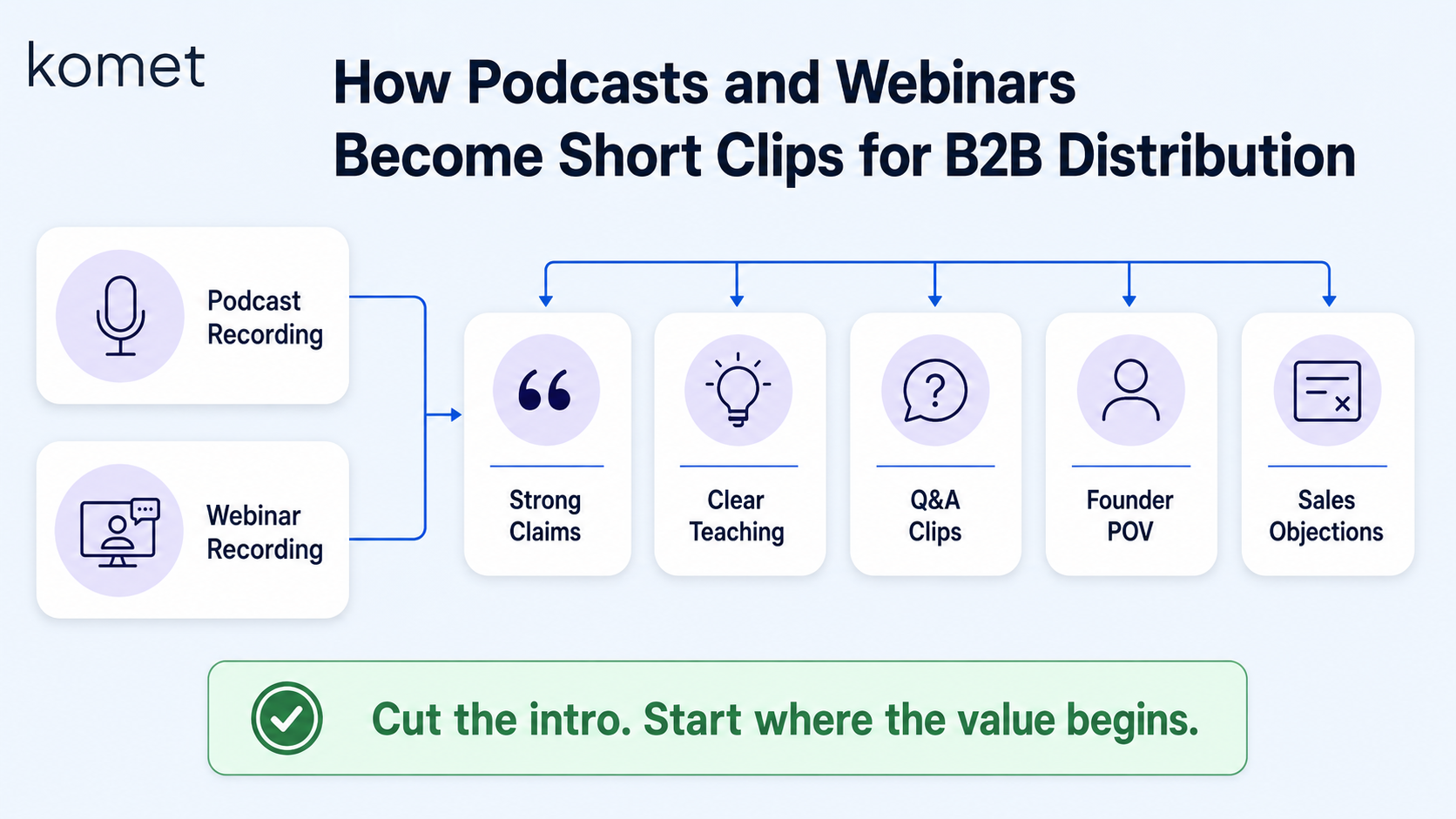
For VC and PE firms, webinar recordings from LP updates, portfolio company showcases, or founder panels are particularly powerful source material. These already contain the credibility signals, specific thinkers, real deals, verified outcomes, that build trust with sophisticated buyers and limited partners.
Video Content Strategy for Venture Capital and Investment Firms
Most VC and PE firms underuse video. They have access to extraordinary source material, partner conversations, portfolio founder interviews, thesis presentations, market analysis sessions, and the content rarely leaves the room it was recorded in.
Short-form video built from this material does three things that written content cannot:
- It makes partners and principals visible and recognizable to LPs, co-investors, and founders before a meeting ever happens.
- It demonstrates pattern recognition and sector expertise in a format that is faster to consume than a white paper.
- It creates social proof at scale without requiring new commitments of time from senior team members.
What works for VC and PE firms on social video:
- Partner takes on market conditions (60–90 seconds, direct to camera or pulled from a longer recording)
- Portfolio founder spotlights extracted from longer interviews
- Investment thesis explanations framed as buyer education
- "Why we invested" clips that surface deal logic and pattern recognition
- Fund milestones and announcements reformatted for LinkedIn
Platform priority for investment firms: LinkedIn is the primary channel. YouTube Shorts builds secondary discoverability. Most VC and PE audiences are not on TikTok professionally, so I do not prioritize it for this segment.
Cadence: Three to five short clips per week is achievable from a single monthly recording session. That is a consistent presence without demanding ongoing time from busy partners.
The firms seeing the strongest inbound results in 2026 are treating their partners as media assets, not just investment professionals. Short-form video is the vehicle that makes that positioning visible to the market.
How to Get More ROI from Long-Form Video Content
The ROI problem with long-form video is not production cost. It is the distribution depth. Most teams publish once to one platform, then move on. The content lifecycle ends at upload.
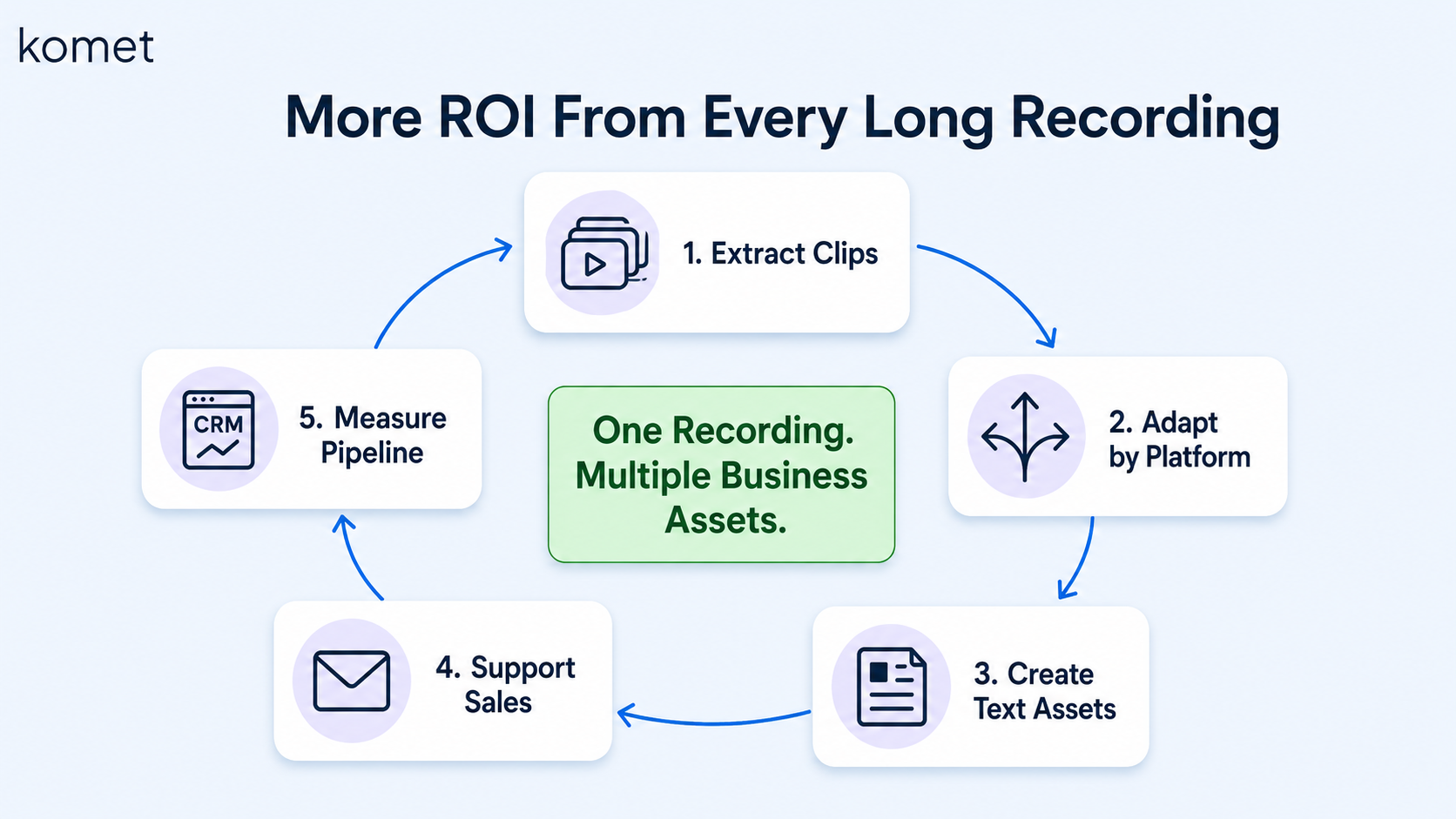
A content lifecycle management approach changes that equation:
Extraction layer: Pull 10–20 clips per long-form recording. Each clip targets a different moment, angle, or audience segment.
Distribution layer: Each clip goes to a different platform with platform-native formatting and copy. The same clip posted identically across LinkedIn, Instagram, and YouTube Shorts will underperform on all three. Adapt the caption, the hook, and sometimes the trim length.
Text layer: Use the transcript to generate companion assets, a LinkedIn article, a blog post, a newsletter section, or a sales email. These assets extend the reach of the same content to text-first audiences.
Sales enablement layer: The most useful clips for pipelines are not always the ones with the highest engagement. A clip that clearly explains a product differentiator or handles a common objection belongs in your sales team's outreach toolkit. Short video in sales sequences consistently outperforms static text when it addresses a specific buyer concern.
Measurement layer: Track which clip types correlate with downstream pipeline activity, not just views. For B2B teams, the right metric is not reach, it is whether the content is reaching the right buyers and moving them toward a conversation.
Teams that treat video repurposing as a system rather than a task consistently generate more pipeline per hour of content produced than teams that rely on one-off publishing.
What Makes Komet Media's Repurposing Approach Different for B2B SaaS and Tech Teams
Most video editing services clip and export. Komet Media does not operate that way. The work is built around pipeline outcomes, not production volume.
Here is what differentiates the approach for B2B SaaS and funded tech startups specifically:
Product knowledge extraction: SaaS teams accumulate product knowledge in demos, onboarding calls, and feature walkthroughs that buyers never see. We identify those moments and turn them into buyer education clips that reduce time-to-trust.
Founder-led growth as a system: Founder thinking is one of the highest-trust content types in B2B. We extract it from recordings, format it for LinkedIn, and build a consistent presence that compounds over time without requiring the founder to create net-new content every week.
Sales-aligned clip selection: We work with sales teams to identify the objections, questions, and comparisons that come up most in deals, then prioritize clips that address those directly. Content that supports the pipeline is weighted above content that performs algorithmically.
Competitors like Motionvillee, Vidpros, TastyEdits, and ShortVids offer strong production capacity for general short-form content. The gap is strategic alignment; they clip and deliver, but do not connect the output to pipeline metrics, demo demand, or buyer education objectives.
For B2B SaaS and funded tech teams, volume without strategy produces noise. The goal is fewer, sharper clips that reach the right buyers at the right stage of the purchase process.
Conclusion
Repurposing long-form video is one of the highest-leverage content activities available to B2B teams in 2026.
- One recording session can power weeks of consistent distribution across LinkedIn, YouTube Shorts, and Reels.
- The right tools (Opus Clip, Descript, CapCut, Riverside.fm) remove most of the production friction.
- Clip selection should be driven by buyer education and pipeline goals, not just engagement metrics.
- Firms and SaaS teams that build this as a repeatable system consistently outpace those treating video as a one-time effort.
If you have long-form content sitting unused, the opportunity cost of not repurposing it compounds every week.
Frequently Asked Questions
Q1: How many short clips can you get from one long-form video?
A 45–60 minute recording typically yields 10–20 clips depending on content density. Webinars and founder interviews tend to produce more clip-worthy moments than demos. Start by scanning the transcript rather than rewatching the full recording to identify candidates faster.
Q2: What is the ideal length for a repurposed short clip in 2026?
For LinkedIn and YouTube Shorts, 60–90 seconds is the sweet spot for education and trust-building. Under 30 seconds works for hooks, announcements, and pattern-interrupt content. Clips over 2 minutes perform better on YouTube as standalone content rather than Shorts.
Q3: Do I need expensive equipment to record clip-worthy long-form content?
No. Riverside.fm produces broadcast-quality recordings from a standard webcam and browser. Clean audio matters more than visual production quality. A decent USB microphone and a stable internet connection are sufficient for most B2B video content.
Q4: How is Komet Media different from a standard video editing subscription service?
Komet Media selects and edits clips based on pipeline and buyer education goals, not just production throughput. Services like Vidpros and TastyEdits handle high-volume editing efficiently. Komet Media aligns clip selection and distribution strategy to what moves buyers forward in the sales process.
Q5: Which platforms should B2B SaaS teams prioritize for short-form video?
LinkedIn is the primary channel for most B2B SaaS audiences. YouTube Shorts adds search discoverability. Instagram Reels works for founder-brand visibility with a broader audience. TikTok is a lower priority for SaaS unless your buyers are active there professionally.
Q6: How often should a B2B team be publishing repurposed video clips?
Three to five short clips per week creates consistent platform presence without requiring new recordings every week. One strong recording session per month, processed through a repurposing workflow, is typically enough to sustain that cadence across multiple platforms.