
🪄 AI Summary
Heading 1
Heading 2
Heading 3
Heading 4
Heading 5
Heading 6
Lorem ipsum dolor sit amet, consectetur adipiscing elit, sed do eiusmod tempor incididunt ut labore et dolore magna aliqua. Ut enim ad minim veniam, quis nostrud exercitation ullamco laboris nisi ut aliquip ex ea commodo consequat. Duis aute irure dolor in reprehenderit in voluptate velit esse cillum dolore eu fugiat nulla pariatur.
Block quote
Ordered list
- Item 1
- Item 2
- Item 3
Unordered list
- Item A
- Item B
- Item C
Bold text
Emphasis
Superscript
Subscript
You just closed your round. Buyers and investors are watching. The window to own your narrative is short, and most funded teams waste it on press releases nobody reads. A LinkedIn video strategy for funded startups is the highest-leverage move you can make right now, turning your funding moment, your product knowledge, and your founder's voice into a compounding pipeline asset.
TL;DR
- LinkedIn native video hits a 5.60% average engagement rate in 2026, outperforming every static format.
- Founder-led video outreaches company-page posts by roughly 7x in organic impressions.
- Post 3–4 times per week; dedicate 1–2 slots specifically to video.
- Use your funding announcement, demo clips, webinar cuts, and founder POV takes as core content pillars.
Why LinkedIn Video Is the Right Channel for a Funded Startup Right Now
Funded startups occupy a brief, powerful moment: credibility is high, attention is available, and the narrative is still unwritten. LinkedIn is where your buyers, future hires, and investors are already evaluating you, and video is the format that holds their attention longest. Native video (30–90 seconds) averages a 5.60% engagement rate on LinkedIn in 2026, and video views grew 36% year-over-year.
That is a format getting more competitive, not less. The window to own a share of voice in your category through video is open now. The algorithm changes matter here too. LinkedIn's 360Brew system, announced in March 2026, replaced the entire content ranking model. It reads content semantically, evaluates topical authority based on posting history, and weights dwell time, saves, and comment depth over raw engagement volume.
In plain terms: the platform now rewards expertise, not noise. That shift benefits funded founders who have something real to say. The algorithm uses semantic analysis to evaluate the "helpfulness" of content, looking for unique insights, personal experiences, and specific industry knowledge, a shift that favors B2B founders with deep expertise. The trust dynamic is equally strong.
In 2026, founder-led content is the highest trust-to-effort ratio content type available because B2B buyers trust people more than brands. Personal LinkedIn accounts generate 7x more impressions than company pages, and inbound replies from founder content convert at 14.6% versus 1.7% for outbound.
This is why a LinkedIn video strategy for funded startups should always lead from the founder's personal profile, not the company page. The math is not close.
How a Series A Startup Should Use LinkedIn Video to Build Credibility
Credibility at the Series A stage is not about broadcasting your raise. It is about using the raise as a signal that earns the right to educate your market. The buyers who see your funding announcement need a reason to keep watching. A 2024 Edelman study found that 59% of B2B buyers trust content from a company's founder more than content from its marketing team. Founder expertise carries personal credibility that corporate content does not.
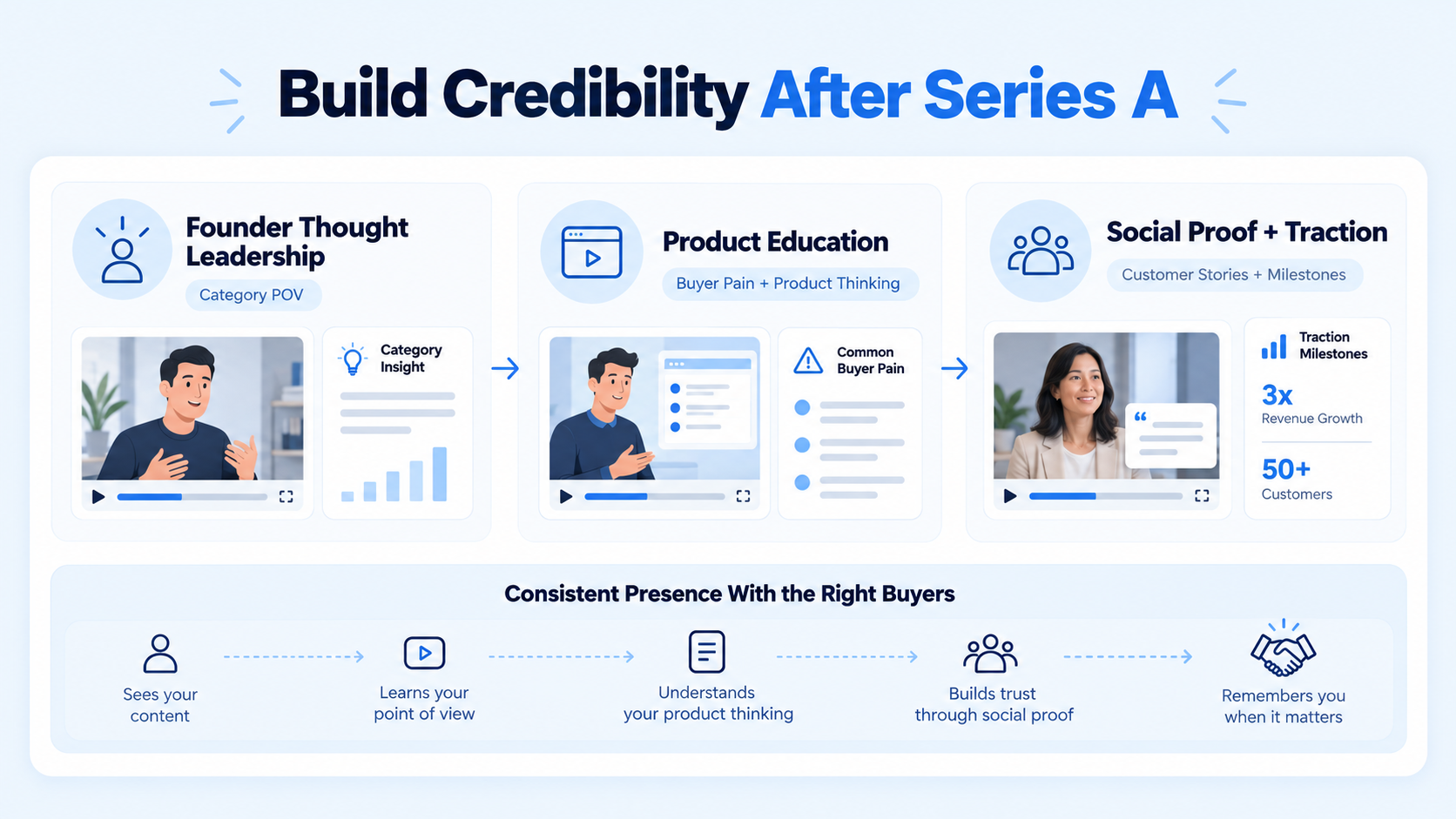
For a Series A team, credibility-building video falls into three buckets:
Bucket 1: Founder thought leadership. Short takes on the category problem your product solves. Not product demos. Opinions. Contrarian takes. Lessons from building. These posts anchor your topical authority inside the algorithm while signalling expertise to buyers before they are ready to talk to sales.
Bucket 2: Product education. Concise clips that address a specific buyer pain point and show, without a full demo, how your product thinks about the problem. Wyzowl data found that 98% of consumers watched explainer videos to learn more about a product or service, and 87% said videos had convinced them to buy products or services. Short product education clips do exactly this at scale.
Bucket 3: Social proof and traction. Customer stories compressed to 60 seconds. Metrics shared authentically. Milestone moments framed around what they mean for the buyer, not the startup. Effective B2B video on LinkedIn is not corporate or overproduced, it features named subject matter experts sharing insights in a conversational tone, driving a 40% lift in engagement compared to generic formal delivery.
At the Series A stage, the goal is not viral reach. It is a consistent presence with the right buyers so that when they enter a buying cycle, your name is already in their head.
The Best LinkedIn Video Content Types for B2B SaaS Startups After Funding
Not all video formats serve the same goal. Here is what actually moves the needle for funded B2B teams, mapped to pipeline intent:
According to the LinkedIn B2B Marketing Benchmark 2025, 41% of B2B marketers say short-form drives the highest ROI of all video formats. The highest-leverage content type for most funded SaaS teams is the webinar-to-clip pipeline. Your product demos, investor briefings, sales calls, and team all-hands are already happening. Turning those sessions into 30–90 second clips via a structured content repurposing framework means every conversation you are already having generates distribution.
LinkedIn data shows short-form video delivers a 17% lift in completion rate versus longer formats, and emotionally resonant video generates 44% higher view-through rate with 2x the completion rate versus standard video. The clip that works is not the highlight reel. It is the moment where the founder says something that makes a buyer think, "that's exactly my problem."
How to Use LinkedIn Video to Announce a Funding Round Effectively
Most funding announcements die in the press release. A video announcement cuts through because it puts a face on the news and gives buyers and investors a reason to respond rather than scroll. Here is the framework for a funding announcement video that generates signal, not just views:
- Open with the problem, not the raise: State the specific buyer problem your company exists to solve. The funding is context, not the headline.
- Announce the raise in one sentence: Amount, lead investor, and what it signals about your category, nothing more.
- Make it specific to your buyer: Tell them what the funding means for the product, the team, or the roadmap. Give them a reason to care.
- End with a question or invitation: A call-to-action that prompts comments, "What's the version of this problem your team is dealing with right now?", feeds the algorithm and starts conversations.
- Keep it under 75 seconds: Videos under 90 seconds achieve maximum completion rates, and videos under 15 seconds see 57% completion rates.
Post the video from the founder's personal profile first. Pin it. Then share it from the company page 24–48 hours later with a different caption angle focused on team or product.
Immediately after the announcement, begin a 4-week follow-up sequence: one video per week expanding on why you raised, what it means for your category, what you are building next, and what you are learning. This sustains the attention spike the announcement creates and converts curiosity into pipeline. You can explore how Komet Media builds these video sequences for funded teams if you want a ready-made system.
How Often Funded Startups Should Post Video on LinkedIn
Cadence is the most misunderstood variable in a LinkedIn video strategy for funded startups. Most teams either over-commit and burn out, or post once after the raise and disappear. For B2B lead generation, posting 3–4 times per week gives you enough frequency to stay top of mind while leaving time to engage meaningfully with comments and DMs, where the actual conversion happens.
For video specifically: the recommended frequency for video posts is 1–2 per week, given the time investment required and the high dwell time they generate. The practical cadence for a funded startup team in 2026:
Short vertical video (30–90 seconds) with captions is the format exception in 2026: vertical video reach increased 80%, while the algorithm penalises content people do not finish. The algorithm rewards accounts whose posts consistently generate engagement. Posting daily with mediocre content dilutes your engagement rate and hurts algorithm perception.
Consistency over volume. Founder-authored video twice a week, every week, compounds. Sporadic posts following the raise do not. If production capacity is the constraint, a dedicated short-form video editing partner removes the bottleneck without requiring the founder to spend time in an editing suite.
Building a Content Repurposing Framework That Scales LinkedIn Video Production
The most common reason funded startups fall off LinkedIn video is production friction or lacking existing recordings. The fix is either leveraging Komet Media's full 'from scratch' production workflow (scripting, recording guidance, and editing) or building a repurposing system that turns what you are already doing into clips.
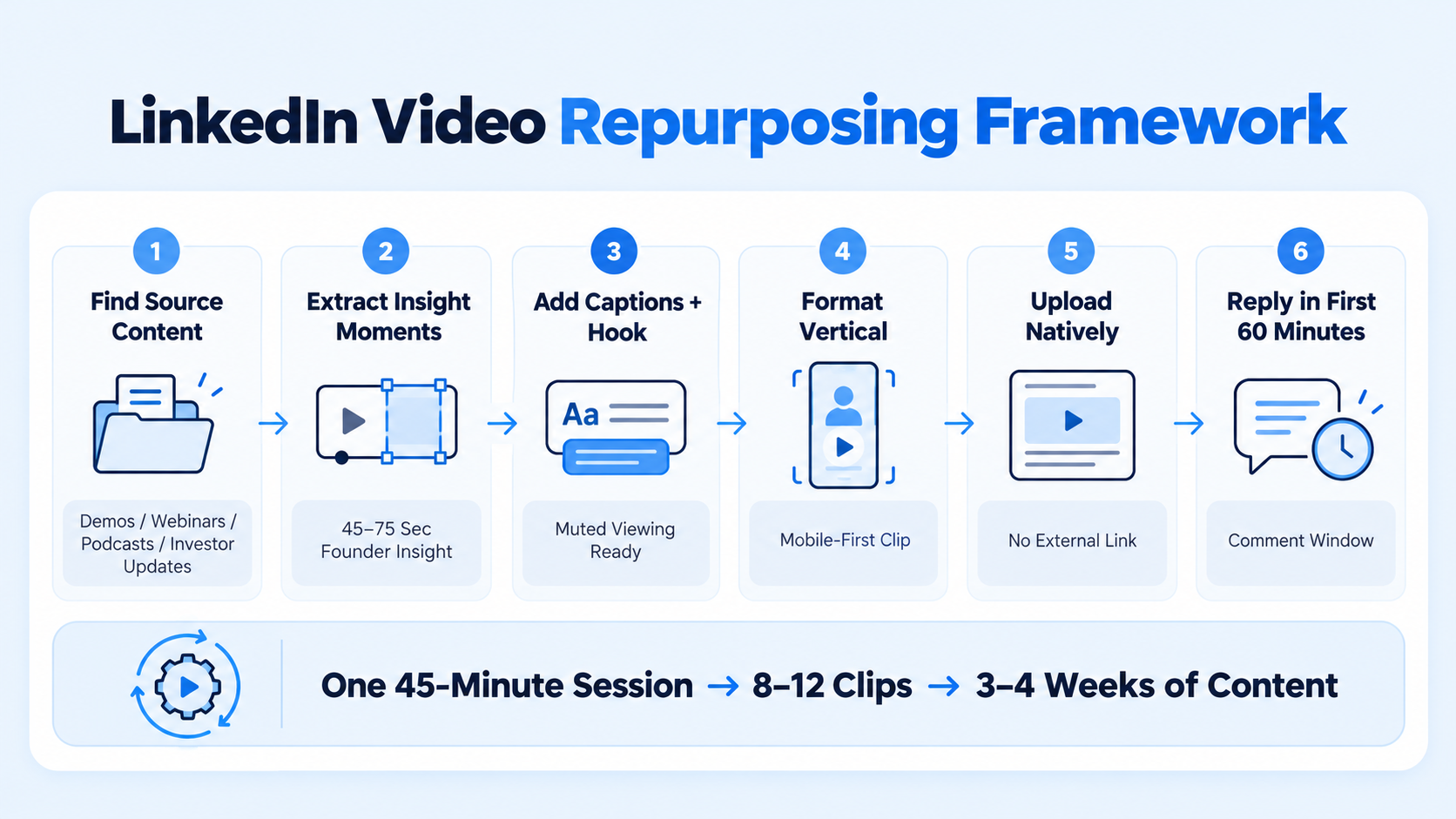
At Komet Media, the repurposing framework we run for funded teams looks like this:
- Identify long-form source content: Weekly team syncs, investor updates, sales demos, webinars, product walkthroughs, and podcasts are all raw material.
- Extract the moments of insight: The 45-second window where the founder explains the core problem in a way that resonates. These are your clips.
- Add captions and a native hook: Native videos with captions boost reach by 112%. Every clip needs a first-frame text hook because most LinkedIn video is watched muted.
- Format for vertical mobile: Vertical videos perform 80% better than horizontal formats due to LinkedIn's mobile-first algorithm, with 72% of engagement happening on mobile devices.
- Upload natively: LinkedIn penalises external video links. Native uploads receive approximately 38% higher engagement than identical content shared via external links.
- Respond to every comment in the first 60 minutes: This is the engagement window that determines algorithmic distribution.
One 45-minute webinar or podcast episode can produce 8–12 clips. That is 3–4 weeks of video content from a single session your team was running anyway. This is the production model that makes consistent video sustainable for a growth team that is also managing pipeline, hiring, and product.
A conversation recorded with a founder or portfolio operator is not just one asset, it is a YouTube video, a LinkedIn clip series, a newsletter hook, and a searchable reference piece. The stronger model is to treat each episode as source material: one conversation can become short-form clips, sales enablement snippets, an email newsletter angle, and a companion article.
Conclusion
A LinkedIn video strategy for funded startups is not a marketing nice-to-have. It is a pipeline lever, a trust signal, and a brand authority machine, if you build it around the right system.
Key takeaways:
- Lead from the founder's personal profile, not the company page, the reach advantage is 7x.
- Post 1–2 native videos per week as part of a 3–4x overall posting cadence.
- Use your funding announcement as a launch event for a 4-week video follow-up sequence.
- Build a repurposing system from webinars, podcasts, and demos, stop treating video as standalone production.
- Vertical, captioned, natively uploaded, under 90 seconds, every time.
Ready to build a video system for your funded startup? Start here with Komet Media's video services.
Frequently Asked Questions
Q1: What should a funded startup founder say in LinkedIn videos after raising funding?
Lead with the problem you are solving, not the raise itself. Use the announcement to frame the category, explain what the funding means for the product roadmap, and invite buyers into the conversation. Treat it as the start of a 4-week content arc, not a one-time post.
Q2: How long should LinkedIn videos be for a B2B SaaS startup?
The 30–90 second range averages a 5.60% engagement rate and is the strongest performing video format in 2026. Keep founder POV clips under 75 seconds and product education clips under 90 seconds for the highest completion rates.
Q3: Should the founder or the company page post LinkedIn videos?
Always start with the founder's personal profile. LinkedIn's algorithm rewards personal accounts over company pages by roughly 7x in impressions for equivalent content. Cross-post to the company page 24–48 hours later with a different caption angle.
Q4: How do we create enough LinkedIn video content without a full production team?
You can either build a repurposing system from existing webinars, demo calls, and podcasts, or use Komet Media's 'from scratch' production option. If starting from scratch with no prior footage, Komet researches your buyer, writes scripts, provides remote recording guidance, and handles full post-production. If repurposing, extract the best 45–75 second insight moments, add captions, format vertically, and upload natively. A short-form video editing service handles the production layer without adding headcount.
Q5: What is the right posting frequency for funded startup LinkedIn video in 2026?
The recommended cadence for video posts is 1–2 per week , paired with 2–3 additional text or document posts. Consistency beats volume, two strong videos per week, every week, outperforms a burst of five videos followed by silence.
Q6: How does a LinkedIn video strategy for funded startups support sales enablement?
Short product education and customer story clips give your sales team content to share during outreach, follow-ups, and proposal stages. Buyers who have already watched your founder's video arrive at demos pre-warmed, which shortens the sales cycle. 76% of B2B buyers say they would rather take a meeting with someone they already follow online.