
🪄 AI Summary
Heading 1
Heading 2
Heading 3
Heading 4
Heading 5
Heading 6
Lorem ipsum dolor sit amet, consectetur adipiscing elit, sed do eiusmod tempor incididunt ut labore et dolore magna aliqua. Ut enim ad minim veniam, quis nostrud exercitation ullamco laboris nisi ut aliquip ex ea commodo consequat. Duis aute irure dolor in reprehenderit in voluptate velit esse cillum dolore eu fugiat nulla pariatur.
Block quote
Ordered list
- Item 1
- Item 2
- Item 3
Unordered list
- Item A
- Item B
- Item C
Bold text
Emphasis
Superscript
Subscript
Most B2B teams finally commit to Instagram in 2026, then silently wonder why nothing moves. The follower count crawls. The pipeline stays flat. The content calendar gets abandoned. The platform isn't the problem. The strategy is. These are the exact Instagram Growth Mistakes for B2B Brands in 2026 that I see killing momentum for SaaS teams, funded startups, and growth-stage firms, along with what to do instead.
TL;DR
- B2B brands fail on Instagram by treating it like LinkedIn with filters.
- Posting generic brand content instead of buyer-education video is the fastest way to stall growth.
- Instagram rewards Reels, saves, and shares, not corporate announcements.
- Fix the strategy, build a content repurposing system, and watch pipeline signals improve.
Why Is My B2B Instagram Not Growing in 2026?
If your Instagram account feels stuck, you're not alone. Instagram's engagement rate dropped 24% year-over-year in 2025, falling to 0.48%. Organic reach has compressed across the board, and the brands still growing are doing so because they've adapted their approach, not because they got lucky. The mistake most B2B teams make is optimizing for the wrong signal. They track follower count and post impressions. Instagram's social media algorithm in 2026 tracks watch time, saves, shares, and DM sends.
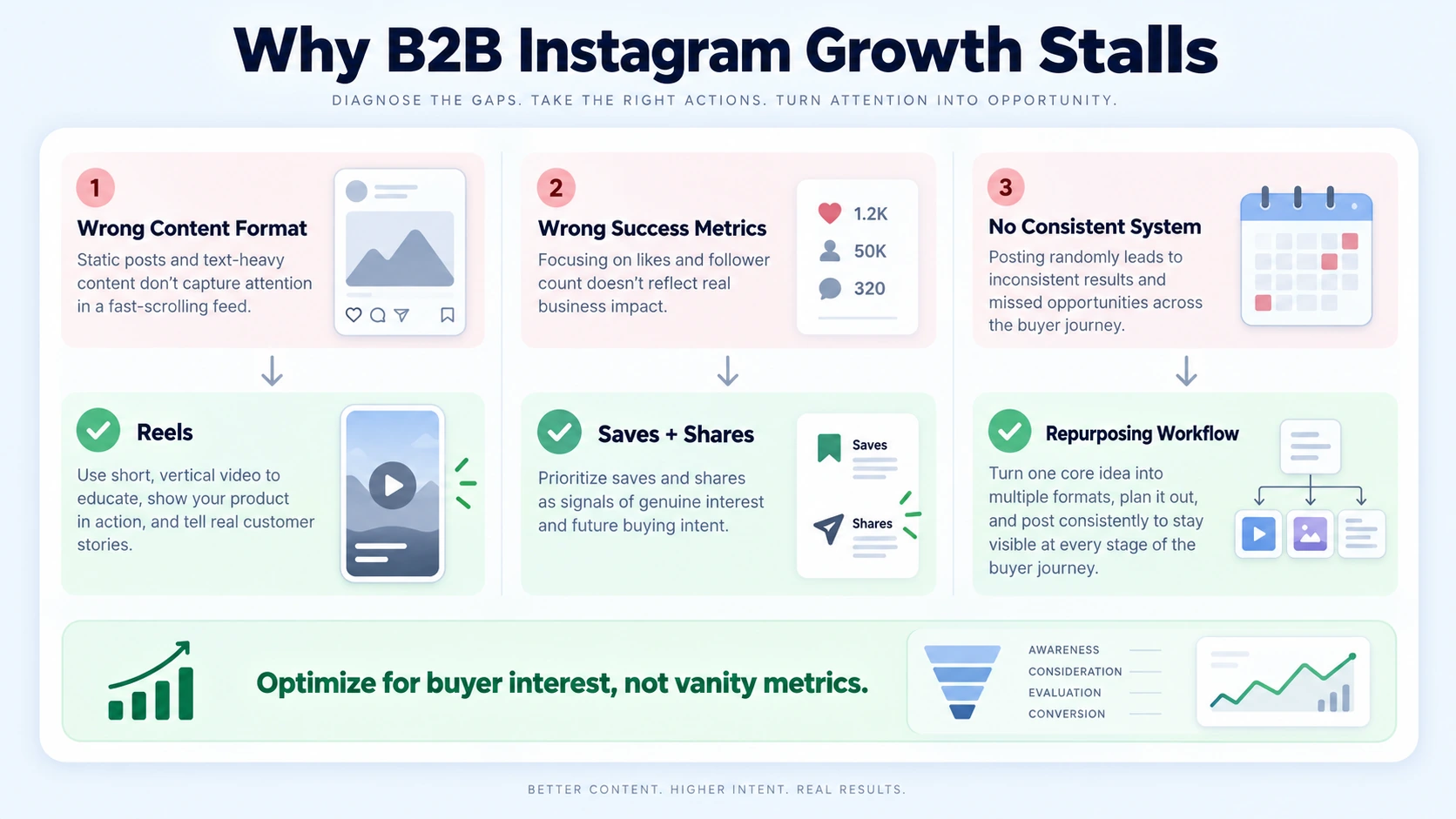
Instagram in 2026 cares less about vanity metrics and more about real interest: the platform pays closer attention to watch time, saves, and shares as signals that someone genuinely cares about your content. For a B2B SaaS brand, this means one thing: every post needs to do something useful for a buyer. Educate them. Challenge their assumption. Show your product solving a real problem. Content that a decision-maker saves to reference later is worth ten posts that collect passive likes.
The second structural issue is treating Instagram as a standalone channel. In 2026, LinkedIn and Instagram are now running neck-and-neck as the top two platforms for B2B thought leadership, according to the 2026 B2B Content Marketing Report by the Content Marketing Institute.
That means the brands winning on Instagram are using it as part of a cross-channel content repurposing framework, not in isolation. They record a webinar, clip the best 60 seconds into a Reel, repurpose the transcript into a carousel, and push both. One piece of thinking becomes five assets. That's the system that compounds.
If your Instagram isn't growing, audit these three things first: content format mix (are you posting Reels?), content intent (does each post serve a buyer?), and posting consistency. Posting 2 to 3 times per week drives an average 19% growth, while posting 10 or more times per week can boost growth by 79%, according to SocialPilot's 2026 data. Most B2B teams post once a week and wonder why the algorithm ignores them.
Mistake #1: Posting B2C-Style Content on a B2B Account
The most common Instagram Growth Mistake for B2B Brands in 2026 is copying what consumer brands do. Aesthetic product shots, inspirational quotes, and office culture posts might get likes, but they don't move a B2B buyer toward a demo. 65% of top-performing B2B posts on Instagram prominently feature products, according to Cropink's 2025 data.
For a SaaS company, that means UI screenshots, workflow walkthroughs, before-and-after use cases, and founder explainers, not stock imagery and motivational captions. B2B brands typically see 0.5–2% engagement on Instagram, while B2C brands in lifestyle, entertainment, and fashion achieve 3–10%. You will never close that gap by mimicking B2C aesthetics. You close it by making content that a CFO, a VP of Sales, or a Head of Product would stop scrolling for. Here's how B2B and B2C Instagram strategies differ at the content level:
The fix is straightforward: audit your last 20 posts. If fewer than half of them directly address a buyer pain point or show your product in action, your content calendar is misaligned. Rebuild it around your buyer persona and what they need to know before they'll take the next step.
Mistake #2: Ignoring Short-Form Video Content and Reels
Skipping Reels is the single fastest way to kill organic reach for a B2B Instagram account in 2026. Brands have already responded by shifting posting volume toward Reels, with a 33% increase year-over-year, and the brands not making that shift are getting buried. Instagram ranks Reels mainly on watch time, likes per reach, and sends per reach, per Adam Mosseri.
None of those signals come from a static graphic. A well-edited 45-second Reel showing how your product eliminates a manual workflow will always outperform a designed quote card announcing your latest feature update. Brands using Reels see 55% higher conversion rates compared to those using only static feed posts, according to RecurPost's 2026 data. For a B2B SaaS team, conversion means profile visits, bio link clicks, and DM inquiries, all of which feed the top of the conversion funnel.
The content types that work for B2B Reels specifically:
- Founder-led takes: Short, direct commentary on an industry problem. CEO content averages 2.1% engagement, above the B2B benchmark for most static formats.
- Product walkthroughs: 30–60 second clips of a specific feature solving a specific pain point.
- Repurposed webinar clips: The best 45 seconds from a webinar you already ran, captioned and edited for mobile.
- Client outcome clips: A short before/after showing what changed after a customer started using your product.
Most B2B teams already have this content buried in Zoom recordings, demo calls, and podcast episodes. They just haven't built the short-form video editing workflow to surface it. That's the gap a content repurposing framework closes.
Mistake #3: Treating Instagram as a Vanity Channel Instead of a Pipeline Asset
A 2025 B2B buyer behavior report found that 78% of software buyers research a brand's social media presence to assess technical maturity before requesting a demo. Most B2B founders treat Instagram as a nice-to-have brand channel. That's a strategic miss. Your Instagram profile isn't just a content channel. It's a trust signal that buyers check before they ever fill out a demo form. 49% of B2B marketing teams consider Instagram one of their most trusted social platforms.
That trust is being built by the brands posting consistently. It's being forfeited by the brands that post sporadically and never think about demand generation as a goal. The fix requires a mindset shift: every Reel, carousel, and Story is a sales enablement asset. Ask these questions about each piece of content before publishing:
- Does this make our product positioning clearer to a cold buyer?
- Does this show proof that our product works (client story, data, outcome)?
- Does this give a decision-maker a reason to visit our profile and click our link?
- Does this demonstrate thought leadership in our category?
If the answer to all four is no, the post isn't serving your pipeline. It's just filling the calendar. Connect your Instagram content strategy to video marketing goals, not social media goals. When the KPI shifts from "post reach" to "demo requests influenced by Instagram," the content strategy sharpens immediately.
Mistake #4: No Content Repurposing Framework Across Channels
Most B2B teams create original content for Instagram from scratch, then burn out after six weeks. The smarter approach is treating every long-form asset as a raw material. One webinar becomes eight Instagram assets. One podcast episode becomes four Reels. One founder talk becomes a full week of content.
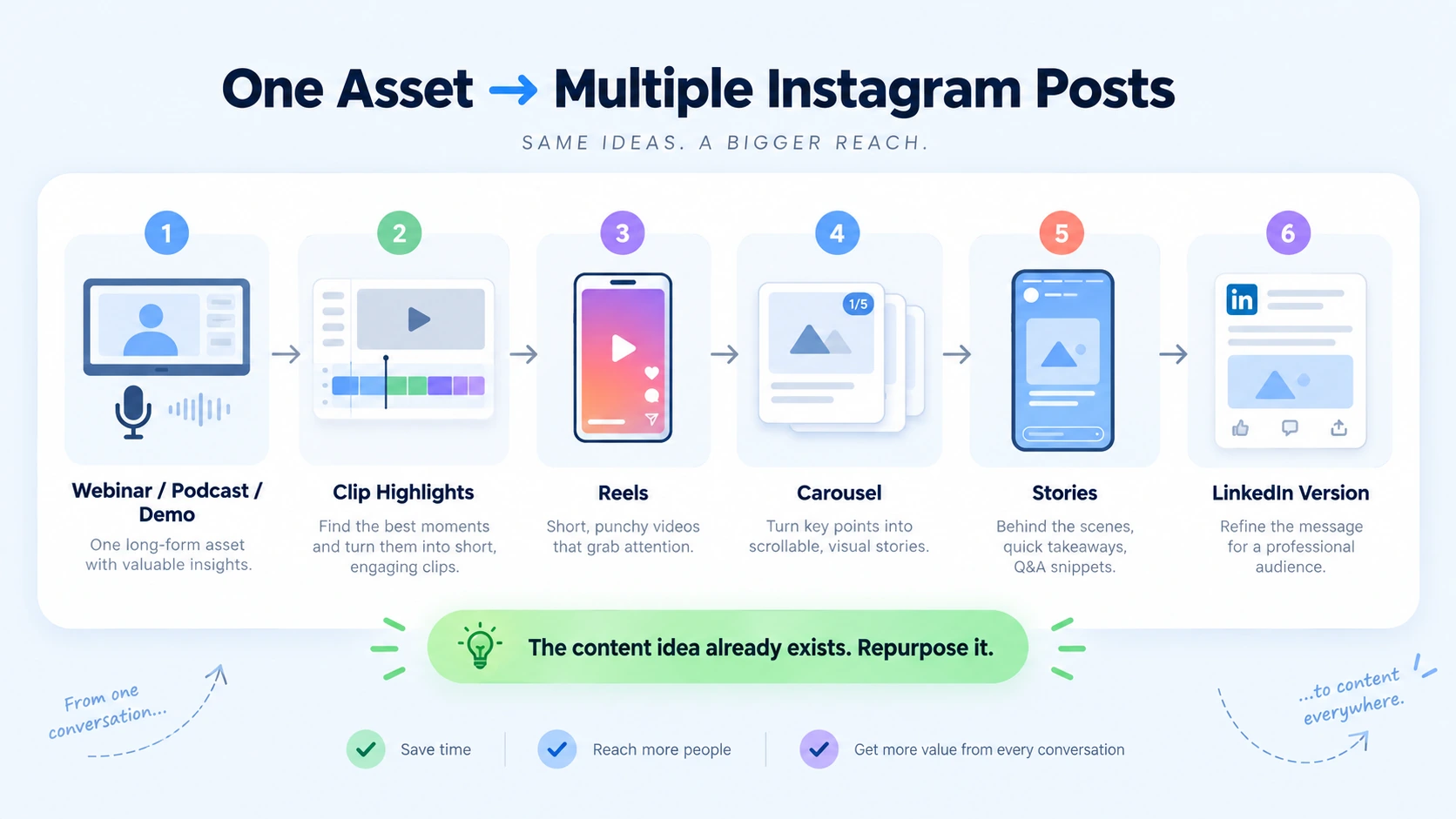
41% of B2B marketers say short-form video drives the highest ROI of any content format, according to the LinkedIn B2B Marketing Benchmark, 2025. The brands achieving that ROI aren't producing more content. They're producing smarter content that moves across formats and channels efficiently.
Here's a practical content repurposing framework for B2B Instagram:
- Record the source asset: A webinar, podcast, demo, founder talk, or client interview.
- Identify the three strongest moments: The most quotable insight, the clearest tactical point, and the sharpest opinion.
- Edit each into a 30–60 second Reel: Add captions, clean audio, and a clear hook in the first three seconds.
- Turn the full transcript into a carousel: Five to seven slides, one point per slide, the last slide with a clear call to action.
- Post one Story per week teasing new content: Drive followers to the Reel or to your bio link.
- Cross-post to LinkedIn with a different caption angle: The same insight, framed for a professional network audience using LinkedIn integration.
This system lets a team with limited bandwidth maintain a consistent content calendar without creating new ideas every week. The thinking already happened in the long-form asset. The video editing services and clipping process is what turns it into Instagram-ready content.
Mistake #5: Weak Audience Targeting and No Decision-Maker Strategy
Posting great content to the wrong audience is still a failure. This is one of the Instagram Growth Mistakes for B2B Brands in 2026 that gets the least attention, because it's invisible until you look at your follower demographics. In 2026, Millennial and Gen Z users aged 18–34 represent 63.2% of Instagram's global audience and collectively account for $4.7 trillion in annual purchasing power, per a joint Deloitte and Meta consumer behavior study released in late 2025.
That cohort includes a significant number of B2B decision-makers, especially in tech and SaaS. Your audience targeting strategy needs to reach them, not just accumulate followers from adjacent industries. Three areas where B2B audience targeting breaks down on Instagram:
- Hashtag strategy built for reach, not relevance: Using broad hashtags like #marketing or #business attracts followers who will never become buyers. Use niche, intent-specific hashtags aligned to your buyer persona.
- No Meta Business Suite audience segmentation: If you're running any paid promotion, the targeting parameters inside Meta Business Suite need to reflect your actual ICP, including job title, company size, and industry vertical.
- Follower base that doesn't include decision-makers: Track follower demographics monthly via Instagram Insights. If your audience skews toward other marketers instead of the titles you sell to, your content angle is off.
The 2025 Edelman x LinkedIn Thought Leadership Impact Report revealed that 55% of decision-makers use thought leadership as part of their vetting process. That vetting happens on Instagram too. Make sure the right people are in your audience to see it.
Mistake #6: No Founder-Led Growth or Brand Authority Content
In 2026, brand pages are losing ground to personal accounts. The Instagram social media algorithm favors authentic, human content over polished corporate posts. For B2B brands, this means one thing: put the founder on camera. According to HubSpot, 48% of marketers say Instagram delivers the highest ROI of any social platform in 2026. The brands capturing that ROI are overwhelmingly the ones with visible leaders, not faceless company accounts posting product updates.
Founder-led growth on Instagram works because:
- It builds brand authority faster than corporate content.
- Decision-makers trust people before they trust logos.
- Personal accounts have higher organic reach in the current algorithm environment.
- It creates social proof that reinforces what buyers see on your website and in sales conversations.
The content types that build the most credibility for B2B founders:
- Direct-to-camera takes on an industry problem or trend.
- Behind-the-scenes clips showing how your team solves client problems.
- Transparent stories about building the product or company.
- Short breakdowns of clients wins, anonymized or with permission.
The biggest execution mistake here is over-producing the founder content. Raw, well-lit, 45-second direct-to-camera Reels consistently outperform heavily branded, scripted videos because they feel real. Polish the editing, clean the audio, add captions. But keep the human energy intact. That's what stops the scroll for a decision-maker audience.
Conclusion
Instagram Growth Mistakes for B2B Brands in 2026 come down to one root problem: applying a B2C playbook to a B2B growth problem. Fix the strategy and the results follow.
Key takeaways:
- Post Reels consistently. The algorithm rewards short-form video content over static posts.
- Build a content repurposing framework around assets you already have: webinars, podcasts, demos.
- Treat every post as a sales enablement and buyer education asset, not a vanity metric.
- Put a founder on camera. Personal brand authority drives the pipeline better than corporate content.
Ready to build a real Instagram system for your B2B team? See what we do at Komet Media.
Frequently Asked Questions
Q1: Are B2B brands wasting time on Instagram in 2026?
No, but most are wasting effort on the wrong content. Instagram generates 20 times more engagement per post than LinkedIn for B2B companies, making it too valuable to ignore. The issue is strategy, not platform. Fix the content approach and Instagram becomes a serious pipeline channel.
Q2: How should B2B brands use Instagram differently than B2C?
B2B brands should prioritize buyer education, product demonstrations, thought leadership Reels, and founder-led content over lifestyle aesthetics. The goal is not desire creation but trust building with a decision-maker audience. Measure success with profile visits, DM inquiries, and link clicks, not likes.
Q3: What content format drives the most B2B growth on Instagram?
Reels are the top format for reach and growth. Users spend 35–39% of their total app time watching Reels, and the format pulls an average engagement rate of 2.7%, compared to 2.2% for standard video. For B2B, Reels paired with carousels in the same content calendar consistently outperform single-format strategies.
Q4: How often should a B2B brand post on Instagram?
Posting 2 to 3 times per week drives an average 19% growth, while posting 10 or more times per week can boost growth by 79%, per SocialPilot's 2026 data. For most B2B teams, 3–5 posts per week, including at least two Reels, is the right starting target.
Q5: What is the biggest Instagram mistake B2B companies make?
Treating Instagram as a brand awareness channel with no connection to the pipeline. Every post should serve a buyer: educating them, building product trust, or demonstrating an outcome. Posts that don't do at least one of those things are filling the calendar, not building the business.
Q6: Can I repurpose existing content for Instagram as a B2B brand?
Yes, and you should. Webinars, podcasts, demo recordings, and founder talks are all raw material for Reels and carousels. A solid content repurposing framework means you never need to create from scratch. Clip the insight, edit for mobile, add captions, and post. One long-form asset can fuel an entire week of Instagram content. Learn more about how we approach this at Komet Media's services page.