
🪄 AI Summary
Heading 1
Heading 2
Heading 3
Heading 4
Heading 5
Heading 6
Lorem ipsum dolor sit amet, consectetur adipiscing elit, sed do eiusmod tempor incididunt ut labore et dolore magna aliqua. Ut enim ad minim veniam, quis nostrud exercitation ullamco laboris nisi ut aliquip ex ea commodo consequat. Duis aute irure dolor in reprehenderit in voluptate velit esse cillum dolore eu fugiat nulla pariatur.
Block quote
Ordered list
- Item 1
- Item 2
- Item 3
Unordered list
- Item A
- Item B
- Item C
Bold text
Emphasis
Superscript
Subscript
A founder's channel works when it carries a specific point of view that buyers, candidates, and investors cannot get elsewhere. A YouTube strategy for founders and CEOs therefore starts with the argument, not the camera: what do you know that your market needs to hear, and how often can you say it without losing a week of your calendar? This guide covers positioning, formats, a 90-day plan, a realistic time budget, and measurement.
Quick answer
Pick one audience and three content pillars. Publish a steady mix of long-form conversations and short clips. Batch recording so it takes hours, not days, and judge results by buyer, hiring, and investor signals, not views alone.
Why YouTube belongs in a founder's plan
YouTube is both a video platform and a search engine, so a good video keeps working after the week it is published. That is the main reason a YouTube strategy for founders and CEOs can outlast a social post. That matters for founders, whose time is the scarcest asset.
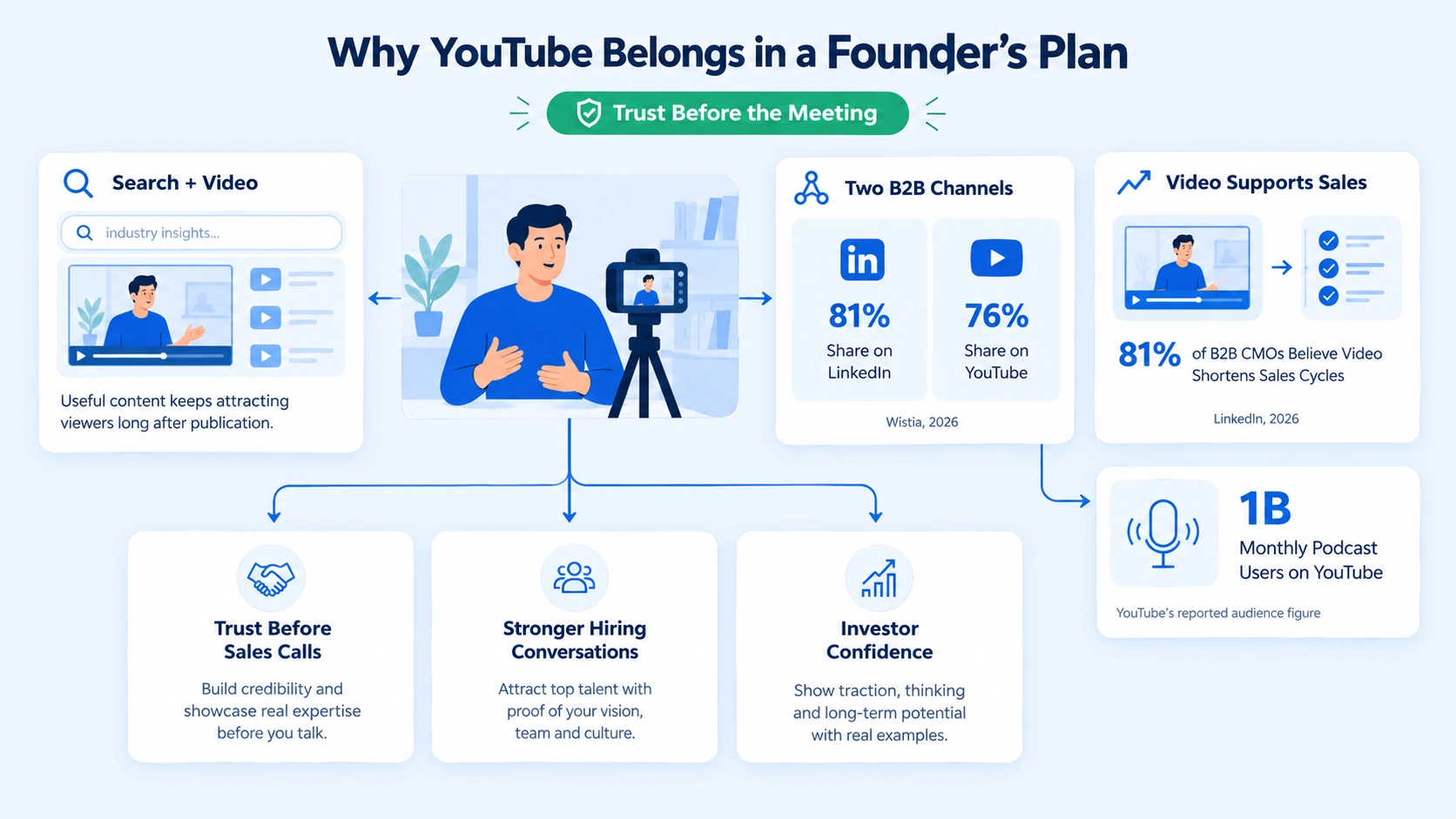
Three data points frame the decision:
- In Wistia's 2026 State of Video Report, based on a survey of more than 900 professionals plus platform data, 81% of teams said they share videos on LinkedIn and 76% on YouTube. Both are mainstream B2B channels, and they work best together.
- YouTube says its podcast content reaches one billion monthly active users. Founder interviews and conversations have a native home on the platform.
- In LinkedIn's 2026 Global B2B Marketing Outlook, 81% of B2B CMOs believed video shortens sales cycles compared with other formats. That is a belief reported in a survey of 1,299 B2B marketers fielded in January and February 2026, and it is LinkedIn's own research. Treat it as a signal, not proof.
My view: the strongest reason to build a founder channel is not reach. It is trust, built before a sales call, a hiring conversation, or an investor meeting.
Decide what the channel is for
A founder channel can serve several goals. Pick one primary goal for the first 90 days, because each goal changes the content.
For funded SaaS and AI-Native companies, sales trust and category education often come first. For a founder preparing to raise, a clear market view matters more than a product tour.
Personal channel or company channel
Founders often ask which one to build. The answer depends on who owns the message.
I usually suggest starting with one channel and one primary host. A second channel can come later, once the first has a rhythm. The related guide on building a founder personal brand engine explains how this fits with other platforms.
Pick three content pillars
A pillar is a topic you can speak about for a year without repeating yourself. Three is enough to start.
- What you believe about the market. Opinions on where the category is heading and why.
- How you make decisions. Hiring, pricing, product, and operating choices that buyers and peers can learn from.
- What customers struggle with. Real questions from sales calls and customer conversations, with names removed.
Test each pillar with one question: would a smart buyer disagree with this, and would the conversation be worth having? If the answer is no, the pillar is too safe.
Founder-led content works when the founder has something specific to say, and production quality cannot replace that.
Formats that fit a founder's schedule
A mix of long and short formats lets one recording block feed several assets.
On length, Shorts can run up to three minutes, according to YouTube Help. The same page notes that, since March 31, 2025, a Short counts a view whenever it starts or replays, with no minimum watch time, and that the older view metric now appears as "engaged views" in YouTube Analytics. That change affects how you read founder Shorts, so look at engaged views as well as total views.
For long-form, the evidence is mixed and comes mostly from vendors. In a DemandGen Report Q&A with Wistia's CEO, Wistia's 2026 data is described as showing click-through near 23% for 30 to 60 minute videos and about 1% for videos under a minute. The article does not define the metric or the sample, so I treat it as a hint that engaged viewers will watch relevant long videos, not as a benchmark to copy.
The practical lesson is to use long-form for depth and Shorts for discovery. Our piece on long-form YouTube versus short-form clips covers the trade-offs.
A realistic time budget
Founder time is the constraint, so design for it. The numbers below are planning assumptions, not benchmarks.
A good production system should give the founder a clear approval window and nothing else. In many B2B production workflows, the biggest delay is a founder who must re-explain the brief each month. A simple brief template solves most of it. Our pre-production checklist for founder videos is a starting point.
A 90-day YouTube strategy for founders and CEOs
Here is the YouTube strategy for founders and CEOs I would run for a new channel.
A few notes on how to run it:
- Set up the channel before publishing, with a clear description, a trailer or featured video, and playlists by pillar.
- Publish the first videos in a short window so new visitors find a real catalog.
- Cut clips from every long video so one recording feeds several assets.
- Review monthly and change one variable at a time.
Packaging: titles, thumbnails, and the first 30 seconds
A good video with weak packaging will not be seen. A few rules I follow:
- Title: state the specific idea or question, not a vague label.
- Thumbnail: one clear image and a few words. See our tutorial on designing thumbnails that earn clicks.
- First 30 seconds: give the claim and the reason to stay. Do not spend them on greetings or channel plugs.
- Description: include a short summary, relevant links, and a clear next step.
For more on search and discovery, read the YouTube SEO basics for B2B channels and our explainer on the YouTube algorithm and reach.
Distribution beyond YouTube
Publishing on YouTube is one step. Each video can support other channels.
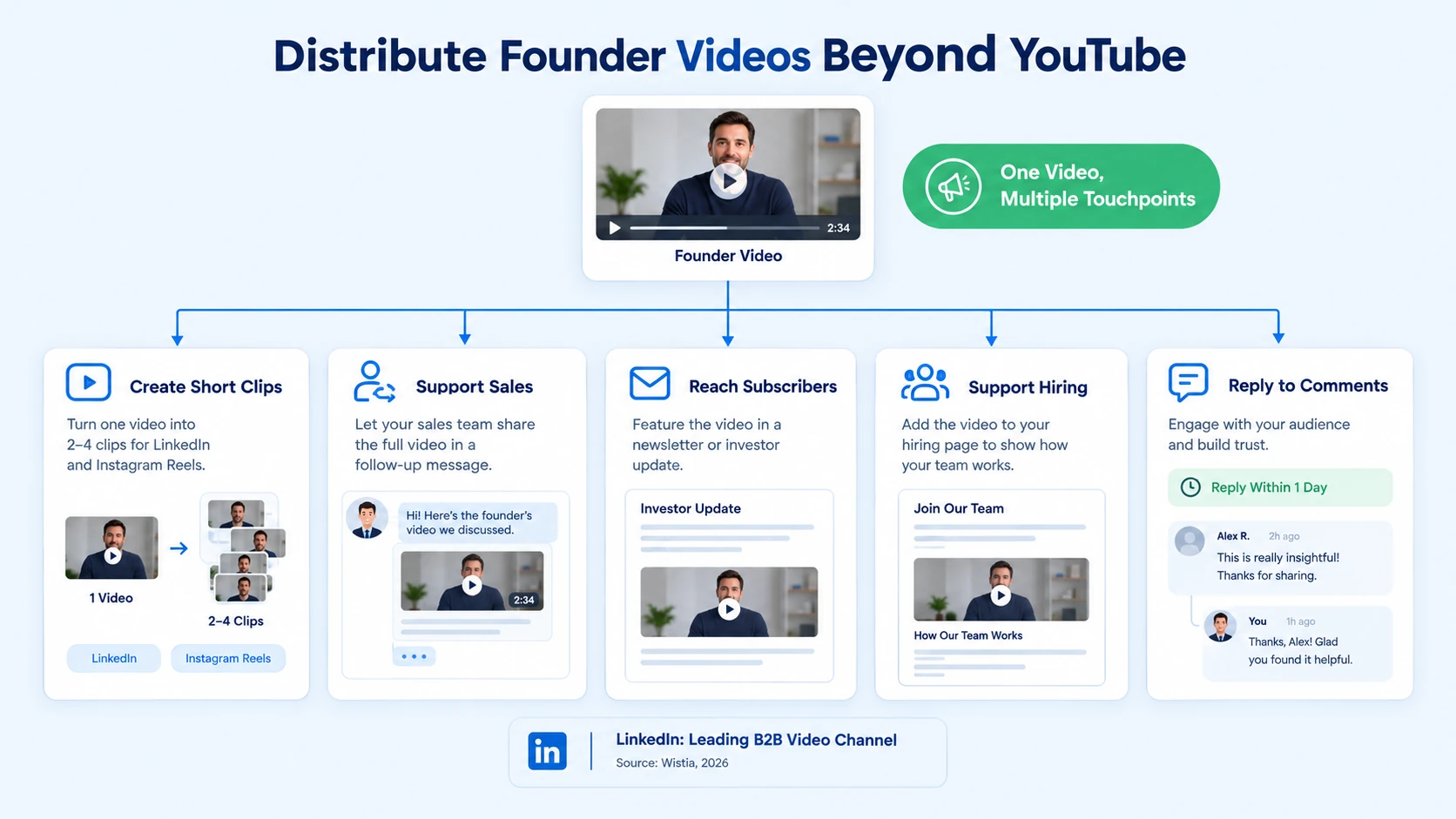
- Cut two to four clips for LinkedIn and Instagram Reels.
- Share the full video with your sales team for follow-ups.
- Include the video in a newsletter or investor update.
- Add it to a hiring page when it shows how you work.
- Reply to comments within a day, with real answers.
LinkedIn remains the most commonly used B2B video channel in Wistia's 2026 report, so cross-posting clips there is worth the effort. Our LinkedIn video strategy for founders and CEOs shows how the two channels work together.
What to measure
Wistia's report lists view counts, conversion assists, and social engagement as top success metrics, and it notes that fewer than half of marketers connect their video platform to a CRM or email tool. Use that as a reminder to measure beyond views.
Attribution will be imperfect. Use several signals together, and read our guide to video KPIs B2B teams should track for a fuller framework.
Guardrails for what a CEO says on camera
A founder channel carries more risk than a company channel, because one offhand comment is attributed to the whole business. A short set of guardrails protects the founder without making the videos stiff.
- Agree on topics that are off limits, such as unannounced products, customer names, and internal disputes.
- Do not discuss fundraising terms or financial performance on camera without checking with your counsel first.
- Get written permission before showing any customer, partner, or employee.
- Keep a short fact-check step for numbers and claims before publishing.
- Decide who can approve a video, and set a turnaround window.
These steps add a few minutes to each video. They also give the founder the confidence to speak plainly, which is what makes a YouTube strategy for founders and CEOs work in the first place.
Mistakes I see repeatedly
Founders who struggle with the channel usually repeat the same errors:
- Starting without a point of view, so every video sounds generic
- Publishing in bursts, then stopping when the calendar fills up
- Over-producing early videos and slowing the whole system
- Using the channel only for product promotion
- Ignoring Shorts and clips, so the long videos get little discovery
- Skipping review, so the channel never improves
Where a production partner helps
A founder should spend time on ideas and recording. Everything after that can be systemized, and that is where a good partner fits into a YouTube strategy for founders and CEOs. Komet Media supports this with YouTube video editing, short-form video editing, and video editing for founders and CEOs. Komet Media offers full from-scratch production options—including research, topic planning, scripting, recording guidance, and distribution—in addition to repurposing existing recordings, podcasts, or webinars. Many founders use both.
Conclusion
The point of a YouTube strategy for founders and CEOs is not to become a media company. It is to make your thinking easy to find and easy to trust. Start with one audience, three pillars, and a monthly recording block, then let the channel compound while you run the business.
FAQ
1. What is the best YouTube strategy for founders and CEOs?
Choose one audience and goal, pick three content pillars, and publish a mix of long-form conversations and short clips on a steady rhythm. Review results monthly and adjust.
2. How often should a founder post on YouTube?
Pick a rhythm that survives a busy quarter. For many founders, one long video and a few clips per week or every two weeks is realistic with delegated editing. Our guide on how often a founder should post video covers this.
3. How much does it cost to run a founder YouTube channel?
Costs depend on editing volume, motion graphics, recording support, and distribution. At Komet Media, our typical retainers run from roughly $2,500 to $5,000, depending on scope, volume, production difficulty, and turnaround. An internal approach costs staff time instead.
4. How long until a founder channel shows results?
I would plan on 90 days before judging format and topic choices. I do not have a verified benchmark for subscriber or view growth, so treat promises of fixed timelines with caution.
5. Should a founder use Shorts or only long videos?
Use both. Long videos carry depth and search value, and Shorts clips support discovery. Shorts can be up to three minutes long, so you can use longer clips when the idea needs it.
6. What should a founder talk about on video?
Talk about the market view, decision-making, and real customer problems. Our article on what founders should talk about on video goes further.
7. Should we hire an agency or run the channel with an internal team?
An internal marketer can manage planning and review. An agency or dedicated editor helps most with editing, packaging, clips, and distribution, so the founder only records and approves.
8. Does Komet Media run YouTube programs for founders and CEOs?
Yes. We work with founders, CEOs, and technology executives on YouTube editing, short-form clips, and distribution, offering both from-scratch production options (from research and scripting to recording support) and editing based on existing recordings. If you want to talk it through, you can book a call.