
🪄 AI Summary
Heading 1
Heading 2
Heading 3
Heading 4
Heading 5
Heading 6
Lorem ipsum dolor sit amet, consectetur adipiscing elit, sed do eiusmod tempor incididunt ut labore et dolore magna aliqua. Ut enim ad minim veniam, quis nostrud exercitation ullamco laboris nisi ut aliquip ex ea commodo consequat. Duis aute irure dolor in reprehenderit in voluptate velit esse cillum dolore eu fugiat nulla pariatur.
Block quote
Ordered list
- Item 1
- Item 2
- Item 3
Unordered list
- Item A
- Item B
- Item C
Bold text
Emphasis
Superscript
Subscript
Most B2B SaaS founders I talk to either dismiss YouTube Shorts entirely or dump random clips onto the platform and wonder why nothing lands. The truth is the YouTube Shorts Algorithm and Reach Explained for B2B SaaS & AI/Tech Startups is not a fluffy creator topic. It is a pipeline topic. When you understand how the algorithm distributes content, you can put your product thinking, founder POV, and buyer education directly in front of the people who sign contracts. Here is how it actually works.
TL;DR
- YouTube Shorts surfaces content based on viewer behavior, not search, and in 2026 the algorithm prioritizes viewer satisfaction, audience retention, and engagement signals over raw view counts.
- Shorts' views jumped from 70 billion to 200 billion daily, making it impossible to ignore as a discovery channel.
- For B2B SaaS and AI startups, Shorts work best as a top-of-funnel trust builder that feeds demos, webinars, and long-form content.
- The right content strategy is not volume. It is specificity, retention, and a clear buyer signal in every frame.
How Does the YouTube Shorts Algorithm Actually Work?
The YouTube Shorts algorithm tests each Short with likely viewers, then expands distribution when those viewers choose to watch, keep watching, and send positive satisfaction signals. Think of it as a tiered promotion system, not a broadcast button. The Shorts algorithm operates separately from the regular YouTube algorithm and tests fresh content with smaller audiences before successful videos reach broader viewership over time.
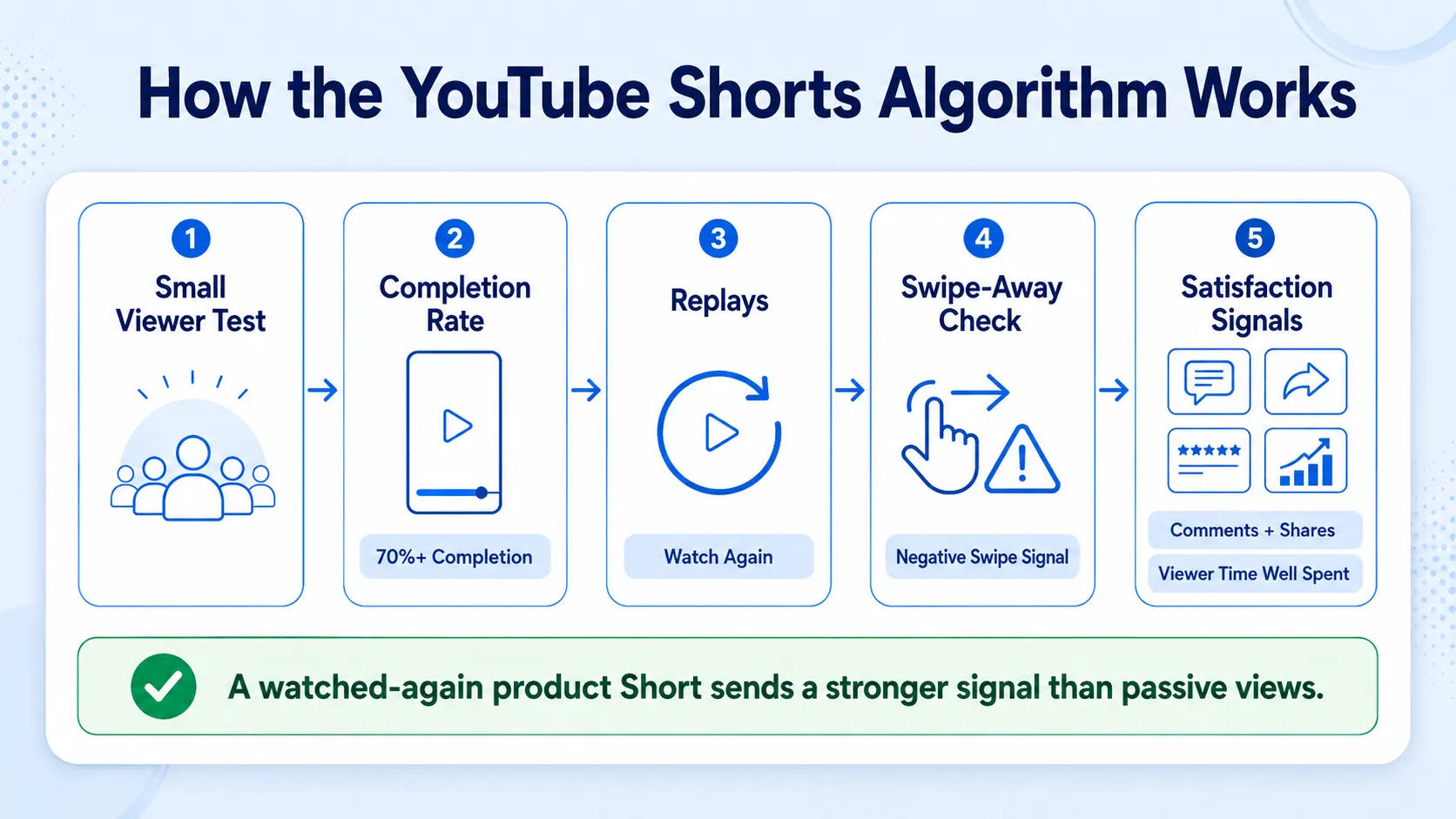
Your first hundred views are a diagnostic test. The algorithm is asking: does this content hold? Will people watch it again? Do they swipe away fast? Here are the primary signals ranked by impact:
- Completion rate: Completion rate is a key factor, and Shorts with over 70% completion are promoted more.
- Replays: Multiple views signal value to the algorithm.
- Swipe-away rate: Swiping is the negative signal. If a viewer swipes away from your Short quickly, the algorithm interprets this as the content not being relevant, and a high number of quick swipes will prevent your Short from being shown to a wider audience.
- Engagement depth: Likes and comments are direct forms of positive feedback, while shares are a powerful endorsement indicating the content was compelling enough to be passed on.
- Satisfaction layer: In 2025, YouTube shifted its entire recommendation model toward satisfaction-weighted discovery, moving beyond clicks and watch time to measure whether viewers actually felt their time was well spent.
YouTube also introduced new analytics for creators like the swipe-away metric, indicating those signals are actively used. Inside YouTube Studio, you can track swipe-away timing frame by frame. If your hook is losing people at second three, you know exactly where to cut.
For B2B SaaS teams: a viewer who watches your 45-second product education Short twice sends a stronger distribution signal than 500 passive views with early drop-off. Track high-performing titles in YouTube Studio to refine new videos, helping the algorithm target the right audience. This feedback loop is the closest thing to a targeting dial you have on the Shorts feed.
YouTube Shorts Reach Explained for SaaS Startups: How Distribution Actually Spreads
The algorithm is a recommendation system that determines which short-form videos appear on users' Shorts feeds. For SaaS startups, understanding the distribution arc is more valuable than optimizing for a single video. Here is how reach expands in practice:
- Initial test pool: YouTube surfaces your Short to a small segment of users whose watch history and engagement patterns match your content topic.
- Signal collection: The algorithm measures completion, replays, swipe-aways, likes, shares, and comments in this initial pool.
- Expansion gate: If satisfaction signals are strong, distribution broadens to a wider but still relevant audience tier.
- Sustained push: Videos that continue performing in the expanded pool receive ongoing distribution, sometimes for weeks.
- Decay or plateau: Low satisfaction at any stage stops the push. The video is not penalised permanently. A new Short simply starts a fresh test.
The Shorts algorithm takes into account each user's watch history to serve up personalized recommendations, meaning content aligned with a user's recent interests has a higher chance of appearing on their feed. This is actually an advantage for B2B SaaS content. A founder who has been watching SaaS growth, product demos, or AI tool reviews is already in a behavioral cluster your content can reach.
YouTube Shorts has evolved from a TikTok competitor into the platform's primary discovery mechanism, and with engagement rates of 5.91%, Shorts now represent the funnel top for B2B buyer journeys. The practical implication for your short-form video strategy: consistency across a coherent topic cluster builds a viewer profile the algorithm can match reliably. Ten Shorts about AI workflow automation train the system to show your next Short to people watching AI workflow automation content.
Can B2B SaaS Companies Actually Grow on YouTube Shorts?
Yes, and the data is no longer ambiguous. YouTube Shorts reaches more users aged 25 to 44 than any other short-form platform, and 53% of B2B buyers report watching short-form video before filling out a contact form or requesting a demo. Research shows 70% of B2B buyers incorporate video in their purchase decisions, and 59% of senior executives prefer video over text when researching solutions.
The concern I hear from SaaS founders is that Shorts attract the wrong audience. That concern is real but solvable. The issue is not the format. It is the content. A Short about "5 reasons your SaaS onboarding is losing trials" will self-select toward product managers and growth leads. A Short about a trending sound has no buyer intent baked in. Marketers using short-form videos including YouTube Shorts report 19% higher lead conversions from these formats compared to static ads.
The conversion lift comes from format and specificity together. For AI startups, the opportunity compounds. One of the most promising niches on YouTube in 2026 is B2B technology and SaaS automation, driven by a growing demand for content that educates and informs about these tools. Your product already lives in a high-interest category. The algorithm has warm audiences ready for your content if you show up consistently and with precision.
B2B video content shortens the sales cycle by an average of 23%. Applied to Shorts: a buyer who has already watched three of your educational clips arrives at the demo call pre-educated. That is a compressible pipeline.
How YouTube Shorts Decides Who Sees Your Video in Tech Niches
This is the question that actually matters for targeting. YouTube customizes content for every individual, factoring in watch history, viewing habits, and even device and time of day, adapting recommendations accordingly. For B2B SaaS and AI startup content, this means your distribution is shaped by how well your content sits within recognizable viewer behavior patterns. The algorithm reads:
- Topic coherence: Does your title, description, and visual content consistently signal the same subject? A Short titled "Why your AI product demo is losing deals" with visual proof of a product walkthrough tells the system what cluster to serve it to.
- Channel topic history: If your channel consistently publishes SaaS, AI, and B2B content, the algorithm builds an audience profile around those signals and matches new Shorts to that profile automatically.
- Viewer behavior graph: The Shorts algorithm takes into account each user's watch history, meaning content aligned with a user's recent interests has a higher chance of appearing on their feed. A CTO who watches AI tool demos regularly is algorithmically warm for your product Short.
The algorithm does not read your ICP doc. It reads viewer behavior. Build content that only your ideal buyer would watch to completion, and the algorithm builds the targeting for you. This represents a fundamental shift from channel authority to content relevance. A well-optimised video from a 500-subscriber channel can rank above a mediocre video from a 100,000-subscriber channel if it better answers the search query and keeps viewers engaged. For new SaaS channels, this levels the playing field considerably.
Use YouTube video editing to sharpen your visual clarity in the first two seconds. The hook does not need to be loud. It needs to be unmistakably relevant to the right person.
YouTube Shorts vs Long-Form Video for B2B SaaS: Which is Better?
Neither format alone wins. The question is what each does in your funnel.
The Shorts algorithm prioritizes watch-through rate and swipe-away speed, while the long-form algorithm rewards total watch time and session duration. These are different games with different success metrics. A practical starting point is 30/70 in favor of long-form for high-consideration or B2B products where search-driven education drives conversion. Shorts serve as the top-of-funnel entry point. Long-form closes the trust gap.
Long-form video lets you walk through complex topics, show your product in detail, and build the kind of trust that converts viewers into customers, and for B2B startups especially, long-form content is where buying decisions get influenced. A hybrid strategy that uses Shorts as teasers funneling viewers into long-form content delivers the strongest overall business results.
At Komet Media, this is how we build video systems for funded teams: Shorts create the pattern interrupt, long-form earns the conversion. You can explore both sides through our video marketing services and our webinar repurposing process.
YouTube's December 2025 home feed UI overhaul reduced long-form video recommendations by up to 80% while Shorts slots increased substantially, making YouTube Shorts integration essential for discovery regardless of channel size or niche. If you were relying on long-form alone, that shift just cut your organic reach significantly.
Best Practices for YouTube Shorts When You Sell to Enterprise Clients
Enterprise B2B requires a specific Shorts approach. Generic tips about trending audio and posting frequency will not move your pipeline. Here is what actually works when your deal size is five or six figures.
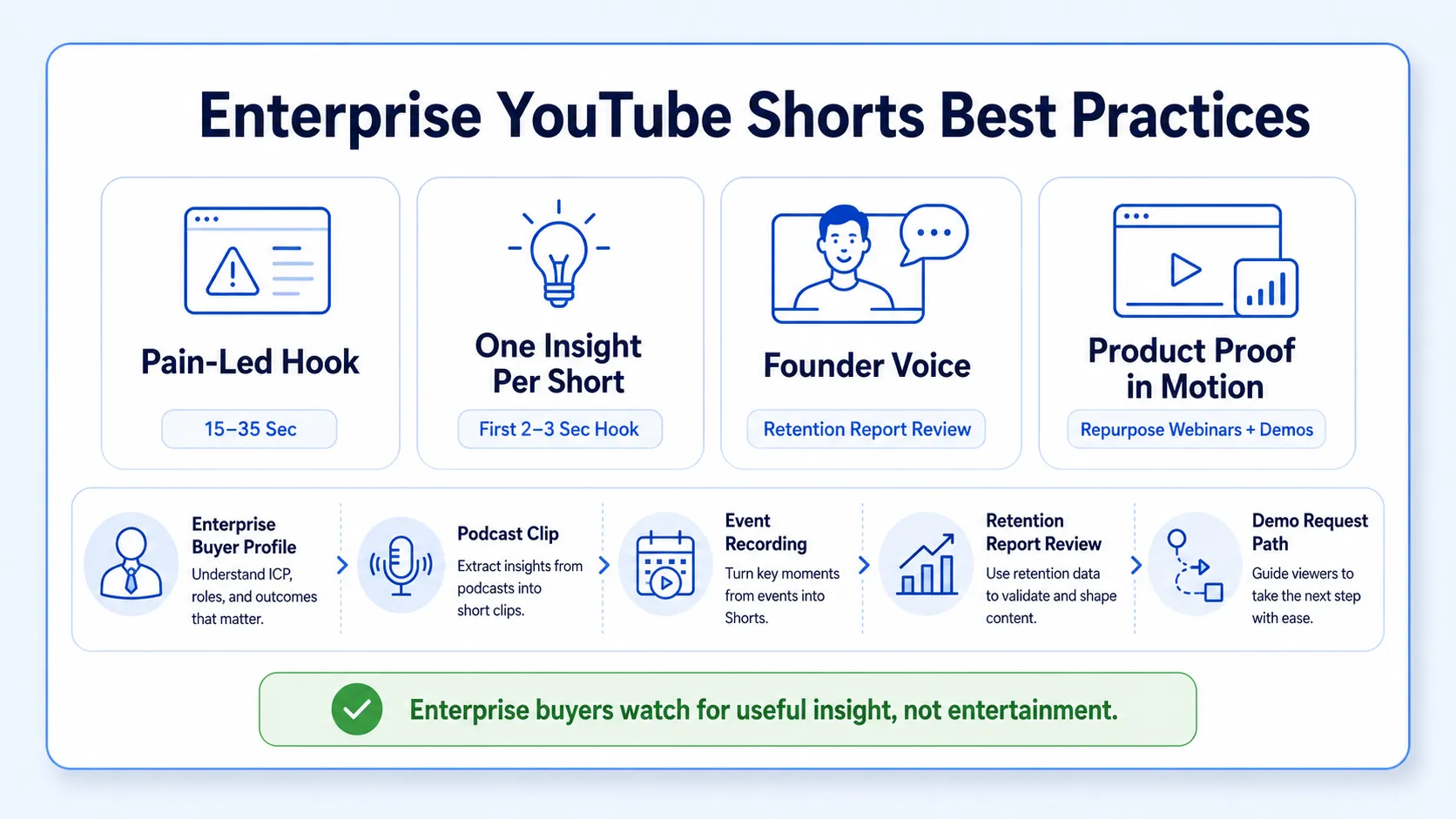
Content types that earn watch-through from enterprise buyers:
- Pain-led hooks: Open with a problem statement your buyer has already Googled. "Why enterprise onboarding takes 90 days when it should take 9" stops a VP of Customer Success mid-scroll.
- One insight per Short: Enterprise buyers do not consume content for entertainment. They consume it to close a knowledge gap. Each Short should deliver one specific, credible insight.
- Founder voice: 93% of B2B buyers see video as building trust in purchase decisions. A Short where the founder speaks directly to a product decision or market observation builds faster than any polished brand clip.
- Product proof in motion: Show the product doing something useful in 10 seconds. No voiceover required. Visual proof is its own hook.
Format specifics that help the algorithm serve enterprise audiences:
- Optimal length for YouTube Shorts in a B2B context is 15 to 35 seconds.
- Strong hooks in the first 2 to 3 seconds are critical to stop early swipes and boost algorithm signals.
- Analyze Audience Retention reports in YouTube Studio to pinpoint drop-off moments and improve those segments.
Repurpose your existing assets. Podcast clips, demo recordings, webinar highlights, and founder interviews from your podcast production and events calendar are already built. The edit is the product. A well-cut 25-second clip from a 40-minute webinar can generate a demo request that the full webinar never would, because the Short reached someone who never would have watched the full version.
Why Are My YouTube Shorts Not Getting Reach? (Diagnosed for Tech Companies)
This is the most common question I get from SaaS marketing heads after their first 30 days on Shorts. Here is a diagnostic framework.
A 30-second Short with 85% watch time ranks better than a 60-second Short at 50% retention. The algorithm measures how much of your Short people watch before they swipe away. Shorter is not always better. Tighter is always better. Use YouTube Studio analytics, specifically retention reports, traffic sources, and peak activity times, to refine your strategy.
The deeper issue for most tech companies is not algorithm knowledge. It is a content volume. A single Short tests a hypothesis. Twenty Shorts across a focused topic cluster build an audience signal the algorithm can act on. If you are producing less than eight Shorts per month as a SaaS brand, you are not giving the system enough data to work with. This is where content repurposing becomes a growth lever, not just an efficiency play.
Conclusion
- The YouTube Shorts algorithm rewards viewer satisfaction and completion rate above everything else. For B2B SaaS, that means specific, buyer-relevant content outperforms polished generic clips every time.
- YouTube's 2025 algorithm overhaul slashed long-form home feed slots by up to 80%, making Shorts integration essential for any B2B channel that relies on organic discovery.
- A hybrid strategy using Shorts as top-of-funnel discovery feeding into long-form conversion content is the right model for enterprise-facing SaaS teams.
- The fastest path to reach is a focused topic cluster, a tight hook, and a consistent repurposing system built on content you already own. Start building that system here.
Frequently Asked Questions
Q1: How long should a YouTube Short be for a B2B SaaS audience?
Optimal YouTube Shorts length for B2B content is 15 to 35 seconds. That window is long enough to deliver one clear insight and short enough to maintain the completion rate the algorithm rewards. Avoid padding. If the point lands at 22 seconds, cut there.
Q2: Does YouTube Shorts work for high-ticket enterprise sales?
Yes, as a discovery and trust-seeding tool, not as a direct closer. 53% of B2B buyers report watching short-form video before filling out a contact form or requesting a demo. Shorts reduce the cold-start problem on demos by giving buyers a low-friction way to evaluate your thinking before they commit to a meeting.
Q3: How does the algorithm decide which B2B viewers see my Short?
The algorithm takes into account each user's watch history and serves content aligned with their recent interests, giving topically consistent Shorts a higher chance of reaching the right feed. Build content that only your ideal buyer watches to completion, and the algorithm builds the targeting naturally.
Q4: Should I post separate Shorts from my long-form videos or repurpose clips?
Both work, but repurposing is faster and more efficient. Webinar highlights, demo clips, podcast excerpts, and founder commentary from existing recordings can all become high-performing Shorts. A hybrid strategy that uses Shorts as teasers funneling viewers into long-form content delivers the strongest overall business results.
Q5: How many YouTube Shorts should a SaaS startup post per month?
There is no single correct number, but less than eight per month typically gives the algorithm insufficient data to build a reliable audience profile around your topic cluster. Consistency across a focused niche trains the system faster than sporadic high-production uploads.
Q6: Why is my YouTube Shorts view count dropping after an initial spike?
The algorithm tests each Short with likely viewers and expands distribution only when satisfaction signals remain strong. An initial spike followed by a drop usually means the broader test pool found the content less relevant than the initial group. Fix this by tightening your hook specificity and ensuring every Short speaks directly to one buyer problem rather than a broad topic.