
🪄 AI Summary
Heading 1
Heading 2
Heading 3
Heading 4
Heading 5
Heading 6
Lorem ipsum dolor sit amet, consectetur adipiscing elit, sed do eiusmod tempor incididunt ut labore et dolore magna aliqua. Ut enim ad minim veniam, quis nostrud exercitation ullamco laboris nisi ut aliquip ex ea commodo consequat. Duis aute irure dolor in reprehenderit in voluptate velit esse cillum dolore eu fugiat nulla pariatur.
Block quote
Ordered list
- Item 1
- Item 2
- Item 3
Unordered list
- Item A
- Item B
- Item C
Bold text
Emphasis
Superscript
Subscript
Most SaaS marketing teams know they need video. Very few know how to make it work in the SaaS marketing funnel where buyers are skeptical, sales cycles are long, and attention is measured in seconds. I'm Rajan Soni, Founder and Video Director at Komet Media. This guide breaks down the best video ad examples for SaaS brands in 2026, what separates the ones that convert from the ones that get skipped, and exactly how to apply those patterns to your own pipeline.
TL;DR
- SaaS websites with product videos convert at 4.8% vs. 1.9% without video.
- The best-performing SaaS ads lead with the buyer's pain, not the product's features.
- LinkedIn and YouTube pre-roll are your two highest-leverage paid channels for B2B in 2026.
- Short, problem-first, caption-on video wins across every placement.
What Are the Best Video Ad Examples for SaaS Brands in 2026?
Every year I look at what the category leaders are doing and strip it back to the core mechanic. In 2026, the gap between good and great video ads comes down to one thing: specificity of pain.
Notion's 3.0 Agents launch is the archetype of a modern feature-launch ad. It opens with the new capability on screen inside the first two seconds, walks through three specific use cases, and closes on a clear "try it now." That structure, capability, use case, CTA, is replicable for almost any SaaS product.
HubSpot's Breeze AI launch ad opens with the product name and the problem it solves in the first six words on screen. The hook is declarative and category-defining, which is the pattern the HubSpot brand team has been sharpening since the Breeze AI suite rolled out.
Slack's 3D animated brand film uses vibrant character animation to show how teams connect, communicate, and collaborate, turning everyday workplace interactions into visually engaging stories. The visual storytelling conveys Slack's value without relying on feature lists or UI walkthroughs.
Dropbox's feature-update video is simple in concept, focusing on smooth animation that makes viewing the interface an engaging experience, with visual imagery that makes the changes memorable.
The common thread across all four: under 90 seconds, problem-first hook, one clear message, brand-consistent visuals, and a strong CTA. That's not a coincidence, it's a formula. What matters for a funded AI startup or B2B SaaS team is understanding why that formula exists, not just copying the aesthetic.
Whether you are producing video ads from scratch or leveraging an existing asset library, you need a clear problem, a tight narrative, and the right production partner to execute it. That's exactly what we build at Komet Media's video advertising service.
What Makes a SaaS Video Ad Successful in 2026?
The data here is unambiguous. Video ads improve brand recall by 80% compared to static ads. But recall is only useful if the creative is structured to convert.
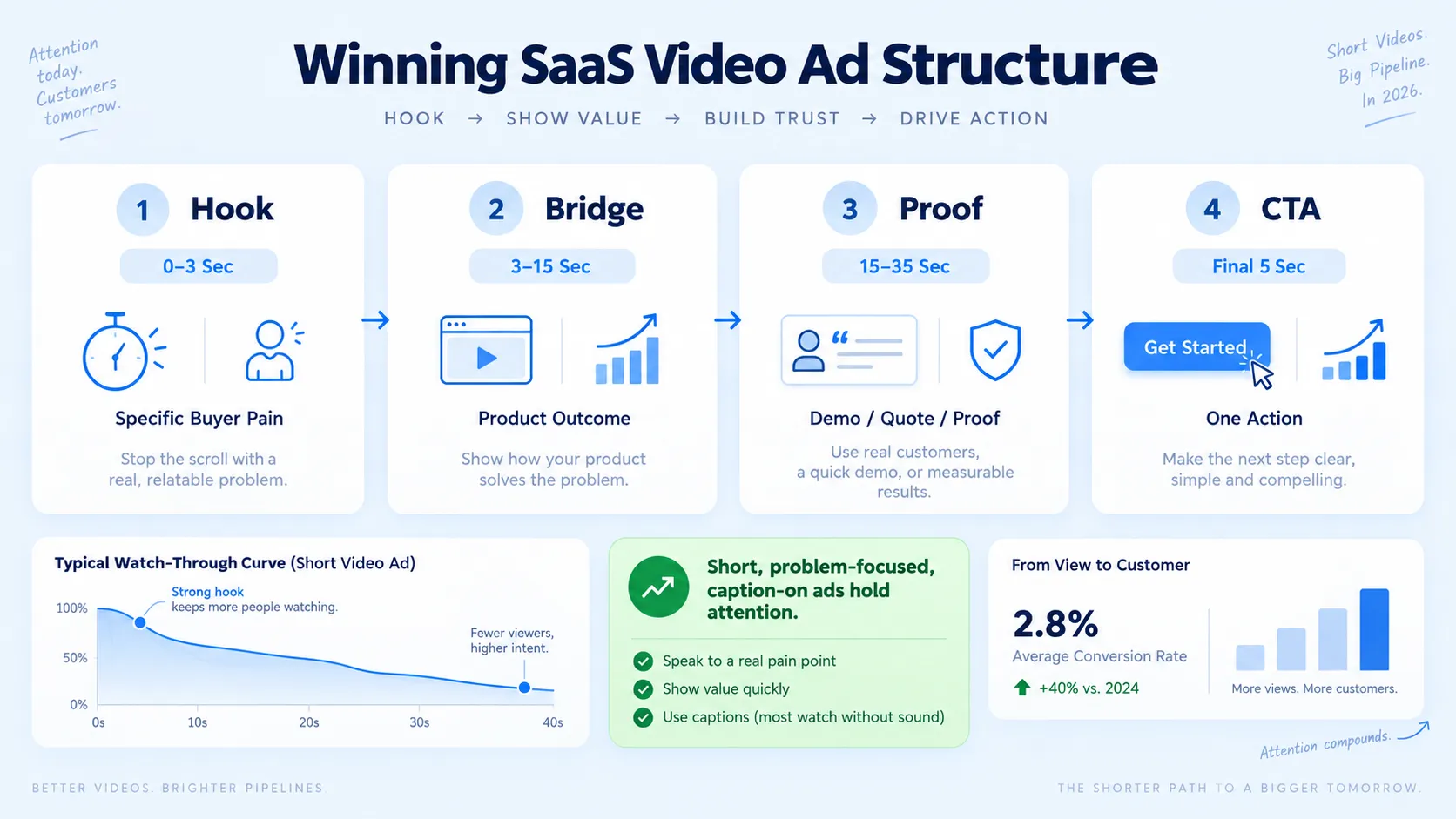
The best-performing SaaS videos are short, problem-focused, and clearly structured. Videos that highlight the user's pain points first, explain the solution simply, stay under 90 seconds, and include a single strong CTA usually deliver the highest conversion rates. The hook is the single most decisive variable.
Your hook is those first critical seconds at the start of a video that determine whether a viewer keeps watching or bounces from your content right away, it's a short moment that decides whether you retain a potential follower or lose them. Wistia's 2025 video benchmark puts the average engagement rate for sub-60-second videos at 50%, roughly 10 points higher than anything over a minute. That number directly informs your production decisions.
Here's what the structure of a winning SaaS video ad looks like in practice:
- Hook (0–3 seconds): Lead with a specific pain point the buyer recognizes immediately. No brand intro.
- Bridge (3–15 seconds): Connect the pain to your product's outcome, not its features.
- Proof (15–35 seconds): Social proof, a quick screen walkthrough, or a customer quote.
- CTA (final 5 seconds): One action. "Start free trial." "Book a demo." Not both.
Wyzowl's State of Video Marketing report reveals that 91% of businesses use video as a marketing tool, but authentic, low-production videos consistently outperform polished content for B2B conversions.
That's significant for SaaS startups on a budget, authenticity is a lever, not a limitation.
How Do Top SaaS Companies Create Video Ads That Drive Signups?
The best teams approach video ads as a system, not a one-off project. They think in terms of funnel stage, placement format, and buyer psychology simultaneously. SaaS explainer videos sit at every stage of the funnel. Top-of-funnel videos build awareness on social media and landing pages. Mid-funnel videos support evaluation by showing real workflows. Bottom-of-funnel videos help champions share your product story internally to close the deal. For demand generation, the format hierarchy in 2026 looks like this:
Explainer videos are the most popular singular use case for video marketing, with 73% of video marketers having created them. But for B2B SaaS specifically, demo-driven advertising and social proof formats outperform generic explainers at the conversion stage.
Whether creating original video concepts from scratch or repurposing existing media, the best teams approach video as a scalable asset. A single founder-led webinar or concept can generate a 30-second LinkedIn hook, a 90-second demo snippet for retargeting, and a 2-minute onboarding video. We handle full end-to-end production as well as Komet Media's short-form video editing service, turning product concepts, raw footage, or long-form sessions into a full short-form video system.
How Are Leading SaaS Brands Using Video Ads on LinkedIn and YouTube in 2026?
Platform strategy matters as much as creative. Spending on the wrong placement with great creative still wastes the budget.
On LinkedIn: Dreamdata's 2025 LinkedIn Ads Benchmarks highlights that LinkedIn Ads' share of total B2B ad budgets grew from 31% in H1 2024 to 39% by year-end, and reports LinkedIn generating the highest ROAS among major networks, LinkedIn 113%, Google Search 78%, Meta 29%.
Demo requests surged 17.4%, while creative formats like document and video ads are outperforming legacy assets, with brand and engagement budgets more than doubling. However, the format specifics matter. Video receives 31.72% of total LinkedIn ad budget, the second largest allocation after single image ads, but delivers the lowest CTR (0.24% median), the highest CPC ($15.61), and the worst efficiency score of any LinkedIn ad format.
This doesn't mean video doesn't work on LinkedIn. It means poorly structured video doesn't work. Thought Leader Ads (founder-to-camera clips formatted as organic content) outperform standard video units significantly.
On YouTube: Google's ABCD framework recommends Attract (2+ shots in first 5 seconds, tight framing, human faces), Brand (visible within first 5 seconds), Connect (emotional benefit), and Direct (clear CTA). ABCD-compliant ads see a 30% lift in short-term sales likelihood.
On LinkedIn, Reels, and YouTube Shorts, sub-30-second creative completes at roughly twice the rate of longer cuts, according to LinkedIn's 2025 B2B benchmark. Short wins. Every time.
Short Video Ad Examples for SaaS Startups on a Budget
Budget is not the blocker most teams think it is. The constraint is clarity, not production spend. Notion, Slack, and Calendly offer some of the best SaaS video examples for startups because they use simple animation styles, focus on a single problem, and communicate value within sixty seconds. These approaches are budget-friendly and highly effective for early-stage companies looking to build awareness.
For a funded AI startup or B2B SaaS team without a large video library, here's a practical short-form video system:
- Founder talking-head clip: Record a 60-second answer to "What problem does your product solve?" No studio needed. Caption it. Run it as a LinkedIn Thought Leader Ad.
- Screen-recorded product moment: Show the single most compelling feature in 20–30 seconds with captions and a CTA card at the end. This is demo-driven advertising without a full demo.
- Customer quote clip: Take a sentence from a customer call or written review. Animate the text over the B-roll of your UI. Under 15 seconds. Use it for retargeting on Meta Ads Manager.
- Repurposed webinar or podcast clip: Pull the sharpest 45-second exchange from an existing recording. Add captions, a lower-third title, and a CTA. This is zero additional recording time.
B2B SaaS pages with explainer videos see conversion lifts exceeding 100% in controlled testing, which means even a basic, authentic video on a landing page can double your signup rate without a single dollar of paid media.
We specialize in full-service video creation—from concept and scriptwriting to full production and content repurposing—at Komet Media. Whether you need fresh ads produced from scratch or existing webinars and demos edited into high-converting assets, we build the pipeline for you.
How to Create High-Converting Video Ads for a SaaS Product
Making a video is easy. Making one that converts requires intentional structure at every stage.
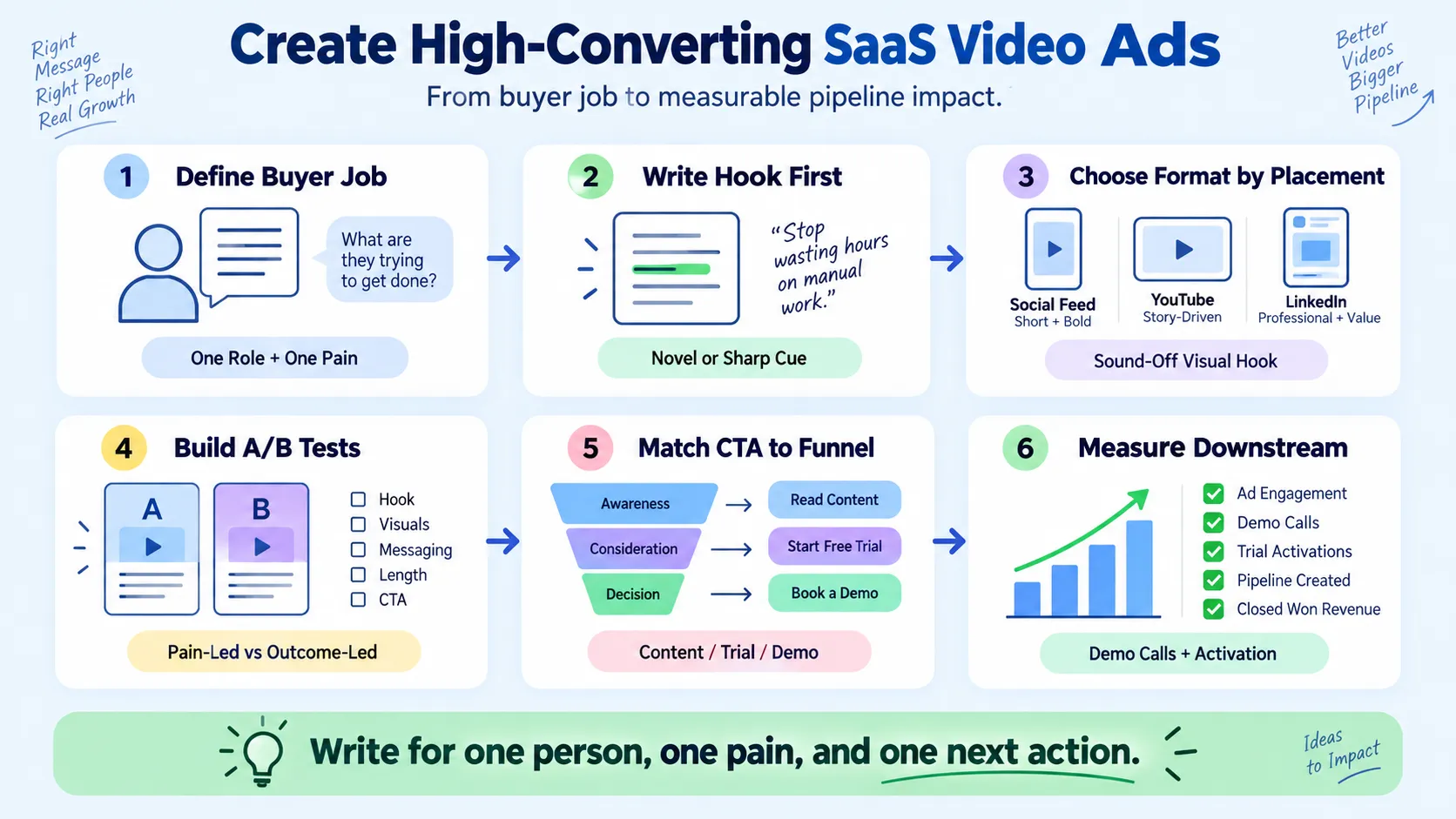
Step 1: Define a single buyer job. Each ad should speak to one specific pain point for one specific role. A marketing head at a Series B SaaS company has different triggers than a sales-led team at an early-stage startup. Write the script for one person.
Step 2: Write the hook before anything else. The viewer's brain is filtering an overwhelming feed; your hook must present a novel or emotionally resonant cue that suggests value right now. That cue could be a startling claim, a tension-filled question, a visual contrast, or the social proof of a credible voice.
Step 3: Choose your format by placement. On platforms where sound is off by default (Meta feed, LinkedIn, Instagram feed), the visual hook and text hook must carry the entire message alone. Always produce with captions.
Step 4: Build for A/B testing creative from day one. Produce at least two hooks for every ad concept, one pain-led, one outcome-led. Let the platform data tell you which framing your buyer responds to. Most teams skip this and wonder why their video ads plateau.
Step 5: Match CTA to funnel stage. Top-of-funnel ads should drive to content, not a demo request. Mid-funnel ads can push a free trial. Bottom-of-funnel retargeting can ask for a meeting directly. Mismatching CTA to stage is one of the most common call-to-action strategy failures in SaaS video.
Step 6: Measure downstream, not just views. The SaaS teams reporting the largest gains from explainer video aren't measuring by view counts, they're measuring downstream pipeline impact: demo-call conversion rate, sales-cycle length, and trial-to-paid activation.
For teams that want this entire system built out without the trial-and-error, our end-to-end production and video editing services handle everything from initial concepting and scriptwriting to raw footage editing and platform-ready assets.
Conclusion
The video ad examples for SaaS brands in 2026 that actually work share a consistent architecture: specific pain, fast hook, clear proof, single CTA. The data backs the framework, SaaS sites with video convert 2.5x better, LinkedIn ROAS leads all major paid networks, and sub-60-second videos hold attention 10 points higher than anything longer.
Key takeaways:
- Lead every ad with pain point messaging, not product features.
- Match format and length to platform: short on LinkedIn, ABCD-compliant on YouTube.
- Produce original video ads from scratch or repurpose existing content (webinars, podcasts, demos) to scale your asset library.
- Measure pipeline impact, not view counts.
If you want to turn your product knowledge into high-converting video ads—created from scratch or built from existing content—talk to us at Komet Media.
Frequently Asked Questions
Q1: How long should a SaaS video ad be in 2026?
Most successful SaaS marketing videos run between 60 and 90 seconds, long enough to explain a core use case and short enough to hold the viewer's attention through the entire call to action. For paid placements on LinkedIn and YouTube Shorts, aim for under 30 seconds at the top of funnel.
Q2: What video ad format works best on LinkedIn for B2B SaaS?
Thought Leader Ads (founder or executive talking-head clips formatted as organic content) outperform standard video placements. At 2.68% CTR and $2.29 CPC, they are approximately 6x more efficient than single-image ads. Use polished video units for retargeting, not cold audiences.
Q3: Should SaaS startups focus on animated or live-action video ads?
Minimalist motion graphics work well for productivity tools, while character-driven animation suits customer-facing platforms. The key is matching the visual tone to your audience's expectations and your brand identity. For early-stage teams, authentic talking-head clips often outperform expensive animation.
Q4: How do I measure whether my SaaS video ad is actually working?
Track watch-through rate, play rate, landing page conversion rate, and demo requests driven directly by the video. View counts and impressions are vanity metrics. The goal is to trace the video's contribution to pipeline and customer acquisition cost reduction.
Q5: What is the most important element of a SaaS video ad?
The hook. Transformation is one of the fastest ways to earn comprehension in-feed, if the viewer can register the delta in a second, the hook does a lot of the selling before the voiceover or copy has to explain anything. For SaaS, show a broken workflow becoming a clean one in the first three seconds.
Q6: Can I repurpose existing content like webinars and podcasts into video ads?
Yes, and this is often one of the fastest paths to a video ad library alongside creating original videos from scratch. A single recorded webinar or podcast episode can produce a 30-second LinkedIn hook ad, a 60-second product explainer, and multiple social proof clips. If you have existing recordings sitting unused, Komet Media's webinar and podcast repurposing services turn that content into platform-ready short-form video without any additional recording time.