
🪄 AI Summary
Heading 1
Heading 2
Heading 3
Heading 4
Heading 5
Heading 6
Lorem ipsum dolor sit amet, consectetur adipiscing elit, sed do eiusmod tempor incididunt ut labore et dolore magna aliqua. Ut enim ad minim veniam, quis nostrud exercitation ullamco laboris nisi ut aliquip ex ea commodo consequat. Duis aute irure dolor in reprehenderit in voluptate velit esse cillum dolore eu fugiat nulla pariatur.
Block quote
Ordered list
- Item 1
- Item 2
- Item 3
Unordered list
- Item A
- Item B
- Item C
Bold text
Emphasis
Superscript
Subscript
How do you keep a video series consistent? Not by relying on willpower. In my experience, series fall apart because the plan depends on someone finding new ideas and free time every single week. The series that survive in B2B SaaS, AI, and tech startups are built as a production system, with a fixed cadence, a batching schedule, and a small set of repeatable content pillars behind them.
Quick Answer
How do you keep a video series consistent? With a realistic cadence, a batched production schedule (whether working from existing recordings or building from scratch), and three to five content pillars, so the team never starts from a blank page.
Why Most Video Series Fail Before They Start
Most video series do not die from a bad idea. They die from a plan that ignores how production actually works. Week one is ambitious, week two ships, and by week five the calendar is a graveyard of ideas nobody has time to film.
The data backs up what this looks like in practice. A team that publishes two solid videos a week, every week, consistently outperforms a team that publishes five videos one week and then nothing for three weeks. Ambition is usually the thing that kills a series, not laziness. A cadence the team cannot hold on its worst week is worse than a lighter one it can.
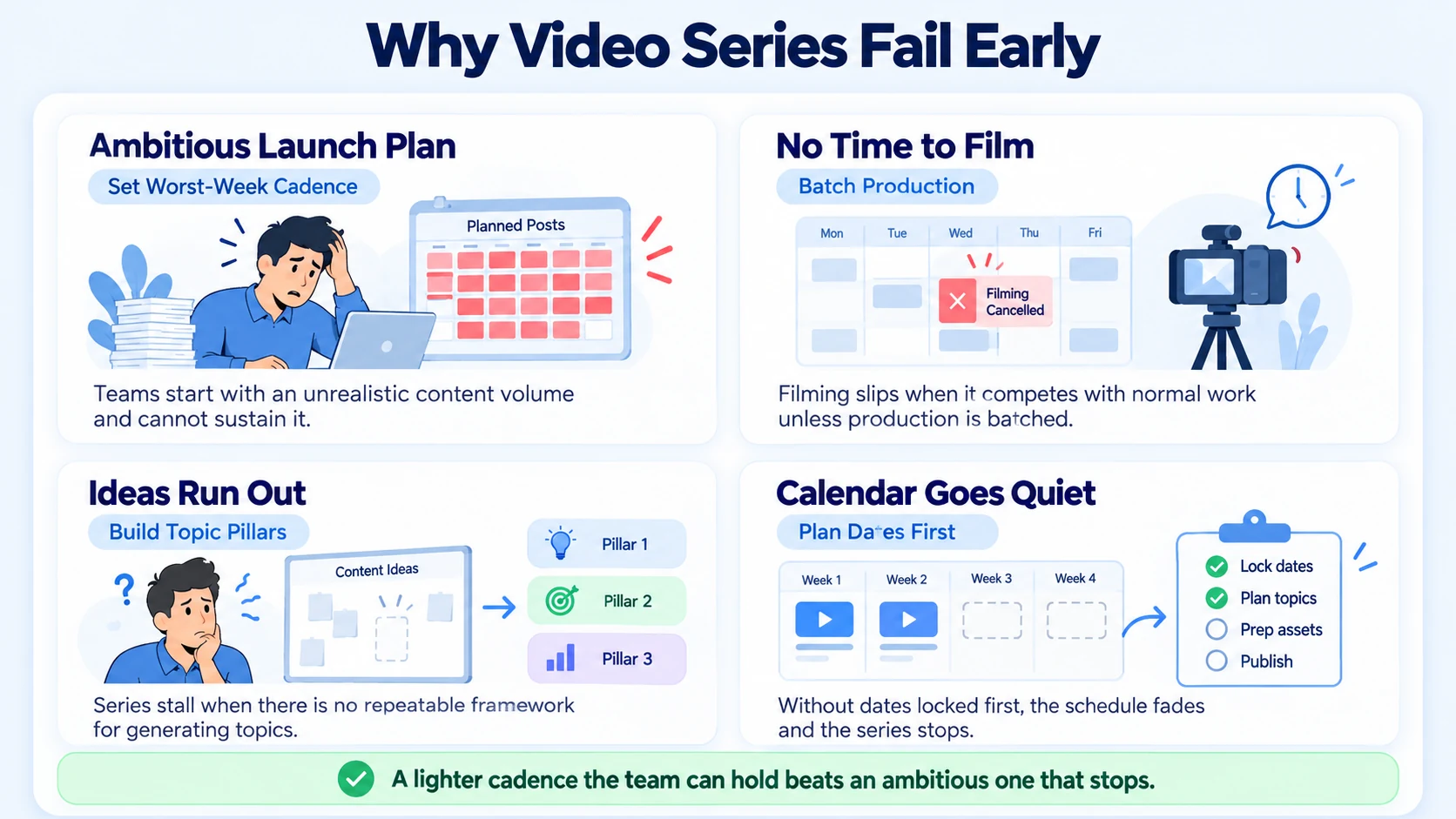
I have watched B2B SaaS, AI, and tech teams launch a weekly interview series with real enthusiasm, then quietly stop after six weeks once the person driving it ran out of guests, ideas, or time. The series was not a bad concept. It was a plan with no system behind it, which is really the whole question of how do you keep a video series consistent once the initial motivation runs out.
The Core System Behind How Do You Keep a Video Series Consistent
Series that survive share the same small set of structural pieces, regardless of the platform or topic, whether you are building fully from scratch or repurposing existing content.
None of these elements work well alone. A strong cadence with no batching plan still burns out whoever is producing the series. This is also where funnel thinking matters for B2B SaaS, AI, and tech teams specifically: a well-planned content calendar maps content to what a buyer needs at each stage, rather than treating every episode as interchangeable.
Common Reasons a Video Series Falls Apart
Most series do not fail because the audience lost interest. They fail because the production plan could not survive contact with a normal week.
The second reason is the one I see most in B2B SaaS, AI, and tech teams with a founder or executive at the center of the series. A single 90-minute recording block can usually produce enough raw material to fuel several weeks of episodes, whether recorded from scratch during a dedicated shoot or pulled from existing footage, answering a large part of how do you keep a video series consistent without adding hours to a founder's week.
A Repeatable Batching and Calendar Workflow
This is the process we use to help teams keep a series running past the first few episodes:
- Define three to five content pillars. These become the recurring buckets every episode idea falls into.
- Set a cadence around the worst realistic week. One reliable episode a week beats three that stop after a month.
- Batch the recording or production. One longer session—whether filming brand new scripts from scratch, hosting a podcast, or capturing founder interviews—can produce several episodes worth of material.
- Map every episode to a real publish date. A calendar with assigned dates, not a loose list of ideas, is what keeps a series accountable.
- Edit and format in the same batch. Consistent captions, pacing, and visual style come from producing episodes together, not separately.
- Review after five to seven episodes. Check engagement against the series' normal baseline and adjust the remaining episodes if something is off.
For a series built from scratch or around existing webinars, podcasts, or founder interviews, this workflow usually turns one strong recording session into a month or more of consistent episodes. Teams that skip the batching step tend to notice the gap only after it has already opened, since a single missed recording session quietly becomes a missed week of publishing, then two.
How to Tell If the Series Is Staying Consistent
Consistency is measurable, not just a feeling about whether the team is keeping up.
I would rather check the publish rate against the calendar every month than wait for a visible engagement drop to notice a series has gone quiet. By the time viewers notice a gap, the series has usually already missed more than one episode, which is exactly the failure pattern that makes how do you keep a video series consistent worth planning for in advance rather than reacting to later.
What a Capable Production Partner Should Handle
Keeping a series consistent is a production and scheduling discipline, not a creative one. A capable partner should handle full end-to-end production—from scripting and developing concepts from scratch to post-production—including:
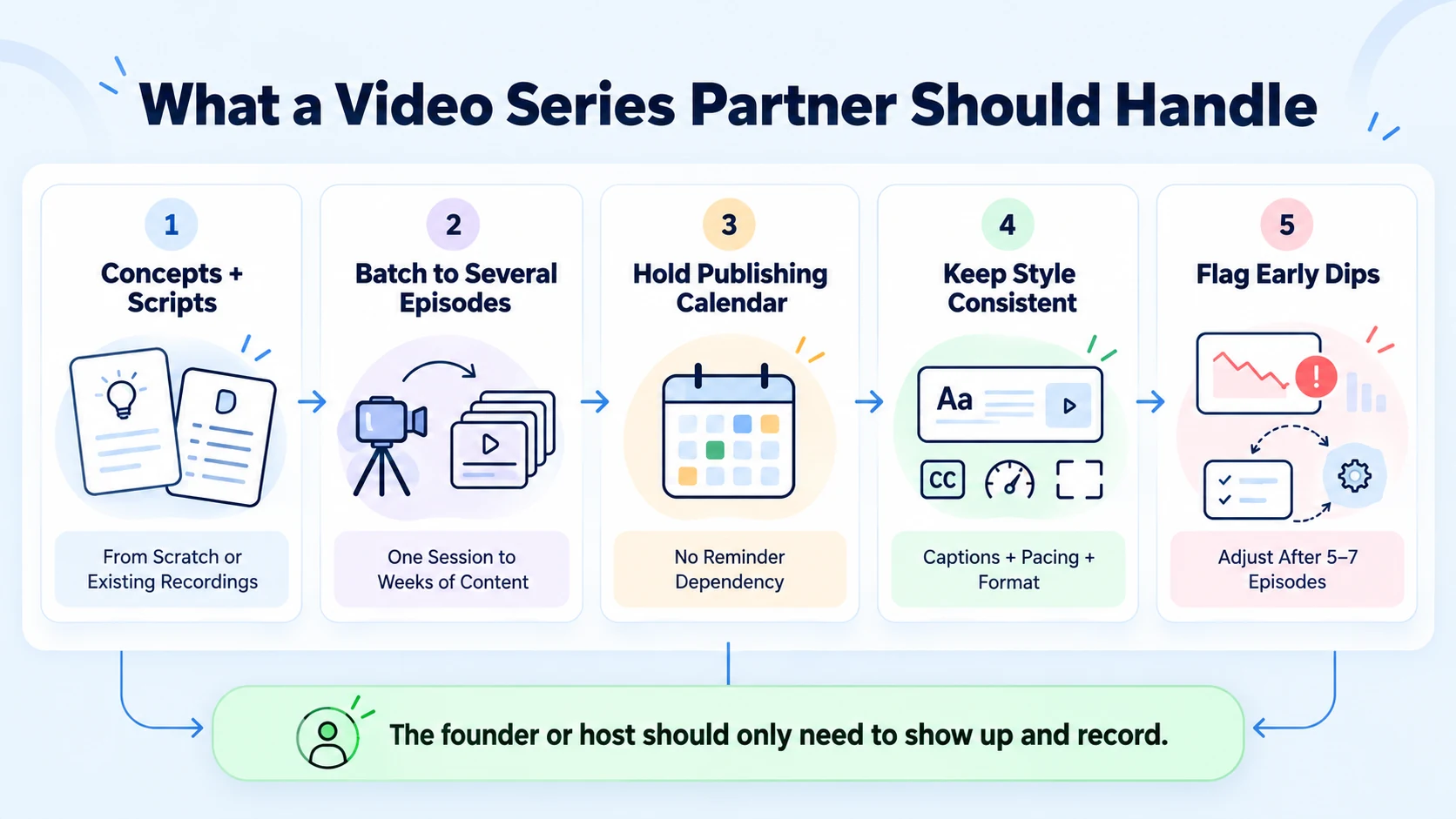
- Developing concepts, scripts, and production guidelines from scratch, or turning a single batched recording session into several weeks of edited episodes
- Holding the publishing calendar so the series does not depend on one person remembering
- Keeping captions, pacing, and visual style consistent across every episode in the batch
- Flagging early when engagement dips so adjustments happen after five to seven episodes, not fifty
- Managing the production side so the founder or host only has to show up and record
This is the core of what we do at Komet Media for B2B SaaS, AI, and tech startups and teams running podcast and short-form video series. Whether you are starting completely from scratch with concept and scripting or working from existing recordings, we build the batching, production, and publishing system around your schedule so the series keeps a consistent cadence instead of depending on whoever has spare time that week.
Conclusion
How do you keep a video series consistent over months, not just for the first few weeks? Build a system that does not depend on someone finding new ideas and free time every week: three to five content pillars, a cadence set around the worst realistic week, batched production, and a fixed publishing calendar. The series that survive are the ones treated as a production system from day one, not the ones with the most ambitious plan on launch day.
FAQ
How do you keep a video series consistent when the team is small?
It means publishing on a predictable schedule over months, not weeks, with a recognizable format the audience can build a habit around. Consistency is measured by whether the cadence holds during busy periods, not just during an easy launch month.
How much does it cost to keep a video series running consistently?
Cost depends on episode volume, whether production starts from scratch or uses existing source material, and how much new recording is needed each month. Retainer-based production that includes full end-to-end strategy, batching, editing, and calendar management typically runs in the range of approximately $2,500 to $5,000 a month, though scope changes the final number.
What is the process for setting up a consistent video series?
The process usually starts with three to five content pillars, script and concept development (from scratch or using existing content), and a batched recording session that produces several episodes at once. Mapping each episode to a fixed publish date and reviewing performance after five to seven episodes keeps the system on track.
How long does it take before a video series feels consistent to an audience?
Most audiences start recognizing a series as a habit after four to six consistently published episodes. A visible pattern in engagement, like repeat comments or return viewers, usually shows up around the same point.
What deliverables come with a consistent video series program?
A typical program includes a set number of edited episodes per batch, a publishing calendar with fixed dates, consistent captions and formatting across episodes, and periodic performance reviews. Some programs also include a content pillar framework built at the start.
Should a freelancer or an agency manage a video series long term?
A freelancer can work well for a series with a light, predictable volume and a team that can manage the calendar directly. An agency tends to hold up better once the series needs batching, consistent formatting, and coverage if one person is unavailable.
Does an in-house team or an external partner make more sense for keeping a series consistent?
Small in-house teams often lose momentum once the person driving the series gets pulled into other priorities. An external partner running the batching and calendar as a standard process tends to protect the cadence better over a full quarter.
Does Komet Media help teams keep a video series consistent?
Yes. We handle full video production from scratch for B2B SaaS, AI, and tech startups & teams—including audience research, scripting, recording guidance, editing, and calendar management—as well as repurposing existing recordings. We build the system around your schedule so a podcast, interview, or short-form series keeps publishing on a steady cadence. Book a call to talk through what a consistent series could look like for your team.