
🪄 AI Summary
Heading 1
Heading 2
Heading 3
Heading 4
Heading 5
Heading 6
Lorem ipsum dolor sit amet, consectetur adipiscing elit, sed do eiusmod tempor incididunt ut labore et dolore magna aliqua. Ut enim ad minim veniam, quis nostrud exercitation ullamco laboris nisi ut aliquip ex ea commodo consequat. Duis aute irure dolor in reprehenderit in voluptate velit esse cillum dolore eu fugiat nulla pariatur.
Block quote
Ordered list
- Item 1
- Item 2
- Item 3
Unordered list
- Item A
- Item B
- Item C
Bold text
Emphasis
Superscript
Subscript
White label video editing for agencies means a production partner edits videos under your agency's name, to your standards, without the end client ever dealing with the partner directly. Done well, it lets a marketing, PR or creative agency sell video without hiring a full editing team. Done badly, it puts your client relationships at risk. This guide covers how the model works, how to structure the workflow, what pricing models exist, how to choose a partner and where the economics hold up.
Quick Answer: White Label Editing for Agencies
White label video editing for agencies lets you resell editing under your brand. It works with clear briefs, one point of contact, written turnaround terms, shared quality standards, and your ownership of the client.
Why Agencies Look for a White Label Video Editing Partner
Demand for video is not the problem. Wyzowl's 2026 video marketing survey, based on 266 respondents surveyed in late 2025, found that 91% of businesses use video as a marketing tool. A sample of 266 is small, so I treat it as an indicator of mainstream adoption rather than an exact figure. For agencies, that adoption translates into client requests: short clips, webinar cutdowns, podcast edits, testimonial videos and ad variations.
The constraint is capacity and consistency. Hiring editors for a fluctuating workload is expensive and slow, and freelancers can be unreliable under volume. White label video editing for agencies solves a specific problem: you need a stable bench that scales up when a client signs and does not cost salary when the work dips.
Typical reasons agencies choose the model:
- Add a service line without building a department.
- Handle spikes from product launches, events or campaign cycles.
- Keep creative leaders focused on strategy and client work, not rendering and exports.
- Improve turnaround with a team that works across time zones.
- Standardize quality across clients with a documented process.
How a White Label Video Editing Partnership Is Structured
A white label arrangement has four layers.
- Client relationship. Your agency owns the contract, billing and communication with the client.
- Brief and review. You turn the client's needs into a brief and review the work before the client sees it.
- Production. The partner edits, designs captions and graphics, and prepares exports.
- Delivery. Final files go out under your name through your channels.
The partner should be invisible to the client, which means no direct contact, no partner branding on deliverables and no sharing of client details beyond what is needed. Put that in writing.
A White Label Video Editing Workflow That Scales
The strength of the model is the process, not the individual edit. A workable cycle:
- Intake. Your account manager collects the client brief, brand assets, goal and platforms.
- Brief to partner. You send a structured brief with references, deadlines and approved style notes. A template helps, and our guide to the video editing brief shows one.
- First cut. The partner delivers a draft by the agreed time.
- Internal review. Your team checks brand fit, factual accuracy and technical specs before the client sees anything.
- Client review. You collect feedback in one consolidated list.
- Revisions. The partner works from the consolidated list, within agreed rounds.
- Final delivery. Exports for each platform, captions, thumbnails and project archives.
- Retrospective. Note what slowed things down and update the brief template.
The step most agencies skip is the internal review. It is also the step that protects your reputation. Never forward a draft to a client without looking at it yourself.
White Label Video Editing Pricing Models You Will Encounter
Partners price white label work in a few ways. Compare them by scope, not by headline price.
I do not have a current primary-source benchmark for market rates, so I will not quote one. Komet Media's typical working range for ongoing B2B retainers is roughly $2,500 to $5,000, with final pricing based on scope, volume, production difficulty and distribution needs. Treat that as a reference for scale of engagement, not a rate card.
When you mark up for clients, price the full service you provide, not only the editing cost. Account management, briefing, review, project tools and risk all belong in your price.
Illustrative Economics of White Label Video Editing
The numbers below are an illustration I constructed to show the logic. They are not market data.
Suppose an agency sells a client a monthly video package at one price and buys the editing from a white label partner at a lower price. The difference covers account management, review time, tools and profit. If the agency adds a second and third client on the same process, the fixed work of briefing templates and review checklists is spread across more clients, so margin per client tends to rise as the process matures. If instead each client needs custom handling, margins shrink.
The lesson is about operations. Margins hold when you standardize briefs, limit revision rounds, bundle formats and keep a predictable volume. They erode when each project is a custom job.
The First 30 Days With a White Label Video Editing Partner
A good start sets the pattern for the year. This is the sequence I would follow.
Week 1: align. Share your client list at the level of detail the partner needs, your style guides, your brief template and your review checklist. Agree who the contacts are and which channels you use for files and feedback.
Week 2: pilot. Run one or two real projects with a modest scope. Measure turnaround, the number of revision rounds and the quality of the first draft. Keep notes on every instruction that had to be repeated.
Week 3: adjust. Update the brief template and the style guides with what you learned. Remove ambiguity: if the partner guessed wrong twice, the brief was unclear, not the partner.
Week 4: scale carefully. Add the next client or the next format. Do not move every account at once. Review the pilot results with the partner and agree on turnaround, revision and escalation terms for the next quarter.
The point of white label video editing for agencies is repeatability. If the pilot is messy, fix the process before you add volume.
What to Put in the White Label Video Editing Contract
Have your counsel review the agreement. The topics below are the ones that tend to matter.
- Scope and deliverables: formats, lengths, aspect ratios, captions and revision rounds.
- Turnaround: the start of the clock, working days, rush terms and what pauses it.
- Confidentiality: an NDA covering client names, footage, unreleased products and financial information.
- Non-solicitation: the partner will not contact or work directly for your clients for an agreed period.
- Intellectual property: you own the final deliverables and project files, subject to third-party licenses.
- Credit and portfolio use: no use of client work in the partner's marketing without written consent.
- Data handling: storage, transfer, retention and deletion of footage, including use of AI tools.
- Liability and insurance: responsibility for errors, delays and rights claims.
- Exit: notice period, handover of work in progress and return or deletion of files.
Agencies working with regulated clients, such as funds and financial companies, should add a clause on compliance review and who signs off on claims.
Scaling White Label Video Editing From a Few Clients to Many
As volume grows, small inefficiencies multiply. Four habits help.
- Templates for everything. Brief, feedback form, delivery checklist, naming convention.
- A single intake channel. Requests arrive in one place, not across email, chat and calls.
- Batching. Group similar projects, such as all podcast clips for the week, so the partner can work in sequence.
- A monthly review. Check metrics and update the process. Ask the partner what slows them down; they often see it before you do.
Plan for the day your best account doubles its order. Ask the partner now how it would handle a doubling of volume in a month, and what notice it needs. For agencies building around white label video editing for agencies, this capacity question matters more than any single sample.
How to Choose a White Label Video Editing Partner
Use the same discipline you would apply to hiring. Ask for evidence, not slogans.
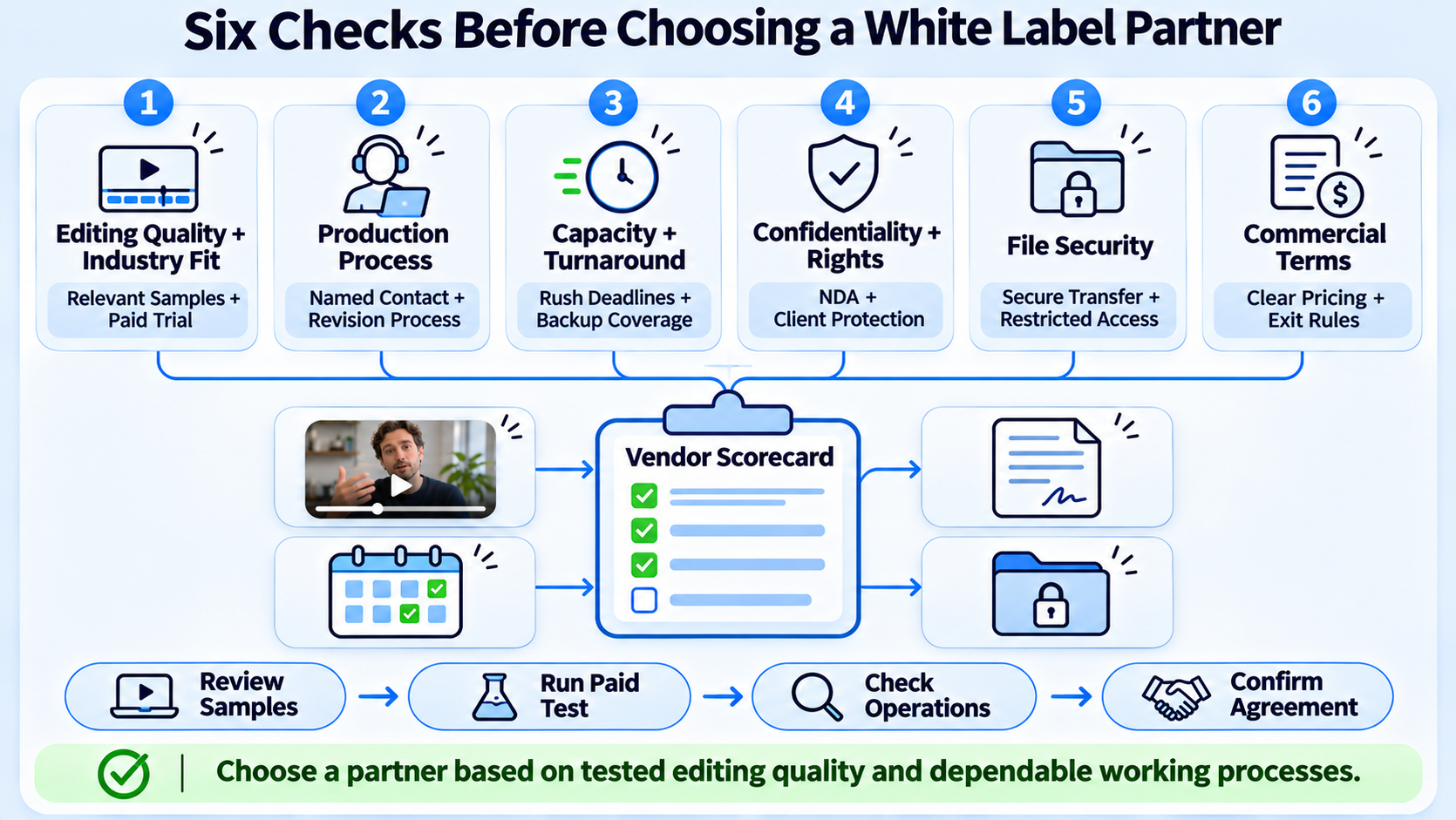
Quality and fit
- Samples that match your clients' industries and formats.
- A paid test project using a real client brief, with names removed.
- Consistent style across several editors, if the partner uses a team.
Process
- A named account contact and a described escalation path.
- A written intake and revision process.
- Version control and file naming standards.
Capacity and speed
- Written turnaround times, including rush terms.
- Cover for illness and holidays.
- The partner's maximum monthly volume.
Confidentiality and rights
- A signed NDA and a clause preventing direct contact with your clients.
- Clear ownership of final files and project assets, with no partner branding.
- Rules on use of work in the partner's portfolio, which should require your consent.
- Handling of music, stock footage and fonts, including licenses.
Security
- How files are stored and transferred.
- Who can access client footage and how long it is kept.
Commercial terms
- A clear price list and what is not included.
- Notice periods and what happens to work in progress if you leave.
For a related decision, see our comparison of freelance editors versus agencies for B2B.
Protecting Your Client Relationships in White Label Video Editing
The risk in any white label model is leakage of the relationship. Reduce it by design.
- Single point of contact. Clients speak to you, never the partner.
- Neutral deliverables. No partner watermarks, metadata or file names.
- Contract clauses. Non-solicitation and non-circumvention terms, reviewed by your counsel.
- Controlled access. Share only the footage and details needed for the job.
- Your tools. Use your own project management and review platform, not the partner's client portal.
If you cannot get these terms, treat that as information about the partner.
Quality Control and Brand Consistency
The more clients you serve, the more important a repeatable standard becomes. Create a one-page style guide for each client covering logo use, color, fonts, caption style, music, pacing and platforms. Ask the partner to apply it to every edit and to flag conflicts, not decide them. Our guide to managing brand consistency across video editors goes into the detail.
Build a short internal checklist for every delivery: file format, captions, audio levels, brand elements, spelling, and legal or compliance items. Keep it the same across clients so reviewers do not rely on memory.
Where AI Fits in White Label Video Editing for Agencies
Many editors now use AI tools for transcription, captioning and rough cuts. Wistia's 2026 State of Video report, a survey of 900-plus professionals, found that more than a third use AI in their video workflow. Ask your partner what tools it uses, how it protects client footage when sending it to a third-party tool, and which steps still receive human review. Do not accept a vague answer if clients have confidentiality terms.
Preparing Your Agency Before You Outsource
Outsourcing exposes weak internal processes. Prepare before you start.
- Document your briefs. Write a standard brief template and a checklist for what clients must provide.
- Standardize your style guides. One page per client, covering fonts, colors, music, caption style and pacing.
- Define your review process. Name who reviews drafts and what they check.
- Set a pricing model. Know your costs and your margin before you quote clients.
- Choose your tools. Project management, file transfer, review platform and storage.
- Train account managers on how to brief editors and how to consolidate client feedback.
- Create a back-up plan for a missed deadline, such as a second partner or a freelancer on call.
Agencies that skip this preparation often blame the partner for problems that originated in unclear briefs.
Briefing Well: A Template
A good brief reduces revision rounds. Include these fields.
- Client and project name, with a contact for questions.
- Goal. What the video should achieve and who it is for.
- Platforms and formats. Aspect ratios, lengths and file types.
- Source files. Location, naming and any known issues.
- Style references. Two or three examples to follow and one or two to avoid.
- Brand assets. Logo, fonts, colors, music and graphics.
- Mandatory elements. Calls to action, legal text, product names.
- Things to avoid. Words, claims, topics.
- Deadlines. First draft, feedback, final delivery.
- Approval path. Who approves at the client and in your agency.
Keep a brief for each project in the same format so the partner can find information quickly.
Managing Client Feedback
Client feedback is where white label arrangements tend to strain. These practices help.
- Collect feedback in one place. Use a review tool with timecoded comments instead of email threads.
- Consolidate before sending. Your account manager merges feedback and removes conflicts before it goes to the partner.
- Separate preference from error. Mark which changes are corrections and which are opinions.
- Limit rounds. Set the number of revisions in the client contract and the partner contract, and align them.
- Document decisions. When a client chooses between options, record why.
If a client wants a change that falls outside the brief, treat it as a new request with a price and timeline.
Quality Assurance Checklist
Before you forward a file to a client, check:
- Picture quality, cropping and framing.
- Audio levels, noise and music balance.
- Captions for accuracy, timing and style.
- Brand elements and spelling of names.
- Legal and compliance text, claims and sources.
- Export format and file name.
- Platform fit, including safe areas.
- Rights for music, footage and fonts.
Keep a list of recurring errors by partner and by client, and review it monthly. Patterns show where a template, a style guide or a briefing habit needs to change.
Risk Management
Several risks come with outsourcing and can be managed.
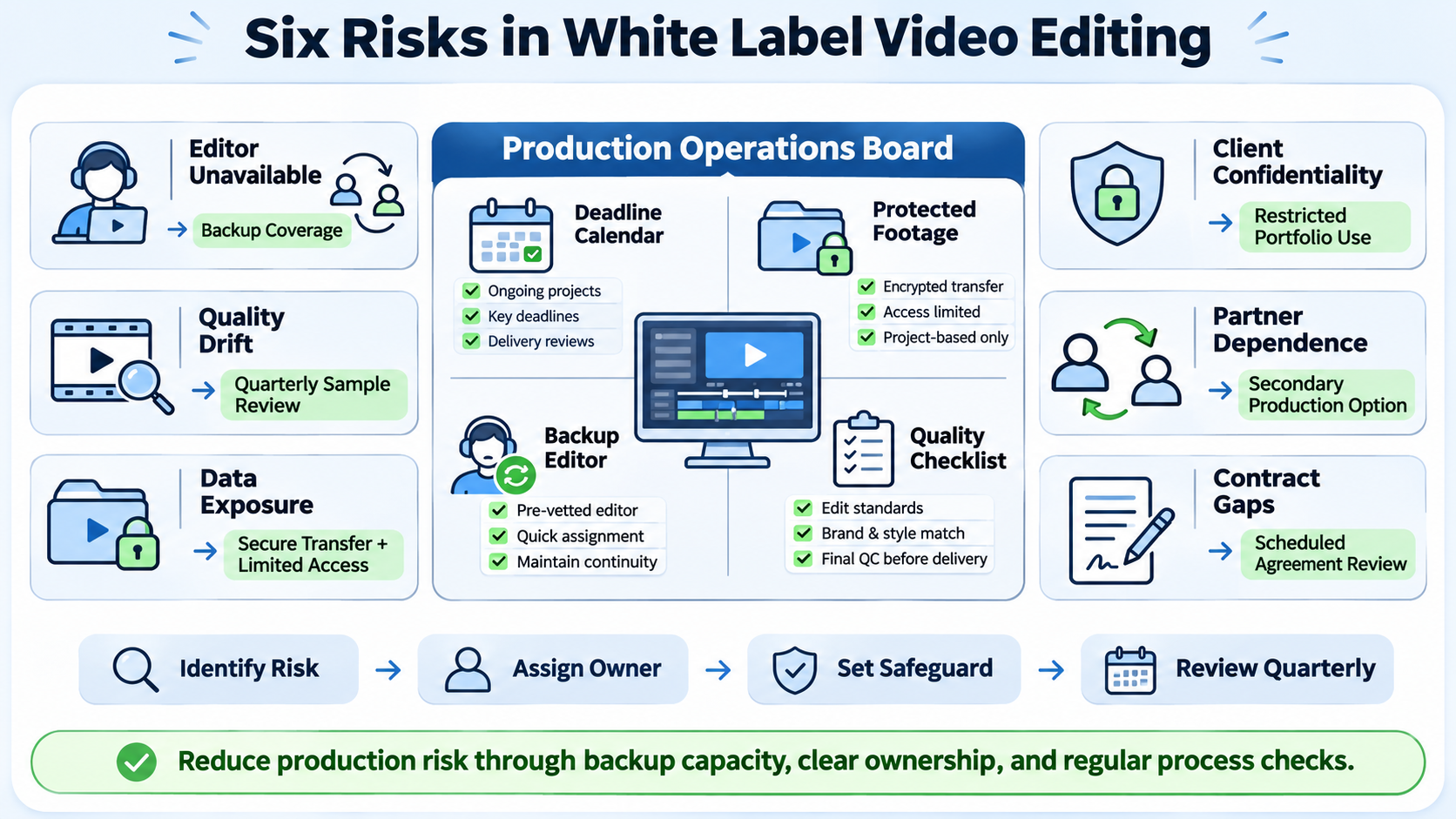
Single point of failure. If one editor holds all knowledge, absence causes delays. Ask for a named backup and shared project files.
Quality drift. Over time, small deviations from your style add up. Run a quarterly review of random samples against the style guide.
Data security. Limit access, use secure transfer and delete files on schedule.
Client confidentiality. Ensure the partner understands which client details cannot be shared in portfolio work or tools.
Dependence. Avoid relying on one partner for everything. Keep a second option for peak periods.
Contract gaps. Review terms every year, especially if volume changes.
Treat the partner relationship as a shared system with owners on both sides, and review it quarterly.
Metrics for the White Label Video Editing Partnership
Track both sides of the relationship.
- Operational: on-time delivery, revision rounds per project, first-draft acceptance rate.
- Quality: client satisfaction comments, rework hours, errors caught in internal review.
- Commercial: margin per project, utilization of retainer capacity, renewals.
- Content performance, where you manage distribution: views, watch time, saves, shares and leads tied to the client's goals.
Attribution is imperfect, so use several signals and review them quarterly with the partner.
When White Label Video Editing Is the Wrong Choice
- Your clients want to meet the editor. Some creative-led clients value a visible team.
- Your volume is too low and irregular. A freelancer on call may suit better.
- Your work depends on a distinctive in-house style that is hard to document.
- You cannot give clear briefs. No partner can fix a vague brief at scale.
- Your clients' confidentiality terms bar third-party handling. Check before you start.
Conclusion: Choosing a White Label Editing Partner
White label video editing for agencies is an operations decision more than a creative one. Choose a partner who can follow your briefs, protect your client relationships and hold a quality bar at volume. Standardize intake, review and revisions, put terms in writing, and test with a paid project. Agencies that treat the partner as an extension of their process, not a vendor of files, tend to get steadier results.
FAQs on White Label Video Editing
What is white label video editing for agencies?
It is an arrangement where a production partner edits video under your agency's brand, so your clients receive the work from you and do not deal with the partner.
How much does white label video editing cost?
Pricing depends on volume, video length, production difficulty, revision rounds and turnaround. Komet Media's typical working range for ongoing retainers is roughly $2,500 to $5,000, with final pricing based on scope.
How long does it take to start?
Setup depends on onboarding and brand documentation. Plan for a test project and a short ramp-up before volume begins.
What deliverables should I expect from a partner?
Edited videos, captions, platform-specific exports, thumbnails where agreed, and project files, delivered through your channels.
Should I use freelancers or a white label agency?
Freelancers suit variable or simple work. A white label agency suits agencies that need consistent quality, volume and backup cover.
Should I build an in-house editing team instead?
In-house gives control and context but costs salary and carries utilization risk. Many agencies keep a small core team and use a partner for peaks.
Is this a fit for agencies serving B2B, VC and SaaS clients?
Yes, when you need steady output such as short clips, webinar cutdowns and podcast edits, and when the partner can follow brand and compliance rules.
How does Komet Media support agencies?
Komet Media creates B2B video content from scratch and also edits and repurposes existing material, including white label arrangements, and can support distribution if you want it.