
🪄 AI Summary
Heading 1
Heading 2
Heading 3
Heading 4
Heading 5
Heading 6
Lorem ipsum dolor sit amet, consectetur adipiscing elit, sed do eiusmod tempor incididunt ut labore et dolore magna aliqua. Ut enim ad minim veniam, quis nostrud exercitation ullamco laboris nisi ut aliquip ex ea commodo consequat. Duis aute irure dolor in reprehenderit in voluptate velit esse cillum dolore eu fugiat nulla pariatur.
Block quote
Ordered list
- Item 1
- Item 2
- Item 3
Unordered list
- Item A
- Item B
- Item C
Bold text
Emphasis
Superscript
Subscript
The rise of short-form video in B2B is not a trend you can afford to sit out. Buyers research vendors on their phones. Decision-makers scroll LinkedIn between meetings. Attention is the new currency, and the teams winning pipeline in 2026 are winning it in under 60 seconds. Whether you're a SaaS founder, a growth lead, or a marketing team trying to generate inbound, this guide breaks down what's working, what the data says, and how to build a system that turns video into real revenue.
TL;DR
- Short-form video generated the highest ROI among all content formats, with 48.6% of marketers ranking it among their top-performing assets, per HubSpot's 2026 State of Marketing report.
- Videos under one minute achieve a 65% completion rate among B2B viewers, while videos over 20 minutes drop to 20%.
- LinkedIn, YouTube Shorts, and Instagram Reels are the three platforms that matter most for B2B short-form distribution right now.
- Content repurposing, turning webinars, podcasts, and demos into clips, is the highest-leverage production system available to B2B teams today.
How Is Short-Form Video Changing B2B Marketing?
The rise of short-form video in B2B is fundamentally changing how buyers get educated, how trust is built, and how pipeline gets generated. The old model was long-form gated content. The new model is short, specific, and ungated, and it meets buyers exactly where they already spend time. Short-form video now accounts for 58% of all time spent on social media, with Reels, Shorts, and TikTok together making up the majority of social platform time. B2B buyers are not exempt from this shift. They're professionals, but they're also humans with the same attention patterns.
Video is now the dominant force in B2B content. On LinkedIn alone, it is shared 20x more than any other format. For SaaS and AI startup teams trying to build brand awareness and inbound demand, that distribution multiplier alone justifies the investment. 98% of B2B decision-makers have watched explainer videos, and 87% say video influenced their purchase decisions. The buyer journey now runs through video before it runs through a sales call. When a founder posts a 60-second clip explaining a product pain point, they're doing pre-sales work at scale.
According to LinkedIn Creative Labs research, video posts generate 20x more shares than any other content format on the platform, and video viewership on LinkedIn increased by 36% in 2024, reaching 154 billion views. What this means for B2B teams practically: your product knowledge, your founder's thinking, your customer case studies, all of it has higher reach and impact when packaged as short video than as a PDF or a blog post. The medium is the message, and the medium in 2026 is short-form video.
Why Are B2B Companies Using TikTok, Reels, and YouTube Shorts Now?
The honest answer: because their buyers are there. The rise of short-form video in B2B is platform-agnostic by nature. Buyers don't switch off their consumption habits when they sit down to evaluate a vendor. That's why serious B2B brands are distributing across TikTok for Business, Instagram Reels, and YouTube Shorts alongside LinkedIn. The top social media marketing channels for B2B in 2025 are short-form videos on YouTube, Instagram, and TikTok, per HubSpot's State of Marketing 2025 report.
Here's how the platform landscape breaks down for B2B:
Finance and B2B advertisers often find Instagram Reels more cost-effective due to its older, higher-intent user base. YouTube Shorts works particularly well for B2B and educational content, helping brands establish credibility that translates into long-term opportunities. A Gartner study from July–August 2025 revealed that 61% of consumers consider YouTube as trustworthy for accurate information, followed by Reddit at 47% and Instagram at 32%. For B2B SaaS brands, the implication is layered distribution: use TikTok and Reels for reach, YouTube Shorts for trust and discoverability, and LinkedIn for direct pipeline.
The move isn't to pick one platform. It's to shoot once and distribute everywhere.
That's where our content repurposing service becomes the operational backbone, one long-form session becomes clips optimized for each platform without doubling your production cost.
What Types of Short-Form Videos Perform Best in B2B Marketing?
Not all short-form videos are equal. The rise of short-form video in B2B has revealed a clear performance hierarchy when it comes to format and content type. Product videos under a minute hit 50% engagement and customer testimonials hit 46%, per Wistia's 2026 State of Video Report.
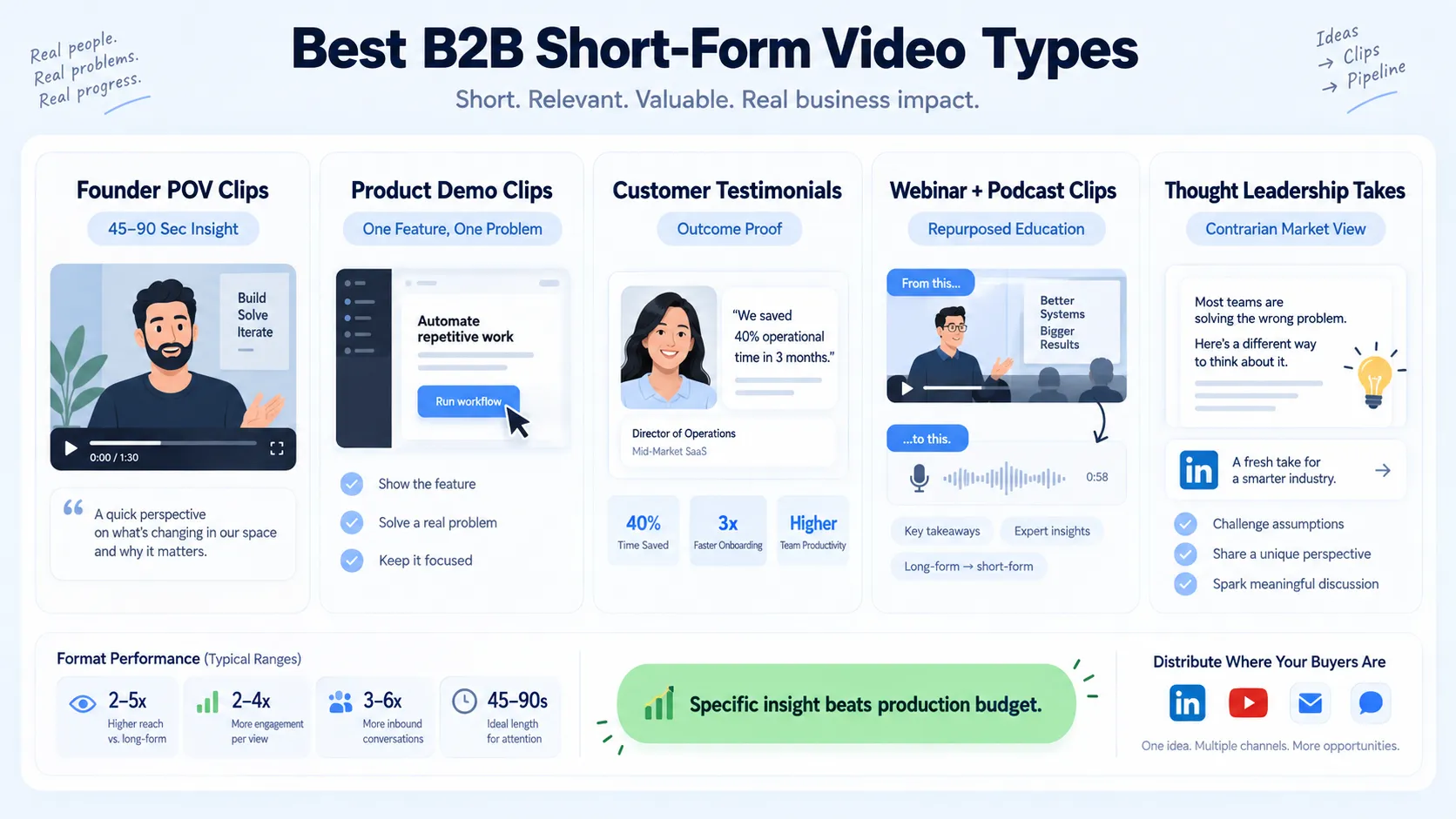
Those two formats are your highest-yield plays. Here's the full breakdown of what works:
- Founder POV clips: A 45–90 second take on a specific pain point, trend, or lesson. No production required. Highest trust-per-dollar of any format.
- Product demos (clipped): Pull a 90-second highlight from a longer demo. Buyers don't watch a 20-minute demo cold, but they will watch a sharp clip that shows one key feature solving one specific problem.
- Customer testimonials: Short, unscripted, focused on outcomes. LinkedIn data shows a +78% engagement lift for video showing authentic emotion, and +41% lift for unscripted versus staged content.
- Webinar and podcast clips: Your long-form content already contains dozens of quotable, educational moments. Pulling these into 60-second clips is the fastest repurposing play available. We turn podcast episodes and webinar recordings into distribution-ready clips as a core part of what we do.
- Thought leadership takes: Commentary on an industry shift or a contrarian perspective. Performs well on LinkedIn because it generates comments and shares rather than passive views.
LinkedIn Creative Labs, analyzing over 13,000 B2B video ads, found that 73% of video completions and 49% of video engagement rates depend on creative decisions rather than budget or production values. The format hierarchy matters less than the content quality and the specificity of the insight. Generic videos about generic topics generate generic results.
Best Short-Form Video Strategies for B2B Brands: A Practical Playbook
The rise of short-form video in B2B creates a real operational challenge: how do you produce enough quality content without burning out your team or blowing your budget? The answer is a system, not a campaign. Here's the framework we use at Komet Media for B2B SaaS and AI startup teams:
- Identify your content sources: Webinars, podcasts, sales calls, founder interviews, product demos, and AMAs are all raw material. If your team creates any long-form content, you already have inventory.
- Extract clips systematically: Pull 3–5 clips per long-form piece. Each clip should make one clear point with a punchy open and a clear close.
- Format for each platform: Square or vertical for LinkedIn and Instagram Reels, vertical for YouTube Shorts and TikTok for Business. Add captions, always.
- Lead with the insight, not the context: Buyers don't need a 10-second setup. Lead with the most valuable sentence in the clip.
- Distribute on a consistent cadence: Volume and consistency matter. One viral clip doesn't build pipeline; a library of credible, specific clips does.
- Repurpose your repurposed content: A LinkedIn clip can become a YouTube Short. A YouTube Short can become a Reel. One source, multiple placements.
HubSpot reports that educational videos, product videos, and webinars were among the most commonly created and highest-impact video formats in 2025. Short-form often works as a distribution layer for bigger ideas: webinar clips, product hooks, founder POVs, event takeaways, customer soundbites, and quick educational posts.
Teams that want to see this in action can explore our video marketing services or review how we approach short-form video editing for B2B clients specifically.
Can Short-Form Video Actually Work for B2B Sales and Pipeline?
Yes, and the data is clear. The skepticism usually comes from teams who tried short-form video as a brand awareness exercise without connecting it to a buyer education or sales enablement system. 93% of marketers say video has given them good ROI, with 49% ranking short-form video as the top ROI format. 82% of businesses say video increased web traffic, 85% report it generated leads, and 83% say it directly boosted sales.
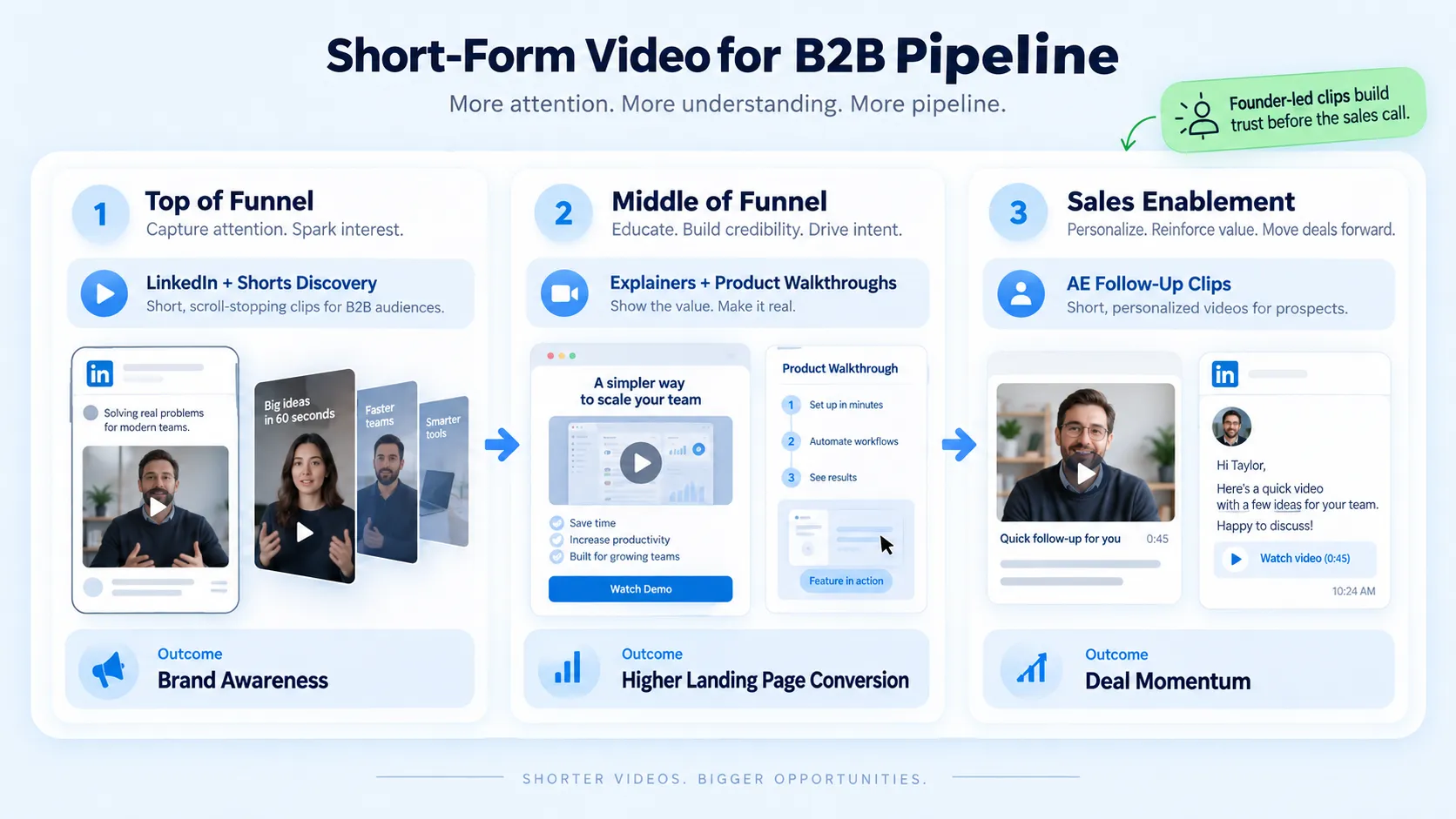
For B2B specifically, the pipeline impact shows up in three places:
- Top of funnel: Short clips on LinkedIn and YouTube Shorts drive discovery and brand awareness among buyers who've never heard of you. This replaces cold outreach as the first touch.
- Middle of funnel: Educational clips, product walkthroughs, feature explanations, use-case demos, shorten the research phase. Landing pages with embedded video convert at 86% higher rates than text-only equivalents. The effect is strongest for complex products and services, B2B SaaS pages with explainer videos see conversion lifts exceeding 100% in controlled testing.
- Sales enablement: Reps share clips in follow-up emails and LinkedIn DMs to reinforce positioning without writing long paragraphs. A 60-second product clip sent after a discovery call keeps momentum alive.
CEO video posts on LinkedIn rose 52% over two years as leaders embrace unscripted video for authenticity. Founder-led content is not just a content strategy, it's a pipeline strategy. When your CEO is publishing specific, credible clips, buyers arrive on sales calls already trusting the product.
The teams generating inbound pipeline from video aren't running campaigns. They're running systems, consistent, specific, and always connected to a buyer problem.
How Do B2B Marketers Measure ROI from Short-Form Video Content?
This is where most teams get stuck. The rise of short-form video in B2B is easy to justify emotionally, harder to justify with a spreadsheet. Here's how to measure it properly. A product demo should usually be judged against conversions or pipeline, while an awareness clip may contribute earlier in the buyer journey and require an assisted-value model. The mistake is applying the same metric to every video. Different clips serve different stages.
Include editing labor, creative review, captioning, tools, media spend, landing-page work, and the reporting time in your cost denominator. If a team counts only the ad budget, it reports a media efficiency metric, not full video marketing ROI. Marketers rank short-form video as the number one ROI format for the third consecutive year, and 57% of marketing budgets now include a dedicated short-form line item.
If your budget doesn't yet include one, this is the year to change that. Platforms like Vidyard and Wistia offer in-depth video analytics specifically for B2B teams, including individual viewer tracking, drop-off points, and CRM integrations that connect video engagement directly to deal data. Those tools close the attribution gap between a view and a pipeline contribution.
Conclusion
The data is unambiguous and the opportunity is real. Here's what matters most:
- Short-form video is the highest-ROI content format in B2B for the third consecutive year, it belongs in your pipeline strategy, not just your brand awareness plan.
- The best content system is a repurposing engine: turn webinars, podcasts, demos, and founder interviews into clips, then distribute across LinkedIn, YouTube Shorts, and Instagram Reels.
- Measurement requires matching the right metric to the right video type, pipeline for demos, assisted value for awareness clips.
- Consistency beats production value. Specific, credible, frequent clips outperform polished campaigns.
If you're ready to build a video system for your B2B team, start here.
Frequently Asked Questions
Q1: How long should a B2B short-form video be?
Under 90 seconds for social distribution. Videos under one minute achieve a 65% completion rate among B2B viewers, compared to just 20% for videos over 20 minutes. For LinkedIn and Reels, 45–75 seconds hits the sweet spot between depth and completion rate.
Q2: Is LinkedIn still the best platform for B2B short-form video?
LinkedIn is the strongest platform for direct pipeline, but it shouldn't be the only one. 70% of video marketers now use LinkedIn, making it the most widely used platform for video marketing, signaling increased B2B adoption and professional content strategies. Pair it with YouTube Shorts for long-term discoverability.
Q3: What's the difference between short-form video and content repurposing?
Short-form video is a format; content repurposing is a production strategy. Short-form often works as a distribution layer for bigger ideas: webinar clips, product hooks, founder POVs, event takeaways, customer soundbites, and quick educational posts. Repurposing turns your existing long-form into that distribution layer.
Q4: Do B2B buyers actually watch TikTok and Instagram Reels for work-related content?
Yes. TikTok and Instagram Reels are increasingly important for B2B campaigns targeting younger decision-makers and early adopters. The 25–40 year-old buyer cohort that now sits in most B2B buying committees grew up on short-form video.
Q5: How many short-form videos should a B2B brand publish per week?
Three to five per week across platforms is a strong starting cadence. Volume matters because performance isn't driven by flashy production or big budgets, it's driven by creative intent, with videos that are emotionally resonant and strategically crafted consistently outperforming the rest. Consistency compounds faster than perfection.
Q6: What's the biggest mistake B2B teams make with short-form video?
Treating it as a campaign instead of a system. The brands that succeed in 2026 build scalable video systems rather than isolated campaigns. One video won't move the pipeline. A consistent library of specific, buyer-focused clips will.