
🪄 AI Summary
Heading 1
Heading 2
Heading 3
Heading 4
Heading 5
Heading 6
Lorem ipsum dolor sit amet, consectetur adipiscing elit, sed do eiusmod tempor incididunt ut labore et dolore magna aliqua. Ut enim ad minim veniam, quis nostrud exercitation ullamco laboris nisi ut aliquip ex ea commodo consequat. Duis aute irure dolor in reprehenderit in voluptate velit esse cillum dolore eu fugiat nulla pariatur.
Block quote
Ordered list
- Item 1
- Item 2
- Item 3
Unordered list
- Item A
- Item B
- Item C
Bold text
Emphasis
Superscript
Subscript
Most edtech teams have a content problem hiding behind a distribution problem. Product demos sit on hard drives, webinars expire without a second life, and founders with genuine expertise never appear on camera. Video marketing for edtech companies fixes all three, but only when it's treated as a pipeline system, not a branding exercise. This guide covers every strategy, format, mistake, and ROI lever I've built systems around at Komet Media.
TL;DR
- Microlearning video achieves an 80% course completion rate versus roughly 20% for traditional long-form formats, your marketing format and product format are the same thing.
- Short-form clips repurposed from webinars and demos drive enrollment, reduce customer acquisition cost, and build buyer trust before a single sales call.
- YouTube, LinkedIn, and TikTok each serve a distinct funnel stage. Treating them as interchangeable wastes budget.
- The biggest edtech video mistake is optimizing for views instead of pipeline.
Video Marketing Strategies for Edtech Companies That Actually Drive Pipeline
Most edtech video strategies fail because they are built around awareness instead of conversion. The fix is a three-layer video system mapped to your enrollment funnel.
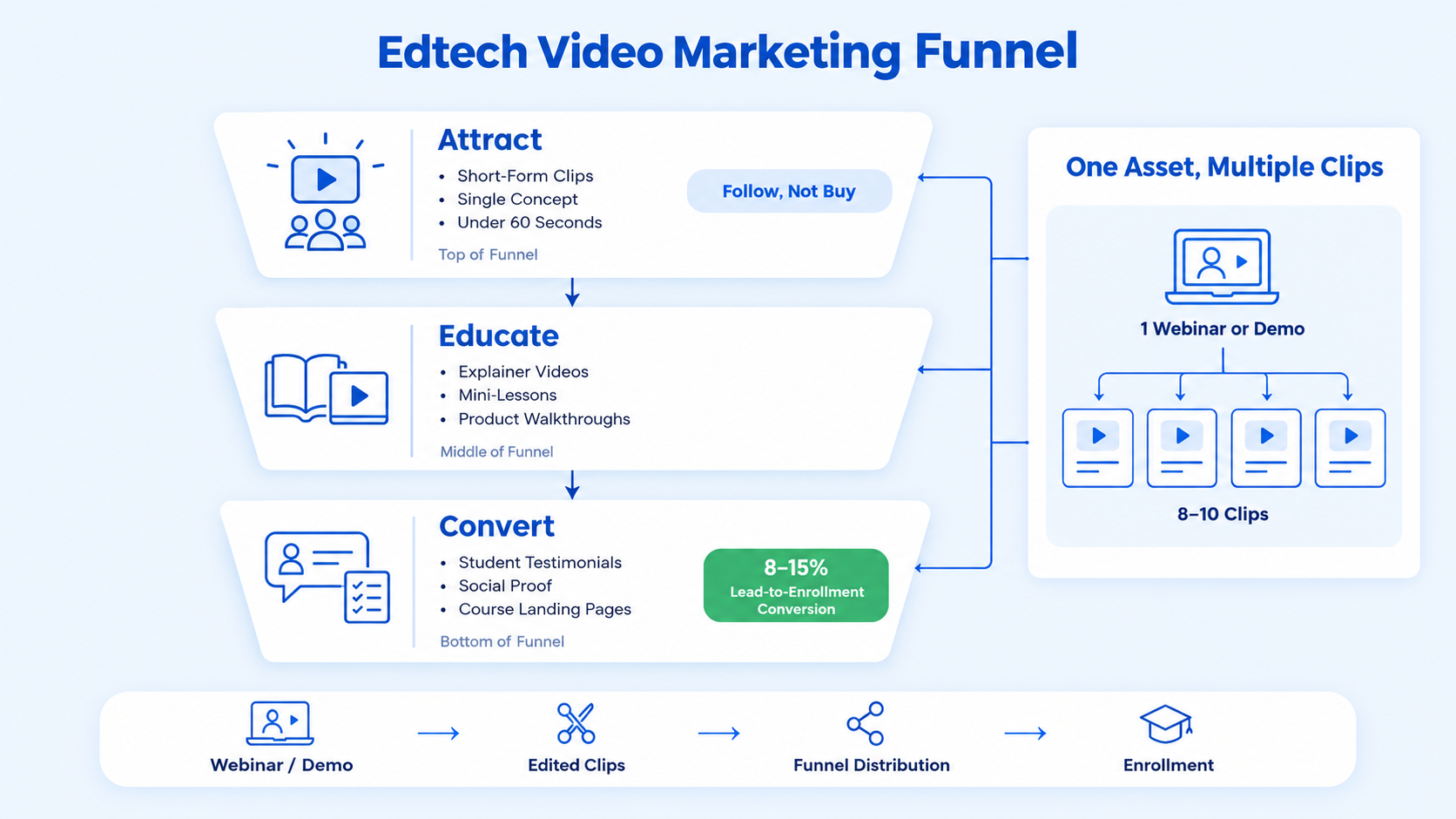
Layer 1, Top of Funnel (Attract): Short-form clips on TikTok, Instagram Reels, and YouTube Shorts introducing a single concept, pain point, or "did you know" insight from your course. These exist to earn attention from cold audiences who have never heard of your platform. Keep them under 60 seconds, and end with a low-friction CTA, follow, not buy.
Layer 2, Middle of Funnel (Educate): This is where video marketing for edtech companies really earns its value. Explainer videos, mini-lessons, and product walkthroughs on YouTube and LinkedIn Learning-style formats educate your buyer about the transformation your product delivers. These videos should answer the questions a prospect types into Google before requesting a demo.
Layer 3, Bottom of Funnel (Convert): Testimonial videos, social proof clips, and founder-led "why we built this" stories placed directly on course landing pages and checkout flows. Brands embedding testimonial-style videos directly onto course landing pages and checkout flows provide social proof right when the prospect is deciding to enroll, and high-quality edtech lead generation campaigns utilizing targeted video creatives achieve an 8% to 15% lead-to-enrollment conversion rate.
Each layer feeds the next. The most common mistake is producing only layer one content and wondering why views don't convert. A content repurposing strategy changes the economics entirely: one webinar or product demo, properly edited, becomes 8–10 short clips that serve all three funnel layers at once.
If your team runs webinars or podcast content, those assets are your raw material. Turning them into clips is the highest-ROI production move available to any edtech team.
How Edtech Companies Use Video to Increase Student Enrollment
Enrollment is an intent and trust problem. Prospects browse, compare, and delay. Video collapses that delay by making the learning experience tangible before a credit card is entered. The format that drives enrollment most efficiently is the micro-lesson preview, a 60–90 second clip that delivers genuine value from inside your course or platform. It functions as a free sample, not a trailer. When a prospect watches your instructor explain a concept clearly in 90 seconds, they stop asking "is this worth it?" and start asking "when does it start?"
One university restructured its TikTok campaigns around student journey stages and achieved a 29% lower CPM, a 1.9% increase in click-through rate, and a 640% increase in total clicks. Those are enrollment infrastructure metrics, not vanity stats. Landing page video is equally important. Video on landing pages increases conversions by 86% compared to text-only equivalents, and that effect is strongest for complex products where video reduces cognitive load before the purchase decision.
The enrollment video stack I recommend to edtech clients:
- Instructor authority clip: 45–60 seconds, on the course landing page, featuring the lead instructor or founder.
- Outcome story: A 60–90 second learner testimonial placed below the pricing section.
- Micro-lesson preview: 60–90 seconds of real course content, embedded in the enrollment CTA area.
- Product walkthrough: A 2–3 minute screen-plus-voiceover for B2B buyers evaluating your Learning Management System or platform.
With edtech's average conversion rate sitting at 2–3% , adding video to these critical conversion points is one of the few levers that moves that number without increasing ad spend.
What Types of Videos Work Best for Edtech Marketing
Not all formats serve the same job. Here is the framework I use to match format to funnel stage and audience type.
63% of consumers would rather watch a short video than read an article or sit through a webinar to learn about a product. For edtech teams, that means every long-form asset, a webinar, a demo recording, a podcast episode, should be broken into short clips immediately after it's published. 87% of learners remember more when they use video-based training compared to traditional methods.
That stat is your product case and your marketing case simultaneously. When your short clips are also instructionally designed, one concept, clear structure, strong close, they function as proof of your pedagogy, not just promotion. The format I see most underused by edtech teams is the short-form video repurposed from existing long-form content. A single 45-minute webinar contains between 8 and 12 clip-worthy moments. Most teams produce zero of them.
How to Create Explainer Videos for an Edtech Product
An explainer video for an edtech product has one job: make the transformation undeniable in under two minutes. Here is the production process I walk clients through:
- Identify the one problem: Start with the single most painful problem your buyer has before discovering your platform. Not three problems, one.
- Show the before state: Two to three sentences (or on-screen text) describing life without your product. Specificity matters, "spending 6 hours building a course from scratch" beats "inefficiency."
- Introduce your solution: Name the product and explain the mechanism. Avoid category jargon. "We turn your recorded demos into a structured microlearning course in 48 hours" is clearer than "AI-powered instructional design platform."
- Prove the outcome: A learner stat, a completion rate, or a customer quote. This is where social proof in education earns its weight.
- Show the product: 20–30 seconds of actual UI or workflow, not a polished animation alone. Buyers want to see what they're buying.
- Close with a specific CTA: "Start your free trial" or "Book a 20-minute demo", not "Learn more."
Production notes for edtech explainers:
- Keep it under 90 seconds for paid distribution; 2–3 minutes for organic YouTube and landing pages.
- Use captions. Most platform video plays without sound on first impression.
- Optimal video length for YouTube educational content sits at 6–12 minutes for full tutorials , but explainer cuts for ads and social should be 60–90 seconds.
- If you are repurposing an existing product demo recording, the raw material already exists, it just needs editing.
How to Use YouTube for Edtech Brand Awareness
YouTube for Education is not a side channel. YouTube pre-roll carries awareness work efficiently for student and professional segments, and video SEO is an underused differentiator for edtech specifically because the product is inherently visual, optimizing YouTube course preview videos with timestamped chapters, keyword-rich descriptions, and end-screen CTAs creates an acquisition channel that most competitors ignore.
YouTube's algorithm weights average view duration at approximately 3x the importance of raw view count when deciding which videos to recommend. This matters for edtech because instructional content naturally earns higher retention. Tutorial and how-to content achieves 45–60% average retention on YouTube, while educational content sits at 40–55%, both significantly above the platform average.
The YouTube strategy for edtech brand awareness I build around three content types:
- Keyword-anchored tutorials: Target the exact search terms your buyers type before enrolling. Khan Academy and Coursera built their organic presence this way, answering specific learner questions at scale.
- Platform comparison / "Which tool is right for you" videos: These capture buyers in active evaluation mode and position your platform as the trusted guide.
- Founder and team videos: LinkedIn video viewership was up 36% year-on-year as of 2025 , and the same trust dynamic applies on YouTube, buyers want to see who is behind the product.
YouTube Shorts deserve a dedicated strategy. YouTube Shorts now average over 200 billion daily views. Edtech teams can use Shorts to surface micro-lessons that funnel to full YouTube tutorials, which in turn funnel to course landing pages. The compounding advantage of YouTube over paid social: a well-optimized tutorial video from 2026 is still driving inbound traffic in 2028. Paid ads stop the moment you stop paying.
Pair YouTube with a structured content repurposing strategy and your webinar recordings and podcast episodes become perpetual discovery assets.
Edtech Video Marketing Mistakes to Avoid
Most edtech video programs produce content without a clear distribution system, which is why they fail to show ROI. Here are the six mistakes I see most often:
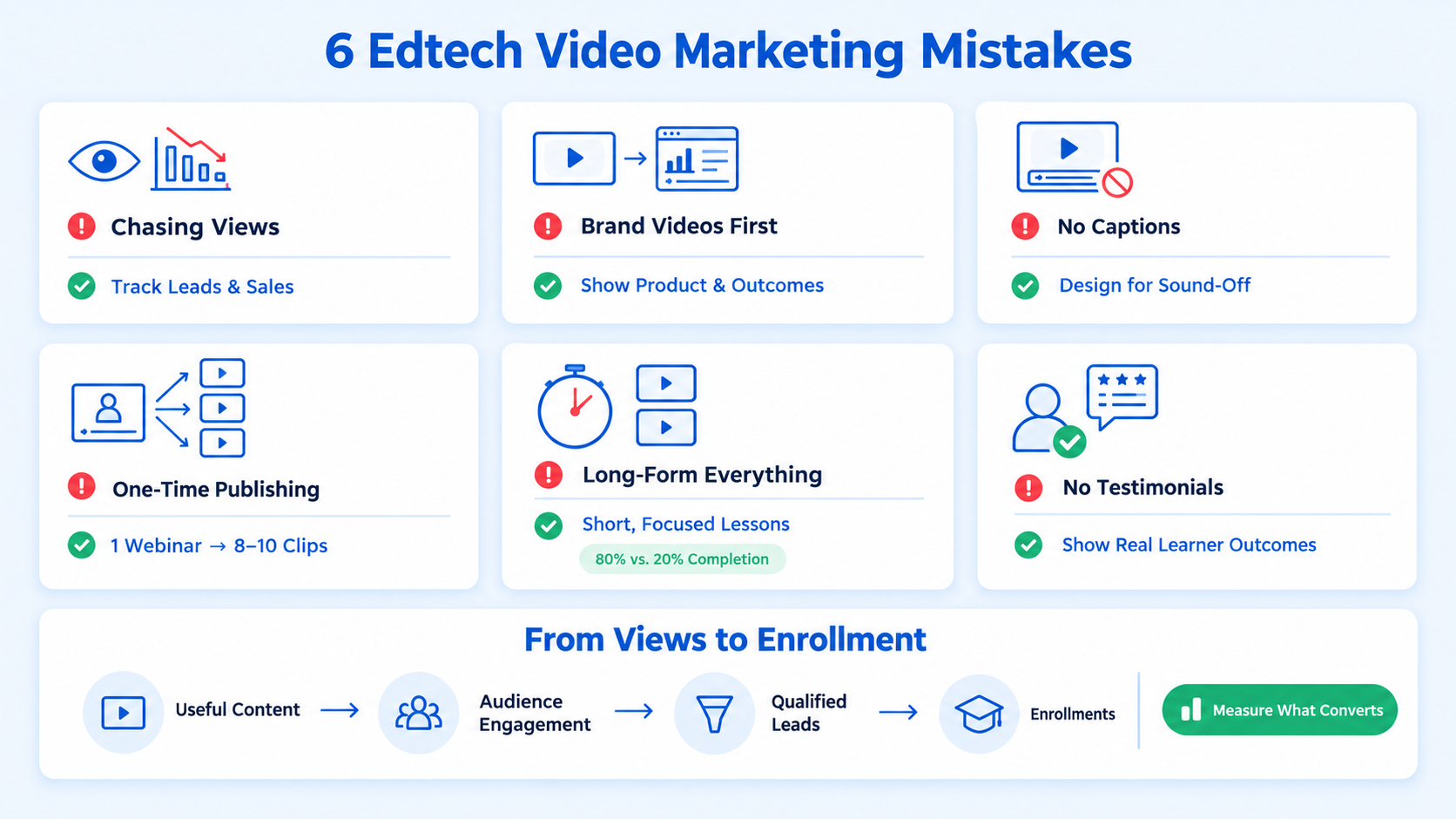
- Optimizing for views instead of pipeline: 52% of marketers quantify video returns through leads and clicks, 40% through engagement and retention, and 32% through bottom-line sales. Views are a vanity metric unless they lead to tracked conversions.
- Producing brand videos before product videos: An edtech buyer wants to see your course interface, your instructor, and a learner outcome before they care about your brand story.
- Ignoring captions: A substantial share of social video plays without sound. No captions means losing a large portion of your audience on first impression.
- No content repurposing system: Publishing a webinar once and never extracting clips from it is the single biggest content waste in edtech. Repurposing one webinar or course module into 8–10 clips is the highest-ROI production approach available to edtech teams.
- Long-form everything: Microlearning courses carry an average completion rate of 80%, while long-form learning modules see only 20% completion. This applies to your marketing content, not just your courses, long videos earn low completion rates in the feed.
- Skipping social proof: Buyers in the edtech startup ecosystem trust peer outcomes more than product claims. One 60-second learner testimonial on a landing page outperforms a polished brand video in conversion tests.
What Is the ROI of Video Marketing for Edtech Companies, and How Do Startups Grow on a Small Budget?
ROI in video marketing for edtech companies is measured across three dimensions: lower customer acquisition cost, higher conversion rate, and improved learner retention rate once enrolled.
On acquisition: edtech platforms that invested in TikTok educational content found organic customer acquisition costs 5–15x lower than paid TikTok or Meta campaigns for student acquisition. Organic short-form video on TikTok and Reels is the highest-leverage distribution channel for early-stage edtech teams with limited budgets.
On conversion: 84% of video marketers report that video has directly helped increase sales, while the same percentage say video has helped keep visitors on their website longer. Both reduce CAC by making paid traffic work harder.
On retention: Microlearning can boost knowledge retention by 25% to 60% compared to traditional longer formats. For edtech, learner retention rate is a product metric and a marketing metric, learners who complete courses leave reviews, refer peers, and enroll in the next course.
For edtech startups operating on a small budget, the playbook is straightforward:
- Record your next product demo, onboarding call, or founder explanation session.
- Edit it into 3–5 short clips targeting specific pain points your buyer searches for.
- Post consistently to one platform, TikTok or LinkedIn depending on your buyer, for 90 days.
- Track which clips drive the most landing page visits, not just views.
- Reinvest in producing more of what drives traffic, not more of what gets likes.
82% of marketers say video delivers positive ROI, and 93% say video has helped increase user understanding of their product or service. For a B2B SaaS edtech team, product understanding is the conversion event. When a buyer fully understands what your platform does after watching three short clips, the demo becomes a formality.
The Komet Media services page covers the full production and repurposing system for teams ready to build this without hiring an in-house video team.
Conclusion
Video marketing for edtech companies is not a content strategy, it is an enrollment and pipeline system. The takeaways that matter:
- Repurposing existing webinars, demos, and founder thinking into short clips is faster and cheaper than producing from scratch.
- Map every video format to a funnel stage; do not produce content without knowing its conversion job.
- YouTube for organic authority, TikTok and Reels for low-CAC acquisition, landing page video for conversion.
- Measure success in leads, enrollments, and demo requests, not views.
Ready to build this for your team? Start here.
Frequently Asked Questions
Q1: What is the best video length for edtech marketing content?
For top-of-funnel social clips, keep videos under 60–90 seconds. For YouTube tutorials and product explainers, 6–12 minutes performs well for retention. Landing page explainers should stay under 2 minutes. Match length to where in the funnel the viewer is.
Q2: How many videos does an edtech startup need to see results?
Consistency outweighs volume early on. A single repurposed webinar can yield 8–10 clips. Posting 3–4 clips per week from existing content for 90 days gives a clearer signal than sporadic high-production launches.
Q3: Should edtech companies invest in short-form or long-form video first?
Short-form first. Videos under 90 seconds achieve 50% completion rates on social platforms, delivering 2.5x more engagement than long-form. Short clips earn the attention you need before long-form earns the trust.
Q4: What metrics should edtech teams track for video ROI?
Track landing page visits from video, demo requests, trial sign-ups, and enrollment conversions, not view counts. Landing pages with video see 86% higher conversion rates, adding one product or founder explainer to your main money page before spending more on traffic is the highest-leverage first move.
Q5: Can existing webinar or podcast content be repurposed into video marketing?
Yes, and this is the most underused asset in edtech. A 45-minute webinar recording typically contains 8–12 clip-worthy moments. Each becomes a standalone short-form asset for social distribution, email, or sales enablement.
Q6: How does video-based learning improve course completion rates for edtech platforms?
Microlearning achieves an 80% completion rate on average, while conventional long-form courses manage only around 20%. Structuring both your product and your marketing content around short, single-concept videos directly improves the learner retention rate metric that drives renewals and referrals.