
🪄 AI Summary
Heading 1
Heading 2
Heading 3
Heading 4
Heading 5
Heading 6
Lorem ipsum dolor sit amet, consectetur adipiscing elit, sed do eiusmod tempor incididunt ut labore et dolore magna aliqua. Ut enim ad minim veniam, quis nostrud exercitation ullamco laboris nisi ut aliquip ex ea commodo consequat. Duis aute irure dolor in reprehenderit in voluptate velit esse cillum dolore eu fugiat nulla pariatur.
Block quote
Ordered list
- Item 1
- Item 2
- Item 3
Unordered list
- Item A
- Item B
- Item C
Bold text
Emphasis
Superscript
Subscript
If you're building or scaling a martech product, your buyers are sophisticated, skeptical, and drowning in vendor noise. Written content alone rarely breaks through. Video marketing for martech companies is how you compress complex ideas, build trust with technical buyers, and generate pipeline before a sales rep ever enters the conversation. This guide covers the full strategy: the right video types, the right cadence, how to explain complex products on screen, what to measure, and the mistakes that quietly kill ROI.
TL;DR
- 91% of businesses now use video as a marketing tool in 2026, making differentiated execution the only competitive lever.
- Martech buyers need education before they want demos; short-form video handles both jobs when structured correctly.
- Explainer videos win at the top of the funnel; demo videos close at the bottom. Use both.
- Measure pipeline contribution, not just views.
What Makes Video Marketing for Martech Companies Different From Generic B2B Video?
Martech is not a simple category. The martech landscape now sits at 15,505 tools, and the market will hit $859 billion in 2025. That scale means buyers arrive at your website already fatigued from evaluating competitors. Generic explainer videos about "streamlining your workflow" will not move them.
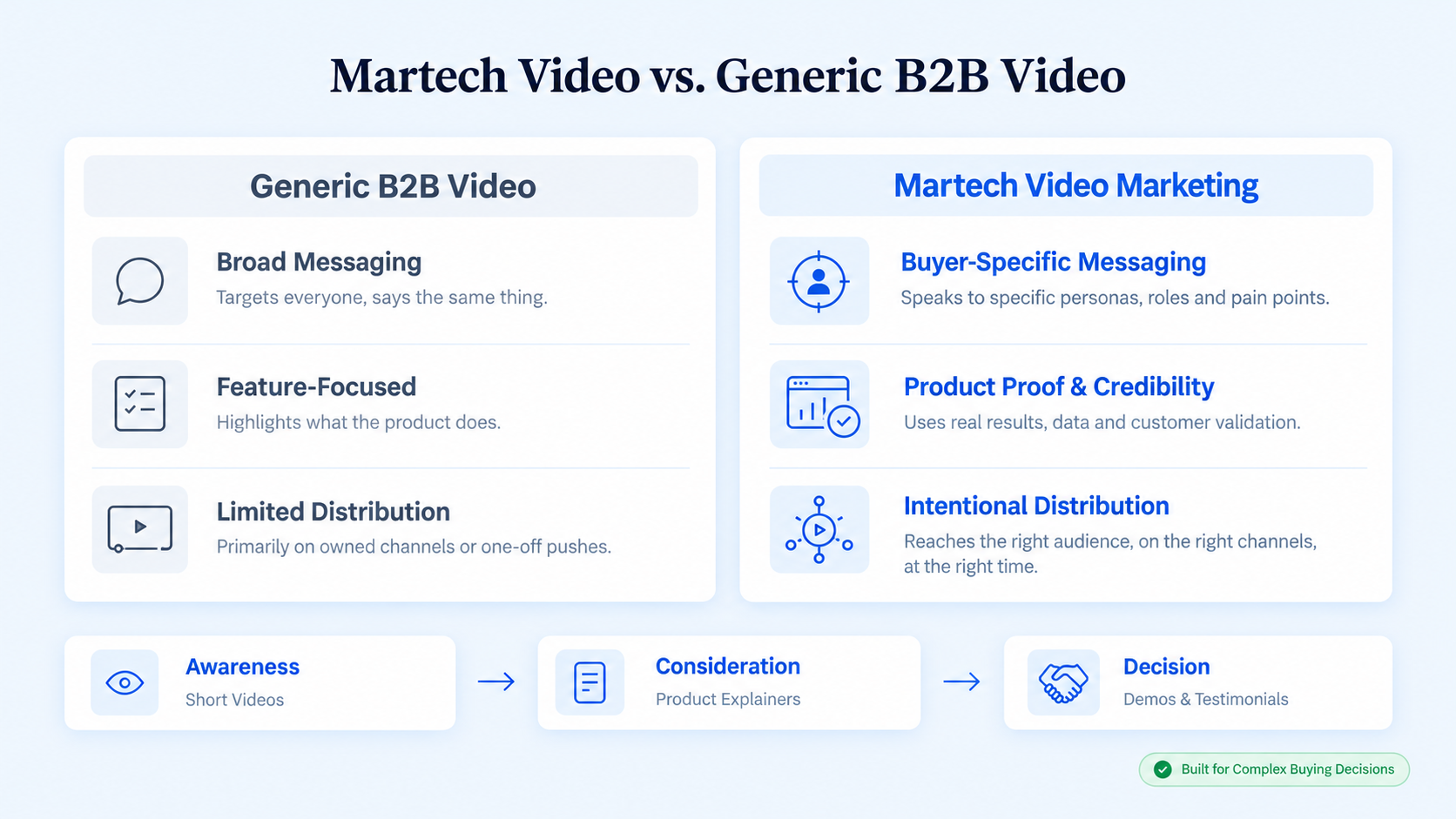
Video marketing for martech companies has to do specific work: it must separate your product from the 15,000 others on the landscape, educate buyers on a problem they may not have fully articulated, and accelerate a decision that typically involves three to seven stakeholders. That is a different brief than most video agencies are handed.
The right video strategy maps against the martech buyer journey at each stage. At awareness, short-form video on LinkedIn and YouTube Shorts introduces a sharp point of view on a problem your product solves. At consideration, product explainers and founder-led thought leadership build enough trust to justify a demo request. At decision, walkthroughs and customer testimonials do the closing work your sales team would otherwise do on calls.
Tech marketers use video to explain complex products (49%), improve brand awareness (39%), generate leads (29%), and increase conversion rates (17%), making video one of the few formats that compounds across the entire funnel.
Three factors separate effective martech video from generic B2B video. First, specificity: the video must name the exact buyer role and the exact problem, not a category-level pain. Second, credibility signals: logos, data points, and real product UI carry more weight with technical buyers than motion graphics alone. Third, distribution intent: martech buyers are on LinkedIn, in Wistia-powered resource centers, and watching platform-embedded videos on your HubSpot landing pages. A video sitting on YouTube with no distribution plan is invisible.
At Komet Media, every martech video we produce starts with those three filters before a single frame is edited.
How Do Martech Companies Use Video to Generate Leads and Accelerate Pipeline?
The fastest path to the pipeline from video is landing page placement. Landing pages with embedded video see up to 86% higher conversion rates than those without, and for B2B SaaS companies running paid campaigns, adding a product walkthrough or founder video to a landing page can redefine what the same ad spend returns.
The second lever is demand generation through short-form educational content. A 60-second video explaining a specific buyer problem, posted consistently to LinkedIn, builds the kind of familiarity that shortens your sales cycle. Integrating video into the sales process can shorten the overall sales cycle by 23%. For martech companies with sales-assisted motions, that compression directly reduces customer acquisition cost.
The third lever is sales enablement. When your SDRs send a personalized product video instead of a text email, response rates rise. When your account executives drop a two-minute Vidyard walkthrough into a follow-up, deals move faster. Video that sits only on your website is wasted leverage.
For martech startups in go-to-market mode, the distribution hierarchy looks like this:
- Embed video on high-intent landing pages (pricing, demo request, product pages).
- Repurpose the same video into short-form clips for LinkedIn and YouTube Shorts.
- Send video clips in outbound sequences via Vidyard or Wistia.
- Use webinar recordings as gated content in account-based marketing sequences.
- Feed high-performing clips into paid retargeting for product-led growth audiences.
Videos featuring customer testimonials have a 44% higher conversion rate in the decision stage, and 97% of B2B buyers say peer reviews and testimonials are the most reliable content type when evaluating a product. For pipeline acceleration, testimonial clips embedded into sales sequences earn more trust than any feature overview. Our video marketing services are built specifically around this pipeline-first distribution model, not just production output.
What Types of Videos Work Best for Martech and B2B SaaS Brands?
Not all video formats pull the same weight at the same funnel stage. Here is how the formats map for a typical martech go-to-market strategy:
High-ROI video focuses on practical education rather than brand storytelling. The most effective formats are 30–60 second explainers, customer testimonials, and product demos that answer specific buyer questions.
For martech specifically, founder-led videos outperform polished brand content because they communicate conviction. A founder explaining exactly which pain their product solves, in plain language, on camera, builds more trust in 90 seconds than a produced motion graphics reel does in three minutes. This is where content repurposing earns its full value: one webinar or podcast recording becomes five to eight short-form clips, each targeting a different buyer question across LinkedIn, email sequences, and your marketing technology stack.
Webinars remain the highest-converting video format, with 73% of B2B marketers rating them highly effective, which makes webinar repurposing one of the highest-leverage activities in any martech content strategy.
Explainer Video vs Demo Video for Martech Products: Which One Do You Need First?
This is the most common question I hear from martech founders and marketing heads, and the answer is: it depends on where your buyers are getting stuck. Explainer videos educate audiences about problems and solutions (60–90 seconds, animated or live-action, builds awareness), while product demos showcase how your specific product works (2–5 minutes, screen recordings or walkthroughs, drives conversions). They serve different stages of the buyer journey.
For a martech startup with low brand awareness, an explainer comes first. Your buyers do not yet have enough context to evaluate a demo. An explainer does not require the viewer to understand your product category. A product demo assumes the viewer already knows what your software is and wants to see how yours works. An explainer can start from scratch: "Your team wastes 10 hours per week on manual tasks. Here is how to get that time back." That makes explainer videos far more effective for cold audiences.
For a martech company with existing inbound traffic but a low demo request rate, a demo video comes first. Your visitors already understand the category; they need proof that your product specifically solves their problem.
The practical decision framework:
- If most inbound traffic is cold or category-unaware, prioritize the explainer.
- If your demo-to-close rate is strong but demo request volume is low, prioritize the demo video on the product page.
- If your sales cycle involves multiple stakeholders, build both and route each format to the appropriate buying stage.
SaaS companies with an explainer video on their homepage see 20–30% higher conversion rates on average compared to those without any video. Once that lift is captured, a product demo video embedded on the pricing or features page compounds the effect further down the funnel.
How Often Should Martech Companies Post Video Content on LinkedIn?
LinkedIn is the primary distribution channel for video marketing for martech companies. The algorithm in 2026 rewards substance over volume. Native video content receives 5x more engagement than static posts on average, and the algorithm specifically boosts educational and how-to video content over promotional material.
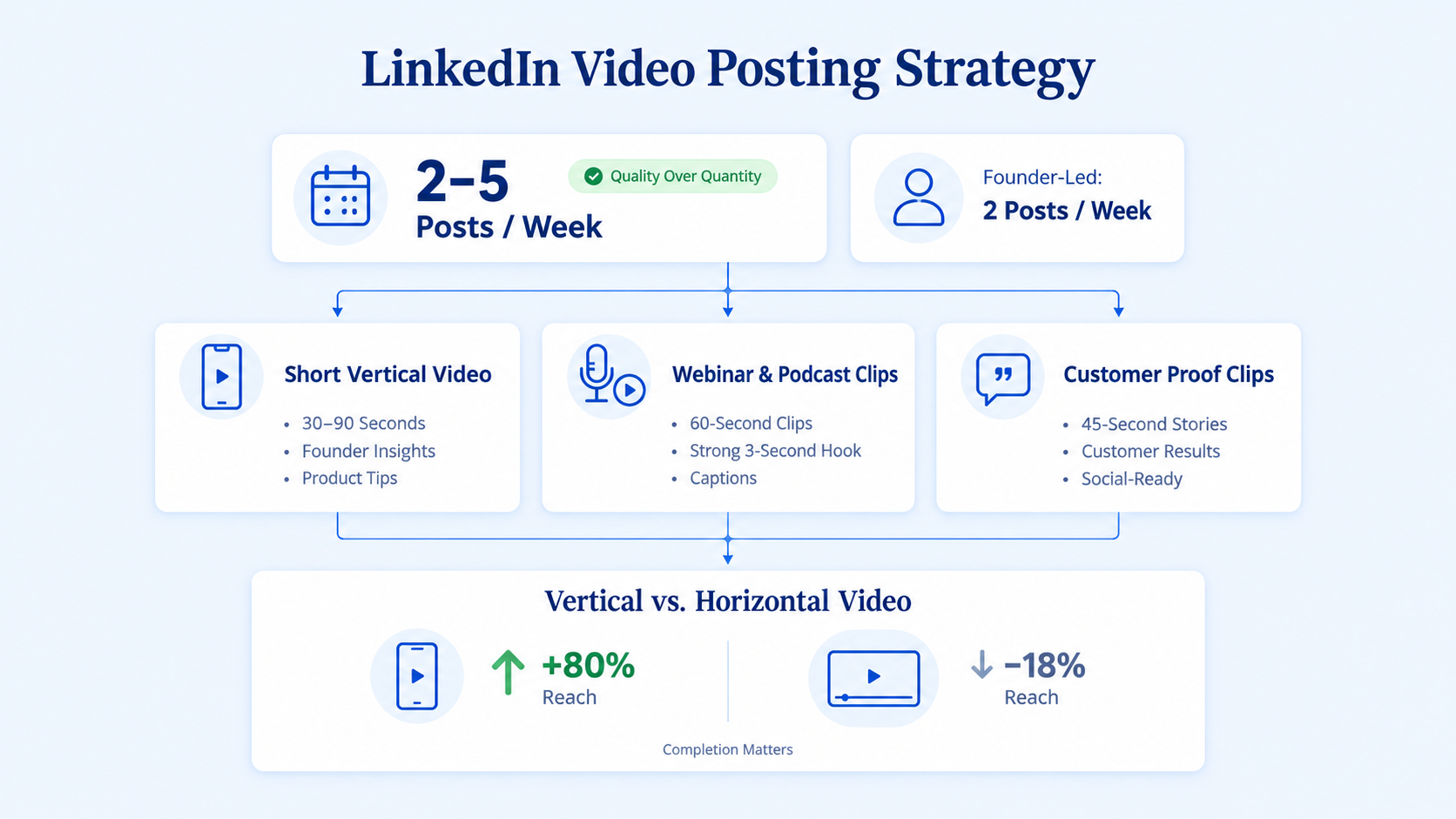
On posting frequency, the data converges on a clear range. Posting 2–5 times per week is the sweet spot, with quality over quantity every time. For founders and executives with limited content bandwidth, posting just twice a week often yields better lead-generation results for that demographic.
Format guidance for martech video on LinkedIn in 2026:
- Short vertical video (30–90 seconds): Founder commentary on a martech trend, a product insight, or a buyer mistake. This drives brand recall and warm audiences for retargeting.
- Educational clips from webinars or podcasts: A 60-second pull from a webinar session, captioned, with a hook in the first three seconds.
- Customer proof clips: A 45-second customer testimonial edited for social, with the result in the caption headline.
Video usage surged 69% year-over-year on LinkedIn, but the algorithm penalises content people do not finish. Short vertical video (30–90 seconds) with captions is the exception, with vertical video reach increasing 80% while horizontal video reach declined 18%.
For martech teams without in-house editing capacity, our short-form video editing service is built exactly for this distribution cadence: consistent, on-brand clips ready to post without internal production overhead.
How to Measure ROI of Video Marketing for a Martech Company
Views and watch time are not business outcomes. The metrics that matter for martech video tie directly to pipeline, demo demand, and revenue. Less than half of marketers connect their video platform to their CRM to track video analytics alongside their marketing data, a measurable missed opportunity for pipeline attribution. 74% of companies measure video ROI through engagement metrics like views, view rates, and average watch time. That gap is where most martech teams leave real signals on the table.
The measurement framework I recommend for martech video ROI:
- Video-influenced pipeline: Tag every lead who watched a key video before requesting a demo. Compare close rates against leads who did not.
- Demo request conversion rate: Track whether embedding a product demo video on the demo request page lifts submissions.
- Sales cycle length: Compare average days-to-close for deals where video was used in follow-up sequences versus those where it was not.
- Customer acquisition cost: If video reduces the number of sales calls needed to close, CAC decreases even if ad spend holds flat.
- Content repurposing output ratio: Measure how many distribution assets you generate per hour of recorded content. More assets per recording means lower cost per impression across the marketing technology stack.
Over half (52%) of B2B marketers cite video as the content type generating the highest ROI precisely because it compounds: a single webinar recording repurposed through Komet Media's content repurposing workflow can power LinkedIn posts, email sequences, sales enablement clips, and paid retargeting simultaneously, compressing your cost per pipeline touch over time.
Plug Wistia or Vidyard into your HubSpot or CRM so every video view creates a contact activity. Then build a lead score threshold that triggers an SDR alert when a prospect watches more than 60% of a demo video. That single workflow alone can materially accelerate pipeline acceleration without increasing headcount.
The Biggest Video Marketing Mistakes Martech Companies Make
Most martech video underperforms not because the production is bad, but because the strategy is wrong.
Mistake 1: Producing video without a distribution plan. A product explainer sitting on a Vimeo link nobody visits is sunk cost. Every video needs a mapped distribution path before production begins.
Mistake 2: Over-producing and under-distributing. Teams spend their full budget on a single hero video and have nothing left for the short-form clips that actually generate daily pipeline on LinkedIn. Allocate at least 40% of video budget to short-form repurposing.
Mistake 3: Using features as the hook instead of buyer outcomes. Martech buyers do not watch a video because they want to see your dashboard. They watch because they have a problem they need solved. Lead with the outcome, not the feature.
Mistake 4: Ignoring sales enablement as a video channel. Most video strategies stop at marketing. The highest-leverage application of video in a martech go-to-market is often inside the sales sequence, where a personalized 90-second product clip sent to a stalled deal can re-engage a buyer more effectively than any email.
Mistake 5: Not repurposing existing long-form content. Marketers actively used just 49% of their martech stack capabilities in 2025. The same underutilization pattern applies to content: most martech companies have hours of recorded webinars, demos, and podcast episodes that have never been edited into short-form assets. That library is a pipeline asset waiting to be activated. Explore our podcast editing and webinar repurposing workflows to convert that backlog into distribution-ready clips.
Conclusion
Video marketing for martech companies is not a branding exercise; it is a pipeline mechanism. Here are the core takeaways:
- Map every video to a funnel stage before production starts. Explainers educate cold audiences; demos convert warm ones; testimonials close.
- Distribute before you produce more. One well-repurposed webinar recording outperforms five underutilized hero videos.
- Post 2–5 short-form videos per week on LinkedIn, with captions, vertical format, and a clear hook in the first three seconds.
- Measure video's contribution to the pipeline, not just engagement metrics, to build the internal case for continued investment.
Ready to build a video system that actually drives the pipeline? Talk to our team at Komet Media.
Frequently Asked Questions
Q1: What is video marketing for martech companies, and why does it matter in 2026?
Video marketing for martech companies is the use of short-form video, product demos, explainers, and thought leadership content to educate buyers, generate pipeline, and shorten sales cycles. With 91% of businesses using video as a marketing tool in 2026, martech companies that rely only on text content cede visibility to competitors who show up on video.
Q2: How much video content should a martech startup produce per month?
Start with two to three LinkedIn videos per week, one repurposed webinar or demo clip per month, and one evergreen explainer or product demo per quarter. Repurposing existing recordings through a workflow like Komet Media's content repurposing service maximizes output without proportional production cost.
Q3: Should martech companies use animated or live-action explainer videos?
Both work. Animated explainers are better for abstract or category-new concepts. Live-action or founder-led videos build more trust for buyers evaluating a known category. Videos with emotional engagement see a 44% higher view-through rate and 2x completions, and founder-on-camera formats typically deliver stronger emotional connection than pure animation.
Q4: What is the ideal length for a martech product demo video?
A UI demo runs 30–90 seconds for landing pages and advertising, while a founder-led demo runs 2–5 minutes for B2B sales and closing contexts. Match length to intent: shorter for cold traffic, longer for warm prospects who have already requested more information.
Q5: How do I use video for account-based marketing in martech?
Use personalized video clips in outbound sequences targeting named accounts, embed product walkthrough videos in account-specific landing pages, and route customer testimonials from similar-sized or same-vertical companies into ABM nurture tracks. 38% of B2B buyers are more likely to watch videos personalized to their industry, and videos addressing specific buyer pain points see a 41% higher watch-through rate than generic product videos.
Q6: What tools should a martech company use to host and track video performance?
Wistia and Vidyard are the two platforms built specifically for B2B pipeline attribution. Both integrate with HubSpot and most CRMs, enabling contact-level tracking of who watched what and for how long. Wistia reports a 16% average video CTA conversion rate across more than 36,000 video CTAs, making CTA placement inside hosted video one of the highest-ROI moves a martech marketing team can make.