
🪄 AI Summary
Heading 1
Heading 2
Heading 3
Heading 4
Heading 5
Heading 6
Lorem ipsum dolor sit amet, consectetur adipiscing elit, sed do eiusmod tempor incididunt ut labore et dolore magna aliqua. Ut enim ad minim veniam, quis nostrud exercitation ullamco laboris nisi ut aliquip ex ea commodo consequat. Duis aute irure dolor in reprehenderit in voluptate velit esse cillum dolore eu fugiat nulla pariatur.
Block quote
Ordered list
- Item 1
- Item 2
- Item 3
Unordered list
- Item A
- Item B
- Item C
Bold text
Emphasis
Superscript
Subscript
Most AI and ML startups have a product that genuinely outperforms the competition. What they lack is a clear, trustworthy way to show it. Buyers can't hold software, touch an ML model, or feel a prediction engine work. They judge on what they see, and right now, most AI startup videos are either too technical, too generic, or simply missing. This guide covers every decision that matters in video marketing for AI and ML startups companies, from strategy to execution to measurement.
TL;DR
- 70% of B2B buyers review video content while making a purchase decision, and 81% trust video more than written content.
- Explainer videos, product demos, and founder-led clips are the three highest-leverage formats for AI/ML products.
- LinkedIn and YouTube are your primary distribution channels; short-form repurposing multiplies their reach.
- Measure pipeline contribution and demo bookings, not views.
How to Use Video Marketing for AI Startups: The Strategic Foundation
Before picking a video format, you need a clear answer to one question: what does your buyer not yet understand that is costing you pipeline? Every AI startup's video strategy lives or dies on that answer.
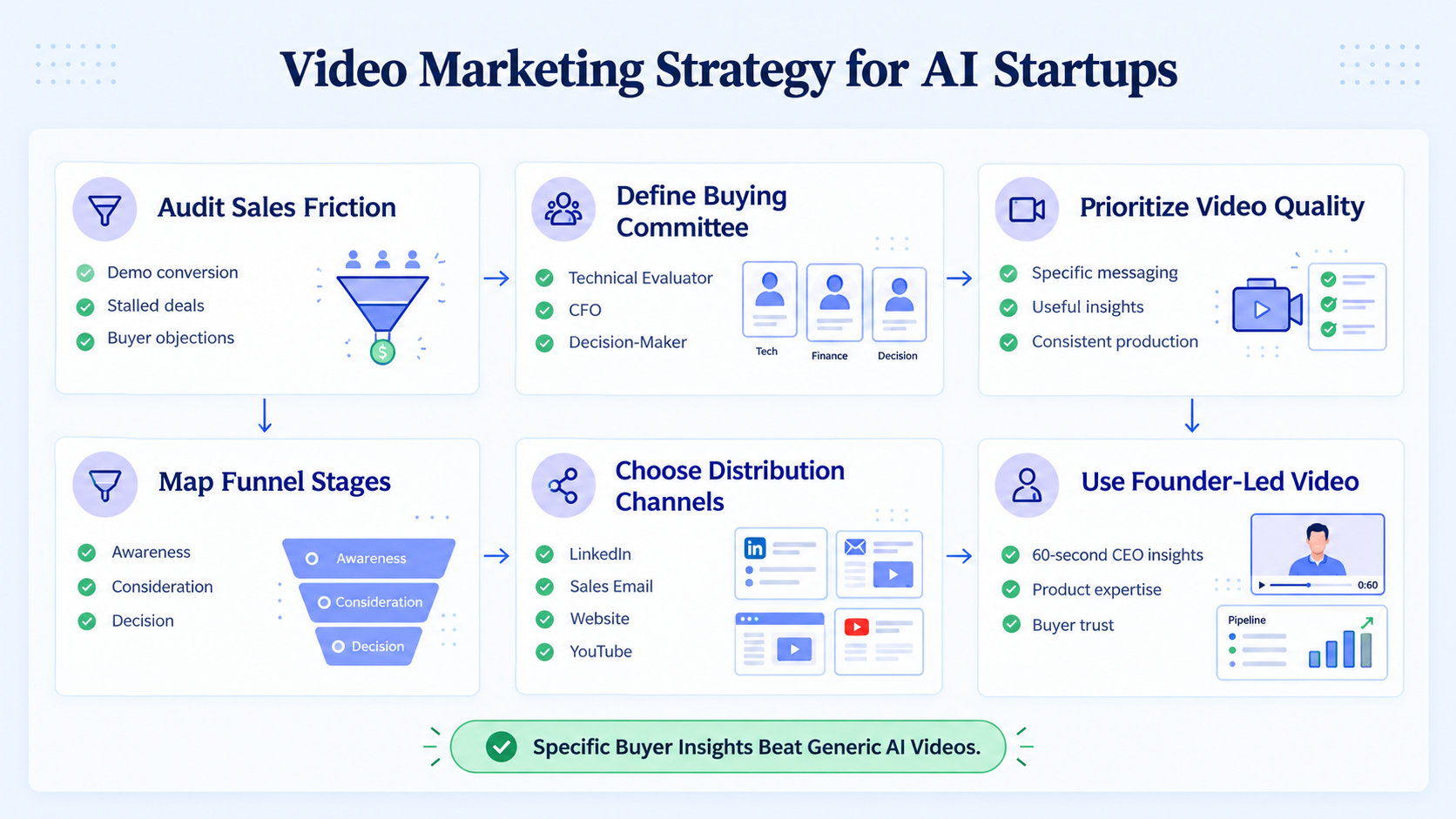
Here is the framework I use with B2B SaaS and funded AI teams at Komet Media:
- Audit your sales cycle friction: Where do deals slow down? Demos not converting? Champions struggling to sell internally? Each friction point maps to a video type.
- Define your buying committee: A technical evaluator needs a different video than a CFO approving budget. Build one video per role, not one video for everyone.
- Choose your content velocity: Volume without quality destroys trust. Wyzowl noted that ROI satisfaction from video fell from 93% in 2025 to 82% in 2026 , driven largely by the flood of undifferentiated AI-generated content. Fewer, sharper videos beat more, weaker ones.
- Map every video to a funnel stage: Awareness videos build recognition; consideration videos educate and pre-close objections; decision-stage videos make the final case.
- Assign a distribution channel before production begins: A video made for LinkedIn native is cut differently than one embedded in a sales email.
Founder-led growth is the highest-trust mechanism in B2B video right now. A 60-second clip of your CEO explaining the core insight behind the product outperforms polished brand animation almost every time.
For video marketing for AI and ML startups companies, the strategic foundation is not production quality, it's specificity. A vague "AI-powered platform" video loses to a specific "here's what our model does in 45 seconds" video every single time. Pair your video marketing services with a clear ICP and you multiply their impact immediately. Venture capital investment in AI video startups reached $4.7 billion in 2025 alone, a 189% increase from 2023. Your buyers are watching a crowded space. Clarity is your competitive advantage.
Best Video Marketing Strategies for Machine Learning Companies
Machine learning companies face a specific challenge: their product is invisible. The model runs; the output appears. Nothing in between is inherently visual. That makes use case storytelling the backbone of any effective ML video strategy.
Core video types that consistently drive pipeline for ML teams:
- Use case scenario videos: Show a specific role (data analyst, sales ops, risk manager) doing a specific job with your product. Starting with pain, showing friction, demonstrating manual inefficiency, then introducing your AI as the hero leverages strong brand storytelling to emotionally connect with the audience before explaining features.
- Algorithm explainer series: Break your ML model's logic into a 3-to-5-part series. Each episode covers one concept. This builds thought leadership content while educating buyers incrementally.
- Product demo videos: 73% of B2B decision-makers prefer a short product or demo video over reading a whitepaper, with buyers increasingly choosing video as the fastest way to evaluate a product. Keep demos under four minutes and lead with the outcome, not the feature.
- Founder personal branding clips: Short, opinionated takes on AI/ML trends posted natively on LinkedIn. These build inbound demand without a sales conversation.
- Customer proof videos: 53% of B2B buyers prefer video case studies over written testimonials. For ML products where the proof is in the data, a customer talking through their results on camera beats any written case study.
The smartest B2B video strategy for machine learning companies treats every webinar, demo, and podcast as raw material. At Komet Media, we routinely turn a single 45-minute product webinar into 8-12 short clips that feed LinkedIn, YouTube, and sales sequences for six weeks. That is content velocity done right.
What Types of Videos Work Best for AI Product Launches
A product launch is not the time to experiment with new formats. These are the four video types that consistently perform for AI product launches, ranked by conversion impact:
Video on landing pages increases conversions by 86%, with the effect strongest for complex products and services where video reduces cognitive load. That stat alone justifies a hero video as your first production investment.
For the product demo, an effective AI product explainer states one clear benefit in the first 3 to 5 seconds, speaks to one buying-committee member at a time rather than all of them at once, and shows a concrete before-and-after moment or live workflow rather than a list of features.
Your launch sequence should run in this order:
- Publish the founder vision clip on LinkedIn 5-7 days before launch to build anticipation.
- Go live with the hero explainer video on the homepage on launch day.
- Send the product demo video in your email sequence during launch week.
- Begin distributing repurposed short clips in the 2-4 weeks following launch to sustain awareness.
For teams that have an active podcast or webinar program, repurposing those into launch-week clips is the highest-ROI production move available.
How AI Startups Explain Complex Technology Through Video for Non-Technical Audiences
This is where most AI/ML startups fail. They default to technical accuracy and lose narrative clarity. Non-technical buyers, the economic buyers signing your contracts, don't need to understand how the model works. They need to understand what changes in their world when they use it.
The three-layer translation framework:
- Layer 1 (What it does): State the output, not the mechanism. "Automatically flags at-risk accounts before they churn" beats "uses a gradient-boosted ensemble model to predict churn probability."
- Layer 2 (Who it helps): Name the role and the specific task. Developer-focused storytelling works for technical evaluators; outcome-led storytelling works for buyers.
- Layer 3 (What it replaces): Show the before state explicitly. Effective design for AI explainers demands visually engaging narratives and laser-focused messaging, prioritizing simplifying intricate AI algorithms into easily digestible visual stories, with visual metaphors and relatable scenarios crucial to enhancing comprehension.
Motion graphics are your best tool for invisible processes. When the "product" is a prediction, a score, or a classification, animation makes the abstract concrete. Best practices recommend keeping explainer videos 60 to 90 seconds long and delivering the core message in the first 3 to 5 seconds, because that structure reduces cognitive load and supports completion on complex topics.
61% of B2B buyers report that video helped them better understand complex products compared to 35% who felt the same about written materials. That gap is your argument for prioritizing video over blog posts and whitepapers in your content mix. Our motion graphics service is purpose-built for exactly this translation challenge.
Common Video Marketing Mistakes AI Startups Make
The volume of video content hitting B2B feeds in 2026 means that strategic errors are punished faster than they were two years ago. These are the mistakes I see most often with AI and ML teams.
Mistakes that directly kill pipeline:
- Explaining the technology, not the outcome: Buyers evaluate whether they can defend the purchase internally. A video that explains ML architecture fails that test. A video that shows a 23% reduction in manual review time passes it.
- One video for everyone: A single product video trying to speak to a developer, a head of operations, and a CFO simultaneously speaks clearly to none of them.
- Ignoring platform-native formatting: A video that goes viral on YouTube can flop on TikTok, and content that generates massive engagement on LinkedIn can be met with silence on Reels; simply reposting the same video across platforms will not yield the results you want.
- Treating production as a one-time event: One polished brand video published once is not a video strategy. A B2B video team that wants a pipeline, not just views, has to build for reuse from the start, with one shoot generating enough material to support a week or more of publishing.
- Measuring views instead of pipeline: Views are a vanity metric for B2B teams. Demo bookings, sales email reply rates, and influenced pipeline are the numbers that matter.
- Relying solely on AI-generated video: Relying solely on AI to generate video content is one of the cardinal video mistakes you can make in 2026. Buyers can detect generic AI content, and it actively erodes the product trust you're trying to build.
The failure mode isn't bad production. Its good production pointed at the wrong message for the wrong audience with no distribution plan.
Best Platforms to Distribute Video Content for AI and ML Companies
Distribution determines whether your production investment generates returns or sits unseen. For B2B video marketing for AI and ML startups companies, platform selection is not optional, it's strategic.
Native uploads on LinkedIn are critical because LinkedIn gives native video 5x the reach of an external link, with 30-90 seconds being the ideal length. Captions are mandatory, since 80% of viewers watch without sound. For YouTube, the platform functions as a search engine for your buyers. An algorithm explainer series with properly optimized titles and descriptions generates compounding inbound demand for years, not weeks.
For mid-funnel video, marketers pay closer attention to site behavior and intent signals: time on page, repeat visits, deeper page journeys, product-page views, and form-start rate, with explainers, product videos, founder videos, and customer proof doing their best work here. The multiplier effect matters: the same core video, reformatted natively for each platform, dramatically extends reach. Check our events page for live sessions on building these distribution workflows.
How to Measure ROI of Video Marketing Campaigns for AI Startups
Most AI teams track views. The teams winning on the pipeline track different metrics entirely.
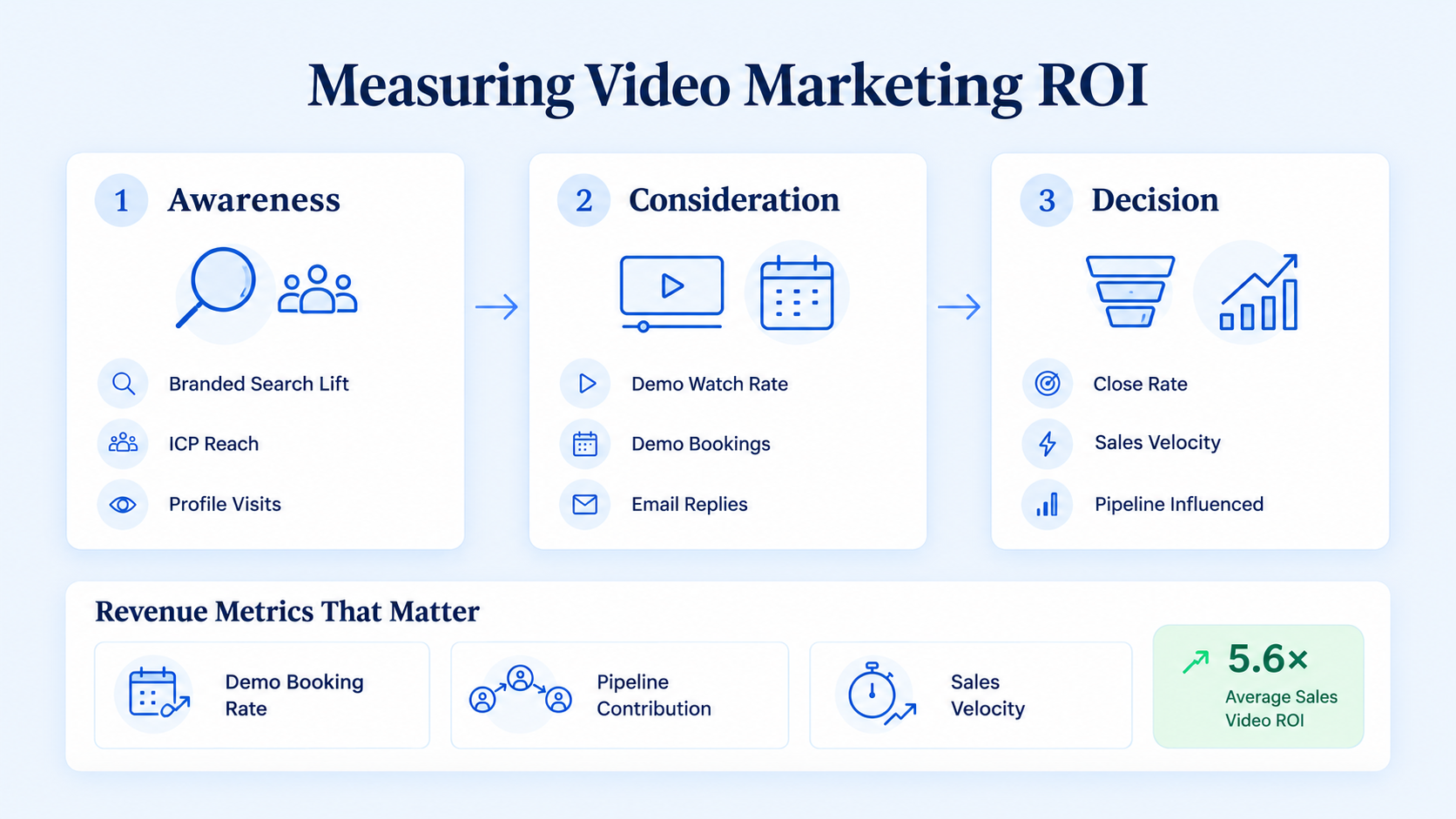
The measurement stack by funnel stage:
- Awareness: Branded search volume lift, LinkedIn profile visits from ICP accounts, reach within target company list.
- Consideration: Watch-through rate on product demos, demo booking rate from video landing pages, sales email reply rates when video is included.
- Decision: Sales cycle length, deal close rate for opportunities that engaged with video versus those that did not, pipeline influenced.
Wyzowl's 2026 video marketing research reports that 63% of video marketers still quantify ROI through engagement metrics such as likes, shares, and reposts, which explains why so many teams can't connect their video spend to revenue. Measure the funnel, not the feed. For SaaS and AI teams specifically, these three metrics give you the clearest picture:
- Demo booking rate from video: Track what percentage of viewers on product demo pages request a demo. A/B test the page with and without video.
- Pipeline contribution: In your CRM (HubSpot, Salesforce), tag opportunities that engaged with video content. Measure close rate and deal size against non-video opportunities.
- Sales velocity: For B2B teams with HubSpot, Salesforce, or similar tools, you can track which prospects watched your content before a sales conversation began, turning video from a "soft" investment into a measurable growth lever.
Sales enablement video delivers an average ROI of 5.6x in B2B SaaS contexts, the highest of any video category. That means every short clip sent in a sales follow-up sequence is worth tracking carefully. Explore our full video editing services to build a trackable video library from your existing content.
Conclusion
Video marketing for AI and ML startups companies works when it's built around buyer clarity, not production ambition. Here are the four decisions that separate teams generating pipeline from teams generating views:
- Specificity wins: One video per buyer role, per pain point, per funnel stage outperforms a single catch-all production.
- Distribution is strategy: Native LinkedIn uploads, YouTube search optimization, and CRM-embedded video each serve a distinct pipeline function.
- Repurposing compound value: Every webinar, demo call, and podcast episode is raw material. Turn one hour of content into 10 deployable assets.
- Measure pipeline, not views: Track demo bookings, sales velocity, and influenced pipeline to prove and improve video ROI.
Contact Komet Media to build the video system your pipeline actually needs.
Frequently Asked Questions
Q1: How much video content should an early-stage AI startup produce per month?
Start with three to five short-form clips per month and one long-form asset (demo or explainer) per quarter. Consistency and specificity matter more than volume. A founder posting two sharp LinkedIn videos per week builds more pipeline than a team churning out ten generic clips.
Q2: What is the ideal length for an AI product explainer video?
60 to 90 seconds is the widely recommended length, with the core message delivered in the first 3 to 5 seconds. For deeper product walkthroughs targeting technical evaluators, 2–4 minutes is acceptable, but keep homepage hero videos under 90 seconds.
Q3: Should AI startup founders appear on camera themselves?
Yes, when possible. Founder-led video builds trust at a pace that polished brand animation cannot match. B2B buyers buy from people they trust. A founder speaking directly to buyer pain points on LinkedIn converts to demo requests more reliably than any other format.
Q4: Which video hosting platform is best for B2B AI companies?
Use Wistia or HubSpot Video for gated and sales-sequence content where you need viewer analytics and CRM integration. Use YouTube for searchable long-form content. Distribute natively on LinkedIn for feed content. Each platform serves a different job in your pipeline.
Q5: How do you repurpose a product demo into short-form video content?
Identify the three moments in the demo where you show the clearest before-and-after transformation. Clip those segments to 45–60 seconds each, add captions, reformat to 9:16 or 1:1, and distribute on LinkedIn. One 30-minute demo can yield 6–8 deployable short clips.
Q6: What makes video marketing for AI and ML startups companies different from standard B2B video?
AI companies must explain complex and often invisible products, models, technologies, and search layers in under two minutes. The primary challenge is translation: turning technical capability into buyer-relevant outcomes. Every video decision, from format to script to distribution, should serve that translation goal.