
🪄 AI Summary
Heading 1
Heading 2
Heading 3
Heading 4
Heading 5
Heading 6
Lorem ipsum dolor sit amet, consectetur adipiscing elit, sed do eiusmod tempor incididunt ut labore et dolore magna aliqua. Ut enim ad minim veniam, quis nostrud exercitation ullamco laboris nisi ut aliquip ex ea commodo consequat. Duis aute irure dolor in reprehenderit in voluptate velit esse cillum dolore eu fugiat nulla pariatur.
Block quote
Ordered list
- Item 1
- Item 2
- Item 3
Unordered list
- Item A
- Item B
- Item C
Bold text
Emphasis
Superscript
Subscript
Video editing for VC firms is not the same job as editing a brand video for a SaaS company. A fund is not selling a product. It is proving judgment, sector knowledge, and access to two different audiences at once: founders who supply deal flow and limited partners who supply capital. I have watched firms with strong track records stay nearly invisible online, while less experienced funds win founder attention because their partners show up consistently on video. Only about 10% of VC firms keep a real content footprint, according to Elasticity's research on content marketing for venture capital, which leaves a wide opening for firms willing to build one.
Quick Answer
Video editing for VC firms works when it turns partner interviews, podcasts, and panel appearances into short, native clips that build founder and LP trust, not when it produces one polished brand reel a year.
Why Video Editing for VC Firms Matters More Than a Polished Reel
Founders now do most of their diligence on a fund before the first call. They check a partner's LinkedIn activity, look for a consistent point of view, and compare what a partner says publicly against what gets pitched in the room. Limited partners do a version of the same thing, watching for evidence that a firm actually understands the sectors it claims to back.
LinkedIn has become the main venue for this, and the platform's own distribution has shifted hard toward individual partners rather than the fund's company page. Reporting on LinkedIn's 2026 algorithm, cited in Manhattan Strategies' guide on how CEOs should use LinkedIn and detailed further in Forbes Councils' 2026 executive LinkedIn strategy piece, found that personal profiles now receive roughly 65% of feed allocation compared to about 5% for company pages, with organic reach on company pages down 60 to 66% since 2024. The same reporting found that executive content generates roughly 4 times more engagement than the average company page post. Whitehat SEO's 2026 LinkedIn engagement guide describes a similar pattern, calling it a 5 times engagement advantage for personal profiles.
Video carries a real distribution edge inside that shift. Agency benchmark data compiled by Meet Léa found that native LinkedIn video, uploaded directly rather than linked from YouTube, earns roughly 5 times more organic reach than an external link. That single detail changes how a partner interview or podcast clip should be published, not just how it should be edited.
Podcasts add a second channel that fits how senior operators already spend their time. Research cited in Signal Hill's executive listening data, summarized in Talks.co's 2026 podcast statistics report, found that 83% of senior executives listened to a podcast in the past week. The same audience increasingly wants to watch, not just listen. Edison Research's Infinite Dial 2026 findings, reported by Truth Work Media, show preference for podcasts a listener can actively watch rising from 30% in April 2022 to 49% in April 2026.
There is also a portfolio support angle that founders and LPs both notice. Firms that consistently feature portfolio company founders in interview clips, panel highlights, or podcast episodes are demonstrating value beyond capital in a way a pitch deck cannot. In my experience, a portfolio founder who gets featured in a well-cut clip remembers it, and other founders in the same sector notice the pattern too. That kind of visible support becomes part of a firm's reputation with LPs, since it signals an active, engaged approach to the portfolio rather than a purely financial one.
Video also plays two distinct commercial roles for a fund, and it helps to separate them early. One is building inbound pipeline, where a consistent presence brings warmer founder introductions instead of relying only on outbound sourcing. The other is growing brand awareness across a sector, which supports fundraising and co-investor relationships even when it does not directly produce a deal. A firm should decide which of these two goals a given piece of content is meant to serve before it gets edited, since the framing, length, and platform choice usually change depending on the goal.
Where VC Firms Get Video Editing Wrong
A few patterns show up again and again in fund content that never gets seen.
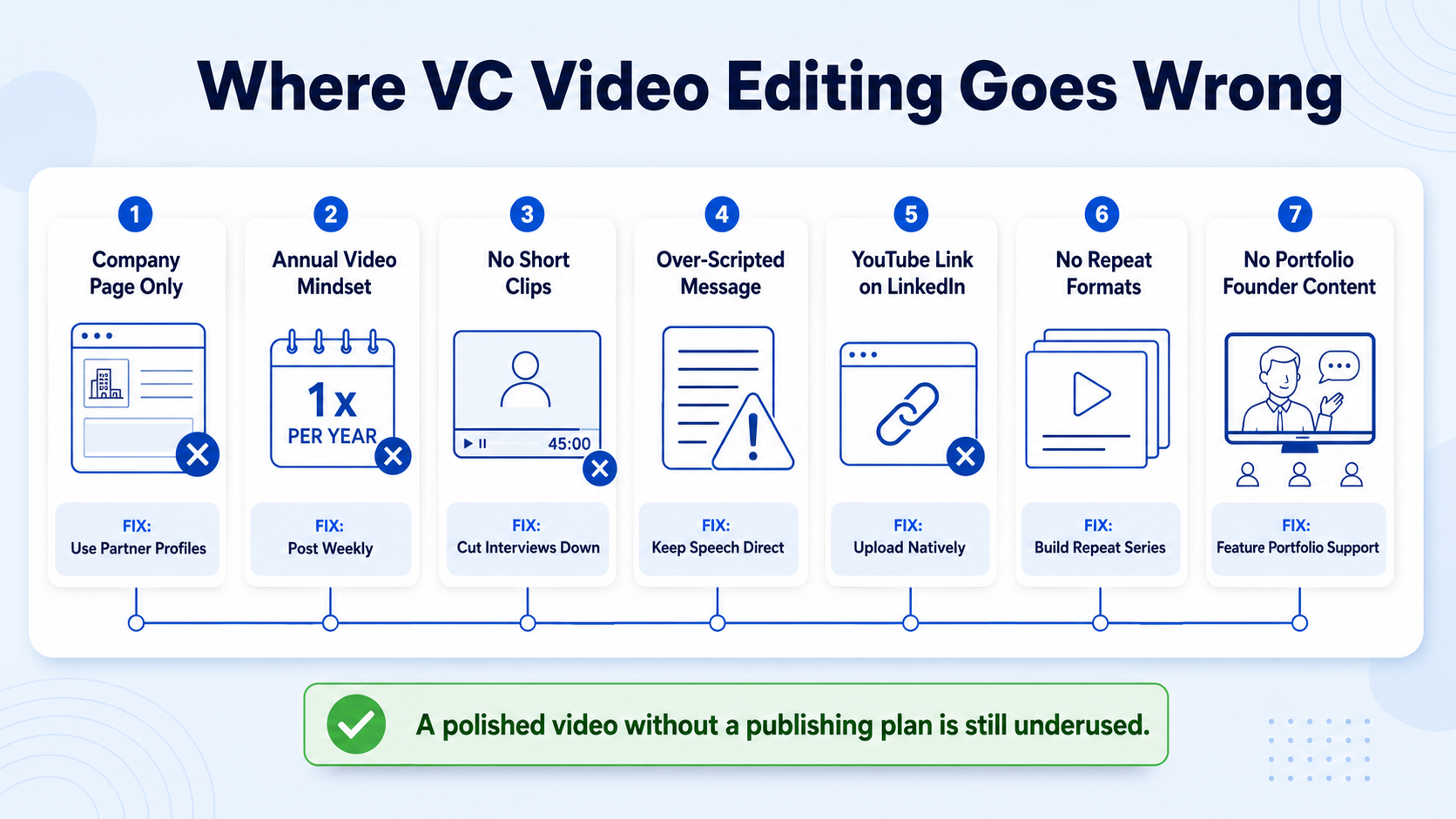
- Publishing only from the company page. Given how heavily LinkedIn now favors personal profiles, a fund update posted only from the firm's page starts at a structural disadvantage before anyone even watches it.
- Treating video as an annual event. A single polished fund video shot once a year cannot compete with a partner who shows up with a clear point of view every week.
- Recording content and never cutting it down. A 45 minute partner interview or LP call often contains three or four strong short clips that never get pulled out and published separately.
- Over-producing the message away. Founders and LPs respond to a partner speaking plainly about a real pattern they have seen. A heavily scripted, corporate-sounding cut usually performs worse than a clean, direct one.
- Uploading to YouTube and linking from LinkedIn. Given the native reach gap, this single habit quietly caps how many people ever see the content.
- No system for repeat formats. Firms that treat every video as a one-off project rebuild the wheel each time instead of running a repeatable thought leadership video repurposing process.
- Leaving portfolio founders out of the content plan. A firm that only ever features its own partners misses an easy way to show LPs and prospective founders what portfolio support actually looks like.
A polished video with no plan for who publishes it, on which platform, and on what cadence is still an underused asset, regardless of how well it was cut.
What Good Video Editing for VC Firms Actually Covers
Video editing for VC firms spans a small number of recurring formats, each suited to a different platform and audience.
On LinkedIn specifically, length matters for how the content performs. Meet Léa's LinkedIn video benchmarks put 2 to 5 minute videos at roughly 30 to 40% completion, while videos in the 3 to 10 minute range see lower completion but stronger qualitative engagement such as comments and saves, which fits longer thesis-style clips better than quick hooks.
These formats work together rather than as separate projects. A single 40 minute partner interview can supply a short LinkedIn clip within a day of recording, a longer YouTube upload within a week, and, if the firm runs a podcast, a full episode plus a handful of additional clips spaced out over the following month. Planning for that reuse before recording, rather than deciding after the fact what to do with the footage, is what separates a firm running a real content system from one producing occasional videos.
A Practical Workflow for Repurposing Partner Content
The output that matters most for most funds is not a new production. It is a system for pulling more out of content the firm is already creating, such as portfolio interviews, fireside chats, panel appearances, and podcast episodes.
- Pick the source recording and the audience it serves. A founder-facing clip and an LP-facing clip often come from the same interview but need different framing.
- Mark the strongest three or four moments. Look for a specific opinion, a named pattern across portfolio companies, or a clear answer to a question founders actually ask.
- Cut a master version for the primary platform. Most funds should treat LinkedIn as the primary platform and edit the tightest version for it first.
- Produce shorter clips from the same footage. One interview can usually support several separate LinkedIn posts spread across a few weeks instead of one long upload.
- Caption everything. Most LinkedIn video gets watched with the sound off, so the message needs to hold up as on-screen text.
- Publish natively on each platform. Upload directly to LinkedIn rather than linking out, given the reach difference.
- Route partner posts through the partner's own profile. Distribution research consistently favors the individual over the company page for this kind of content.
- Review what actually landed and repeat the format that worked. A consistent cadence beats a single high-effort post that never gets followed up.
This is the same discipline behind our podcast editing and video editing services work, applied specifically to how funds need to show up for founders and LPs.
What Changes the Price of Video Editing for VC Firms
Cost depends less on the vendor and more on scope. Here are the factors that move the price the most for a venture firm:
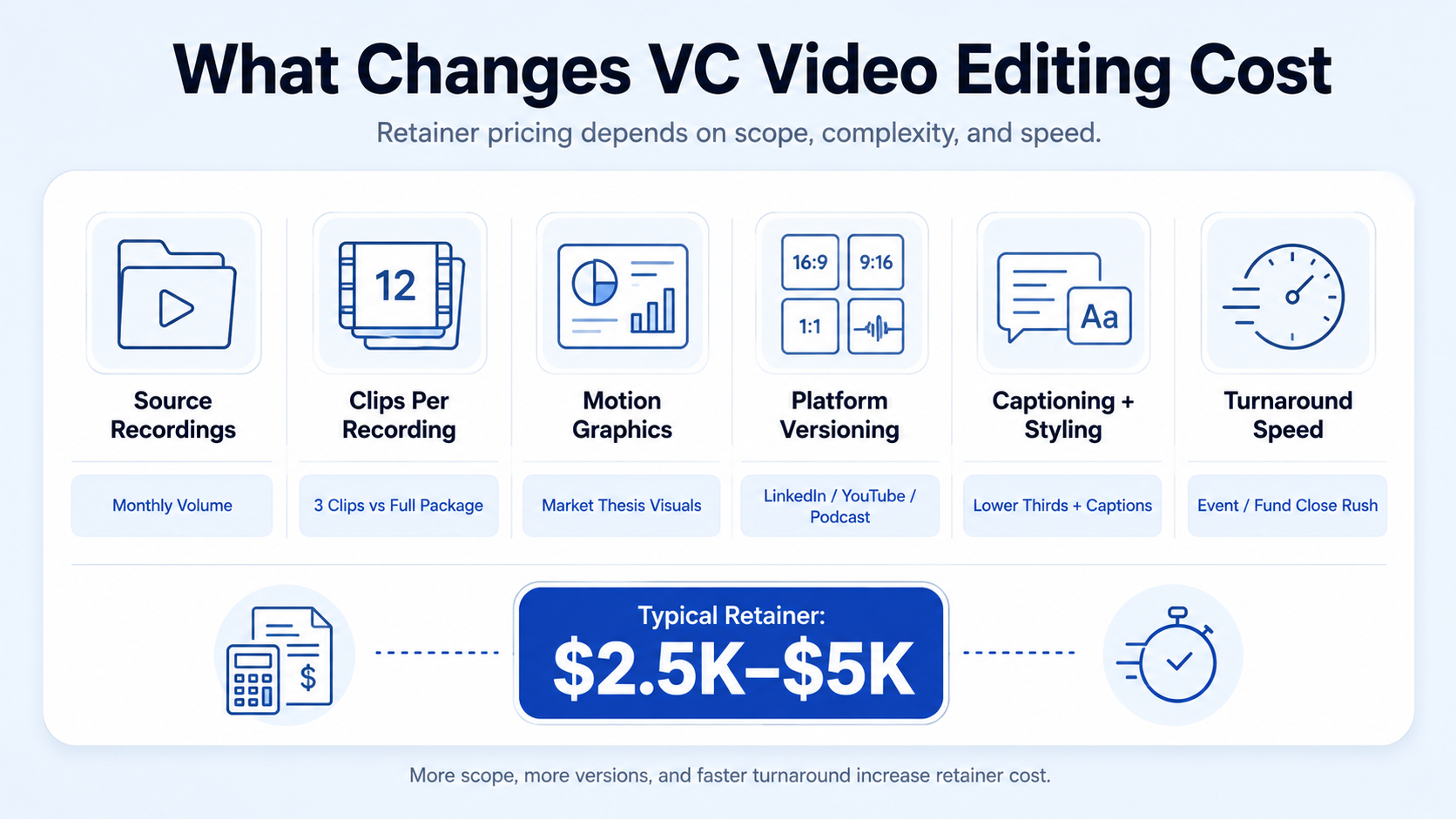
- Number of source recordings per month. A fund publishing from one interview a quarter has a different scope than one recording weekly partner conversations.
- Number of clips produced per recording. Three clips from one interview cost less than a full multi-format package built from the same footage.
- Motion graphics and data visualization. Illustrating a market thesis or portfolio data adds production time beyond a straight talking-head cut.
- Platform-specific versioning. LinkedIn, YouTube, and podcast platforms each need their own length and aspect ratio.
- Captioning and branded styling. Consistent lower thirds, captions, and intro treatment across a growing library take setup time upfront.
- Turnaround expectations. Fast turnaround around a live event, fund close, or portfolio milestone typically costs more than a standard weekly cadence.
Komet Media typically works with venture firms through retainers in the range of roughly $2,500 to $5,000, with final scope set by the factors above rather than a fixed public package. Our B2B video editing pricing models resource goes deeper on this, and our video editor cost guide compares freelancer, subscription, and retainer pricing.
Measuring What the Content Actually Produced
Views tell a fund almost nothing about deal quality or LP confidence. Match the metric to the purpose of the content.
Treat these signals together rather than relying on one dashboard number. Attribution is especially imperfect in venture, since a founder may watch a partner's content for months before ever sending a deck, and an LP conversation shaped by a firm's content library rarely gets logged as such. Watch for the content showing up in conversation, a founder mentioning a specific clip, an LP referencing a portfolio update, since that qualitative signal often says more than a view count. Our notes on video KPIs B2B teams should track and attribution for video and podcast content go further into building a measurement plan that holds up over a full fundraising or deployment cycle.
Conclusion
Video editing for VC firms is not about producing a better-looking video once a year. It is about building a repeatable way to turn partner conversations the firm is already having into content that founders and LPs actually see, on the platform where they are most likely to see it. We work with venture capital firms on exactly this kind of system, from partner interview clips to full podcast repurposing.
FAQ
1) What is video editing for VC firms?
It is the process of turning a fund's existing recordings, partner interviews, podcast episodes, panel appearances, LP calls, into edited clips built for LinkedIn, YouTube, and podcast platforms. The goal is founder and LP visibility, not a single polished brand video.
2) How much does video editing cost for a VC firm?
Cost depends on how many source recordings a firm produces per month, how many clips come from each one, and whether motion graphics or heavy platform versioning are involved. Komet Media typically works in the $2,500 to $5,000 range per retainer. See our B2B video editing pricing models breakdown for detail.
3) What does the production process look like?
It usually starts with selecting a source recording, marking the strongest moments, cutting a master version for LinkedIn, producing shorter clips from the same footage, captioning everything, and publishing natively on each platform rather than linking out.
4) How long does it take to see results?
A single clip rarely moves the needle. Most firms need a consistent few months of weekly or biweekly publishing before founders and LPs start referencing the content directly in conversations.
5) What deliverables should a firm expect?
Expect a set of short partner clips per recording, captioned and formatted for LinkedIn, plus longer versions for YouTube when the source material supports it, and podcast-specific cuts if the firm runs a show.
6) Is a freelancer or an agency better for this work?
A freelancer can work for a firm publishing occasionally with a single point of contact directing every edit closely. An agency tends to fit better once a firm wants a repeatable weekly or biweekly system across multiple partners, since that requires more coordinated capacity. Our freelancer versus agency comparison covers the trade-offs in more depth.
7) Does every VC firm need this, or only larger funds?
Smaller and emerging funds often benefit the most, since visibility is one of the few advantages a newer fund can build quickly without a longer track record. Larger funds with established reputations still use it, mainly to keep individual partners visible as deal flow and LP relationships depend more on the partner than the firm name.
8) Does Komet Media produce video content for venture capital firms?
Yes. We edit partner interviews, podcast episodes, and panel content for venture firms, building the repeatable clip system described above rather than one-off videos. You can see our approach on the VC firm video editing solution page or book a call to talk through a specific fund's content.