
🪄 AI Summary
Heading 1
Heading 2
Heading 3
Heading 4
Heading 5
Heading 6
Lorem ipsum dolor sit amet, consectetur adipiscing elit, sed do eiusmod tempor incididunt ut labore et dolore magna aliqua. Ut enim ad minim veniam, quis nostrud exercitation ullamco laboris nisi ut aliquip ex ea commodo consequat. Duis aute irure dolor in reprehenderit in voluptate velit esse cillum dolore eu fugiat nulla pariatur.
Block quote
Ordered list
- Item 1
- Item 2
- Item 3
Unordered list
- Item A
- Item B
- Item C
Bold text
Emphasis
Superscript
Subscript
Most SaaS founders know they should be on video. They don't know what to say. That blank-camera moment, the one where you know your product is cold but freeze on camera, is not a confidence problem. It's a strategy problem. This guide answers the question of what founders should talk about on video with a concrete framework built for the pipeline: specific topic categories, how to structure them, how to turn investor trust into buyer trust, and what makes founder-led content actually convert in 2026.
TL;DR
- Founder video works when it targets buyer problems, not product features.
- Personal profiles generate 8x more engagement than company pages , so post as a founder, not a brand account.
- The best topics span four pillars: your origin story, buyer education, category POV, and failure/lessons.
- Consistency and topic specificity matter more than production quality.
Why Founder-Led Video Is Your Highest-Trust Content Asset
Before the topic list, the "why" needs to be settled. Prospects in 2026 are increasingly cynical of polished brand accounts. They want to buy from experts, founders, and engineers. That shift is the single biggest tailwind for founder-led short-form video. The numbers back this up hard.
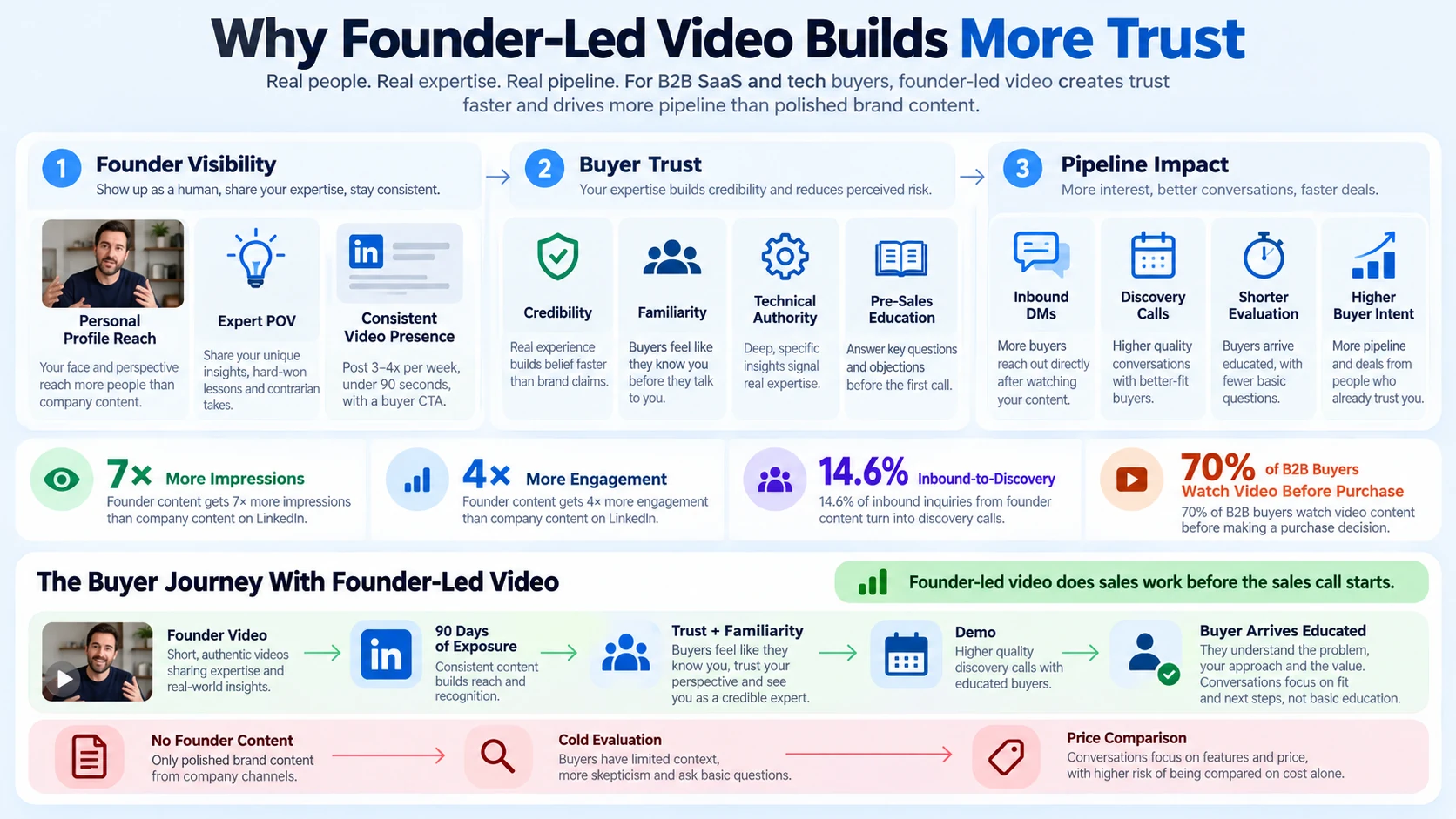
Personal LinkedIn profiles generate roughly 7x more impressions and 4x more engagement than company pages. And reach is only half the story. Inbound outreach, where a prospect messages a founder after consuming their content, converts at roughly 14.6% to discovery call versus 1.7% for outbound prospecting
LinkedIn video experienced a 36% year-over-year increase in 2025, and 70% of B2B buyers watch video before purchasing. That means your buyers are actively looking for this content. The question is whether they find your competitor's founder or yours.
The B2B buying journey has shifted entirely online. Research from 6sense, LinkedIn, and Gartner reveals that 80% of B2B sales now take place entirely online, and the vast majority of the buyer's journey is completed before a prospect ever speaks to a sales representative. That means your video content is doing sales work whether you've designed it to or not.
The buyer who watches your videos for 90 days arrives at your demo already sold. The buyer who never sees you arrives skeptical, comparing you on price. The answer to what founders should talk about on video is not "whatever feels natural." It's a deliberate content system built around four topic pillars, each with a specific pipeline job.
The Four Founder Video Content Pillars That Actually Drive Pipeline
Most founders default to product updates or company announcements. Both are the lowest-leverage topics available. High-performing founder-led content organizes into four pillars that serve different stages of the buyer journey.
Pillar 1: Origin Story: This is where most good founder stories start. Not with your background. Not with your funding. But with the moment you realized something in the market was clearly broken. One origin story video, tightly edited to under 90 seconds, earns more trust than twelve product feature clips.
Pillar 2: Buyer Education: Build videos from real buyer questions, objections, and workflow problems. Objection-led videos sit closer to revenue than broad awareness clips. They also help sales teams and reduce repetitive explanations. Pull these topics directly from sales calls, support tickets, and demo recordings.
Pillar 3: Category POV: Every piece of content you produce should tie towards your point of view or advocate for that point of view. That consistency is what builds memory. Over time, buyers start to associate your brand with a specific way of seeing the world.
Pillar 4: Failure and Lessons: Most founders only share wins. Buyers learn nothing from that. Failure stories are rarely shared, but deeply human. A well-told mistake story does more for authority than a case study.
What Topics Should a Startup CEO Cover in Videos?
If you run a SaaS or AI startup and need a ready list, here is where to start. These are not generic ideas. Each one maps to a specific buyer need.
Problem and market insight videos:
- The exact moment you realized the current solution was broken
- Why most teams approach [your category problem] backwards
- The one metric your buyers are tracking that does not actually predict success
- What you learned from your first 20 customer conversations that surprised you
Product thinking and decision videos:
- Why you built the product to do X instead of Y (feature trade-off rationale)
- A decision you reversed after talking to customers
- The build vs. buy call you made and what you learned from it
Buyer education and sales enablement videos:
- How to evaluate vendors in your category (the framework your buyers need before they call anyone)
- The three questions you should ask any SaaS vendor before signing a contract
- What a good implementation timeline actually looks like vs. what vendors promise
Social proof and customer story videos:
- A specific customer outcome with numbers, named (or anonymized) industry, and the before state
- The objection a customer had that almost lost the deal, and what changed their mind
Niche industry-specific content drives 15-22% ICP-fit engagement rates. Viral or generic content drops below 1%. Specificity is not a nice-to-have. It is the entire strategy. Every topic above works because it speaks to one type of buyer in one real situation.
For short-form video editing that extracts these clips efficiently from recorded content, the system matters as much as the topic.
How Founders Use Video to Build Trust with Investors and Buyers
The trust mechanics for investors and buyers are different enough that they need separate treatment. Both start with the same foundation: a written post tells people what you think. A video shows them how you think. It signals confidence, clarity, and a founder-friendly communication style, before you ever take a meeting.
For buyers, the trust sequence looks like this:
- They encounter your video in their feed (category POV or education content)
- They follow you and consume 3-5 more clips over several weeks
- They visit your website or engage a sales rep already partially convinced
- A prospect who has been reading your posts for three months arrives at a sales call already sold on your thinking.
For investors, the trust mechanics shift to signal credibility and market conviction:
- Vision video: your market thesis and why now (not why your product, why the moment)
- Traction narrative: customer insight videos that demonstrate you understand the buyer better than incumbents
- Founder character: failure stories signal resilience and leadership far more than growth charts ever will.
Research from Edelman found that 55% of brands featuring authentic founder interviews experience a measurable increase in consumer trust. This makes founder videos especially effective for startups and B2B companies where buyers need to trust the team before they trust the product.
A key format that works for both audiences: the talking head video under 90 seconds, single insight, no sales pitch, direct to camera. The drop-off point for B2B video happens when audiences don't clearly see the value in the first 15-30 seconds, not at the 10-minute mark. Front-load the insight.
Our video editing services at Komet Media are specifically built to produce this format at volume, without the founder spending hours in post-production.
Should Founders Talk About Their Failures on Video?
Yes. Without qualification. In 2026, honesty beats polished positioning. Transparency builds trust faster than perfect messaging. The failure story is one of the highest-performing formats in B2B video for a structural reason: your competitors are not posting them. That white space is yours.
What makes a failure video work is specificity and frame. Follow this structure:
- Name the specific decision or bet you made
- Describe what you expected to happen
- Describe what actually happened (with honest context)
- Articulate the lesson in one sentence your buyer can apply
- Connect it to how you think differently now
When a founder explains why they made a product decision, what they got wrong in year one, or what they'd do differently, that specificity creates a level of credibility no brand-voice copywriter can manufacture.
Common failure topics that perform well in B2B SaaS:
- "We almost ran out of runway because we ignored this one metric"
- "The enterprise deal we lost and what we changed in our sales process"
- "Why our first positioning completely missed the buyer"
- "The feature we spent six months building that customers never used"
Most founders avoid this. That is exactly why it works. The psychological barrier to posting failure content is the trust signal itself. If you are willing to be honest about what did not work, buyers and investors assume your claims about what does work are equally honest.
One execution note: failure content does not need high production value. Raw, phone-recorded, direct-to-camera performs as well as studio content for this format because the lo-fi quality amplifies authenticity.
How to Decide What to Talk About as a Founder (The Content Prioritization System)
The blank-camera problem is usually a prioritization problem. There is too much you could say, so nothing gets made. The highest-ROI content for B2B SaaS is founder-led LinkedIn content combined with a targeted email newsletter and SEO-optimized blog posts on core category keywords. But within founder video, you still need a system for what to film first. Use this three-filter framework to prioritize topics:
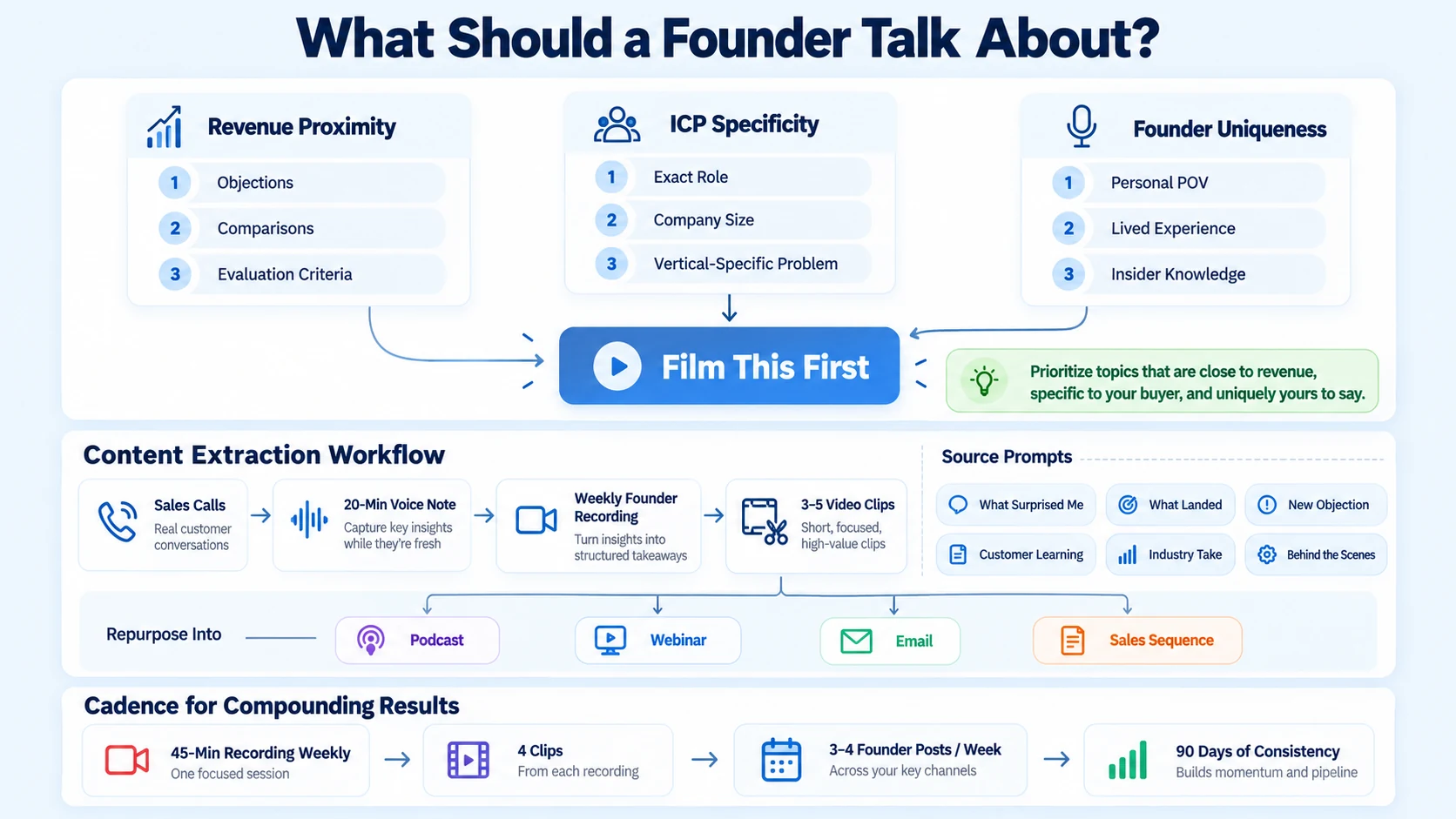
Filter 1: Revenue proximity. How close is this topic to a buying decision? Topics that address objections, compare approaches, or educate on evaluation criteria sit closest to revenue. Film those first.
Filter 2: ICP specificity. Would your exact buyer, at your exact company size, in your exact vertical, immediately recognize this problem? If a director at a 150-person SaaS company would say "that's exactly us" while watching, it passes. If it's too broad, it fails.
Filter 3: Founder uniqueness. Could your marketing team have written this without you? If yes, it's brand content, not founder content. Founder video requires the founder's actual perspective, lived experience, or insider knowledge.
The valuable content ideas already exist inside the company. They live in the heads of the executives, operators, and subject matter experts who understand the customers, know the industry, and do the work every day.
The fastest content extraction method: Record a 20-minute voice note after your next three sales calls. Describe what came up, what surprised you, what you said that landed, and what objection you had not heard before.
A founder recording 30-60 minutes of audio per week, covering this week's learnings, customer conversations, hot takes on industry news, and behind-the-scenes operational notes, gives a strategist or editor everything needed to extract 3-5 videos per week.
Sales emails with video get 16% higher open rates and 26% higher reply rates than text-only emails. Every clip you produce can also be repurposed across your podcast, webinars, and sales sequences, multiplying output without multiplying recording time.
The cadence that works:
LinkedIn is your primary pipeline channel. Post as a founder, 3-4x per week, under 90 seconds, with a buyer CTA on every clip. One weekly recording session of 45 minutes yields four clips when edited properly. Founders who film once a week and post consistently for 90 days will outperform competitors who produce a single polished brand video quarterly, every time.
Conclusion
The question of what founders should talk about on video has a short answer: the problems your buyers live in, the thinking behind your product decisions, and the honest account of what you got wrong. Those three categories, executed consistently, build more pipelines than any paid channel at the same cost.
Key takeaways:
- Map every video to one of four pillars: origin story, buyer education, category POV, or failure lessons.
- Prioritize topics by revenue proximity and ICP specificity, not by what feels comfortable.
- Post from your personal profile at 3-4x per week, under 90 seconds per clip.
- Repurpose one recording session into four clips rather than creating four separate pieces.
- Founder-led brands see customer acquisition costs run about 40% lower than brands leaning mainly on paid channels.
If you have the content but not the system to turn it into clips, Komet Media works with SaaS founders to build exactly that.
Frequently Asked Questions
Q1: What should founders talk about on video if they're pre-product-market fit?
Focus on the problem, not the solution. Film your buyer research process, the market gap you discovered, and the specific customer type you are building for. These videos build an audience of ideal future customers while you are still iterating. Avoid product demos until you have repeatable outcomes to show.
Q2: How often should a founder post videos on LinkedIn?
LinkedIn is your primary pipeline channel. Post as a founder, 3-4x per week, under 90 seconds, with a buyer CTA on every clip. Consistency over several months builds compounding reach that single burst campaigns cannot match.
Q3: What video length performs best for B2B founders on LinkedIn?
Under 90 seconds for organic feed content. The drop-off point for B2B video happens when audiences don't clearly see the value in the first 15-30 seconds , so front-load the main insight before anything else. Save longer formats for YouTube or gated webinar content.
Q4: Should founders post videos from their personal profile or the company page?
Always from the personal profile. Posts from individual profiles receive 8x the engagement of identical content from company pages. This gap is widening, not closing. The company page serves as a credibility checkpoint for prospects who already found you.
Q5: Do founder videos need to be highly produced?
No. LinkedIn Creative Labs research reports large lifts for "Expert Takes" and "Human Touch" creative approaches. Framing, message structure, and cultural cues can materially shift engagement , regardless of production budget. A clear, well-edited talking head clip consistently outperforms a polished brand video with no founder presence.
Q6: How long does founder video content take to generate pipeline results?
Expect three time horizons before the pipeline. First signals such as impressions and inbound DMs citing posts arrive in 3-6 weeks. Measurable pipeline including sourced demos takes 9-12 weeks. Plan for a 90-day minimum before assessing ROI, and track inbound DM volume and self-reported attribution alongside formal attribution tools.