
🪄 AI Summary
Heading 1
Heading 2
Heading 3
Heading 4
Heading 5
Heading 6
Lorem ipsum dolor sit amet, consectetur adipiscing elit, sed do eiusmod tempor incididunt ut labore et dolore magna aliqua. Ut enim ad minim veniam, quis nostrud exercitation ullamco laboris nisi ut aliquip ex ea commodo consequat. Duis aute irure dolor in reprehenderit in voluptate velit esse cillum dolore eu fugiat nulla pariatur.
Block quote
Ordered list
- Item 1
- Item 2
- Item 3
Unordered list
- Item A
- Item B
- Item C
Bold text
Emphasis
Superscript
Subscript
If your team records a podcast and hits publish without clipping it, you're extracting maybe 10% of its value. The real question isn't whether to repurpose, it's how many clips can you get from one podcast and how to make every single one earn its place in your content distribution framework. Whether you're a SaaS founder, a marketing head, or a growth team feeding pipeline, this guide gives you the exact numbers, the framework, and the execution system.
TL;DR
- A 45–60 minute podcast episode can realistically yield 5 to 20+ usable clips, depending on episode quality and clip strategy.
- The sustainable publishing sweet spot for most B2B teams is 5–7 clips per episode per week.
- Clip quality, hook strength, and platform fit matter far more than raw volume.
- A strong repurposing system turns one recording into a full week (or more) of social content.
How Many Clips Can You Get From One Podcast Episode?
The honest answer has a range. A well-structured 40 to 60 minute episode typically yields 10 to 20 usable clips, though not all should be published. Most teams shortlist their top 8 to 12 based on hook strength and platform fit.
At the more aggressive end, a single 60 minute podcast recording can realistically produce 15 to 25 usable short clips, meaning the true cost per piece of content often drops below what most brands pay for a single standalone UGC video.
For most B2B teams, though, a tighter range is more practical. Cutting 3 to 8 vertical clips per episode, each running 15 to 90 seconds, is the standard starting point, with the priority on moments where a guest makes a strong claim or shares a counterintuitive insight.
So the operative answer is: 5 to 15 quality clips per episode is what serious B2B teams can extract and actually publish well. The ceiling is higher if you count every format variation, but quality falls fast when you push volume without editorial judgment. What drives that range? Three variables:
- Episode length: A 30-minute episode yields fewer viable clip moments than a 60-minute one.
- Content density: Interview-style, opinion-forward, or demo-rich episodes clip far better than solo narration or loosely structured conversations.
- Platform strategy: If you're distributing across LinkedIn, YouTube Shorts, Instagram Reels, and TikTok, each platform can absorb a different cut of the same core moment, multiplying your usable clip count without requiring entirely new source content.
At Komet Media, I've found that B2B SaaS podcasts, especially ones featuring founder-led thinking, product demos, or deep category expertise, are among the richest sources for short-form video editing. The insight density is high, the trust signals are built-in, and buyers respond to specificity.
Podcast Episode: How Many Short Clips Is the Right Weekly Target?
Knowing the theoretical maximum and knowing your sustainable publishing target are two different things. Most shows see good consistency with 4–7 clips per week from each new episode. Volume matters less than repeatability, aim for a cadence your team can sustain every week. Three to six is the sweet spot for most experts. AI tools will happily generate 20–30, but quality and your point of view matter more than volume. Here's how I think about the weekly target in tiers:
If you publish a weekly podcast, you already have enough material to post daily on TikTok, Instagram Reels, and YouTube Shorts. The bottleneck is never the source content, it's the editorial workflow and production system to clip, caption, and distribute consistently.
For B2B SaaS teams specifically, I'd rather see 5 high-intent clips that educate a buyer on your product's positioning than 15 generic sound bites that generate impressions and nothing else. Our podcast marketing service is built around exactly that distinction.
Repurposing One Podcast Into Multiple Clips: The Content Atomization Framework
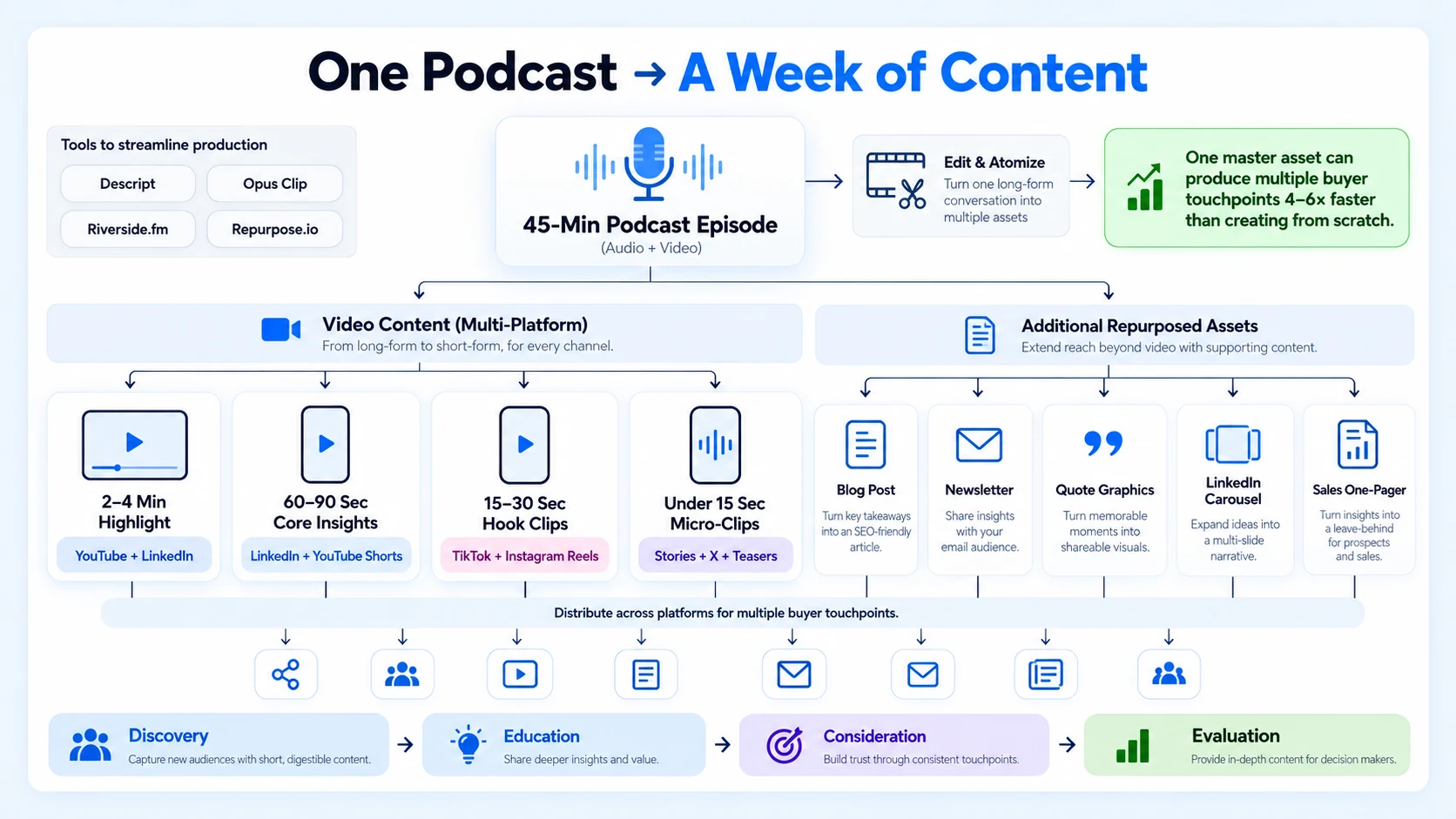
Content atomization is the discipline behind the number. A single 45-minute conversation can produce short video clips, a long-form blog post, an email newsletter, quote graphics, a LinkedIn carousel, and a sales one-pager, each reaching a different audience at a different moment in the buying journey, from first discovery to active evaluation.
For the video clips specifically, here's the atomization hierarchy I use with clients:
- Full episode clip (2–4 min): A longer highlight reel for YouTube or LinkedIn. One per episode.
- Core insight clips (60–90 sec): The 3–5 sharpest arguments or category takes from the episode. These go on LinkedIn and YouTube Shorts.
- Hook clips (15–30 sec): The sharpest opening line or most provocative moment. Built for TikTok and Instagram Reels with waveform visualization or animated captions (audiogram format for audio-only shows).
- Micro-clips (under 15 sec): A single quotable line, a stat, or a reaction moment. Used for Stories, X, or as pre-roll teaser content.
Building one master asset and deriving multiple formats from it is roughly 4–6x faster than creating each of those pieces from scratch. That math is why content atomization has become the default model for any serious B2B content operation.
Tools that support this workflow include Opus Clip and Descript for transcript-based editing, Riverside.fm for high-quality recording, and Repurpose.io for automated cross-platform distribution. Each reduces the friction between "we have a recording" and "we have a week of content."
How to Maximize Clips From a Single Podcast Recording
Maximizing clip yield starts before you hit record, not after. Here's the process I recommend:
- Record with clipping in mind: Structure the episode around 5–7 defined topics or questions. Each topic becomes a natural clip boundary.
- Transcribe immediately: Use Descript or Riverside.fm's built-in transcription. A full transcript turns clip discovery from a listening exercise into a reading exercise, much faster.
- Flag clip moments during transcript review: Look for strong claims, surprising data, counterintuitive takes, clear "before/after" moments, and disagreements. These clip best.
- Batch edit by format: Don't edit one clip fully, then start the next. Cut all core insight clips first, then go back for hook clips. Batching cuts context-switching time dramatically.
- Adapt, don't just repost: A clip optimized for TikTok's sound-off, fast-hook behavior rarely performs the same way on LinkedIn or YouTube Shorts without re-editing for pacing, captions, and framing.
- Schedule with a content calendar: Spread clips across 5–7 days. Don't publish all clips from one episode on the same day, it telegraphs the repurposing and reduces perceived variety.
Repurposing only works if the original episode was good. People try to repurpose thin, vague, meandering episodes and then wonder why none of the spin-off content lands. If your episode did not have a clear argument, did not go deep on anything, and wandered around without a real point, you cannot fix that in post. For teams running webinar content through a similar system, the same framework applies.
Podcast Repurposing: How Many Clips Is Too Many?
There's a ceiling, and it matters. Podcast clipping isolates specific high-value moments, a strong quote, a surprising stat, a debate, into standalone short-form assets. Full episode repurposing usually means cutting the entire episode into a shorter highlight reel, which tends to perform worse on short-form platforms because it lacks a single sharp hook.
The quality decay curve is real: Publishing more than 10–12 clips from a single episode without strong editorial selection almost always results in diminishing engagement by clips 8–10, because the best moments have already surfaced and what remains lacks the hook strength to earn attention in a short-form feed.
Signs you've hit the clip ceiling:
- Clips start with contextual setup rather than a strong opening line.
- The topic of the clip overlaps heavily with one you've already published from the same episode.
- You're clipping segments that need to be heard in sequence to make sense.
- Completion rates drop below 20% across multiple consecutive clips.
Video podcasts repurposed into Reels, Shorts, or TikToks receive 4.6x more total impressions than full-length episodes alone, but that advantage erodes when clip quality drops. Volume without editorial discipline creates noise, not pipeline.
The right call: extract the maximum number of genuinely strong clips (usually 5–10 for a 60-minute B2B episode), then stop. Save weaker moments as evergreen content to resurface 60–90 days later when the episode is no longer in the feed cycle.
Best Practices for Clipping a Podcast Episode Into Short Videos for B2B
B2B clip strategy is different from consumer podcast clipping. The goal isn't virality, it's building trust with a specific buyer and moving them toward a demo, a conversation, or a deeper content asset. Editors unfamiliar with B2B audiences often select clips that generate views but not opportunities. A strong B2B clip should build trust, credibility, and curiosity with the right audience. Clip selection criteria for B2B SaaS:
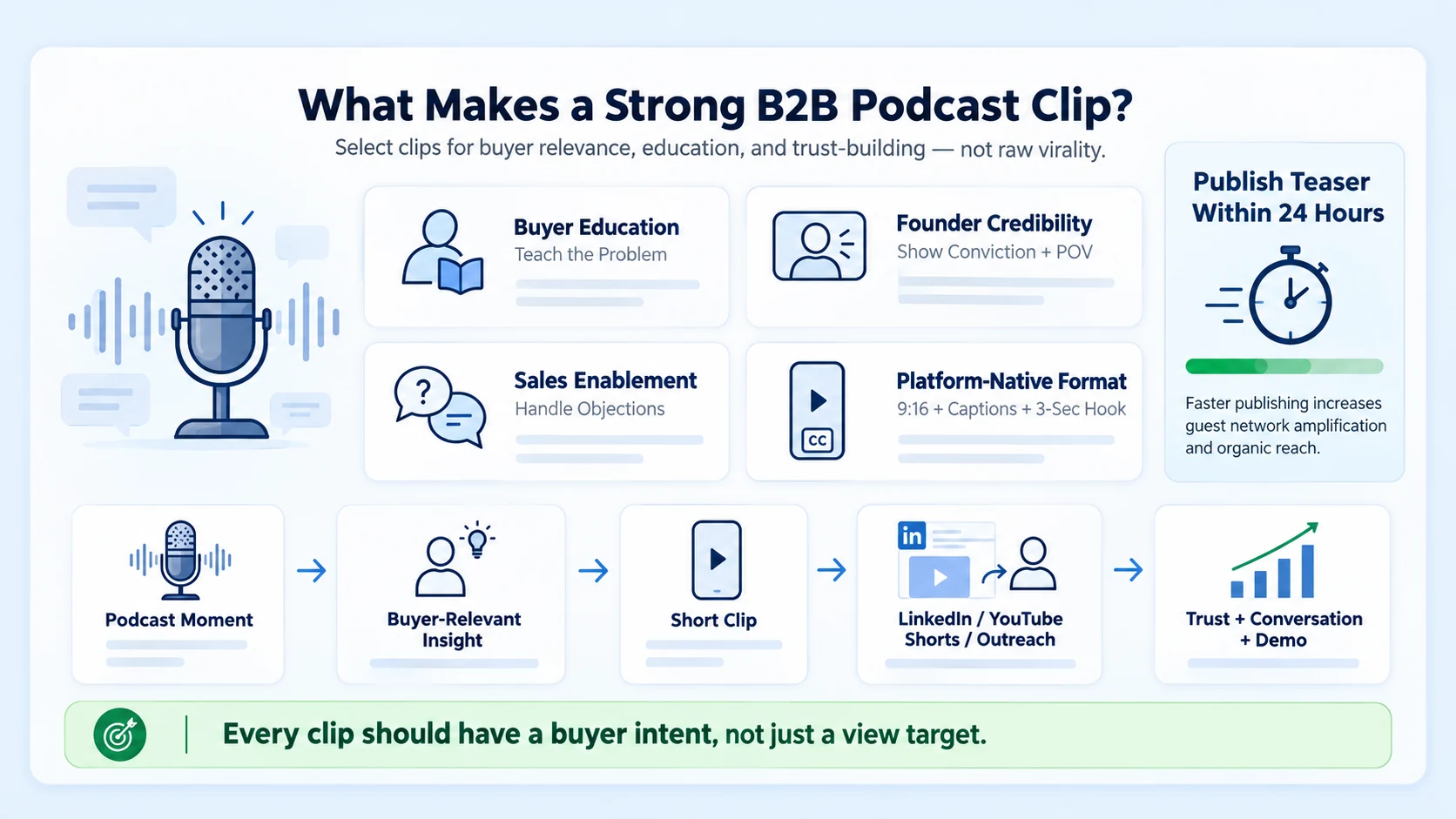
- Buyer education moments: Does this clip help an ideal buyer understand their problem better, or see your category differently?
- Founder-led credibility: Does this clip show the thinking, the conviction, or the point of view that differentiates your team?
- Sales enablement value: Could a sales rep share this clip to a prospect to advance a conversation or handle an objection?
- Platform-native format: Is the clip 9:16, captioned, and opening with a hook in the first 3 seconds?
Creators who post teaser clips within 24 hours of publishing the full episode see a 39% increase in cross-platform traffic. For B2B teams, that window matters, it's when the episode topic is freshest in a guest's network and your team's organic reach is highest.
For B2B specifically, podcast-engaged prospects close 23% faster than non-engaged ones, which means clips aren't just top-of-funnel awareness assets. They're pipeline-warming tools when distributed intentionally through LinkedIn video marketing and direct outreach sequences.
This is the lens Komet Media uses across podcast production and video marketing engagements: every clip has a buyer intent behind it, not just a view target.
Conclusion
- A 45–60 minute podcast episode yields 5–15 publishable clips for most B2B teams, with a theoretical maximum of 20+ across all format variations.
- 5–7 clips per episode per week is the sustainable, high-quality target for teams without a dedicated content operation.
- Quality and hook strength define the real ceiling, not episode length or AI tool output limits.
- Content atomization, used correctly, turns one recording into a full week of buyer-educating, pipeline-supporting, evergreen content that works across LinkedIn, YouTube Shorts, Reels, and TikTok.
Frequently Asked Questions
Q1: How many clips can you get from one podcast if it's only 20–30 minutes long?
A shorter episode still yields usable clips, but expect 3–6 strong ones rather than 10+. Prioritize the single sharpest insight, the strongest hook moment, and one clear takeaway. Quality over count matters even more at lower episode lengths.
Q2: Does it matter if my podcast is audio-only vs. video-recorded?
Yes, significantly. Video performs significantly better on most platforms since it supports captions, visual pacing, and thumbnail selection. Audio-only podcasts can still be clipped using waveform visualizers or static branded graphics, but expect lower engagement compared to video-recorded episodes.
Q3: How many reels can I make from one podcast episode?
Realistically, 3–8 Reels from a standard 45–60 minute episode. Three to six 30–90 second moments for Reels, TikTok, and YouTube Shorts, auto-captioned and reframed to 9:16, is the standard range. Each Reel should open with a standalone hook, not episode context.
Q4: Should I publish all the clips I extract at once?
No. Spread clips across 5–7 days on your social media content calendar. Publishing everything at once signals repurposing, reduces perceived content variety, and doesn't give each clip time to gather engagement before the next one arrives.
Q5: What's the best tool for extracting clips from a podcast?
Opus Clip and Descript are the most widely used for B2B teams. Riverside.fm handles recording and basic clip extraction in one workflow. Repurpose.io automates cross-platform distribution after clips are cut. The right tool depends on whether you need AI-assisted clip selection or manual editorial control.
Q6: How many clips is too many from a single podcast episode?
Three to six is the sweet spot for most experts. AI tools will happily generate 20–30, but quality and your point of view matter more than volume. Beyond 10–12 clips per episode, engagement typically drops because the strongest moments have already surfaced. Stop when clip quality drops, not when the tool runs out of suggestions.