
🪄 AI Summary
Heading 1
Heading 2
Heading 3
Heading 4
Heading 5
Heading 6
Lorem ipsum dolor sit amet, consectetur adipiscing elit, sed do eiusmod tempor incididunt ut labore et dolore magna aliqua. Ut enim ad minim veniam, quis nostrud exercitation ullamco laboris nisi ut aliquip ex ea commodo consequat. Duis aute irure dolor in reprehenderit in voluptate velit esse cillum dolore eu fugiat nulla pariatur.
Block quote
Ordered list
- Item 1
- Item 2
- Item 3
Unordered list
- Item A
- Item B
- Item C
Bold text
Emphasis
Superscript
Subscript
Should B2B brands be on TikTok? For some, yes. For others, not yet. In my experience, the honest answer depends on whether the brand has a clear message, someone willing to be human on camera, and a website that can actually convert curious viewers. TikTok can build early awareness for B2B SaaS, AI, and tech startups & teams—whether producing video content from scratch or repurposing existing assets. It cannot fix a message problem or an unclear offer.
Quick Answer
Should B2B brands be on TikTok? For B2B SaaS, AI, and tech startups & teams with a clear offer, a willing spokesperson, and a site that converts, yes. Others should build that foundation first.
Why This Question Keeps Coming Up Now
TikTok adoption among marketers has grown, but it still lags well behind the platforms most B2B teams already use. As of January 2026, only 32% of marketers used TikTok, ranking it fifth behind Facebook, Instagram, LinkedIn, and YouTube. That gap is smaller than it looks, though. The same platform reports the best per-post engagement rate of any major network, at 3.7%, roughly 7.7 times Instagram's rate.
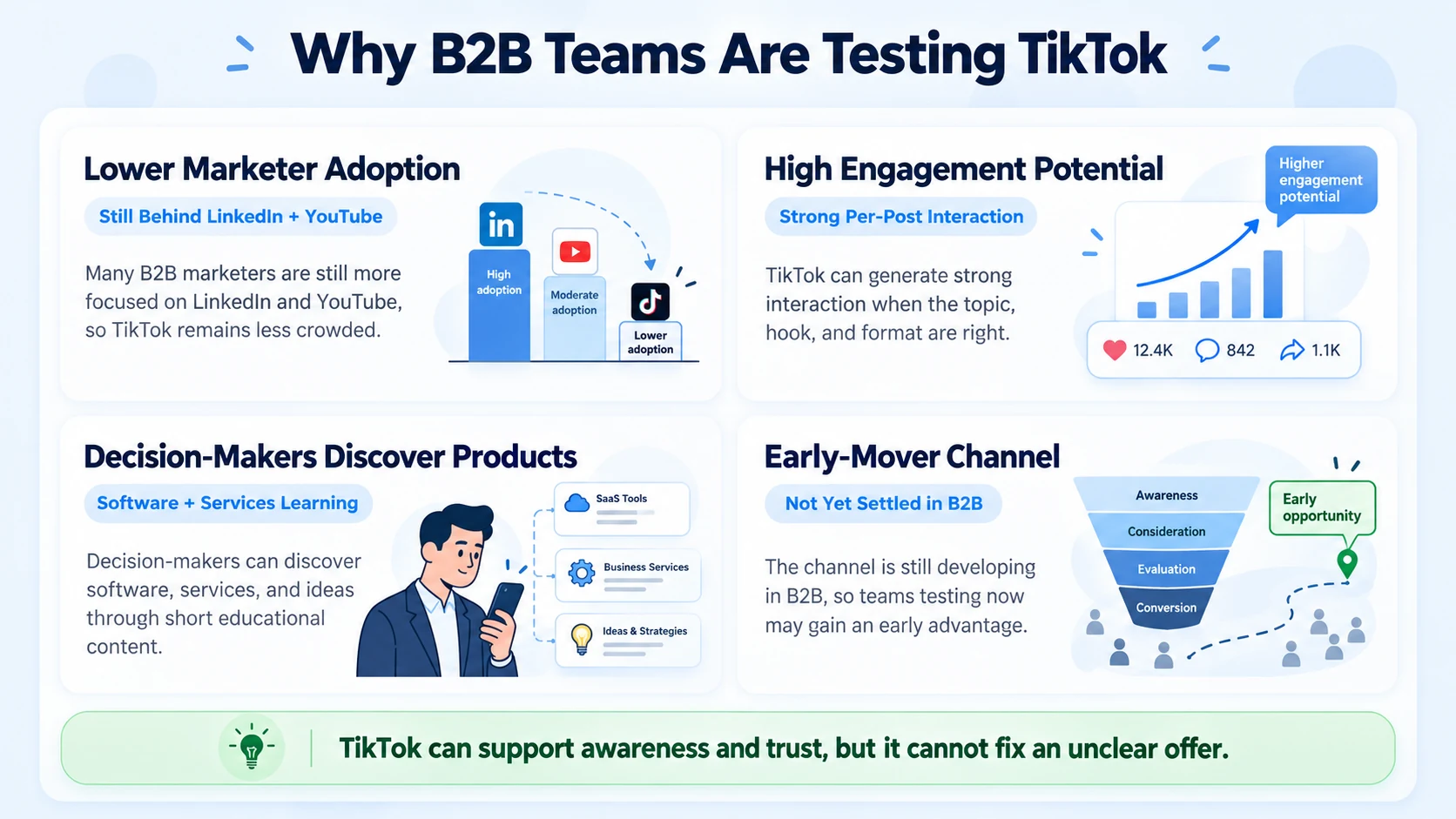
The audience question matters as much as the engagement numbers. Industry research on B2B decision-makers who are on TikTok suggests roughly two-thirds of them use the platform to discover or learn about business products, software, or services. Adoption estimates for B2B brands themselves vary widely by source, from roughly a quarter of B2B companies in some surveys to well over half of marketers overall reporting some TikTok use. That range is a signal in itself: this is still an early-mover channel for most B2B categories, not a settled one.
I have seen B2B SaaS, AI, and tech startups & teams treat TikTok as a magic lead source and get disappointed, and I have seen others dismiss it outright without checking whether their buyers are actually there. Both reactions skip the real question, which is whether the specific brand and audience fit the platform. One 2026 industry assessment frames it plainly: TikTok is worth considering for B2B companies that need awareness, trust formation, and category education before a sales conversation, but it is too early for a company whose offer is still unclear or whose site cannot convert mobile visitors.
Who TikTok Actually Works for in B2B
Should B2B brands be on TikTok depends less on industry and more on a small set of practical conditions.
TikTok's algorithm also levels the playing field in a way LinkedIn and Instagram do not. It ranks primarily on engagement signals like watch time and comments rather than follower count, so a new account can reach a wide audience faster than on more established B2B platforms.
Common Mistakes B2B Teams Make on TikTok
Most B2B teams that struggle on TikTok are not failing because the platform does not work for B2B. They are failing because they brought the wrong content to it.
The second mistake is the one I see most often with funded B2B SaaS, AI, and tech startups & teams under pressure to show fast results. TikTok is closer to a top-of-funnel discovery channel for B2B, not a direct-response one, and judging it by last-click leads alone usually leads to giving up too early. That measurement mistake, not a firm no, is often the real answer hiding behind should B2B brands be on TikTok.
A Workflow for Testing TikTok Without Betting the Whole Budget
This is the process we use at Komet Media to help B2B SaaS, AI, and tech startups & teams find out whether TikTok fits, without a large upfront commitment using our short-form video editing and production services:
- Confirm the offer is clear. If a stranger cannot understand what the company sells in one sentence, fix that before testing a new channel.
- Find a comfortable spokesperson. A founder, expert, or team member who can talk naturally on camera, without a script.
- Pull from existing raw material. Sales calls, demos, webinars, and podcast footage are usually the fastest source of real content.
- Post consistently for four to six weeks. A single video says almost nothing about fit.
- Track assisted signals, not just views. Website visits, branded search, and inbound mentions matter more than the view count alone.
- Decide with a full batch of data. Judge the channel on a body of posts, not the first one or two.
For teams starting from scratch or repurposing existing content like webinars or podcast episodes, this test usually requires minimal overhead while establishing a predictable video creation pipeline.
How to Measure Whether TikTok Is Worth It
TikTok rarely closes a B2B deal on its own. The right signals reflect that.
Attribution here is rarely clean. I would rather look at several of these signals together over a full quarter than expect one dashboard number to settle whether TikTok is working for a specific B2B brand. That quarterly view is usually a better test of should B2B brands be on TikTok than any single week of posting.
What a Capable Production Partner Should Handle
Testing and scaling TikTok for a B2B brand is a production and strategy problem, not just a content-creation one. A capable partner should be handling:
- Producing original videos from scratch or turning existing sales calls, demos, and podcast footage into TikTok-native clips
- Coaching or briefing spokespeople for unscripted, on-camera delivery
- Matching pacing and tone to what performs on the platform, without losing the brand's substance
- Tracking assisted signals alongside raw view counts
- Deciding, with real data, whether to scale the channel or redirect the effort elsewhere
This is close to the core of what we do at Komet Media. Our short-form video editing and production services help B2B SaaS, AI, and tech startups & teams test whether should B2B brands be on TikTok holds up for their specific audience, using both full production from scratch and repurposed existing recordings, so the decision gets made on real performance data, not a guess.
Conclusion
Should B2B brands be on TikTok? For B2B SaaS, AI, and tech startups & teams with a clear offer, a willing spokesperson, and a converting site, the platform is worth a real test, especially given how far marketer and content adoption still lag its consumer scale. For companies still working out their message or funnel, TikTok will not fix those problems, and the content will underperform no matter how well it is produced. Komet Media offers short-form video editing and production services to help test it with real material—whether created from scratch or repurposed—measure more than views, and let a full batch of data decide, rather than one video or one gut reaction.
FAQ
Should B2B brands be on TikTok if their competitors already are?
Not automatically. Competitor presence is a signal worth investigating, but readiness still depends on having a clear, simply stated offer, a spokesperson comfortable with unscripted delivery, and a website that can convert curious visitors into a next step. Without those three things, TikTok content tends to produce views without measurable business value, competitor or not.
How much does it cost for a B2B brand to test TikTok?
Cost depends on whether you are producing new concepts from scratch or repurposing existing footage. Retainer-based production, covering strategy, scripting, editing, and platform-specific cuts, typically runs in the range of approximately $2,500 to $5,000 a month, though a smaller initial test can cost less.
What is the process for testing whether TikTok fits a B2B brand?
The process usually starts with confirming the offer is clear, finding a comfortable spokesperson, and deciding whether to produce original concepts from scratch or pull from existing recordings. Posting consistently for four to six weeks and tracking assisted signals, not just views, is what determines fit.
How long does it take to know if TikTok is working for a B2B brand?
Most teams need at least four to six weeks of consistent posting before a real pattern emerges. Commercial signals, like branded search or sales-reported recognition, usually take longer to show up clearly than content engagement does.
What deliverables come with a B2B TikTok test program?
A typical test includes a set number of edited clips per week created from scratch or pulled from existing source material, platform-specific captions and pacing, and a short report on view-through rate, completion rate, and assisted traffic. Some programs also include spokesperson coaching and scripting for on-camera delivery.
Should a freelancer or an agency handle a B2B brand's TikTok test?
A freelancer can work well for a light, low-volume test with a team that can manage the channel directly. An agency tends to hold up better once the brand wants consistent posting, tested formats, and reporting across a full quarter.
Does an in-house team or an external partner make more sense for a TikTok test?
Small in-house teams often struggle to sustain the posting volume needed to judge fit fairly. An external partner running the test as a structured process tends to produce a clearer, faster answer on whether the channel is worth scaling.
Does Komet Media help B2B brands decide if TikTok is worth it?
Yes. Komet Media offers short-form video editing and production services to B2B SaaS, AI, and tech startups & teams to produce video content from scratch as well as convert existing recordings into TikTok-native clips, tracking the signals that actually indicate fit rather than judging the channel on views alone. Book a call to talk through whether a TikTok test makes sense for your brand.