
🪄 AI Summary
Heading 1
Heading 2
Heading 3
Heading 4
Heading 5
Heading 6
Lorem ipsum dolor sit amet, consectetur adipiscing elit, sed do eiusmod tempor incididunt ut labore et dolore magna aliqua. Ut enim ad minim veniam, quis nostrud exercitation ullamco laboris nisi ut aliquip ex ea commodo consequat. Duis aute irure dolor in reprehenderit in voluptate velit esse cillum dolore eu fugiat nulla pariatur.
Block quote
Ordered list
- Item 1
- Item 2
- Item 3
Unordered list
- Item A
- Item B
- Item C
Bold text
Emphasis
Superscript
Subscript
If you're running marketing or growth at a legaltech company, you already know the problem: your product is sophisticated, your buyer is skeptical, and your sales cycle is long. Short-form video for legaltech companies cuts through all three barriers, faster than a whitepaper, more credible than a cold email, and more scalable than a live demo. This guide breaks down exactly how to build a video system that educates buyers, earns trust, and drives pipeline for legal technology SaaS teams in 2026.
TL;DR
- Short-form video builds the buyer trust legaltech companies need, before a single sales conversation happens.
- LinkedIn is the primary distribution channel; 30–90 second clips targeting legal ops, managing partners, and in-house counsel perform best.
- Content that simplifies complex legal software (demos, explainers, founder POVs) converts better than brand awareness content.
- Repurposing webinars, podcasts, and demos into clips is the highest-leverage entry point for most legaltech teams.
Is Short-Form Video Actually Effective for B2B Legaltech Marketing?
Legaltech buyers are thorough, risk-averse, and slow to commit. That makes trust the central variable, and video is the fastest way to build it at scale. 93% of B2B buyers say video builds brand trust, and 91% of consumers feel more confident purchasing a product after watching a video. In a sector where a single software procurement decision involves multiple stakeholders and months of evaluation, that trust gap is exactly where most legaltech sales cycles stall.
Videos under 60 seconds generate 2.5x more engagement per impression than any other content type, and short-form video has ranked as the number-one ROI format for marketers for the third consecutive year, with 57% of marketing budgets now including a dedicated short-form line item. 80% of B2B sales now take place entirely online, and the vast majority of the buyer journey is completed before a prospect ever speaks to a sales representative.
That means a legaltech buyer evaluating case management software, e-discovery platforms, or contract tools like those from Clio or Thomson Reuters is already forming opinions before your SDR reaches out. Short-form video for legaltech companies is how you shape that opinion early. Before reaching out to a vendor, most B2B buyers review an average of 11 pieces of content, with 72% starting their search online. Your video content needs to be part of that research stack.
The compliance communication challenge also matters here. Law firms and legal departments are conservative by nature. A 45-second clip of your founder explaining how your software handles data security, references bar association guidelines, or integrates with existing case management workflows does more persuasive work than a product brochure. Video makes abstract compliance positioning concrete and human.
At Komet Media, we help legaltech SaaS teams either turn product knowledge, founder thinking, and demo recordings into short clips or create them from scratch, educating buyers and supporting the pipeline before the first sales touchpoint.
How Legaltech Companies Use Short-Form Video for Marketing
The most effective legaltech video programs run four content types in parallel:
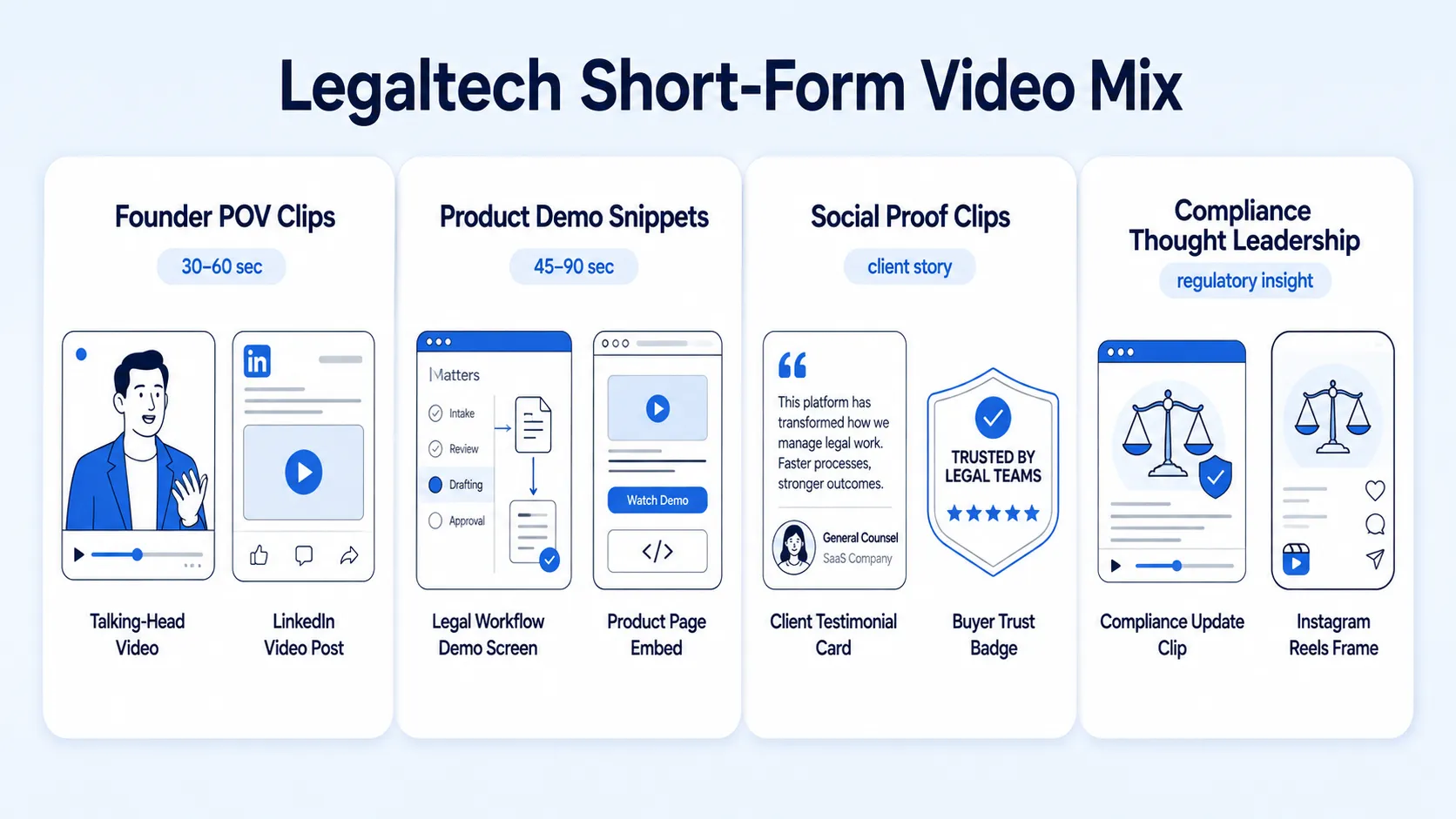
1. Founder POV clips: The founder or a senior executive explains a specific legal workflow problem in 30–60 seconds. No pitch. No product screenshots. Just a sharp take on a real pain point that in-house counsel or law firm partners face daily. LinkedIn is the natural distribution channel for this format, and LinkedIn video watch time grew 36% year over year in 2025.
For examples watch here:
2. Product demo snippets: These are not full demos. They are 45–90 second highlights that show one specific workflow solving one specific problem, for example, how a matter management platform automates conflict checks, or how an AI drafting tool handles clause review. 57% of B2B buyers watch product demos during the consideration stage, making this the format with the most direct link to pipeline.
For examples watch here:
3. Social proof clips: A client success story compressed into 60 seconds, covering the before state, the switch, and a specific outcome. 72% of customers trust brands more with positive video reviews, and in legaltech, where word-of-mouth travels through bar associations and legal ops communities, a recognizable client face carries significant weight.
For examples watch here:
4. Compliance and thought leadership content: Short clips that explain regulatory shifts, bar association guideline updates, or how AI impacts attorney-client privilege. This type of video positions the brand as a credible voice in legal content marketing, not just a software vendor.
For examples watch here:
- https://www.linkedin.com/posts/clio---cloud-based-legal-technology_ai-hallucinations-in-court-activity-7475540846470135808-oHWs
The distribution play is straightforward: post natively on LinkedIn, repurpose into Instagram Reels for attorney client acquisition at smaller firms, and embed clips on product pages to support video SEO and conversion.
Best Short-Form Video Strategies for Legal Technology Startups
Legaltech startups face a specific constraint: limited content libraries and lean marketing teams. The highest-leverage approach is content repurposing, converting long-form assets already inside the business into short-form clips.
Here is the system:
- Audit existing long-form assets: Pull all webinar recordings, podcast episodes, product demos, investor pitch decks (as scripts), and sales call recordings.
- Identify repeatable moments: Find sections where a founder, PM, or customer explains a problem clearly in under two minutes. These are your source clips.
- Edit into vertical video: Format for 9:16 (LinkedIn, Reels, TikTok) and 1:1 (LinkedIn feed). Add captions, over 80% of social video is watched without sound.
- Write a hook for each clip: The first three seconds determine whether a viewer continues. Lead with a specific problem statement, not a company introduction.
- Distribute natively per platform: Upload directly to LinkedIn rather than sharing YouTube links. Native uploads receive dramatically more reach from platform algorithms.
- Build a content series, not individual posts: Build repeatable series, not random posts. A series makes it easier to create, easier to measure, and easier for viewers to recognize.
For teams without existing content, the starting point is a founder-led LinkedIn video series: one insight per week, recorded on a smartphone, edited into a clean 45–60 second clip with captions and a clear CTA. Consistency beats production value at this stage.
Our short-form video services handle the entire pipeline for legaltech teams, whether you need to repurpose existing assets or create high-quality content from scratch, including research, scripting, and production support.
How to Explain Complex Legal Software in a 60-Second Video
This is the question most legaltech marketers get wrong. They try to explain the full product. The answer is: explain one outcome. The 60-second structure that converts:
Watch Ironclad video here:
For legal technology SaaS products, the hook has to be hyper-specific. Not "managing legal documents is complex." Instead: "If your litigation team is still building deposition prep folders manually, you're losing four hours per case." That precision signals to an attorney or legal ops director that the creator actually understands their workflow.
Motion graphics work well for compliance communication and abstract concepts like AI-assisted contract review or predictive case outcome modeling, areas where live-action screen recording struggles to convey the logic visually. Concept videos are particularly useful in software, financial services, and technical B2B sectors for brands creating new categories or explaining technical concepts that resist live-action treatment.
The same principle applies on TikTok for B2B and Instagram Reels: specificity is the differentiator. A 60-second Reel titled "Why 73% of legal ops teams still use spreadsheets for matter tracking" will outperform a generic "Here's how our software helps law firms" clip every time. Our video marketing services are built around this framework, scripting for specificity first, production second.
How Legaltech SaaS Companies Can Grow on LinkedIn Using Short Video
LinkedIn is the top B2B video channel, with 8 in 10 teams identifying it as their primary medium for sharing video, surpassing even YouTube. For legaltech, LinkedIn is not optional. It is where managing partners, legal ops directors, chief innovation officers, and in-house counsel spend professional time.
The LinkedIn video strategy for legaltech SaaS has three layers:
Executive personal branding: Founders and senior leaders posting short video takes on legal technology trends. Lawyer personal branding and founder-led growth intersect here. A managing partner at a law firm trusts other legal professionals far more than a corporate brand page. Thought leadership content from identifiable people compounds over time.
Company page video: Product-led clips, client stories, and feature highlights posted from the company handle. The LinkedIn algorithm prioritizes 2–3 substantial, valuable posts per week over daily superficial updates. Consistency and depth beat frequency.
Paid video retargeting: Video ads served to audiences who have already engaged with organic content or visited the product page. Video ads in retargeting campaigns showcase product features and provide in-depth explanations, the right message for a buyer already in the consideration window.
LinkedIn fits legaltech well because law firm and corporate legal personas are precise: targeting by job titles including Managing Partner, COO, CIO, Chief Innovation Officer, Director of Practice Management, and Director of Litigation Support allows for efficient spend with minimal audience waste.
Organic LinkedIn activity delivers an average ROI of 229% according to 2025 benchmarks, while paid social efforts follow closely at 192% over a three-year window. The combination of organic video content for trust-building and paid video for retargeting is the highest-compound LinkedIn strategy for legaltech SaaS teams.
The Biggest Mistakes Legaltech Companies Make With Short-Form Video
Most legaltech video programs underperform not because of production quality, but because of strategy errors. Here are the most common:
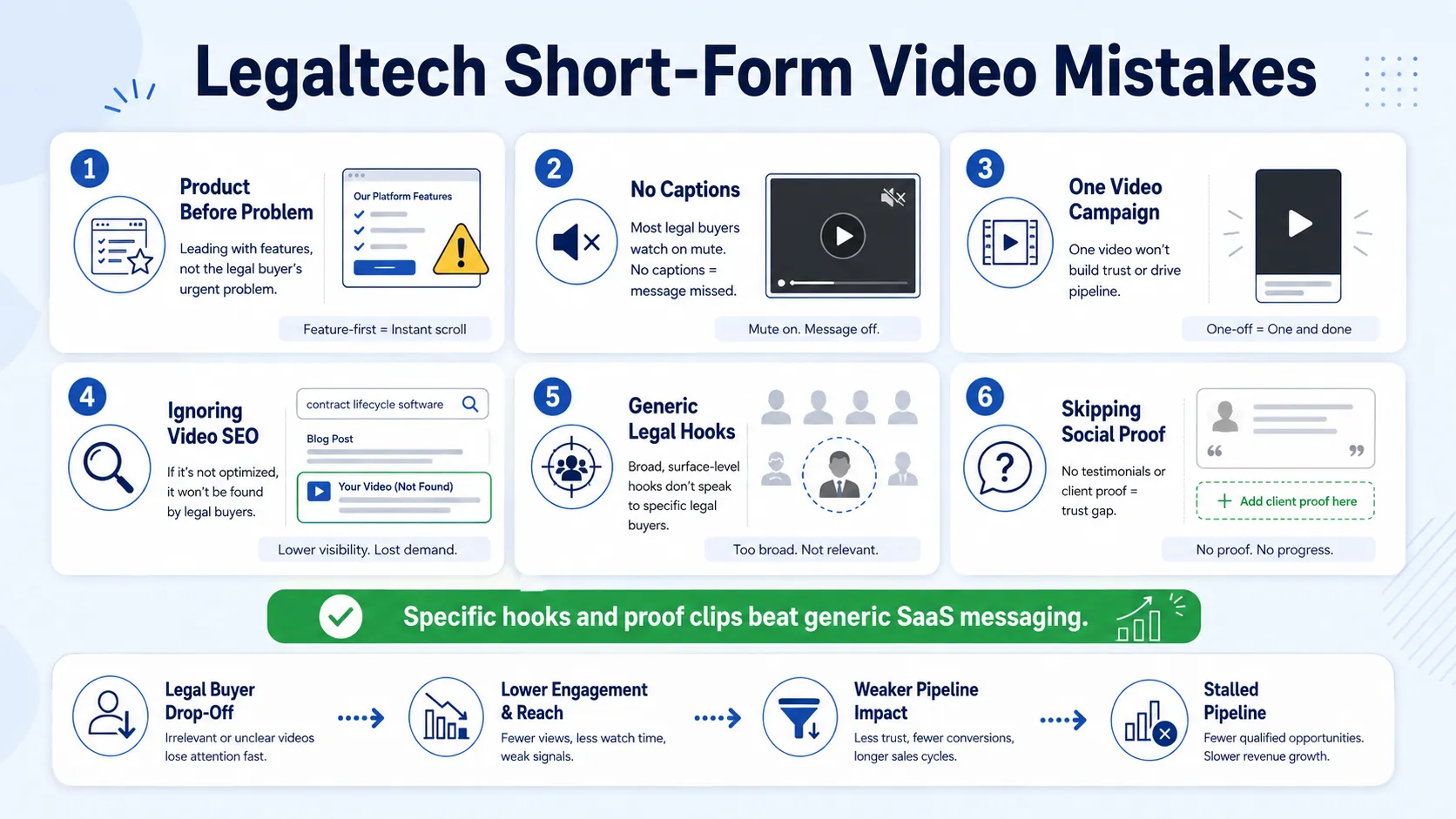
- Explaining the product instead of the problem: Buyers at the consideration stage already know they have a problem. Video that leads with product features loses them in the first eight seconds. Lead with the pain, then show the solution.
- Ignoring captions and accessibility: Legal professionals often watch video between meetings, on mute. No captions means no watch time.
- Producing one video and calling it a campaign: Short-form requires more production volume, not less. A 15-second clip needs to be adapted into vertical Reels, horizontal pre-roll, Shorts, and TikTok, each with the right aspect ratio and pacing. Multiply that by your product range and campaign cadence, and the number gets significant fast.
- Neglecting video SEO: Titles, descriptions, and transcripts on embedded video increase search visibility. Legaltech buyers searching for "best e-discovery software" or "matter management tools" should find your content before your competitors'.
- Generic hooks aimed at "law firms" broadly: Targeting is everything in legal content marketing. A clip for a corporate in-house legal team at a Fortune 500 company requires a different hook than one aimed at a solo practitioner or a legal technology investor. Vertical video production strategy must account for the specific audience segment.
- Skipping social proof: 37% of sales teams now lean on video as a core asset in their outreach and deal-closing workflows. Client testimonial clips belong in the sequence, not as an afterthought.
You can explore how we handle video editing services for B2B SaaS teams to see what a systematic approach looks like in practice.
Conclusion
Short-form video for legaltech companies is no longer a nice-to-have, it is the medium through which buyer trust is built, product complexity is resolved, and pipeline is generated before a sales call happens. The key takeaways:
- Repurpose existing webinars, demos, and podcasts first, the content is already inside your business.
- LinkedIn is the primary channel; founder POVs and 45–90 second product clips perform best with legal buyers.
- Specificity in hooks and outcomes separates high-converting legaltech video from generic SaaS content.
- Consistency and volume matter more than production perfection at the start.
Ready to build a video system for your legaltech team? Talk to Komet Media about turning your existing content into a pipeline asset.
Frequently Asked Questions
Q1: What length of short-form video works best for legaltech B2B audiences?
71% of marketers report that short-form videos in the 30-second to 2-minute range perform best. For legaltech, 45–90 seconds is the practical sweet spot: long enough to explain one workflow or outcome clearly, short enough to respect a busy attorney's time. Keep TikTok and Reels under 60 seconds; LinkedIn can support up to 90 seconds effectively.
Q2: Should legaltech companies post on TikTok, or focus only on LinkedIn?
LinkedIn should be the primary channel for legaltech SaaS targeting law firm decision-makers and legal ops. TikTok for B2B and Instagram Reels work for attorney client acquisition at smaller firms and for building brand visibility with younger legal professionals. Start with LinkedIn, build a content library, then repurpose to other platforms as volume increases.
Q3: How do we repurpose a webinar into short-form video clips?
Start by identifying two to four moments in the webinar where a speaker delivers a sharp, self-contained insight in under 90 seconds. Clip those segments, add captions, write a platform-specific hook for the first line of the caption, and post natively. A single one-hour webinar can yield six to ten standalone clips for LinkedIn and Reels.
Q4: Do bar association advertising guidelines restrict legaltech video content?
Bar association guidelines primarily govern attorney advertising, claims of specialization, client guarantees, and testimonials. Legaltech vendors are not attorneys, so most restrictions apply only if your video features a lawyer making claims on behalf of clients. Always review ABA Model Rule 7.1 if your video includes attorney spokespeople or client outcome claims to ensure compliance.
Q5: How many short-form videos should a legaltech SaaS team publish per week?
The LinkedIn algorithm prioritizes 2–3 substantial, valuable posts per week over daily superficial updates. For most legaltech teams starting out, two videos per week on LinkedIn, one founder POV and one product or client clip, is a sustainable and effective cadence. Quality and consistency compound faster than volume without strategy.
Q6: What is the ROI timeline for short-form video in B2B legaltech marketing?
Short-form video builds compounding returns, not immediate ones. Expect the first 60–90 days to focus on audience development and content calibration. Pipeline influence typically becomes measurable in months two through four, as buyer familiarity and trust accumulate. Landing pages with embedded video convert at 86% higher rates than text-only equivalents, and B2B SaaS pages with explainer videos see conversion lifts exceeding 100% in controlled testing, so product pages are often the fastest place to see a measurable return.