
🪄 AI Summary
Heading 1
Heading 2
Heading 3
Heading 4
Heading 5
Heading 6
Lorem ipsum dolor sit amet, consectetur adipiscing elit, sed do eiusmod tempor incididunt ut labore et dolore magna aliqua. Ut enim ad minim veniam, quis nostrud exercitation ullamco laboris nisi ut aliquip ex ea commodo consequat. Duis aute irure dolor in reprehenderit in voluptate velit esse cillum dolore eu fugiat nulla pariatur.
Block quote
Ordered list
- Item 1
- Item 2
- Item 3
Unordered list
- Item A
- Item B
- Item C
Bold text
Emphasis
Superscript
Subscript
I've reviewed hundreds of podcast clips across SaaS, tech, and B2B shows this year. The gap between clips that drive real reach and clips that die at 200 views is not production budget. It's decisions: which moment you pull, how you open it, and whether the edit respects the platform you're posting to. This article breaks down the podcast clip examples that drove reach in 2026, the formats behind them, and the specific mechanics you can apply right now if you're repurposing founder conversations, demos, or webinars for pipeline.
TL;DR
- Podcast clip examples that drove reach in 2026 share three traits: a hook in the first two seconds, one clear idea, and platform-native formatting.
- Podcasts that post clips on TikTok, YouTube Shorts, or Instagram Reels see an average audience reach growth of 65%.
- Audiograms still work for LinkedIn and X. Video clips win on TikTok, Reels, and Shorts.
- B2B founders leave the most reach on the table by clipping the wrong moments and skipping captions.
Podcast Clip Examples That Went Viral in 2026 (And What Made Them Work)
The shows that consistently generate reach from clips are not the ones with the biggest production budgets. They're the ones with the most disciplined clipping systems. In 2026, the single fastest way to grow a podcast isn't inside Spotify, it's on TikTok, Instagram Reels, and YouTube Shorts. Look at almost any podcast that grew significantly in the last two years, Diary of a CEO, Chris Williamson's Modern Wisdom, My First Million, Shawn Ryan Show, and you'll find a relentless short-clip engine behind it.
What do the clips from these shows actually have in common? Three things every time:
- A clip-worthy moment, not just a good quote: Clips that challenge conventional wisdom or present a contrarian viewpoint are highly effective at stopping the scroll. When a guest provides a perspective that contradicts industry norms, it creates a cognitive itch viewers feel compelled to scratch, and those clips spark intense discussion in comments, which signals platform algorithms to increase reach.
- Volume treated as a system: A one-hour podcast episode can yield 10–20 short clips. If each clip reaches even a small audience and a fraction of those viewers convert to podcast listeners, you've built a powerful growth engine without creating any new content.
- A distinct clips channel: Lenny Rachitsky, whose product podcast consistently ranks in Apple's top charts, recently launched a dedicated YouTube channel where he shares focused, topic-specific clips from longer podcast episodes, each clip going deep into just one specific topic from the full conversation.
On the B2B side, the Joe Rogan Experience has mastered the art of clips by pulling 10–20 minute clips from each episode to share on YouTube, allowing the team to select the most compelling content from a three-hour interview to bring in a larger audience. That same principle scales down directly to a 45-minute SaaS founder interview or a product demo deep-dive.
What Podcast Clips Actually Drove Reach and Growth This Year
The 2025 Edison Research Infinite Dial study shows podcast discovery has shifted from directory browsing to social clip discovery, with TikTok and YouTube Shorts now driving the majority of new-listener attribution. That is a structural shift, not a trend. For B2B teams, it means your podcast or webinar recording is dead weight unless clips are actively deployed. The clips that drove the most measurable reach in 2026 shared these characteristics:
- Contrarian or surprising insight: Short-form podcast clips work because they tap into a core principle of digital engagement: the hook point. A compelling 30-second moment can generate stronger interest than a traditional display ad or static creative because it delivers personality, context, and emotion immediately.
- High completion rate: The mathematics of social media algorithms work heavily in favor of podcast clips. When someone watches your 60-second clip from start to finish, that represents a 100% completion rate.
- Engagement velocity: Engagement velocity plays a crucial role in algorithmic success. Clips generate likes, comments, and shares much faster than longer content because they require less investment from viewers, and that signals to algorithms that the content is resonating, leading to broader distribution.
For B2B SaaS specifically, short clips from genuine expert conversations consistently outperform polished brand creative. A 60-second moment from a real podcast interview, a sharp insight, an unexpected admission, a specific outcome, is the kind of content that stops a SaaS buyer mid-scroll.
Best Podcast Clip Formats for Social Media in 2026
Not all clip formats perform equally across platforms. The format decision is as important as the moment you select. Here's how to match format to platform:
Short-form video optimization in 2026 comes down to three inputs: specs matched to each platform, a hook that lands in the first second, and content structure that keeps the viewer's question alive until the end.
Platform signals differ: TikTok rewards saves and shares over likes, Instagram Reels pushes content based on reach and profile follows, and YouTube Shorts ranks on CTR and average view duration.
YouTube Shorts behave differently from TikTok and Reels: it's tied to YouTube search and suggested video, so clips compound over months rather than dying in 48 hours. Multiple analytics sources point to a practical target around 30–33 seconds with a strong 3-second hook.
What Makes a Podcast Clip Go Viral: Hook Engineering and Clip Virality Triggers
The first two to three seconds of your clip determine everything. TikTok's creator program shifted payouts toward clips with higher average watch time, which means the first three seconds of your podcast clip now determine whether it makes money or gets buried.
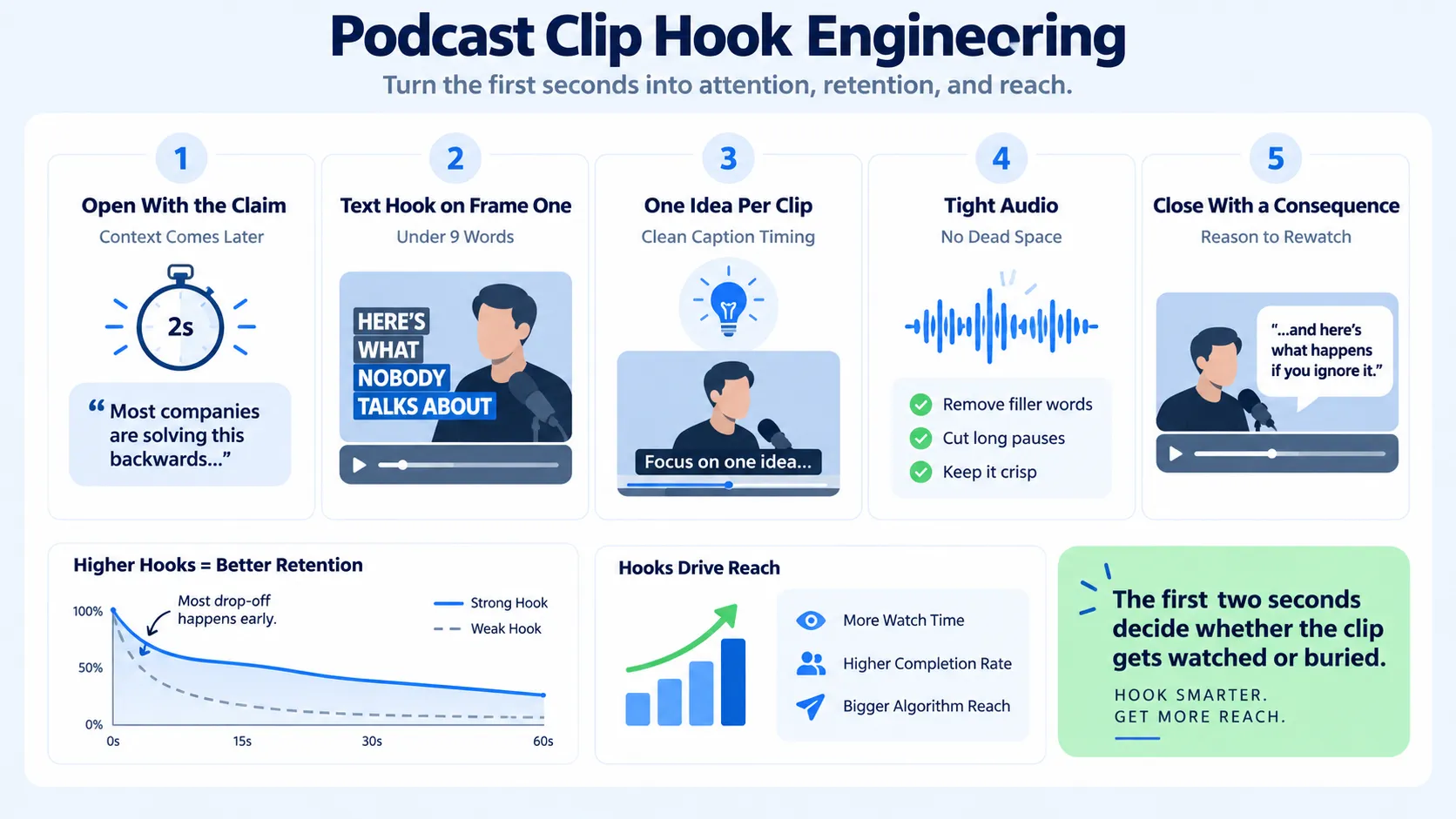
Instagram Reels made a similar move, tying reach directly to completion rates rather than raw views. Hook engineering is the discipline of designing those first seconds deliberately. The checklist that separates clips that land from clips that scroll past:
- Open with the claim, not the context: Lead with the provocative statement. Context comes after attention is earned.
- Text hook on frame one: Text overlays for the hook moment lift retention 1.5 to 3x relative to caption-only clips. Most successful podcast TikTok accounts run captions plus large hook-text overlays during the first 1 to 3 seconds of every clip.
- One idea per clip: Keep the checklist simple: hook in the first 2 seconds, one idea per clip, caption accuracy, and on-screen text under 9 words.
- Tight audio: Remove dead space, breaths between thoughts, and filler. Compression exposes every flaw.
- Close with a consequence: The last 3 seconds should give a reason to rewatch, comment, or follow.
The old workflow of dumping podcast audio into an audiogram tool, slapping a waveform on it, and posting it to three platforms stopped working sometime around late 2025. Virality in 2026 requires intentional editing, not just clipping.
Podcast Audiogram vs. Video Clip: Which Drives More Reach?
This is the question I get most from founders and marketing heads deciding where to spend their video editing workflow budget. The honest answer: it depends entirely on the platform. Podcast audiograms are easier to scale from audio-only episodes, while podcast video clips are stronger for showing personality, trust, and conversation dynamics.
For B2B teams that haven't yet built a video recording setup, audiograms give you a functional starting point. But for discovery-led reach, video wins. Average viewer retention for video podcasts is 2.7 times higher than for audio-only formats on mobile. And podcasts that include video receive an average of 47% higher engagement than audio-only shows, according to Podtrac and Edison Research.
The practical split I recommend for B2B teams:
- TikTok, Reels, Shorts: Video clip only. Audiograms are deprioritized by these algorithms.
- LinkedIn: LinkedIn video posts are shared 20x more than other content types, which is why clips outperform static posts for reach. Use short talking-head clips or audiograms with strong captions.
- X (Twitter): Audiograms with sharp quote overlays work well for thought leadership distribution.
- Spotify Clips: You can upload short-form clips directly on Spotify, live in over 100 markets, where your audience already comes to listen and watch.
Audiograms work best when you treat them as promotional assets, not full episode replacements. Use them to drive traffic to video content or full episodes, not as the main reach vehicle.
How to Clip Long-Form Podcast Content for Maximum Reach (The B2B Playbook)
This is the content repurposing framework I use with SaaS founders and funded AI teams. A single 45-minute recorded conversation should generate at minimum eight deployable clips. Here's the system:
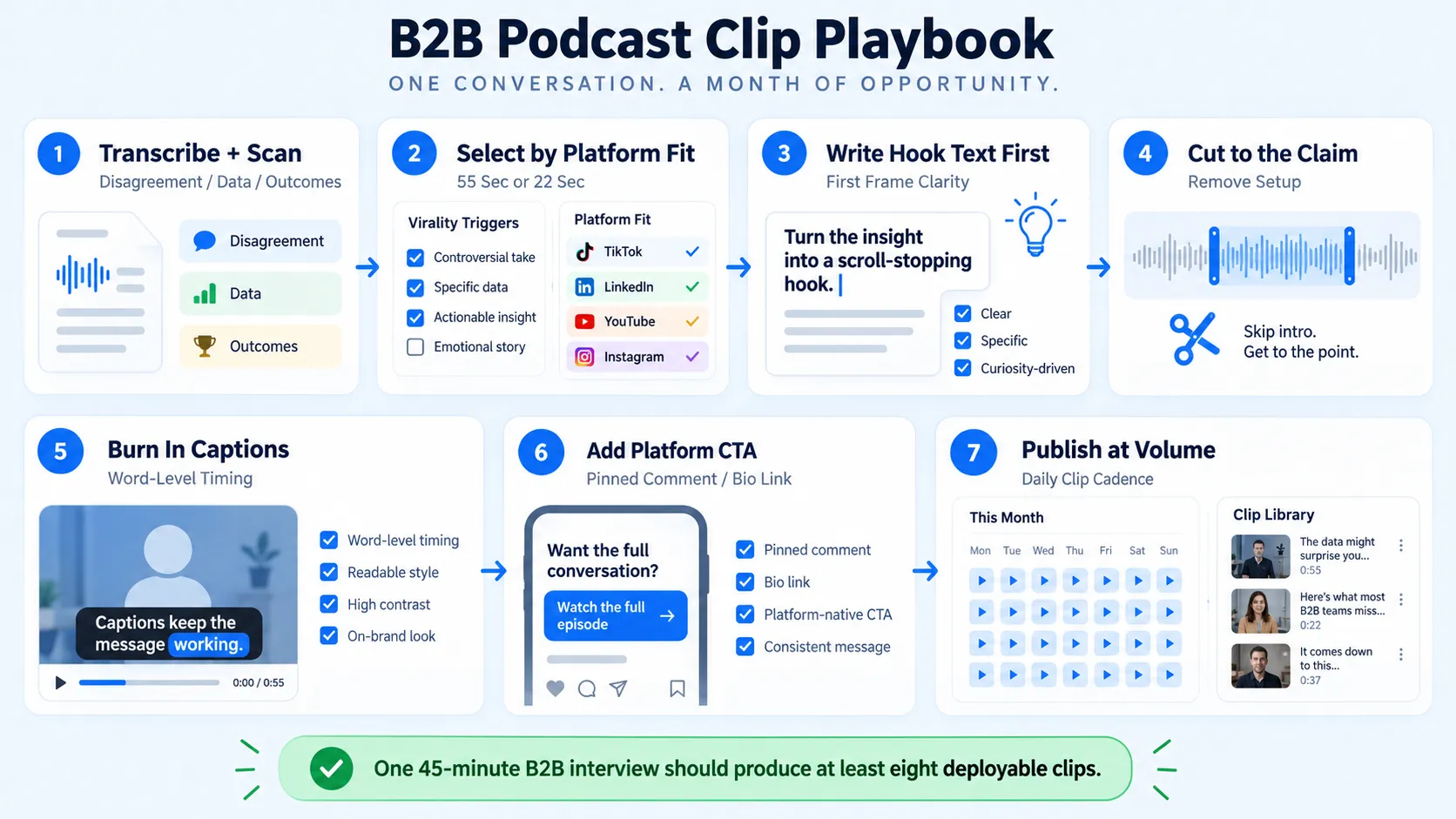
- Transcribe and scan for virality triggers: Look for moments of disagreement, surprising data, counter-intuitive advice, or specific named outcomes. These are your clip candidates.
- Select by platform fit first: A 55-second dense explanation works on YouTube Shorts. A 22-second punchy statement works on TikTok and Reels.
- Write the hook text before you edit: The on-screen text overlay for the first frame should be written before you open your editing tool. This forces clarity on what the clip is actually about.
- Edit to eliminate setup: Most podcast clips start 15–20 seconds too late. Cut straight to the claim or the tension.
- Burn in captions with accurate word timing: Two-line captions with tight word-level sync outperform single-line captions for attention retention.
- Add a platform-native CTA: For YouTube Shorts, use a pinned comment with the episode link (clickable), and reference it in the caption. For Reels, use the bio link. For TikTok, keep the CTA soft and casual.
- Publish at volume: The job of a clip is to take the 30–60 seconds of any episode that stand alone as a compelling hook, put captions on it, and post it daily across TikTok, Reels, and Shorts.
Gartner's 2026 research found that 67% of B2B buyers prefer a rep-free buying experience. They're researching you before they ever talk to sales, and a well-produced podcast puts genuine expertise in front of them at that exact moment.
For teams building founder-led video content from webinars, demos, and podcast appearances, the repurposing playbook above is how you turn one recording session into a month of buyer education assets.
Conclusion
Podcast clip examples that drove reach in 2026 share a clear pattern: the right moment, engineered hooks, platform-native formats, and consistent volume. The format debate (audiogram vs. video) matters less than moment selection and hook discipline.
Key takeaways:
- Pull contrarian, surprising, or outcome-specific moments, not summaries.
- Use video clips for TikTok, Reels, and Shorts; audiograms for LinkedIn and X.
- The first two seconds of every clip decide everything.
- Volume and editorial cadence beat occasional viral swings every time.
If your team is sitting on recorded podcast episodes, webinars, or demo conversations, that's an immediate growth lever available to you right now. For teams without existing content libraries, Komet Media also offers full video creation and content production from scratch—handling research, scripting, and production from the ground up. Komet Media builds the video systems that turn both repurposed recordings and new production into consistent pipeline reach.
Frequently Asked Questions
Q1: How long should a podcast clip be for maximum reach in 2026?
Roughly 30–60 seconds works for most educational or talking-head clips. YouTube Shorts compounds best at 30–33 seconds with a strong 3-second hook. TikTok and Reels reward completion, so match length to how long the payoff actually takes, not a fixed number.
Q2: Do podcast clips need captions to perform?
Yes, without exception. Post vertical at 9:16, minimum 1080p, with captions on every video. Captions serve two functions: accessibility for muted autoplay viewing and algorithm signals that come from high completion rates. Skipping captions is leaving a reach on the table.
Q3: What's the best type of podcast moment to clip for B2B audiences?
Contrarian takes, specific outcomes, and surprising data points outperform general advice. A 60-second moment from a real podcast interview, a sharp insight, an unexpected admission, a specific outcome, is the kind of content that stops a SaaS buyer mid-scroll. Avoid summary clips. Go for tension or revelation.
Q4: How many clips should I pull from one podcast episode?
A one-hour podcast episode can yield 10–20 short clips. For a typical 45-minute B2B interview, aim for at least 6–10 clips across different moments. Each clip should cover exactly one idea, never try to pack multiple points into a single clip.
Q5: Does publishing podcast clips on LinkedIn actually drive reach?
In 2026, a well-crafted founder post typically gets 5 to 15 times more reach than the equivalent post from a company page, making LinkedIn the highest-ROI organic channel for B2B founders. Video clips from genuine expert conversations consistently outperform static posts and polished brand creative on the platform.
Q6: Is a video clip always better than an audiogram?
Not always. Both play vital roles in podcast marketing but excel on different platforms. Audiograms are short, visually engaging snippets ideal for Instagram and X, while regular video clips offer a more immersive experience perfect for YouTube and Facebook where longer content thrives. Match format to platform, not preference.