
🪄 AI Summary
Heading 1
Heading 2
Heading 3
Heading 4
Heading 5
Heading 6
Lorem ipsum dolor sit amet, consectetur adipiscing elit, sed do eiusmod tempor incididunt ut labore et dolore magna aliqua. Ut enim ad minim veniam, quis nostrud exercitation ullamco laboris nisi ut aliquip ex ea commodo consequat. Duis aute irure dolor in reprehenderit in voluptate velit esse cillum dolore eu fugiat nulla pariatur.
Block quote
Ordered list
- Item 1
- Item 2
- Item 3
Unordered list
- Item A
- Item B
- Item C
Bold text
Emphasis
Superscript
Subscript
Every serious B2B marketing team eventually faces this question: do you invest in a podcast or a webinar series? Both build authority. Both educate buyers. But they work very differently inside a pipeline, and choosing the wrong one for your stage and goals costs time, budget, and momentum. This article breaks down the B2B podcast vs webinar decision using current data, real trade-offs, and a clear framework so your team can stop debating and start executing.
TL;DR
- Webinars drive faster, measurable lead capture with synchronous, high-intent audiences.
- Podcasts build compounding trust and evergreen authority over a longer horizon.
- Neither format is universally superior, your sales cycle, team capacity, and goal define the right choice.
- For most B2B SaaS teams, running both and repurposing across channels produces the highest ROI.
What's the Difference Between a B2B Podcast and a Webinar?
These two formats look similar on paper, both are long-form, both build thought leadership, but they operate on opposite communication models.
A webinar is a synchronous event. It runs live (or as a gated replay) on platforms like Zoom Webinars or ON24, and it demands that your audience commit to a specific time. That friction is actually a signal: someone who blocks out an hour on a Tuesday afternoon to learn about your solution has serious buyer intent, they're not browsing, they have a problem they need solved. Webinars use slides, screen sharing, live polls, and Q&A. They're structured like presentations, not conversations.
A podcast is asynchronous. Delivered via RSS feed and distributed on Spotify for Podcasters, Apple Podcasts, or YouTube, it meets listeners on their schedule. Podcasts offer audiences the convenience of accessing content at their pace and time, and are highly effective at content delivery because of the flexible access they provide.
The format is conversational, not scripted, which changes how trust is built.
Both formats can fill your pipeline, but they attract completely different types of prospects, one builds relationships over months, the other converts visitors into leads within weeks.
Podcast vs Webinar for B2B Marketing: Which Is Better?
The honest answer: it depends entirely on your goal and where buyers sit in your funnel. But here's how the data actually breaks it down.
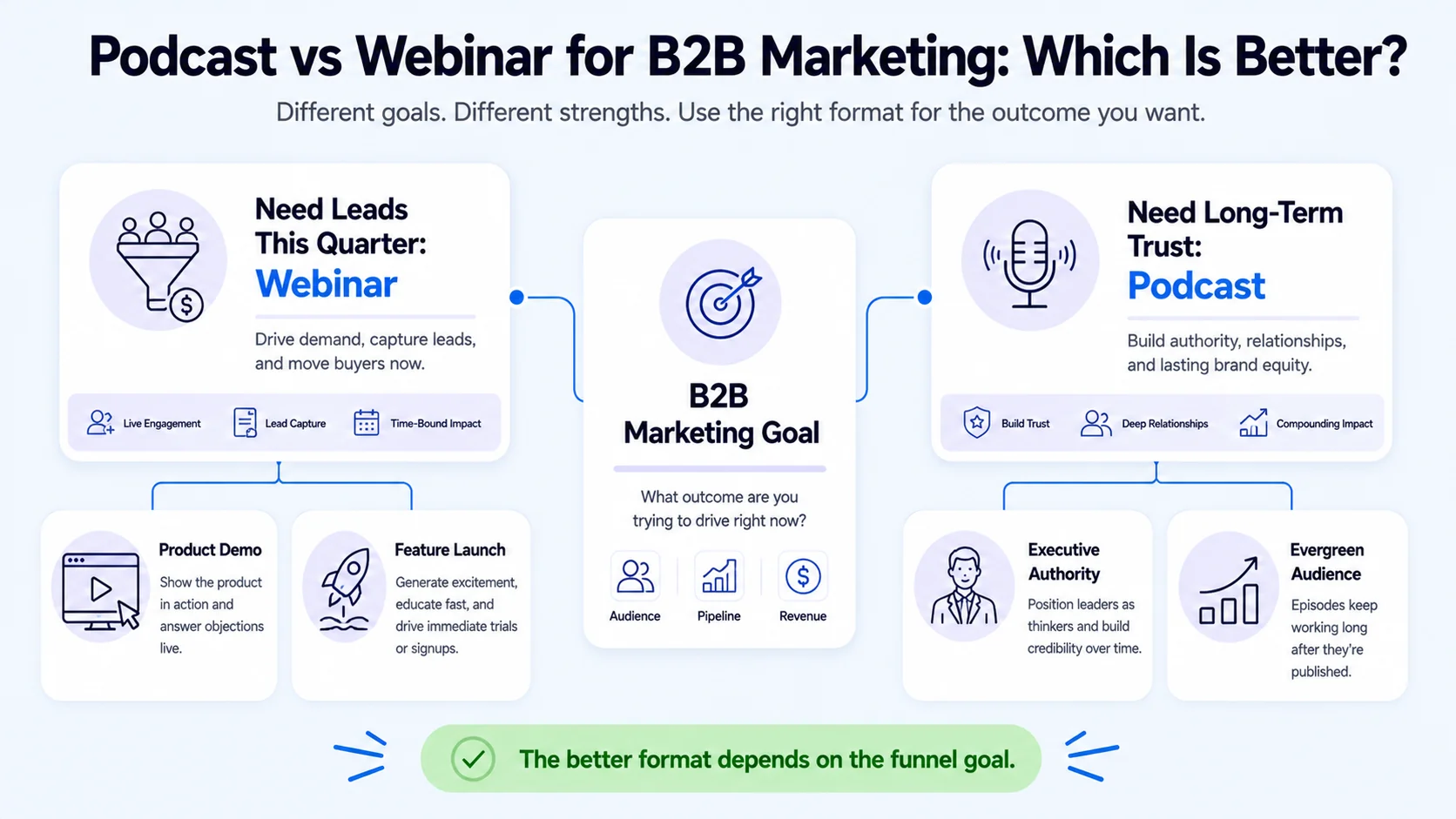
Where webinars win: 73% of B2B marketers and sales leaders believe webinars are the best way to generate high-quality leads. 73% of B2B webinar attendees become leads, compared to 20-40% of B2C attendees. For demand generation campaigns tied to product demos, feature launches, or bottom-of-funnel education, webinars are difficult to beat.
Where podcasts win: 68% of B2B podcast listeners say they trust companies featured on podcasts more than those advertised on other media. 83% of senior executives reported listening to a podcast in the past week, and are twice as likely to consume at least 5 hours per week. For reaching decision-makers early and building the kind of trust that shortens long B2B sales cycles, podcasts have a structural advantage.
The repurposing gap is real. At Komet Media, we see this consistently with clients: a webinar produces one strong asset. A podcast episode produces a system. 85% of companies now capture video when producing podcasts, and 65% of showrunners post short clips weekly, feeding LinkedIn, email, and YouTube simultaneously. "Downloads are dead. If your board still celebrates listener growth while pipeline stagnates, you're measuring the wrong game.", Fame, 2026
In the podcast vs webinar debate for lead generation, podcasts have the edge for long-term ROI, authority, and audience trust, while webinars work best for short-term campaigns and immediate lead capture.
Which Format Drives More Leads: B2B Podcast vs Webinar?
Lead volume and lead quality are two different things, and each format wins on a different axis.
Webinar lead metrics (2026 benchmarks):
- On average, 57% of B2B webinar registrations convert to attendees.
- Engaged attendees are 30% more likely to convert, and webinars generate leads at approximately $72 per lead, delivering 200%-1,200%+ ROI, outperforming trade shows and many paid channels.
- Webinar-influenced revenue accounts for 27.6% of total closed-won ARR, and deal velocity for attendee accounts runs 18% faster than non-attendee comparable accounts.
Podcast pipeline metrics (2026 benchmarks):
- The average guest-to-client conversion rate on B2B podcasts is 10%.
- Top performers see 25-40% of podcast guests enter the pipeline within 12 months.
- One enterprise software company targeting Fortune 500 accounts invited 48 executives as guests over 12 months and opened 23 active opportunities, a 48% conversion rate, resulting in $4.2M in closed revenue within 18 months.
The pattern is clear: webinars generate more leads faster, but podcast-sourced relationships close larger deals at higher retention. Lifetime customer value tells a different story for podcast-generated customers, they often have higher retention rates and spend more over time because the extended relationship-building phase creates stronger buyer commitment.
For B2B SaaS teams with six-month-plus sales cycles, the compounding ROI of a podcast is hard to ignore. For teams needing pipeline this quarter, a webinar series is the faster path.
How to Use a Podcast for B2B Thought Leadership
A B2B podcast built for thought leadership follows a different playbook than a general interest show. Here's the framework that produces pipeline results:
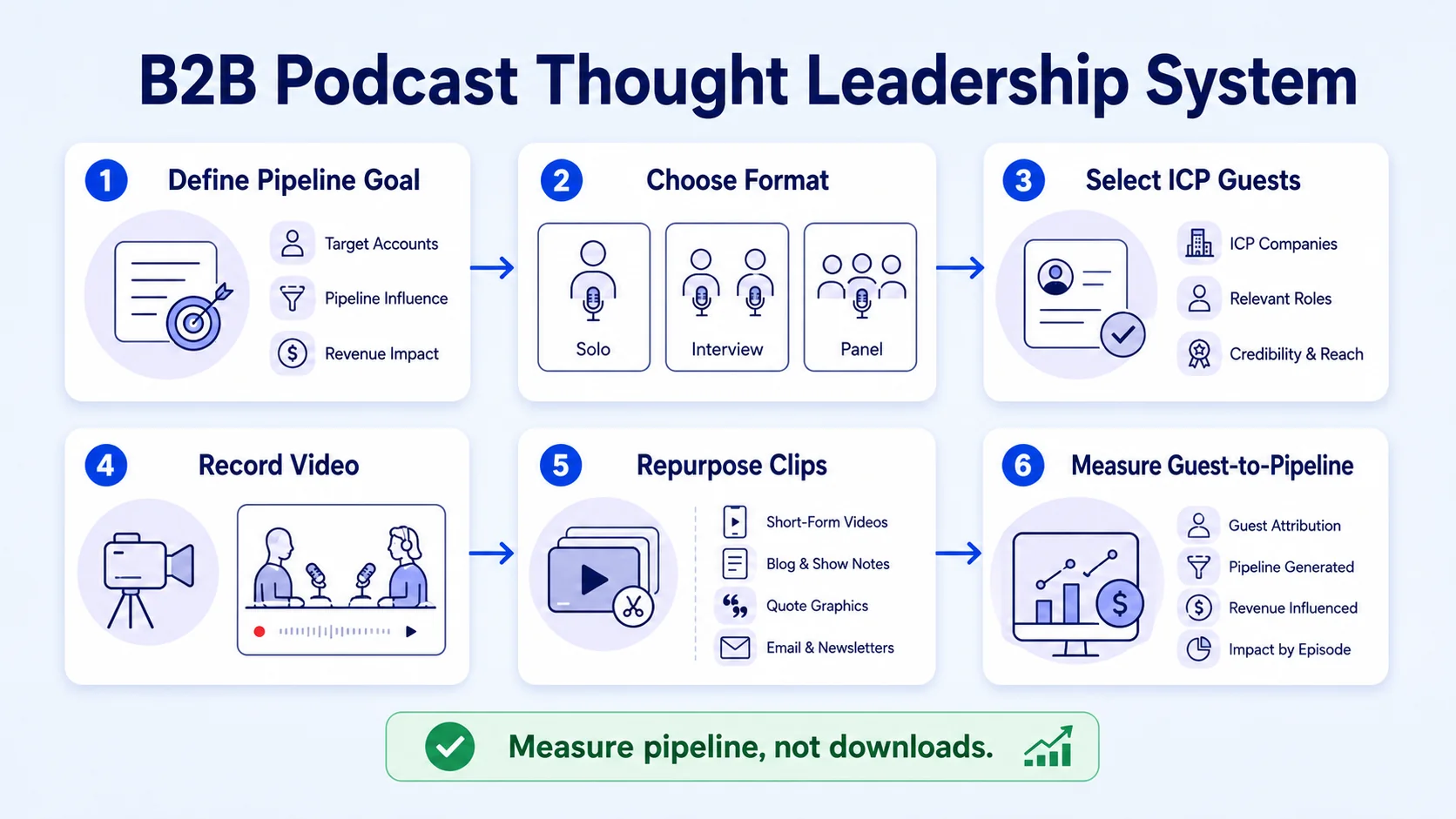
- Define a pipeline goal first: Most B2B podcasts fail because they launch with vague goals like "thought leadership" or "brand awareness", those aren't goals, they're excuses for poor performance. Strategic alignment means your podcast directly supports pipeline generation, customer expansion, or category creation.
- Choose your format deliberately: Solo episodes build founder authority fast. Interview episodes with ICP-matched guests double as account-based outreach. A professional services firm tested three formats and found that panel discussions with client executives generated 3x more qualified leads than celebrity interviews.
- Select guests by revenue potential, not reach: Prioritize guests who match your ideal customer profile, have budget authority, and represent target accounts. This turns your podcast into an account-based sales tool, not just a media property.
- Record video and clip aggressively: Use your podcast as a "seed asset", the first layer of content production, from which you repurpose clips to share on social media, blog posts, newsletters, YouTube, and more. This is exactly what we build at Komet Media through short-form video editing workflows.
- Measure guest-to-pipeline conversion, not downloads: Modern B2B podcast strategy demands attribution models that connect audio content directly to closed deals, not impressions.
- Distribute through content distribution channels consistently: Publish to Spotify for Podcasters, Apple Podcasts, and YouTube simultaneously. 65% of weekly podcast consumers go back and listen to older episodes they missed, your back catalog actively recruits new buyers on autopilot.
Biggest Mistakes B2B Companies Make With Podcasts vs Webinars
Understanding where teams go wrong saves months of wasted effort.
Podcast mistakes:
- Chasing audience size over pipeline: Downloads are dead, if your board celebrates listener growth while pipeline stagnates, you're measuring the wrong game.
- Wrong guest selection: Inviting influencers for their reach rather than prospects for their fit dilutes ROI. Guest selection strategy determines 50% of podcast ROI.
- No repurposing system: Publishing one episode and calling it done ignores most of the asset's value. Every episode should generate at minimum a LinkedIn clip, show notes via podcast transcription, and a short-form video cut.
Webinar mistakes:
- One-and-done events with no nurture: Over 88% of webinars are standalone or one-off events, and most of the pipeline value is left in the post-event follow-up that never happens.
- Ignoring the replay opportunity: On a rolling 30-day window, recorded replays generate 2.4x the unique viewers of the live session, and 58% of webinar-sourced opportunities now first touch the replay, not the live event.
- Pitching too early: Only 5-20% of webinar attendees actually buy something, so the real game is layering value first, not pushing products too soon. People aren't logging into a sales call, they're showing up for insight.
The shared mistake: treating either format as a channel rather than a content system. Both produce their highest ROI when each piece of content is engineered to feed the next touchpoint.
Should Your B2B Company Start a Podcast, a Webinar Series, or Both?
Use this decision framework based on your actual situation:
Thought leadership content influences the way 75% of B2B buyers select suppliers, which means the format you choose shapes how buyers experience your brand before they ever talk to sales.
The most effective B2B content strategies in 2026 don't pick one. They run a webinar series for bottom-of-funnel demand gen, launch a podcast for mid-funnel trust building, and then repurpose both into short-form video for LinkedIn.
B2B companies running a podcast see an average of 20-30% higher engagement on LinkedIn and other digital platforms compared to those relying solely on written content, and that lift compounds when webinar clips enter the same distribution mix.
If you're a B2B SaaS or funded tech team with limited bandwidth, start with whichever format maps to your most urgent goal. If pipeline is the problem this quarter, start with a webinar. If buyer trust and founder visibility are the bottleneck, start with a podcast. Then build the repurposing system around whichever you launch first.
Conclusion
- Webinars win on speed: faster lead capture, higher immediate conversion, and strong intent signals from attendees.
- Podcasts win in depth: compounding trust, longer shelf life, and higher lifetime value from listeners who become clients.
- The B2B podcast vs webinar question has no universal answer, it has a right answer for your stage, goal, and team capacity.
- The highest-ROI teams treat both formats as a single content system, where every recording feeds short-form clips, email sequences, and LinkedIn marketing, not just a one-off event or episode.
Frequently Asked Questions
Q1: Can a B2B podcast replace our webinar program entirely?
No. They serve different funnel stages. A podcast builds mid-funnel trust and executive authority over time, while webinars drive bottom-of-funnel intent and faster lead capture. Replacing one with the other creates a gap in either pipeline speed or long-term audience engagement. Run both when possible, or choose based on your most urgent goal.
Q2: How long does it take for a B2B podcast to generate pipeline results?
Expect 6-12 months for meaningful pipeline attribution, though guest-to-pipeline conversion can happen faster with a deliberate account-based guest strategy. Top performers convert 48% of strategically selected podcast guests from target accounts into pipeline opportunities , but this requires intentional guest selection from day one, not a broad audience-building approach.
Q3: What platforms should a B2B team use for podcasts and webinars?
For podcasts: record on Riverside.fm for high-quality remote video, distribute via RSS feed to Spotify for Podcasters, Apple Podcasts, and YouTube simultaneously. For webinars: ON24 is strong for enterprise nurture and personalization; Zoom Webinars suits teams already in the Zoom ecosystem. Platform choice matters less than your content strategy and post-event repurposing system.
Q4: How do you measure thought leadership ROI from a podcast?
Skip downloads as a primary metric. Track guest-to-opportunity conversion rate, pipeline influenced by podcast listeners, deal velocity for accounts that engaged with episodes, and inbound requests attributing the podcast. CFOs want to see an influenced pipeline, sourced opportunities, and multi-touch attribution that ties podcast touchpoints to revenue, and build your reporting around those outputs.
Q5: What's the ideal webinar length for B2B SaaS?
The ideal length for a webinar is 30 to 45 minutes. Keep the presentation to 30-35 minutes and reserve the final 10-15 minutes for live Q&A. Avoid going over 60 minutes, attention drops sharply and the replay value decreases as length increases.
Q6: Is it worth repurposing both webinar and podcast recordings into short-form video?
Absolutely, and it's one of the highest-leverage moves in B2B content strategy. 85% of companies capture video when producing podcasts, and 65% of showrunners post short clips weekly, aligning with platform algorithms that prioritize short-form, native video content. The same logic applies to webinar recordings. Short clips extend the life of every piece of long-form content and drive compounding reach across LinkedIn and YouTube with minimal additional production cost.